Kerplunk! How to not lose your marbles: Evidence, employability and - - PowerPoint PPT Presentation

kerplunk how to not lose your marbles evidence
SMART_READER_LITE
LIVE PREVIEW

Kerplunk! How to not lose your marbles: Evidence, employability and - - PowerPoint PPT Presentation

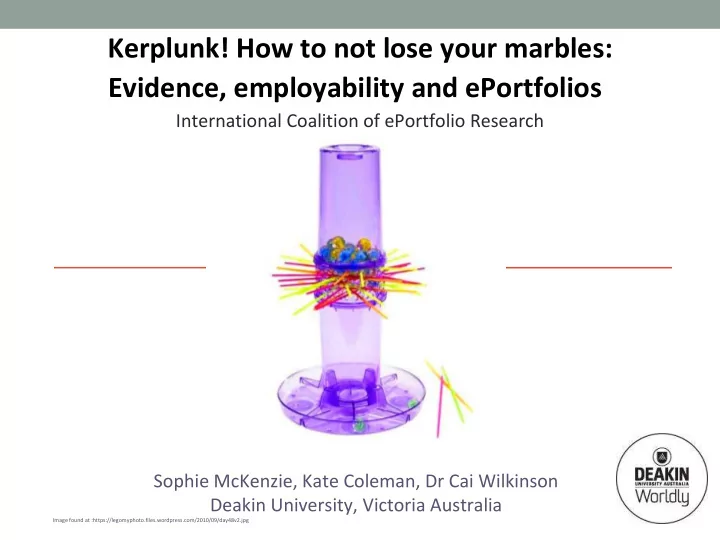
Kerplunk! How to not lose your marbles: Evidence, employability and ePortfolios International Coalition of ePortfolio Research Sophie McKenzie, Kate Coleman, Dr Cai Wilkinson Deakin University, Victoria Australia Image found at


slide-1
SLIDE 1

Kerplunk! How to not lose your marbles: Evidence, employability and ePortfolios

International Coalition of ePortfolio Research Sophie McKenzie, Kate Coleman, Dr Cai Wilkinson Deakin University, Victoria Australia

Image found at :https://legomyphoto.files.wordpress.com/2010/09/day48v2.jpg

slide-2
SLIDE 2

Introduction: INCEPR

  • The Inter/National Coalition for Electronic Portfolio

Research: http://ncepr.org/

  • Convenes research/practitioners to study the impact
  • f eportfolios on student learning and educational
  • utcomes
  • Investigations @ Deakin
  • Bch of Nursing (3 year course)
  • Bch of IT (3 year course)
  • Final report on IT and International studies
  • Deakin still in early stages of Course Wide ePortfolio
slide-3
SLIDE 3

INCEPR Cohort VII: 4 Propositions

Assessment through the lens of four propositions.

  • 1. For meaningful assessment, interaction of pieces of evidence

within an eportfolio is more important than single pieces of evidence.

  • 2. Reflection on pieces of evidence within an eportfolio and on the

eportfolio as a whole provides information for assessment that is not available by other means.

  • 3. The material practice of eportfolio composition generates distinctive

knowledge about learning.

  • 4. Eportfolios enable meaningful comparison of student learning

across institutions (and other contexts) without standardisation

slide-4
SLIDE 4

Evidencing Graduates

  • Courses are accredited to the Australian

Qualifications Framework and accountable to the Tertiary Education Quality and Standards Agency

  • As well as discipline accreditation bodies (for example

in IT we use the Australian Computer Society)

  • Course must align with Deakin’s underpinning

curriculum model

  • Live the Future 2020 Strategic Plan
  • Evidence generic graduate attribute within

the discipline

slide-5
SLIDE 5

Assessment is re-framed as an opportunity for students to create evidence of their achievement of the Graduate Learning Outcomes. All students are encouraged to curate the evidence in a portfolio - this could be an e-portfolio in CloudDeakin, a personal digital space or professional social media channels.

slide-6
SLIDE 6

ePortfolios at Deakin: Types

Audience Purpose Context

  • Evidencing learning for graduate employability
  • Integrative learning and career development

learning

  • Sense making and the grand narrative
slide-7
SLIDE 7

Research Question: INCEPR

Image found at: https://uwsystem.courses.wisconsin.edu/d2l/eP/artifacts/context_artifact_stream.d2lFile?ou=26422&contextId=28337,28336

What is core to Portfolio at Deakin University?

slide-8
SLIDE 8

Initial Results: Value of Portfolios

  • Pilot study in IT and Nursing 2013
  • n = 17, n = 14 participants – low numbers
  • Results
  • Low value for students
  • Issue with tools
  • Students and staff buy in low
  • Understanding of the need for ‘portfolio pedagogy’ low
  • Since 2013 course enhancement - further

exploration

slide-9
SLIDE 9

Our process of inquiry

  • Many questions of ‘value’

a.How does ePortfolio work in this context? b.How do we translate portfolio pedagogy into a language students can understand? c.How do we do this within the disciplines, university and the AQF learning framework? d.How do we translate skills for the global perspective? e.How do we reflect?

  • Iterative spiral

Design Thinking - Try it out – understand local language, try again

slide-10
SLIDE 10
slide-11
SLIDE 11

Bachelor of Information Technology

slide-12
SLIDE 12
slide-13
SLIDE 13
slide-14
SLIDE 14
slide-15
SLIDE 15

Graduate learning outcomes portfolio template

slide-16
SLIDE 16
slide-17
SLIDE 17
slide-18
SLIDE 18

Bachelor of International Studies

slide-19
SLIDE 19
slide-20
SLIDE 20

Staff use of ePortfolio

slide-21
SLIDE 21

Lenses of Learning: Experiences from initial experiments

  • Reflection: What does this mean? How do we engage in

the correct language?

  • Evidence: What does this look like? How does the

context, assessment and underlying profession impact about the curation of evidence?

  • Materiality: How is the ePortfolio constructed? Is there a

similar way in which to construct? How does the reader impact upon viewing of a portfolio?

  • Standards: How do we assess ePortfolios? How does

reflection, evidence and materiality impact upon standards, if at all? What are the minimum standards?

slide-22
SLIDE 22

How to not lose your marbles!

  • 1. Community of Practice - stand on the shoulders of giants
  • 2. Learning Design - Design learning, teaching and assessment

for personalized learning and metacognition

  • Have a clear understanding of the portfolio pedagogy

required

  • Design for evidenced based learning, reflection and learning-

centred learning

  • Develop an understanding of the use and purpose in

curriculum across different disciplines

  • 3. Openness - grapple with standards and standardisation

together

  • Have a clear understanding of what exactly are you are

assessing

  • Design and develop shared examples for all stakeholders
  • Get feedback - whenever and wherever.
slide-23
SLIDE 23

How to not lose your marbles!

  • 4. Teach - Be explicit with students about the purpose, audience

and context for value

  • Scaffold content curation and compositional devices
  • Scaffold and teach reflection, intent and creation
  • Demonstrate that the interaction of evidence in a portfolio

provides information beyond a single piece of evidence

  • Teach the technology - don’t assume anything!
  • 5. Share - Collaborate, present and reflect as inter/cross

disciplinarians - learn from each other.

  • Build a Team of experts, stakeholders and support people
  • 6. Practice - Have a portfolio and iteratively design and ‘re’

curate it.

slide-24
SLIDE 24

References

1. Coleman, K., McKenzie, S., & Wilkinson, C. (2015). Standing on the shoulders of giants: learning and researching value as a community of practice, International Coalition of ePortfolio Research Cohort VII 2013 - 2015 Report. http://ncepr.org/finalreports/cohort7/deakin_final_report.pdf 2. Coleman, K. (2015). Through the lens of the museum curator: Teaching compositional and digital literacies to curate a folio

  • f process and product in art education In Lemon, N. (Ed.). Revolutionizing Arts Education in K-12 Classrooms through

Technological Integration. Hershey, Pennsylvania, USA: IGI Global. 3. Polly, P., Cox, J., Coleman, K., Yang, J.L. & Thai, T. (2015). Creative teaching, learning and assessment: Using ePortfolios to develop scientists beyond just knowing their own discipline content. In Coleman, K.S. & Flood, A. (Eds.)(in press). Capturing Creativity: The Link between Creativity and Teaching Creatively, Common Ground, Champaign, Illinois: Common Ground Publishing LLC. University Press. 4. Yang, J.L., Coleman, K., Das, M & Hawkins, N. (2015). Creative Course Design and Integrative Learning and Teaching: Delivery of Specific Knowledge and Career Skills by ePortfolio Learning. In Coleman, K.S. & Flood, A. (Eds.)(in press). Capturing Creativity: The Link between Creativity and Teaching Creatively, Common Ground, Champaign, Illinois: Common Ground Publishing LLC. University Press. 5. Yang, J.L., Coleman, K., Das, M. & Hawkins, N. (2015) Integrated career development learning and ePortfolios. International Journal of Adult, Community and Professional Learning, 22 (1), 1-17. http://jialinyang.cgpublisher.com/product/pub.255/prod.57 6. McKenzie, S., Palmer, S., Coldwell-Neilson, J. & Coleman, K. (2014). Understanding career aspirations of Information Technology students at Deakin University - A pilot study, IEEE International Conference on Teaching, Assessment, and Learning for Engineering, Wellington, December 2014.