SLIDE 1 CS6202 Separation Logic 1
CS6202: Advanced Topics in Programming Languages and Systems Lecture 8/9 : Separation Logic
- Overview
- Assertion Logic
- Semantic Model
- Hoare-style Inference Rules
- Specification and Annotations
- Linked List and Segments
- Trees and Instuitionistic Logic
- (above from John Reynold’s mini-course)
- Automated Verification
CS6202 Separation Logic 2
Motivation Motivation
Program reasoning is important for: correctness of software safety (fewer or no bugs) performance guarantee
CS6202 Separation Logic 3
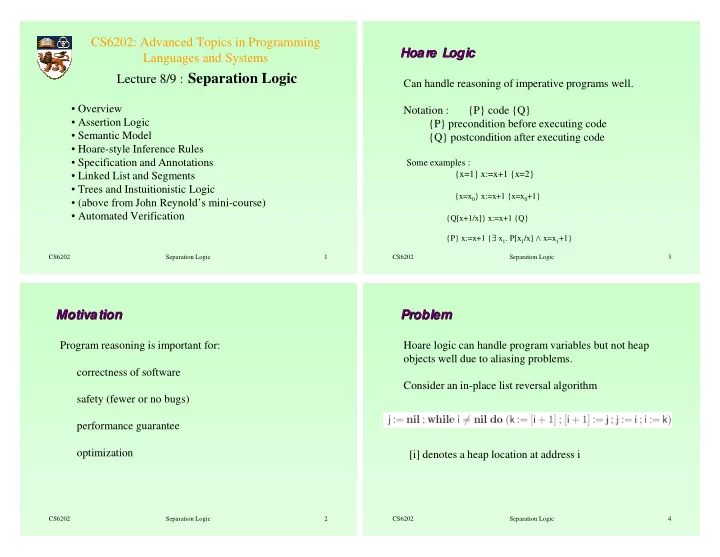
Hoare Logic Hoare Logic
Can handle reasoning of imperative programs well. Notation : {P} code {Q} {P} precondition before executing code {Q} postcondition after executing code
Some examples : {x=1} x:=x+1 {x=2}
{x=x0} x:=x+1 {x=x0+1} {Q[x+1/x]} x:=x+1 {Q} {P} x:=x+1 { x1. P[x1/x] x=x1+1}
CS6202 Separation Logic 4
Problem Problem
Hoare logic can handle program variables but not heap
- bjects well due to aliasing problems.
Consider an in-place list reversal algorithm [i] denotes a heap location at address i
SLIDE 2 CS6202 Separation Logic 5
Loop Invariant Loop Invariant
Loop invariant is a statement that holds at the beginning of each iteration of the loop.
heap predicate relates a list
CS6202 Separation Logic 6
Loop Invariant Loop Invariant
in separation logic :
CS6202 Separation Logic 7
B a sics of S eparation Logic B a sics of S eparation Logic
CS6202 Separation Logic 8
Simple Language with Heap Store Simple Language with Heap Store
SLIDE 3
CS6202 Separation Logic 9
Memory F aults Memory F aults
Can be caused by out of range look up of memory.
CS6202 Separation Logic 10
Assertion L anguage Assertion L anguage
CS6202 Separation Logic 11
S emantic Model S emantic Model
CS6202 Separation Logic 12
S emantic Model S emantic Model
SLIDE 4 CS6202 Separation Logic 13
S eparation Conjunction S eparation Conjunction -
Examples
CS6202 Separation Logic 14
Conjunction Conjunction -
Examples
Conjunction describes the same heap space.
CS6202 Separation Logic 15
S eparation Implication S eparation Implication -
Examples
CS6202 Separation Logic 16
Inference Rules Inference Rules
Reasoning with normalization, weakening and strengthening.
SLIDE 5 CS6202 Separation Logic 17
Pure Assertion Pure Assertion
Axiom schematic guided by pure formulae
CS6202 Separation Logic 18
T wo Unsound Axiom S chemata T wo Unsound Axiom S chemata
Structural logic without contraction and weakening.
CS6202 Separation Logic 19
Partial Correctness Specification Partial Correctness Specification
CS6202 Separation Logic 20
T
- tal Correctness Specification
T
- tal Correctness Specification
SLIDE 6
CS6202 Separation Logic 21
Examples of Valid Specifications Examples of Valid Specifications
CS6202 Separation Logic 22
Hoare Inference Rules Hoare Inference Rules
CS6202 Separation Logic 23
Hoare Inference Rules Hoare Inference Rules
Structural rules are applicable to any commands.
CS6202 Separation Logic 24
Partial Correctness of While Loop Partial Correctness of While Loop
SLIDE 7 CS6202 Separation Logic 25
T
- tal Correctness of While L
- op
T
- tal Correctness of While L
- op
CS6202 Separation Logic 26
Hoare Inference Rules Hoare Inference Rules
CS6202 Separation Logic 27
Hoare Inference Rules Hoare Inference Rules
CS6202 Separation Logic 28
Annotated Specifications Annotated Specifications
In annotated specifications, additional assertions called annotations are placed in command in such a way that it assist proof construction process. Examples :
SLIDE 8
CS6202 Separation Logic 29
Minimal Annotated Specifications Minimal Annotated Specifications
Should attempt to minimise annotations where possible. Restrict to pre/post of methods and invariant of loops. Further advances : (i) intraprocedural inference (ii) interprocedural inference.
CS6202 Separation Logic 30
Structural Inference Rules Structural Inference Rules
CS6202 Separation Logic 31
Structural Inference Rules Structural Inference Rules
CS6202 Separation Logic 32
Structural Inference Rules Structural Inference Rules
SLIDE 9 CS6202 Separation Logic 33
Rule of Constancy from Hoare L
Rule of Constancy from Hoare L
CS6202 Separation Logic 34
Frame Rule of S eparation Logic Frame Rule of S eparation Logic
This facilitates local reasoning and specification
CS6202 Separation Logic 35
Local Specifications Local Specifications
CS6202 Separation Logic 36
Inference Rules for Mutation Inference Rules for Mutation
SLIDE 10
CS6202 Separation Logic 37
Inference Rules for Inference Rules for Deallocation Deallocation
CS6202 Separation Logic 38
Inference Rules for Inference Rules for Noninterfering Noninterfering Allocation Allocation
CS6202 Separation Logic 39
Inference Rules for Lookup Inference Rules for Lookup
CS6202 Separation Logic 40
Notation for S equences Notation for S equences
SLIDE 11 CS6202 Separation Logic 41
Singly Linked List Singly Linked List
What is the default property (invariant) of this predicate?
CS6202 Separation Logic 42
Singly Linked List S egment Singly Linked List S egment
CS6202 Separation Logic 43
Singly Linked List S egment Singly Linked List S egment
Properties
CS6202 Separation Logic 44
Non Non-
egment T
egment
Easier test for emptiness
SLIDE 12 CS6202 Separation Logic 45
Braced List Segment Braced List Segment
CS6202 Separation Logic 46
Bornat Bornat List List
CS6202 Separation Logic 47
Doubly Linked List Doubly Linked List
CS6202 Separation Logic 48
XOR XOR-
Linked List Segment
SLIDE 13
CS6202 Separation Logic 49
Array Allocation Array Allocation
Inference rule :
CS6202 Separation Logic 50
Trees Trees
CS6202 Separation Logic 51
DAGs DAGs
CS6202 Separation Logic 52
Intuitionistic Intuitionistic S eparation Logic S eparation Logic
Supports justification rather than truth. Things that no longer hold include: law of excluded middle (P P) double negation ( P = P) Pierce’s law (((P Q) P) P) Formulae valid in intuitionistic separation logic but not the classical one. x 1,y emp x 1,y * y ,nil x 1,_
SLIDE 14
CS6202 Separation Logic 53
Intuitionistic Intuitionistic Assertion Assertion
CS6202 Separation Logic 54
Inference for Procedures Inference for Procedures
CS6202 Separation Logic 55
Copying Tree Copying Tree
CS6202 Separation Logic 56
Copying Tree (Proof) Copying Tree (Proof)
SLIDE 15
CS6202 Separation Logic 57
Copying Tree (Proof) Copying Tree (Proof)
CS6202 Separation Logic 58
Automated Verification Automated Verification
Modular Verification (i) Given pre/post conditions for each method and loop (ii) Determine each postcondition is sound for method body. (iii) Each precondition is satisfied for each call site. Why Verification? (i) can handle more complex examples (ii) can be used to check inference algorithm (iii) grand challenge of verifiable software
CS6202 Separation Logic 59
Core Imperative Language Core Imperative Language
CS6202 Separation Logic 60
Data Nodes and Notation Data Nodes and Notation
SLIDE 16 CS6202 Separation Logic 61
Shape Predicates Shape Predicates
Linked-list with size Double linked-list (right traversal) with size Sorted linked-list with size, min, max
CS6202 Separation Logic 62
Insertion Sort Algorithm Insertion Sort Algorithm
CS6202 Separation Logic 63
Prime Notation Prime Notation
Prime notation is used to capture the latest values
- f each program variable. This allows a state
transition to be expressed since the unprimed form denotes original values.
CS6202 Separation Logic 64
Prime Notation Prime Notation
Example : {x’=x y’=y} x:=x+1 {x’=x+1 y’=y} x:=x+y {x’=x+1+y y’=y} y:=2 {x’=x+1+y y’=2}
SLIDE 17
CS6202 Separation Logic 65
Forward Verification Forward Verification
Given 1, infer 2 : {1} e {2}
CS6202 Separation Logic 66
Forward Verification Forward Verification
CS6202 Separation Logic 67
Separation Constraint Normalization Rules Separation Constraint Normalization Rules
Target :
CS6202 Separation Logic 68
Separation Constraint Approximation Separation Constraint Approximation
XPuren() returns a sound approximation of the form :
non-null symbolic addresses
Normalization :
SLIDE 18
CS6202 Separation Logic 69
Translating to Pure Form Translating to Pure Form
CS6202 Separation Logic 70
Deriving Shape Invariant Deriving Shape Invariant
From each pure invariant, such as (n 0) for ll<n> We use Inv1(..) to obtain a more precise invariant :
CS6202 Separation Logic 71
Separation Constraint Entailment Separation Constraint Entailment
denotes
CS6202 Separation Logic 72
Separation Constraint Entailment Separation Constraint Entailment
SLIDE 19
CS6202 Separation Logic 73
Unfolding Predicate in Antecedent Unfolding Predicate in Antecedent
CS6202 Separation Logic 74
Folding a Predicate in Consequent Folding a Predicate in Consequent
Folding is recursively applied until x::ll<n> matches with the two data nodes in the antecedent, resulting in : Effect of folding is not the same as unfolding a predicate In consequent as values of derived variable may be lost!
CS6202 Separation Logic 75
Folding a Predicate in Consequent Folding a Predicate in Consequent
CS6202 Separation Logic 76
Soundness of Entailment Soundness of Entailment