
Lecture 33: Concurrency
- Moore’s law (“Transistors per chip doubles every N years”), where
N is roughly 2 (about 1, 000, 000× increase since 1971).
- Has also applied to processor speeds (with a different exponent).
- But predicted to flatten: further increases to be obtained through
parallel processing (witness: multicore/manycode processors).
- With distributed processing, issues involve interfaces, reliability,
communication issues.
- With other parallel computing, where the aim is performance, issues
involve synchronization, balancing loads among processors, and, yes, “data choreography” and communication costs.
Last modified: Wed Apr 23 12:58:06 2014 CS61A: Lecture #33 1Example of Parallelism: Sorting
- Sorting a list presents obvious opportunities for parallelization.
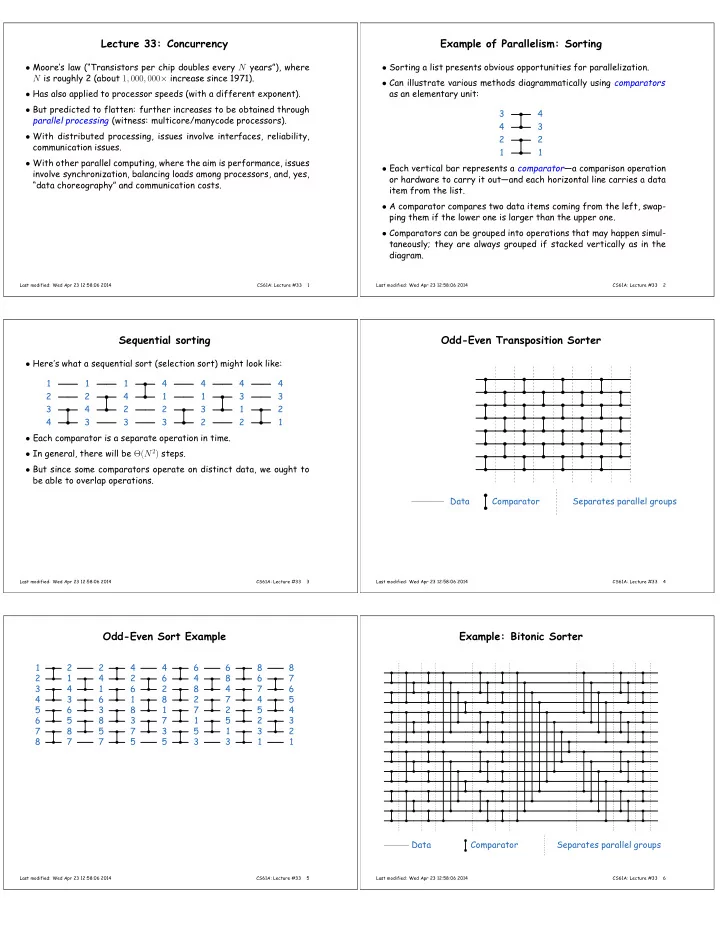
- Can illustrate various methods diagrammatically using comparators
as an elementary unit: 1 2 4 3 1 2 3 4
- Each vertical bar represents a comparator—a comparison operation
- r hardware to carry it out—and each horizontal line carries a data
item from the list.
- A comparator compares two data items coming from the left, swap-
ping them if the lower one is larger than the upper one.
- Comparators can be grouped into operations that may happen simul-
taneously; they are always grouped if stacked vertically as in the diagram.
Last modified: Wed Apr 23 12:58:06 2014 CS61A: Lecture #33 2Sequential sorting
- Here’s what a sequential sort (selection sort) might look like:
4 3 2 1 3 4 2 1 3 2 4 1 3 2 1 4 2 3 1 4 2 1 3 4 1 2 3 4
- Each comparator is a separate operation in time.
- In general, there will be Θ(N 2) steps.
- But since some comparators operate on distinct data, we ought to
be able to overlap operations.
Last modified: Wed Apr 23 12:58:06 2014 CS61A: Lecture #33 3Odd-Even Transposition Sorter
Data Comparator Separates parallel groups
Last modified: Wed Apr 23 12:58:06 2014 CS61A: Lecture #33 4Odd-Even Sort Example
8 7 6 5 4 3 2 1 7 8 5 6 3 4 1 2 7 5 8 3 6 1 4 2 5 7 3 8 1 6 2 4 5 3 7 1 8 2 6 4 3 5 1 7 2 8 4 6 3 1 5 2 7 4 8 6 1 3 2 5 4 7 6 8 1 2 3 4 5 6 7 8
Last modified: Wed Apr 23 12:58:06 2014 CS61A: Lecture #33 5Example: Bitonic Sorter
Data Comparator Separates parallel groups
Last modified: Wed Apr 23 12:58:06 2014 CS61A: Lecture #33 6