Lecture 32/Chapter 27 Step 2: Consider 7 Critical Components - - PowerPoint PPT Presentation

lecture 32 chapter 27
SMART_READER_LITE
LIVE PREVIEW

Lecture 32/Chapter 27 Step 2: Consider 7 Critical Components - - PowerPoint PPT Presentation

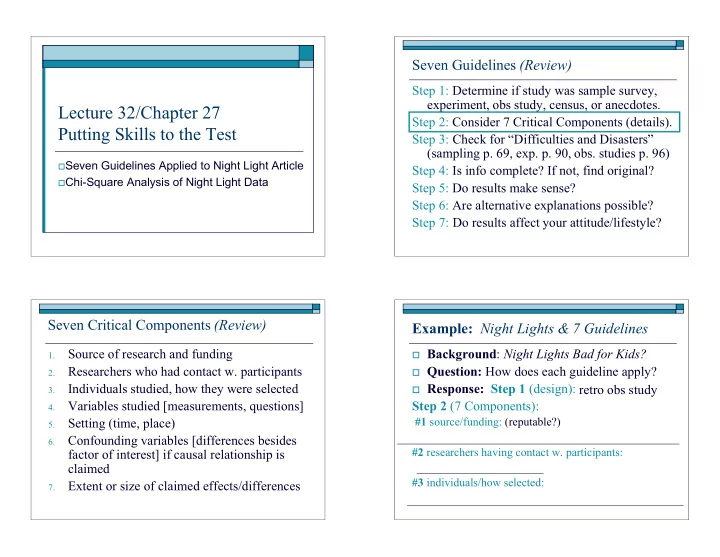
Seven Guidelines (Review) Step 1: Determine if study was sample survey, experiment, obs study, census, or anecdotes. Lecture 32/Chapter 27 Step 2: Consider 7 Critical Components (details). Putting Skills to the Test Step 3: Check for


slide-1
SLIDE 1

Lecture 32/Chapter 27 Putting Skills to the Test

Seven Guidelines Applied to Night Light Article Chi-Square Analysis of Night Light Data

Seven Guidelines (Review)

Step 1: Determine if study was sample survey, experiment, obs study, census, or anecdotes. Step 2: Consider 7 Critical Components (details). Step 3: Check for “Difficulties and Disasters” (sampling p. 69, exp. p. 90, obs. studies p. 96) Step 4: Is info complete? If not, find original? Step 5: Do results make sense? Step 6: Are alternative explanations possible? Step 7: Do results affect your attitude/lifestyle?

1.

Source of research and funding

2.

Researchers who had contact w. participants

3.

Individuals studied, how they were selected

4.

Variables studied [measurements, questions]

5.

Setting (time, place)

6.

Confounding variables [differences besides factor of interest] if causal relationship is claimed

7.

Extent or size of claimed effects/differences

Seven Critical Components (Review) Example: Night Lights & 7 Guidelines

Background: Night Lights Bad for Kids? Question: How does each guideline apply? Response: Step 1 (design):

Step 2 (7 Components):

#1 source/funding: (reputable?) #2 researchers having contact w. participants: #3 individuals/how selected:

retro obs study

_________________________________________________ ______________________ ________________________________________________

slide-2
SLIDE 2

Example: Night Lights & 7 Guidelines

Response: Step 2 (7 Components)

continued:

#4 variables: #5 setting: #6 confounding variables (diffs in groups compared): #7 magnitude/quantify effect: ____________________ ____________________ explan: ______________________________ response: ____________________________ ______________________________________

Example: Night Lights & 7 Guidelines

  • Response: Step 3 Difficulties? (Obs. p. 96)

1.

Confounding variables?

2.

Extending results inappropriately?

3.

Using the past as a source of data? __________________________________________ _____________ _________________________________________

Example: Night Lights & 7 Guidelines

  • Response: Step 3 Difficulties(sampling p.69)

1.

Using the wrong sampling frame?

2.

Not reaching individuals selected?

3.

Having a low response rate?

4.

Volunteer/self-selected sample?

5.

Convenience or haphazard sample? ___________________________________________ ________ _______ ________ _______

Example: Night Lights & 7 Guidelines

  • Response:

Step 4 Information complete? Step 5 Do results make sense? Step 6 Alternative explanation? Step 7 Results’ impact on you?

______

_____________________________________ _____________________________________ ______________

slide-3
SLIDE 3

Example: Night Lights & Chi-Square

Background: Article reports % myopic: darkness

10% of 172; nightlight 34% of 232; lamp 55% of 75

Question: What are the observed counts? Response:

Total Lamp Nightlight Darkness Total OK Myopic 172 232 75 479

Example: Night Lights & Chi-Square

Background: We have table of observed counts. Question: What are the expected counts? Response:

479 342 137

T

75

L

232

N

172

D Total NM M

Obs 479 342 137

T

75

L

232

N

172

D Total NM M Exp

Example: Night Lights & Chi-Square

Background: Observed and expected counts are Question: What is chi-square? Conclusions? Response:

_____________________________________________ 479 342 137

T

75

L

232

N

172

D Total NM M

Obs 479 342 137

T

75

L

232

N

172

D Total NM M Exp