Lecture 26/Chapter 22 variable of interest is categorical) or mean - - PowerPoint PPT Presentation

lecture 26 chapter 22
SMART_READER_LITE
LIVE PREVIEW

Lecture 26/Chapter 22 variable of interest is categorical) or mean - - PowerPoint PPT Presentation

Two Forms of Inference Confidence interval: Set up a range of plausible values for the unknown population proportion (if Lecture 26/Chapter 22 variable of interest is categorical) or mean (if variable of interest is quantitative). Hypothesis


slide-1
SLIDE 1

Lecture 26/Chapter 22

Hypothesis Tests for Proportions

Null and Alternative Hypotheses Standardizing Sample Proportion P-value, Conclusions Examples

Two Forms of Inference

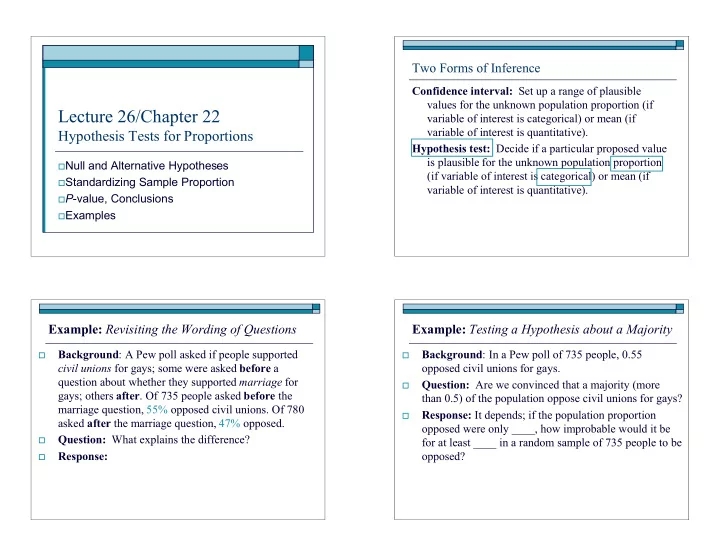
Confidence interval: Set up a range of plausible values for the unknown population proportion (if variable of interest is categorical) or mean (if variable of interest is quantitative). Hypothesis test: Decide if a particular proposed value is plausible for the unknown population proportion (if variable of interest is categorical) or mean (if variable of interest is quantitative).

Example: Revisiting the Wording of Questions

  • Background: A Pew poll asked if people supported

civil unions for gays; some were asked before a question about whether they supported marriage for gays; others after. Of 735 people asked before the marriage question, 55% opposed civil unions. Of 780 asked after the marriage question, 47% opposed.

  • Question: What explains the difference?
  • Response:

Example: Testing a Hypothesis about a Majority

  • Background: In a Pew poll of 735 people, 0.55
  • pposed civil unions for gays.
  • Question: Are we convinced that a majority (more

than 0.5) of the population oppose civil unions for gays?

  • Response: It depends; if the population proportion
  • pposed were only ____, how improbable would it be

for at least ____ in a random sample of 735 people to be

  • pposed?
slide-2
SLIDE 2

Example: Testing a Hypothesis about a Minority

  • Background: In a slightly different Pew poll of 780

people, 0.47 opposed civil unions for gays.

  • Question: Are we convinced that a minority (less than

0.5) of the population oppose civil unions for gays?

  • Response: It depends; if the population proportion
  • pposed were as high as ____, how improbable would it

be for no more than ____ in a random sample of 780 people to be opposed?

Note: In both examples, we test a hypothesis about the larger population, and our conclusion hinges on the probability of observed behavior occurring in a random

  • sample. This probability is called the P-value.

Testing Hypotheses About Pop. Value

1.

Formulate hypotheses.

2.

Summarize/standardize data.

3.

Determine the P-value.

4.

Make a decision about the unknown population value (proportion or mean).

Null and Alternative Hypotheses

For a test about a single proportion,

Null hypothesis: claim that the population

proportion equals a proposed value.

Alternative hypothesis: claim that the

population proportion is greater, less, or not equal to a proposed value. An alternative formulated with is two-sided; with > or < is one-sided.

Testing Hypotheses About Pop. Value

1.

Formulate hypotheses.

2.

Summarize/standardize data.

3.

Determine the P-value.

4.

Make a decision about the unknown population value (proportion or mean).

slide-3
SLIDE 3

Standardizing Normal Values (Review) Put a value of a normal distribution into perspective by standardizing to its z-score:

  • bserved value - mean

z = standard deviation

The observed value that we need to standardize in this context is the sample proportion. We’ve established Rules for its mean and standard deviation, and for when the shape is approximately normal, so that a probability (the P-value) can be assessed with the normal table.

Rule for Sample Proportions (Review)

Center: The mean of sample proportions equals

the true population proportion.

Spread: The standard deviation of sample

proportions is standard error = population proportion (1-population proportion)

Shape: (Central Limit Theorem) The frequency

curve of proportions from the various samples is approximately normal.

sample size

Standardized Sample Proportion

To test a hypothesis about an unknown population

proportion, find sample proportion and standardize to

z is called the test statistic.

Note that “sample proportion” is what we’ve observed, “population proportion” is the value proposed in the null hypothesis. sample size

sample proportion - population proportion

population proportion (1-population proportion) z =

Conditions for Rule of Sample Proportions

1.

Randomness [affects center]

Can’t be biased for or against certain values

2.

Independence [affects spread]

If sampling without replacement, sample should be

less than 1/10 population size

3.

Large enough sample size [affects shape]

Should sample enough to expect at least 5 each in

and out of the category of interest. If 1st two conditions don’t hold, the mean and sd in z are wrong; if 3rd doesn’t hold, P-value is wrong.

slide-4
SLIDE 4

Testing Hypotheses About Pop. Value

1.

Formulate hypotheses.

2.

Summarize/standardize data.

3.

Determine the P-value.

4.

Make a decision about the unknown population value (proportion or mean).

P-value in Hypothesis Test about Proportion

The P-value is the probability, assuming the null hypothesis is true, of a sample proportion at least as low/high/different as the one we

  • bserved. In particular, it depends on whether

the alternative hypothesis is formulated with a less than, greater than, or not-equal sign.

Testing Hypotheses About Pop. Value

1.

Formulate hypotheses.

2.

Summarize/standardize data.

3.

Determine the P-value.

4.

Make a decision about the unknown population value (proportion or mean).

Making a Decision Based on a P-value

If the P-value in our hypothesis test is small, our sample proportion is improbably low/high/different, assuming the null hypothesis to be true. We conclude it is not true: we reject the null hypothesis and believe the alternative. If the P-value is not small, our sample proportion is believable, assuming the null hypothesis to be true. We are willing to believe the null hypothesis. P-value small reject null hypothesis P-value not small don’t reject null hypothesis

slide-5
SLIDE 5

Hypothesis Test for Proportions: Details

  • 1. null hypothesis: pop proportion = proposed value

alt hyp: pop proportion < or > or proposed value

  • 2. Find sample proportion and standardize to z.
  • 3. Find the P-value= probability of sample proportion as

low/high/different as the one observed; same as probability of z this far below/above/away from 0.

  • 4. If the P-value is small, conclude alternative is true. In

this case, we say the data are statistically significant (too extreme to attribute to chance). Otherwise, continue to believe the null hypothesis.

Example: Testing a Hypothesis about a Majority

  • Background: In a Pew poll of 735 people, 0.55
  • pposed civil unions for gays.
  • Question: Are we convinced that a majority (more

than 0.5) of the population oppose civil unions for gays?

  • Response:

1.

Null: pop proportion ______ Alt: pop proportion______

2.

Sample proportion=_____, z =

3.

P-value=prob of z this far above 0: ______________

4.

Because the P-value is small, we reject null hypothesis. Conclude _____________________________________

Example: Testing a Hypothesis about a Minority

  • Background: In a Pew poll of 780 people, 0.47
  • pposed civil unions for gays.
  • Question: Are we convinced that a minority (less than

0.5) of the population oppose civil unions for gays?

  • Response:

1.

Null: pop proportion ______Alt: pop proportion ______

2.

Sample proportion = _____, z =

3.

P-value=prob of z this far below 0: approximately_____

4.

Because the P-value is ________________________ _________________________

Example: Testing a Hypothesis about M&Ms

  • Background: Population proportion of red M&Ms is
  • unknown. In a random sample, 15/75=0.20 are red.
  • Question: Are we willing to believe that 1/6 = 0.17 of

all M&Ms are red?

  • Response:

1.

Null: pop proportion ______Alt: pop proportion ______

2.

Sample proportion = _____, z =

3.

P-value=prob of z this far away from 0 (either direction) _________________________________

4.

Because the P-value isn’t too small, _____________ ________________________