Lecture 17: Software Engineering Research 2015-07-16 Prof. Dr. - - PDF document

lecture 17 software engineering research
SMART_READER_LITE
LIVE PREVIEW

Lecture 17: Software Engineering Research 2015-07-16 Prof. Dr. - - PDF document

Softwaretechnik / Software-Engineering Lecture 17: Software Engineering Research 2015-07-16 Prof. Dr. Andreas Podelski, Dr. Bernd Westphal 17 2015-07-16 main Albert-Ludwigs-Universit at Freiburg, Germany Schedule of the Block


slide-1
SLIDE 1

– 17 – 2015-07-16 – main –

Softwaretechnik / Software-Engineering

Lecture 17: Software Engineering Research

2015-07-16

  • Prof. Dr. Andreas Podelski, Dr. Bernd Westphal

Albert-Ludwigs-Universit¨ at Freiburg, Germany

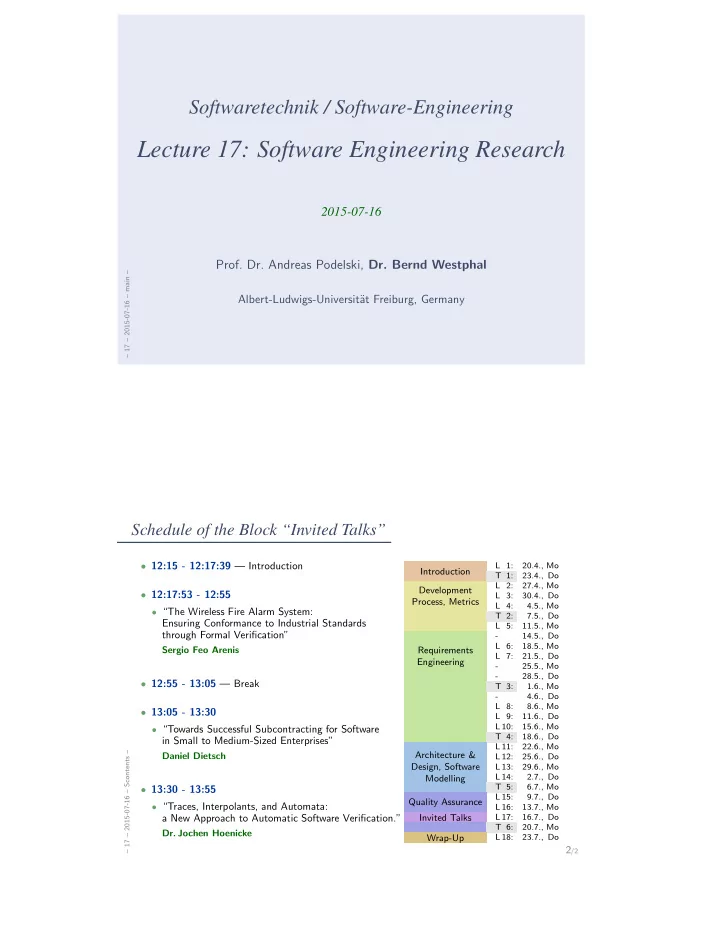
Schedule of the Block “Invited Talks”

– 17 – 2015-07-16 – Scontents –

2/2

  • 12:15 - 12:17:39 — Introduction
  • 12:17:53 - 12:55
  • “The Wireless Fire Alarm System:

Ensuring Conformance to Industrial Standards through Formal Verification”

Sergio Feo Arenis

  • 12:55 - 13:05 — Break
  • 13:05 - 13:30
  • “Towards Successful Subcontracting for Software

in Small to Medium-Sized Enterprises”

Daniel Dietsch

  • 13:30 - 13:55
  • “Traces, Interpolants, and Automata:

a New Approach to Automatic Software Verification.”

  • Dr. Jochen Hoenicke

L 1: 20.4., Mo

Introduction

T 1: 23.4., Do L 2: 27.4., Mo L 3: 30.4., Do L 4: 4.5., Mo

Development Process, Metrics

T 2: 7.5., Do L 5: 11.5., Mo

  • 14.5., Do

L 6: 18.5., Mo L 7: 21.5., Do

  • 25.5., Mo
  • 28.5., Do

Requirements Engineering

T 3: 1.6., Mo

  • 4.6., Do

L 8: 8.6., Mo L 9: 11.6., Do L 10: 15.6., Mo T 4: 18.6., Do L 11: 22.6., Mo L 12: 25.6., Do L 13: 29.6., Mo L 14: 2.7., Do

Architecture & Design, Software Modelling

T 5: 6.7., Mo L 15: 9.7., Do

Quality Assurance

L 16: 13.7., Mo

Invited Talks

L 17: 16.7., Do T 6: 20.7., Mo

Wrap-Up

L 18: 23.7., Do

slide-2
SLIDE 2

Context

Develop a wireless fire alarm system (safety critical). Requires certification to international standards. Small company with little to no experience with formal methods, but an acute need for product safety and quality. Project duration: ca. 2 years.

Sergio Feo-Arenis (Uni. Freiburg) Wireless Fire Alarm System SWT 2015 2 / 23

slide-3
SLIDE 3

Goals

Can formal methods handle development projects in the context af a small company (SME)? at which cost? How to tackle requirements from industrial standards using formal methods? What research ideas emerged from the project?

Sergio Feo-Arenis (Uni. Freiburg) Wireless Fire Alarm System SWT 2015 3 / 23

slide-4
SLIDE 4
slide-5
SLIDE 5
slide-6
SLIDE 6
slide-7
SLIDE 7

Challenges

Testing a design is difficult: There is a very large number of possible system configurations. Requires a prototype implementation. Controlling timing and radio communication environments requires costly procedures. The requirements assume an inherent nondeterminism.

Sergio Feo-Arenis (Uni. Freiburg) Wireless Fire Alarm System SWT 2015 5 / 23

Challenges

Testing a design is difficult: There is a very large number of possible system configurations. Requires a prototype implementation. Controlling timing and radio communication environments requires costly procedures. The requirements assume an inherent nondeterminism. Thus: Verification could help.

Sergio Feo-Arenis (Uni. Freiburg) Wireless Fire Alarm System SWT 2015 5 / 23

slide-8
SLIDE 8

General Risks

Development in a small company. Development team of 3 people: 1 computer scientist, 1 programmer, 1 electrical engineer. Underspecified standard requirements. High cost of certification. A failed certification attempt threatens the very existence of the company. Market introduction deadlines have high priority. Lack of structure in the software development process. Weak documentation practices. No familiarity with model-based development.

Sergio Feo-Arenis (Uni. Freiburg) Wireless Fire Alarm System SWT 2015 6 / 23

slide-9
SLIDE 9

What to Verify: Requirements Formalization

EN-54 provides: High-level real-time requirements (hard to formalize). Test Procedures. Effort required: Months. It was necessary to negotiate ambiguities with the certification authority.

Sergio Feo-Arenis (Uni. Freiburg) Wireless Fire Alarm System SWT 2015 8 / 23

What to Verify: Requirements Formalization

EN-54 provides: High-level real-time requirements (hard to formalize). Test Procedures. Effort required: Months. It was necessary to negotiate ambiguities with the certification authority. Chose duration calculus (DC) as formalism to generalize and capture the standard requirements based on test procedures. The formalism was not familiar to developers or the certificate authority. Required developing a graphical means of communication between the stakeholders. [Visual Narratives]

Sergio Feo-Arenis (Uni. Freiburg) Wireless Fire Alarm System SWT 2015 8 / 23

slide-10
SLIDE 10

What to Verify: Requirements Formalization

Result of the DC formalization: Captured test procedures. Captured environment assumptions during tests (frequency jamming, simplifying assumptions). Generalized to cover all components in arbitrary system topologies.

Sergio Feo-Arenis (Uni. Freiburg) Wireless Fire Alarm System SWT 2015 10 / 23

slide-11
SLIDE 11

What to Verify: Requirements Formalization

Result of the DC formalization: Captured test procedures. Captured environment assumptions during tests (frequency jamming, simplifying assumptions). Generalized to cover all components in arbitrary system topologies. In total: 6 (quantified) observables 7 (quantified) testable DC formulae

Sergio Feo-Arenis (Uni. Freiburg) Wireless Fire Alarm System SWT 2015 10 / 23

slide-12
SLIDE 12

Modeling: Monitoring Function

Decomposition gives way to additional proof obligations: No interference between networks (by design). No collisions (TDMA). [Guard time analysis] Topology subsumption: Verifying a maximal subnetwork is enough.

Sergio Feo-Arenis (Uni. Freiburg) Wireless Fire Alarm System SWT 2015 12 / 23

slide-13
SLIDE 13

Modeling: Monitoring Function

Decomposition gives way to additional proof obligations: No interference between networks (by design). No collisions (TDMA). [Guard time analysis] Topology subsumption: Verifying a maximal subnetwork is enough. To make models tractable, we require optimization: Each component has an individual clock. [Quasi-equal clock reduction] Support plug-in models: Separate environment and design.

Sergio Feo-Arenis (Uni. Freiburg) Wireless Fire Alarm System SWT 2015 12 / 23

Modeling: Sensor Failures

Modeled as timed automata networks with UPPAAL: x 1 x 1

Sergio Feo-Arenis (Uni. Freiburg) Wireless Fire Alarm System SWT 2015 13 / 23

slide-14
SLIDE 14

Modeling: Sensor Failures

x 4 x 126

Sergio Feo-Arenis (Uni. Freiburg) Wireless Fire Alarm System SWT 2015 14 / 23

Verification: Monitoring Function

Other model components: Auxiliary automata: Master, Central clock, Monitor Inner network: 10 Repeaters

Sergio Feo-Arenis (Uni. Freiburg) Wireless Fire Alarm System SWT 2015 15 / 23

slide-15
SLIDE 15

Verification: Monitoring Function

Other model components: Auxiliary automata: Master, Central clock, Monitor Inner network: 10 Repeaters Found 2 flaws: Timing was off by 1 tic Frequency intrusion

Sergio Feo-Arenis (Uni. Freiburg) Wireless Fire Alarm System SWT 2015 15 / 23

Verification: Monitoring Function

Other model components: Auxiliary automata: Master, Central clock, Monitor Inner network: 10 Repeaters Found 2 flaws: Timing was off by 1 tic Frequency intrusion A revised design was successfully verified:

Sensors as slaves Repeaters as slaves Query seconds MB States seconds MB States Detection 36,070.78 3,419.00 190M 231.84 230.59 6M No Spurious 97.44 44.29 0.6M 3.94 10.14 0.15M No LZ-Collision 12,895.17 2,343.00 68M 368.58 250.91 9.6M Detection Possible 10,205.13 557.00 26M 38.21 55.67 1.2M

Verification is scalable for real world problems (!). But additional effort is required.

Sergio Feo-Arenis (Uni. Freiburg) Wireless Fire Alarm System SWT 2015 15 / 23

slide-16
SLIDE 16

Modeling: Alarm Function

Sergio Feo-Arenis (Uni. Freiburg) Wireless Fire Alarm System SWT 2015 17 / 23

slide-17
SLIDE 17

Verification: Alarm Function

For single, explicit topologies: Timed automata / UPPAAL.

Full collision Query ids seconds MB States OneAlarm

  • 3.6 ± 1

43.1 ± 1 59k ± 15k TwoAlarms seq 4.7 67.1 110,207 TenAlarms seq 44.6 ± 11 311.4 ± 102 641k ± 159k

  • pt

41.8 ± 10 306.6 ± 80 600k ± 140k

Checking one topology is feasible, but the procedure does not scale for full verification (more than 10126 possible topologies). [Parameterized Verification of Aggregation Protocols] Models are still useful for simulation: extracted expected alarm times for different scenarios.

Sergio Feo-Arenis (Uni. Freiburg) Wireless Fire Alarm System SWT 2015 18 / 23

Verification: Alarm Function

For single, explicit topologies: Timed automata / UPPAAL.

Limited Collision Query ids seconds MB States OneAlarm

  • 1.4 ± 1

38.3 ± 1 36k ± 14k TwoAlarms seq 0.5 24.1 19,528 TenAlarms seq 17.3 ± 6 179.1 ± 61 419k ± 124k

  • pt

17.1 ± 6 182.2 ± 64 412k ± 124k

Checking one topology is feasible, but the procedure does not scale for full verification (more than 10126 possible topologies). [Parameterized Verification of Aggregation Protocols] Models are still useful for simulation: extracted expected alarm times for different scenarios.

Sergio Feo-Arenis (Uni. Freiburg) Wireless Fire Alarm System SWT 2015 18 / 23

slide-18
SLIDE 18

Verification: Alarm Function

For increased confidence: Does the collision resolution algorithm guarantee non-starvation?

Sergio Feo-Arenis (Uni. Freiburg) Wireless Fire Alarm System SWT 2015 19 / 23

Verification: Alarm Function

For increased confidence: Does the collision resolution algorithm guarantee non-starvation? Created an untimed model in PROMELA / SPIN. N: number of colliding components. I: set of IDs that may participate in the collision. Check all possible N-collision scenarios: vary IDs and timing.

Sergio Feo-Arenis (Uni. Freiburg) Wireless Fire Alarm System SWT 2015 19 / 23

slide-19
SLIDE 19

Verification: Alarm Function

For increased confidence: Does the collision resolution algorithm guarantee non-starvation? Created an untimed model in PROMELA / SPIN. N: number of colliding components. I: set of IDs that may participate in the collision. Check all possible N-collision scenarios: vary IDs and timing. Results: Reproduced the hidden terminal problem. For N = 2: found a problem with IDs 0 and 128. For N = {3..10}: still not scaling to all IDs, used sampling (31744).

|I| N sec. MB States 255 2 49 1,610 1,235,970 H 10 3,393 6,390 6,242,610 L 10 4,271 10,685 10,439,545 Rnd 10 4,465 11,534 11,268,368 average 4,138 9,994 9,763,809

Sergio Feo-Arenis (Uni. Freiburg) Wireless Fire Alarm System SWT 2015 19 / 23

Lessons Learned

Generalized test procedures are useful for verification: Developers are already used to producing test specifications. Thus: are cost-effective for increasing confidence.

Sergio Feo-Arenis (Uni. Freiburg) Wireless Fire Alarm System SWT 2015 20 / 23

slide-20
SLIDE 20

Lessons Learned

Generalized test procedures are useful for verification: Developers are already used to producing test specifications. Thus: are cost-effective for increasing confidence. Models are useful: For validation. As documentation. But still not very accesible for developers. Formal verification shows potential to relieve the effort of testing.

Sergio Feo-Arenis (Uni. Freiburg) Wireless Fire Alarm System SWT 2015 20 / 23

Conclusions

Formal methods are able to handle typical industrial scenarios (but require expert knowledge). The customers are confident early in the process that certification tests will be passed. Implementation is easier when based on a verified design. Other requirements can be simply tested. Still expensive: Almost as expensive as the certification test itself. Additional value: Formal methods not only improve confidence but helps structure development processes. Difficult technology transfer: SMEs prefer to scale out instead of up.

Sergio Feo-Arenis (Uni. Freiburg) Wireless Fire Alarm System SWT 2015 21 / 23

slide-21
SLIDE 21

Outlook

Check whether the source code of the implementation corresponds to the design models. Interrupt based implementations are hard to verify. Use the models to perform model-based testing. Investigate reuse strategies (new features, product lines).

Sergio Feo-Arenis (Uni. Freiburg) Wireless Fire Alarm System SWT 2015 22 / 23 Sergio Feo-Arenis (Uni. Freiburg) Wireless Fire Alarm System SWT 2015 23 / 23

slide-22
SLIDE 22

Towards Successful Sub contracting for Software in Sm all to M edium -Sized Enterp rises

RELA W W orkshop , 2012-09 -25

Bernd Westphal1, Daniel Dietsch1, Sergio Feo-Arenis1, Andreas Podelski1, Louis Pahlow2, Jochen Morsbach3, Barbara Sommer3, Anke Fuchs3, Christine Meierh¨

  • fer3

1 Albert-Ludwigs-Universit¨

at Freiburg, Germany

2 Universit¨

at des Saarlandes, Saarbr¨ ucken, Germany

3 Universit¨

at Mannheim, Germany

– 0 – 2012-09-25 – main –

O utline

◮ Introduction

  • What is sub-contracting for software?
  • When is it succesful?
  • Why is it ofen not successful?
  • The Salomo Approach:
  • Overview
  • Checkable Requirements, Checking Tool
  • Regulations in the Contract
  • Related Work
  • Conclusion and Further Work

– 0 – 2012-09-25 – Scontent –

2/17

slide-23
SLIDE 23

Successful Sub contracting for Software in SM Es

SME A SME B

S

  • f

t w a r e

– 0 – 2012-09-25 – Ssuccess –

3/17

Successful Sub contracting for Software in SM Es

Customer Contractor

S

  • f

t w a r e

– 0 – 2012-09-25 – Ssuccess –

3/17

slide-24
SLIDE 24

Successful Sub contracting for Software in SM Es

Customer Contractor

§

– 0 – 2012-09-25 – Ssuccess –

4/17

Successful Sub contracting for Software in SM Es

Customer Contractor

Software

Software

§

develop deliver

– 0 – 2012-09-25 – Ssuccess –

4/17

slide-25
SLIDE 25

Successful Sub contracting for Software in SM Es

Customer Contractor

Software

Software

:-) :-)

§

develop deliver accept pay

– 0 – 2012-09-25 – Ssuccess –

4/17

Sub contracting for Software in SM Es in Reality

Customer Contractor

S

  • f

t w a r e

Software

§

develop deliver

:-( :-(

– 0 – 2012-09-25 – Sreality –

5/17

slide-26
SLIDE 26

Sub contracting for Software in SM Es in Reality

Customer Contractor

S

  • f

t w a r e

Software

§

develop deliver

:-( :-(

There are three main sources of disputes (and thus uncertainty):

  • misunderstandings in the requirements,

– 0 – 2012-09-25 – Sreality –

5/17

Bringing Software-related D isp utes to C ourt...

. . . is generally highly unattractive for SME:

– 0 – 2012-09-25 – Sreality –

6/17

slide-27
SLIDE 27

Bringing Software-related D isp utes to C ourt...

. . . is generally highly unattractive for SME: (i) a court ruling takes time, thus further delays the project,

– 0 – 2012-09-25 – Sreality –

6/17

Bringing Software-related D isp utes to C ourt...

. . . is generally highly unattractive for SME: (i) a court ruling takes time, thus further delays the project, (ii) a court ruling incurs costs,

– 0 – 2012-09-25 – Sreality –

6/17

slide-28
SLIDE 28

Bringing Software-related D isp utes to C ourt...

. . . is generally highly unattractive for SME: (i) a court ruling takes time, thus further delays the project, (ii) a court ruling incurs costs, (iii) it is uncertain whether the necessary compensation can be achieved,

– 0 – 2012-09-25 – Sreality –

6/17

Bringing Software-related D isp utes to C ourt...

. . . is generally highly unattractive for SME: (i) a court ruling takes time, thus further delays the project, (ii) a court ruling incurs costs, (iii) it is uncertain whether the necessary compensation can be achieved, (iv) a court only decides over the rights and duties of each party, no suggestion how to use the decision to achieve project success,

– 0 – 2012-09-25 – Sreality –

6/17

slide-29
SLIDE 29

Bringing Software-related D isp utes to C ourt...

. . . is generally highly unattractive for SME: (i) a court ruling takes time, thus further delays the project, (ii) a court ruling incurs costs, (iii) it is uncertain whether the necessary compensation can be achieved, (iv) a court only decides over the rights and duties of each party, no suggestion how to use the decision to achieve project success, (v) mutual trust between the former partners is hampered, already achieved project progress may be lost.

– 0 – 2012-09-25 – Sreality –

6/17

Bringing Software-related D isp utes to C ourt...

. . . is generally highly unattractive for SME: (i) a court ruling takes time, thus further delays the project, (ii) a court ruling incurs costs, (iii) it is uncertain whether the necessary compensation can be achieved, (iv) a court only decides over the rights and duties of each party, no suggestion how to use the decision to achieve project success, (v) mutual trust between the former partners is hampered, already achieved project progress may be lost. In addition, there is a high uncertainty about the outcome:

  • given unclear requirements,

an appointed expert witness may confirm either interpretation.

– 0 – 2012-09-25 – Sreality –

6/17

slide-30
SLIDE 30

Sub contracting for Software in SM Es in Reality

Customer Contractor

S

  • f

t w a r e

Software

§

develop deliver

:-( :-(

There are three main sources of disputes (and thus uncertainty):

  • misunderstandings in the requirements,

– 0 – 2012-09-25 – Sreality –

7/17

Sub contracting for Software in SM Es in Reality

Customer Contractor

S

  • f

t w a r e

Software

§

develop deliver

:-( :-(

There are three main sources of disputes (and thus uncertainty):

  • misunderstandings in the requirements,
  • misunderstandings or (under-regulations) of acceptance testing procedure,

– 0 – 2012-09-25 – Sreality –

7/17

slide-31
SLIDE 31

Sub contracting for Software in SM Es in Reality

Customer Contractor

S

  • f

t w a r e

Software

§

develop deliver

:-( :-(

There are three main sources of disputes (and thus uncertainty):

  • misunderstandings in the requirements,
  • misunderstandings or (under-regulations) of acceptance testing procedure,
  • misunderstandings of regulations of the contract.

– 0 – 2012-09-25 – Sreality –

7/17

Sub contracting for Software in SM Es in Reality

Customer Contractor

S

  • f

t w a r e

Software

§

develop deliver

:-( :-(

There are three main sources of disputes (and thus uncertainty):

  • misunderstandings in the requirements,
  • misunderstandings or (under-regulations) of acceptance testing procedure,
  • misunderstandings of regulations of the contract.

Many SMEs conclude: subcontracting for software is too risky due to these three main sources of uncertainty.

– 0 – 2012-09-25 – Sreality –

7/17

slide-32
SLIDE 32

O b servation

  • (Legal) certainty is crucial for subcontracting between SMEs:

Outcomes of possible court judgements need to be as clear as possible.

  • To achieve legal certainty, we need

(a) clear and precise requirements, they avoid the 1st source of uncertainty. (b) clear and precise acceptance testing procedures, they avoid the 2nd source of uncertainty. (c) standardised legal contracts which integrate (a) and (b), they avoid the 3rd source of uncertainty. The contract allows a judge to decide on (a) and (b), and thus increases legal certainty.

– 0 – 2012-09-25 – main –

8/17

O utline

  • Introduction
  • What is sub-contracting for software?
  • When is it succesful?
  • Why is it ofen not successful?

◮ The Salomo Approach:

  • Overview
  • Checkable Requirements, Checking Tool
  • Regulations in the Contract
  • Related Work
  • Conclusion and Further Work

– 0 – 2012-09-25 – Scontent –

9/17

slide-33
SLIDE 33

Towards (Legal) C ertainty

Customer Contractor

S

  • f

t w a r e S

  • f

t w a r e :-) :-)

modular con- tract checkable require- ments checking tool accept y/n/?

Ingredients:

  • new notion:

checkable requirement,

  • new notion:

checking tool.

  • a new, modular software

development contract, The modular contract assumes: a subset of requirements is designated as checkable requirements, includes: the checkable requirements in machine-readable form, codifies: agreement that outcome of corresponding checking tool is — with few and exactly specified exceptions — binding for both parties, provides: legal certainty.

– 0 – 2012-09-25 – main –

10/17

C heckab le Sp ecifi cation/Req uirem ent, C hecking Tool

  • A checkable specification is a pair (ϕ, T)

comprising a program property ϕ and a backend T.

  • A backend maps a program p and a program property ϕ

to a result T(p, ϕ) ∈ {Yes, No, Unknown} such that the result is

  • Yes only if the program has the property,
  • No only if the program does not have the property.

– 0 – 2012-09-25 – main –

11/17

slide-34
SLIDE 34

C heckab le Sp ecifi cation/Req uirem ent, C hecking Tool

  • A checkable specification is a pair (ϕ, T)

comprising a program property ϕ and a backend T.

  • A backend maps a program p and a program property ϕ

to a result T(p, ϕ) ∈ {Yes, No, Unknown} such that the result is

  • Yes only if the program has the property,
  • No only if the program does not have the property.
  • A checking tool maps a set of checkable specifications

Φ = {(ϕ1, T1), . . . , (ϕn, Tn)}, n ∈ N0, to a checking tool result {(ϕ1, s1), . . . , (ϕn, sn)}, si ∈ {Yes, No, Unknown}.

– 0 – 2012-09-25 – main –

11/17

C heckab le Sp ecifi cation/Req uirem ent, C hecking Tool

  • A checkable specification is a pair (ϕ, T)

comprising a program property ϕ and a backend T.

  • A backend maps a program p and a program property ϕ

to a result T(p, ϕ) ∈ {Yes, No, Unknown} such that the result is

  • Yes only if the program has the property,
  • No only if the program does not have the property.
  • A checking tool maps a set of checkable specifications

Φ = {(ϕ1, T1), . . . , (ϕn, Tn)}, n ∈ N0, to a checking tool result {(ϕ1, s1), . . . , (ϕn, sn)}, si ∈ {Yes, No, Unknown}.

  • A requirement is called checkable requirement if and oly if

a checkable specification can (mechanically) be derived from it.

– 0 – 2012-09-25 – main –

11/17

slide-35
SLIDE 35

Backend Ex am p les

  • “The Program Compiles”: wrapper applies compiler and yields
  • Yes, compiler C in version V produces a non-empty executable.
  • No, otherwise.

– 0 – 2012-09-25 – main –

12/17

Backend Ex am p les

  • “The Program Compiles”: wrapper applies compiler and yields
  • Yes, compiler C in version V produces a non-empty executable.
  • No, otherwise.
  • “Test Coverage”: wrapper applies unit-tests
  • Yes, normal termination of unit tests indicates 100% branch coverage,
  • No, normal termination and branch coverage below 100%,
  • Unknown, otherwise.

– 0 – 2012-09-25 – main –

12/17

slide-36
SLIDE 36

Backend Ex am p les

  • “The Program Compiles”: wrapper applies compiler and yields
  • Yes, compiler C in version V produces a non-empty executable.
  • No, otherwise.
  • “Test Coverage”: wrapper applies unit-tests
  • Yes, normal termination of unit tests indicates 100% branch coverage,
  • No, normal termination and branch coverage below 100%,
  • Unknown, otherwise.
  • “Absence of Generic Errors”: wrapper applies, e.g., Frama-C
  • Yes, all assertions related to safe memory access hold or not tried,
  • No, at least one assertion has status surely invalid, and
  • Unknown otherwise.

– 0 – 2012-09-25 – main –

12/17

Backend Ex am p les

  • “The Program Compiles”: wrapper applies compiler and yields
  • Yes, compiler C in version V produces a non-empty executable.
  • No, otherwise.
  • “Test Coverage”: wrapper applies unit-tests
  • Yes, normal termination of unit tests indicates 100% branch coverage,
  • No, normal termination and branch coverage below 100%,
  • Unknown, otherwise.
  • “Absence of Generic Errors”: wrapper applies, e.g., Frama-C
  • Yes, all assertions related to safe memory access hold or not tried,
  • No, at least one assertion has status surely invalid, and
  • Unknown otherwise.
  • “Invariant Satisfied”: wrapper applies, e.g., VCC
  • Yes, verifier output indicates invariant proven; Unknown, otherwise.

– 0 – 2012-09-25 – main –

12/17

slide-37
SLIDE 37

Backend Ex am p les

  • “The Program Compiles”: wrapper applies compiler and yields
  • Yes, compiler C in version V produces a non-empty executable.
  • No, otherwise.
  • “Test Coverage”: wrapper applies unit-tests
  • Yes, normal termination of unit tests indicates 100% branch coverage,
  • No, normal termination and branch coverage below 100%,
  • Unknown, otherwise.
  • “Absence of Generic Errors”: wrapper applies, e.g., Frama-C
  • Yes, all assertions related to safe memory access hold or not tried,
  • No, at least one assertion has status surely invalid, and
  • Unknown otherwise.
  • “Invariant Satisfied”: wrapper applies, e.g., VCC
  • Yes, verifier output indicates invariant proven; Unknown, otherwise.
  • “Certification”: expert reviews of programs

– 0 – 2012-09-25 – main –

12/17

Regulations in the C ontract

  • The modular software development contract
  • consists of a framework contract, referred to by individual contract,
  • customisation by several contractual modules.

– 0 – 2012-09-25 – main –

13/17

slide-38
SLIDE 38

Regulations in the C ontract

  • The modular software development contract
  • consists of a framework contract, referred to by individual contract,
  • customisation by several contractual modules.
  • The acceptance checking procedure is regulated in two clauses:

(i) checkable requirements tested with and only with checking tool. Exit option: if

  • backend is evidently erroneous, or
  • the parties agree to consider the result erroneous, or
  • there is an “Unknown” among only “Yes”s and “Unknown”s,

then the clause for other requirements applies. (ii) testing procedure for other requirements determined by customer.

– 0 – 2012-09-25 – main –

13/17

O utline

  • Introduction
  • What is sub-contracting for software?
  • When is it succesful?
  • Why is it ofen not successful?
  • The Salomo Approach:
  • Overview
  • Checkable Requirements, Checking Tool
  • Regulations in the Contract

◮ Related Work

  • Conclusion and Further Work

– 0 – 2012-09-25 – Scontent –

14/17

slide-39
SLIDE 39

Related W ork

  • (Berenbach, Lo & Sherman, 2010)

Scope limited to the time after the contract has been awarded, limited discussion regarding contract compliance check.

  • (Governatori, Milosevic, & Sadiq, 2006) — formalise contract conditions

Use FCL to formalise requirements business rules and tools which decide compliance as acceptance checking procedure.

  • (Breaux, Ant´
  • n, Spafford, 2009) — delegation

We consider top-level obligations and verification sets without delegation.

  • (Fanmuy, Fraga & Llor´

ens, 2012) — requirements verification Use requirements verification as acceptance checking procedure if creation

  • f a requirements document is subject of a contract.

– 0 – 2012-09-25 – main –

15/17

C onclusion and F urther W ork

  • We tackle a main challenge of contracting for software: legal uncertainty.
  • We outline a possible approach to resolve three reasons of uncertainty:

a modular legal contract codifies the mutual agreement that checkable requirements are verified by checking tool exclusively.

  • Both, contractor and customer have strong interest in obtaining

positive checking results since positive results mean certainty.

  • Our contract is well-suited for a gradual introduction of formal

methods — any backend is supported as long as both parties agree.

  • Formal methods effort promises increased confidence in software quality.

Further work:

  • legally support traceability, change-requests.
  • consider a concept of delegation similar to (Breaux et al., 2009),
  • provide more backends.

– 0 – 2012-09-25 – main –

16/17

slide-40
SLIDE 40

Thanks.

http://www.salomo-projekt.de

– 0 – 2012-09-25 – main –

17/17

Traces, Interpolants, and Automata: a New Approach to Automatic Software Verification

Jochen Hoenicke

University of Freiburg

joint work with Andreas Podelski and Matthias Heizmann

16 July 2015

slide-41
SLIDE 41

Software Verification

◮ prove or disprove that a given program satisfies a given specification

Software Verification

◮ prove or disprove that a given program satisfies a given specification ◮ problem is undecidable [Turing, 1936]

slide-42
SLIDE 42

Example

ℓ0:

assume p != 0;

ℓ1:

while(n >= 0)

{ ℓ2:

assert p != 0; if(n == 0)

{ ℓ3:

p := 0;

} ℓ4:

n--;

}

pseudocode

ℓ0 ℓ1 ℓ2 ℓ3 ℓ4 ℓ5 ℓerr p != 0 n >= 0 n == 0 p := 0 n != 0 p == 0 n-- n < 0

control flow graph

slide-43
SLIDE 43

Example

ℓ0:

assume p != 0;

ℓ1:

while(n >= 0)

{ ℓ2:

assert p != 0; if(n == 0)

{ ℓ3:

p := 0;

} ℓ4:

n--;

}

pseudocode

ℓ0 ℓ1 ℓ2 ℓ3 ℓ4 ℓ5 ℓerr p != 0 n >= 0 n == 0 p := 0 n != 0 p == 0 n-- n < 0 p != 0 n >= 0 p == 0

control flow graph

  • 1. take trace π1

p != 0 n >= 0 p == 0

slide-44
SLIDE 44
  • 1. take trace π1
  • 2. consider trace as program P1

1: assume p != 0; 2: assume n >= 0; 3: assert p != 0; pseudocode of P1

p != 0 n >= 0 p == 0

  • 1. take trace π1
  • 2. consider trace as program P1
  • 3. analyze correctness or P1

p != 0 n >= 0 p == 0

true p = 0 p = 0 false

slide-45
SLIDE 45
  • 1. take trace π1
  • 2. consider trace as program P1
  • 3. analyze correctness or P1
  • 4. generalize program P1

◮ add transitions

{ p = 0 } n-- { p = 0 } is valid Hoare triple p != 0 n >= 0 p == 0

true p = 0 p = 0 false

  • n--
  • 1. take trace π1
  • 2. consider trace as program P1
  • 3. analyze correctness or P1
  • 4. generalize program P1

◮ add transitions

{ p = 0 } n-- { p = 0 } is valid Hoare triple { p = 0 } n != 0 { p = 0 } is valid Hoare triple p != 0 n >= 0 p == 0

true p = 0 p = 0 false

  • n != 0

n--

slide-46
SLIDE 46
  • 1. take trace π1
  • 2. consider trace as program P1
  • 3. analyze correctness or P1
  • 4. generalize program P1

◮ add transitions

{ p = 0 } n-- { p = 0 } is valid Hoare triple { p = 0 } n != 0 { p = 0 } is valid Hoare triple { p = 0 } n >= 0 { p = 0 } is valid Hoare triple p != 0 n >= 0 p == 0

true p = 0 p = 0 false

  • n != 0

n-- n >= 0

  • 1. take trace π1
  • 2. consider trace as program P1
  • 3. analyze correctness or P1
  • 4. generalize program P1

◮ add transitions

p != 0 n >= 0 p == 0

true p = 0 p = 0 false

  • all \{ p := 0 }
slide-47
SLIDE 47
  • 1. take trace π1
  • 2. consider trace as program P1
  • 3. analyze correctness or P1
  • 4. generalize program P1

◮ add transitions

p != 0 n >= 0 p == 0

true p = 0 p = 0 false

  • all \{ p := 0 }

all all \{ p := 0 } all

  • 1. take trace π1
  • 2. consider trace as program P1
  • 3. analyze correctness or P1
  • 4. generalize program P1

◮ add transitions ◮ merge locations

q0

true

q1

p = 0

q2

false

all all p != 0 p == 0 all \{ p := 0 }

slide-48
SLIDE 48

New View on Programs

“A program defines a language over the alphabet of statements.”

slide-49
SLIDE 49

New View on Programs

“A program defines a language over the alphabet of statements.”

◮ Set of statements: alphabet of formal language

e.g., Σ = { p != 0 ,

n >= 0 , n == 0 , p := 0 , n != 0 , p == 0 , n-- , n < 0 , }

New View on Programs

“A program defines a language over the alphabet of statements.”

◮ Set of statements: alphabet of formal language

e.g., Σ = { p != 0 ,

n >= 0 , n == 0 , p := 0 , n != 0 , p == 0 , n-- , n < 0 , }

◮ Control flow graph: automaton over the alphabet of statements ◮ Error location: accepting state of this automaton

slide-50
SLIDE 50

New View on Programs

“A program defines a language over the alphabet of statements.”

◮ Set of statements: alphabet of formal language

e.g., Σ = { p != 0 ,

n >= 0 , n == 0 , p := 0 , n != 0 , p == 0 , n-- , n < 0 , }

◮ Control flow graph: automaton over the alphabet of statements ◮ Error location: accepting state of this automaton ◮ Error trace of program: word accepted by this automaton

slide-51
SLIDE 51
slide-52
SLIDE 52
  • 1. take trace π2

p != 0 n >= 0 n == 0 p := 0 n-- n >= 0 p == 0

  • 1. take trace π2
  • 2. consider trace as program P2

p != 0 n >= 0 n == 0 p := 0 n-- n >= 0 p == 0

slide-53
SLIDE 53
  • 1. take trace π2
  • 2. consider trace as program P2
  • 3. analyze correctness or P2

p != 0 n >= 0 n == 0 p := 0 n-- n >= 0 p == 0

true true true n = 0 n = 0 n = −1 false false

  • 1. take trace π2
  • 2. consider trace as program P2
  • 3. analyze correctness or P2
  • 4. generalize program P2

◮ add transitions ◮ merge locations

q0 q1 q2 q3 all all n == 0 n-- n >= 0 all \{ n-- } all \{ n-- }

slide-54
SLIDE 54

ℓ0 ℓ1 ℓ2 ℓ3 ℓ4 ℓ5 ℓerr p != 0 n >= 0 n == 0 p := 0 n != 0 p == 0 n-- n < 0

?

program P

q0 q1 q2 all all p != 0 p == 0 all \{ p := 0 }

  • program P1

q0 q1 q2 q3 all all n == 0 n-- n >= 0 all \{ n-- } all \{ n-- }

  • program P2

ℓ0 ℓ1 ℓ2 ℓ3 ℓ4 ℓ5 ℓerr p != 0 n >= 0 n == 0 p := 0 n != 0 p == 0 n-- n < 0

?

program P

q0 q1 q2 all all p != 0 p == 0 all \{ p := 0 }

  • program P1

q0 q1 q2 q3 all all n == 0 n-- n >= 0 all \{ n-- } all \{ n-- }

  • program P2

P ⊆ P1 ∪ P2

slide-55
SLIDE 55

Verification Algorithm

program P “P is correct” “P is incorrect” L(P) ⊆ L(P1) ∪ · · · ∪ L(Pn) is π feasible ? no pick new error trace π no construct infeasiblity proof for π construct generalized program Pi yes yes

Verification Algorithm

program P “P is correct” “P is incorrect” L(P) ⊆ L(P1) ∪ · · · ∪ L(Pn) is π feasible ? no pick new error trace π no construct infeasiblity proof for π construct generalized program Pi yes yes

slide-56
SLIDE 56

Verification Algorithm

program P “P is correct” “P is incorrect” L(P) ⊆ L(P1) ∪ · · · ∪ L(Pn) is π feasible ? no pick new error trace π no construct infeasiblity proof for π construct generalized program Pi yes yes

Verification Algorithm

program P “P is correct” “P is incorrect” L(P) ⊆ L(P1) ∪ · · · ∪ L(Pn) is π feasible ? no pick new error trace π no construct infeasiblity proof for π construct generalized program Pi yes yes

slide-57
SLIDE 57

Verification Algorithm

program P “P is correct” “P is incorrect” L(P) ⊆ L(P1) ∪ · · · ∪ L(Pn) is π feasible ? no pick new error trace π no construct infeasiblity proof for π construct generalized program Pi yes yes

Interprocedural/Recursive Programs

slide-58
SLIDE 58

Recursive Programs - Challenge 1: Control Flow

procedure m(x) returns (res)

ℓ0: if x>100 ℓ1:

res:=x-10 else

ℓ2:

xm := x+11

ℓ3:

call m

ℓ4:

xm := resm

ℓ5:

call m

ℓ6:

res := resm

ℓ7: assert (x<=101 -> res=91)

return m

McCarthy 91 function

ℓ0 ℓ1 ℓ2 ℓ3 ℓ4 ℓ5 ℓ6 ℓ7 ℓerr x>100 res:=x-10 x<=100 xm:=x+11 call m xm:=resm call m res:=resm return m ↑ ℓ3 return m ↑ ℓ5 x≤101∧res=91

control flow graph

Recursive Programs - Challenge 1: Control Flow

procedure m(x) returns (res)

ℓ0: if x>100 ℓ1:

res:=x-10 else

ℓ2:

xm := x+11

ℓ3:

call m

ℓ4:

xm := resm

ℓ5:

call m

ℓ6:

res := resm

ℓ7: assert (x<=101 -> res=91)

return m

McCarthy 91 function

ℓ0 ℓ1 ℓ2 ℓ3 ℓ4 ℓ5 ℓ6 ℓ7 ℓerr x>100 res:=x-10 x<=100 xm:=x+11 call m xm:=resm call m res:=resm return m ↑ ℓ3 return m ↑ ℓ5 x≤101∧res=91

control flow graph

slide-59
SLIDE 59

Recursive Programs - Challange 2: Local Annotations

What is an annotation for an interprocedural execution?

◮ state with a stack?

locality of annotation is lost

true xp = 0 xp = 0 x = 0 xp = 0 xp =-1 xp = 0 xp = −1 x = 1 xp = 0 xp =-1 res =-1 xp = 0 resp = -1 xp = -1 xp = 0 res = 0 resp = 0 xp = 0 false xp:=0 call p xp:=x-1 call p res:=x return res:=resp-xp return resp < xp

Recursive Programs - Challange 2: Local Annotations

What is an annotation for an interprocedural execution?

◮ state with a stack?

locality of annotation is lost

true xp = 0 xp = 0 x = 0 xp = 0 xp =-1 xp = 0 xp = −1 x = 1 xp = 0 xp =-1 res =-1 xp = 0 resp = -1 xp = -1 xp = 0 res = 0 resp = 0 xp = 0 false xp:=0 call p xp:=x-1 call p res:=x return res:=resp-xp return resp < xp

◮ only local valuations?

call/return dependency lost, sequence of state assertions is not a proof

xp:=0 call p xp:=x-1 call p res:=x return res:=resp-xp return resp < xp true xp =0 true xp =x−1 true res =x ? ? ? ?

slide-60
SLIDE 60

Recursive Programs - Challange 2: Local Annotations

What is an annotation for an interprocedural execution? Idea: “Nested Interpolants” Define sequence of state assertions with respect to nested trace.

xp:=0 call p xp:=x-1 call p res:=x return res:=resp-xp return resp < xp true xp =0 true xp =x−1 true res =x resp ≥xp res ≥x resp ≥ xp false

Define ternary post operator for return statements

post( res =x , xp =x−1 , return p ) ⊆ resp ≥xp local state

  • f caller

before call local state

  • f callee

before return local state

  • f caller

after return

Termination Analysis

slide-61
SLIDE 61

Termination Analysis

◮ Challenge 1: counterexample to termination is infinite execution

Termination Analysis

◮ Challenge 1: counterexample to termination is infinite execution

Solution: consider infinite traces, use ω-words and B¨ uchi automata

slide-62
SLIDE 62

Termination Analysis

◮ Challenge 1: counterexample to termination is infinite execution

Solution: consider infinite traces, use ω-words and B¨ uchi automata

◮ Challenge 2: An infinite trace may not have any execution although

each finite prefix has an execution. E.g., ( x > 0

x-- )ω

while (x > 0) { x--; }

Termination Analysis

◮ Challenge 1: counterexample to termination is infinite execution

Solution: consider infinite traces, use ω-words and B¨ uchi automata

◮ Challenge 2: An infinite trace may not have any execution although

each finite prefix has an execution. E.g., ( x > 0

x-- )ω

while (x > 0) { x--; } Solution: ranking functions (here: f(x)=x)

Ranking Function (for a Loop)

Function from program states to well-founded domain such that value is decreasing while executing the loop body. Proof by contradiction for the absence of infinite executions.

slide-63
SLIDE 63

Example: Bubble Sort

program sort(int i, int a[]) ℓ1: while (i>0) ℓ2: int j:=1 ℓ3: while(j<i) if (a[j]>a[i]) swap(a,i,j) ℓ4: j++ ℓ5: i--

Example: Bubble Sort

program sort(int i) ℓ1: while (i>0) ℓ2: int j:=1 ℓ3: while(j<i) ℓ4: j++ ℓ5: i--

ℓ1 ℓ2 ℓ3 ℓ4 ℓ5 i>0 j:=1 j<i j++ j>=i i--

slide-64
SLIDE 64

Example: Bubble Sort

program sort(int i) ℓ1: while (i>0) ℓ2: int j:=1 ℓ3: while(j<i) ℓ4: j++ ℓ5: i-- quadratic ranking function: f (i, j) = i2 − j lexicographic ranking function: f (i, j) = (i, i − j)

ℓ1 ℓ2 ℓ3 ℓ4 ℓ5 i>0 j:=1 j<i j++ j>=i i--

program P module P1 module P2

(Outer+Inner)ω (Inner∗.Outer)ω (Inner+Outer)∗.Innerω

ℓ1 ℓ2 ℓ3 ℓ4 ℓ5 i>0 j:=1 j<i j++ j>=i i-- ℓ1 ℓ2 ℓ3 ℓ4 ℓ5 i>0 j:=1 j<i j++ j>=i i-- ℓ0 ℓ2 ℓ3 ℓ4 ℓ5 ℓ′

3

ℓ′

4

i>0 j:=1 j<i j++ j>=i i-- j:=1 j<i j++

ranking function ranking function f (i, j) = i f (i, j) = i − j

slide-65
SLIDE 65

program P module P1 module P2

(Outer+Inner)ω

= = =

(Inner∗.Outer)ω +

+ +

(Inner+Outer)∗.Innerω

ℓ1 ℓ2 ℓ3 ℓ4 ℓ5 i>0 j:=1 j<i j++ j>=i i--

= = =

ℓ1 ℓ2 ℓ3 ℓ4 ℓ5 i>0 j:=1 j<i j++ j>=i i--

∪ ∪ ∪

ℓ0 ℓ2 ℓ3 ℓ4 ℓ5 ℓ′

3

ℓ′

4

i>0 j:=1 j<i j++ j>=i i-- j:=1 j<i j++

ranking function ranking function f (i, j) = i f (i, j) = i − j

ℓ1 ℓ2 ℓ3 ℓ4 ℓ5 i>0 j:=1 j<i j++ j>=i i--

slide-66
SLIDE 66

From ω-Trace to Terminating Program – Example

input: ultimately periodic trace i>0 j:=1 ( j<i j++ )ω,

From ω-Trace to Terminating Program – Example

input: ultimately periodic trace i>0 j:=1 ( j<i j++ )ω,

  • 1. consider ω-trace as program with single while loop

ℓ1 ℓ2 ℓ3 ℓ4 i>0 j:=1 j<i j++

slide-67
SLIDE 67

From ω-Trace to Terminating Program – Example

input: ultimately periodic trace i>0 j:=1 ( j<i j++ )ω,

  • 1. consider ω-trace as program with single while loop

ℓ1 ℓ2 ℓ3 ℓ4 i>0 j:=1 j<i j++

  • 2. synthesize ranking function

f (i, j) = i − j

Col´

  • n, Sipma

Synthesis of Linear Ranking Functions (TACAS 2001) Podelski, Rybalchenko A complete method for the synthesis of linear ranking functions (VMCAI 2004) Bradley, Manna, Sipma Termination Analysis of Integer Linear Loops (CONCUR 2005) Bradley, Manna, Sipma Linear ranking with reachability (CAV 2005) Bradley, Manna, Sipma The polyranking principle (ICALP 2005) Ben-Amram, Genaim Ranking functions for linear-constraint loops (POPL 2013) H., Hoenicke, Leike, Podelski Linear Ranking for Linear Lasso Programs (ATVA 2013) Cook, Kroening, R¨ ummer, Wintersteiger Ranking function synthesis for bit-vector relations (FMSD 2013) Leike, H. Ranking Templates for Linear Loops (TACAS 2014)

From ω-Trace to Terminating Program – Example

input: ultimately periodic trace i>0 j:=1 ( j<i j++ )ω,

  • 1. consider ω-trace as program with single while loop

ℓ1 ℓ2 ℓ3 ℓ4 i>0 j:=1 j<i j++

  • 2. synthesize ranking function

f (i, j) = i − j

  • 3. compute rank certificate

ℓ1

  • ldrnk = ∞

ℓ2

  • ldrnk = ∞

ℓ3

i − j ≺ oldrnk

ℓ4

i − j ≤ oldrnk ∧ i − j ≥ 0

i>0 j:=1 j<i j++

slide-68
SLIDE 68

From ω-Trace to Terminating Program – Example

input: ultimately periodic trace i>0 j:=1 ( j<i j++ )ω,

  • 1. consider ω-trace as program with single while loop

ℓ1 ℓ2 ℓ3 ℓ4 i>0 j:=1 j<i j++

  • 2. synthesize ranking function

f (i, j) = i − j

  • 3. compute rank certificate

ℓ1

  • ldrnk = ∞

ℓ2

  • ldrnk = ∞

ℓ3

i − j ≺ oldrnk

ℓ4

i − j ≤ oldrnk ∧ i − j ≥ 0

i>0 j:=1 j<i j++

  • 4. add additional transitions

ℓ1

  • ldrnk = ∞

ℓ3

i − j ≺ oldrnk

ℓ4

i − j ≤ oldrnk ∧ i − j ≥ 0

Σ Σ j<i j++

Generalization of Program with Rank Certificate

◮ Case 1: q1 not accepting Hoare triple { state assertion 1 } stmt { state assertion 2 } automaton transition

q1

state assertion 1

q2

state assertion 2 stmt

slide-69
SLIDE 69

Generalization of Program with Rank Certificate

◮ Case 1: q1 not accepting Hoare triple { state assertion 1 } stmt { state assertion 2 } automaton transition

q1

state assertion 1

q2

state assertion 2 stmt ◮ Case 2: q1 accepting Hoare triple { state assertion 1 }

  • ldrnk:=f(x)

stmt { state assertion 2 } automaton transition

q1

state assertion 1

q2

state assertion 2

  • ldrnk:=f(x)

stmt

Implemented in

Ultimate B¨ uchi Automizer

http://ultimate.informatik.uni-freiburg.de/BuchiAutomizer/

slide-70
SLIDE 70

Implemented in

Ultimate B¨ uchi Automizer

http://ultimate.informatik.uni-freiburg.de/BuchiAutomizer/ For synthesis of ranking functions for single traces we use the tool: Ultimate LassoRanker http://ultimate.informatik.uni-freiburg.de/LassoRanker/

developed together with Jan Leike

Implemented in

Ultimate B¨ uchi Automizer

http://ultimate.informatik.uni-freiburg.de/BuchiAutomizer/ For synthesis of ranking functions for single traces we use the tool: Ultimate LassoRanker http://ultimate.informatik.uni-freiburg.de/LassoRanker/

developed together with Jan Leike

Programs with procedures and recursion? B¨ uchi Nested Word Automata!

slide-71
SLIDE 71
slide-72
SLIDE 72

Future Work

◮ verification tasks ↔ automata ◮ optimized inclusion check for B¨

uchi automata

◮ differnt ω-automata in termination analysis

Thank you for your attention!