Lecture 1/Chapter 1 a maximum of 4 points, and total maximum is 50 - - PowerPoint PPT Presentation

lecture 1 chapter 1
SMART_READER_LITE
LIVE PREVIEW

Lecture 1/Chapter 1 a maximum of 4 points, and total maximum is 50 - - PowerPoint PPT Presentation

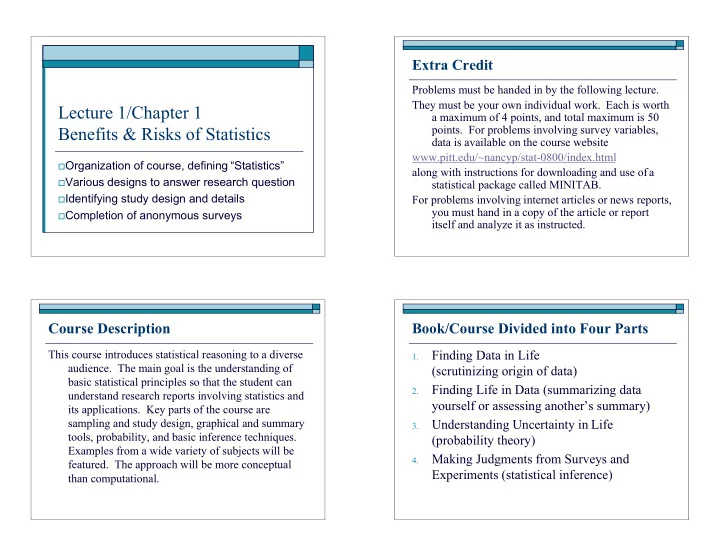
Extra Credit Problems must be handed in by the following lecture. They must be your own individual work. Each is worth Lecture 1/Chapter 1 a maximum of 4 points, and total maximum is 50 points. For problems involving survey variables,


slide-1
SLIDE 1

Lecture 1/Chapter 1 Benefits & Risks of Statistics

Organization of course, defining “Statistics” Various designs to answer research question Identifying study design and details Completion of anonymous surveys

Extra Credit

Problems must be handed in by the following lecture. They must be your own individual work. Each is worth a maximum of 4 points, and total maximum is 50

  • points. For problems involving survey variables,

data is available on the course website www.pitt.edu/~nancyp/stat-0800/index.html along with instructions for downloading and use of a statistical package called MINITAB. For problems involving internet articles or news reports, you must hand in a copy of the article or report itself and analyze it as instructed.

Course Description

This course introduces statistical reasoning to a diverse

  • audience. The main goal is the understanding of

basic statistical principles so that the student can understand research reports involving statistics and its applications. Key parts of the course are sampling and study design, graphical and summary tools, probability, and basic inference techniques. Examples from a wide variety of subjects will be

  • featured. The approach will be more conceptual

than computational.

Book/Course Divided into Four Parts

1.

Finding Data in Life (scrutinizing origin of data)

2.

Finding Life in Data (summarizing data yourself or assessing another’s summary)

3.

Understanding Uncertainty in Life (probability theory)

4.

Making Judgments from Surveys and Experiments (statistical inference)

slide-2
SLIDE 2

Definitions

Variable: a characteristic that varies from one

individual to another

Statistics: the science of principles and

procedures for gaining and processing data (info about variables’ values for a sample) and using the info to draw general conclusions

Statistics: summaries of data (such as a

sample average or sample proportion)

Example: Research study design

Background: Researchers want to determine

if sugar can cause hyperactivity in children.

Question: Is there a single best way to gather

information?

Response:

Example: Sugar hyperactivity? Design #1

Background: To determine if sugar can

cause hyperactivity in children, a researcher could ask 5 people about their child’s sugar intake and whether he/she has ADHD.

Question: Is this a good design? Response:

Example: Sugar hyperactivity? Design #2

Background: To determine if sugar can

cause hyperactivity in children, a researcher could ask 50 acquaintances about their child’s sugar intake and whether he/she has ADHD.

Question: Is this a good design? Response:

slide-3
SLIDE 3

Definitions (ways to gather data)

Anecdotal evidence: Personal accounts,

usually by a few individuals selected haphazardly or by convenience.

Observational study: Researchers observe

what happens naturally in terms of variables

  • f interest.

Experiment: Researchers take control of

values of one variable to see how it affects values of another variable

Example: Sugar hyperactivity? Design #3

Background: To determine if sugar can cause

hyperactivity in children, a researcher could conduct an observational study: obtain a random sample of 50 families, record children’s sugar intake and whether they have ADHD.

Question: Suppose this study shows that ADHD is

more likely to occur in children with high sugar

  • intake. Can we conclude sugar causes

hyperactivity?

Response:

Example: Sugar hyperactivity? Design #3

Background: To determine if sugar can cause

hyperactivity in children, a researcher could conduct an observational study. Suppose it shows that ADHD is more likely to occur in children with high sugar intake.

Question: What other explanations are possible,

besides sugar causing hyperactivity?

Response: Other factors that can play a role:

Example: Sugar hyperactivity? Design #4

Background: To determine if sugar can

cause hyperactivity in children, a researcher could select 50 families; assign a low-sugar diet to some, high-sugar to others. Then evaluate children’s activity.

Question: Why is this an experiment, not an

  • bservational study?

Response:

slide-4
SLIDE 4

Example: Sugar hyperactivity? Design #4

Background: To determine if sugar can

cause hyperactivity in children, a researcher could select 50 families; assign a low-sugar diet to some, high-sugar to others. Then evaluate children’s activity.

Question: Should assignment of diets be done

by asking for volunteers?

Response:

Example: Sugar hyperactivity? Design #4

Background: To determine if sugar can

cause hyperactivity in children, a researcher could select 50 families; randomly assign a low-sugar diet to some, high-sugar to others. Then evaluate children’s activity.

Question: Should subjects know if they’re

getting low or high sugar levels?

Response:

Definitions

The placebo effect is when subjects respond to the

idea of treatment, not the treatment itself.

A placebo is a “dummy” treatment. A blind subject is unaware of which treatment

he/she is receiving.

The experimenter effect is biased assessment of

(or attempt to influence) response, due to knowledge

  • f treatment assignment.

A blind experimenter is unaware of which treatment

a subject has received.

Example: Sugar hyperactivity? Design #4

Background: To determine if sugar can

cause hyperactivity in children, a researcher could select 50 families; randomly assign a low-sugar diet to some, high-sugar to others. Then evaluate children’s activity.

Question: What would be an appropriate

placebo treatment to compare to a diet with high amounts of sugar?

Response:

slide-5
SLIDE 5

Example: Sugar hyperactivity? Design #4

Background: Suppose an experiment finds a

higher proportion hyperactive among children randomly assigned to high-sugar (vs. artificially sweetened) foods.

Question: Can we conclude that sugar causes

hyperactivity?

Response:

GREAT NEWS! Town Confirms Oatmeal Can Help Lower Cholesterol 100 people in Lafayette, Colorado volunteered to eat a good-sized bowl of oatmeal for 30 days to see if simple lifestyle changes---like eating oatmeal---could help reduce cholesterol.

  • After 30 days, 98 lowered their cholesterol.
  • With these great results, the people in Lafayette proved to

themselves that simple changes can make a real difference. GREAT NEWS!

Example: Reviewing Study Design Issues

  • Background: Consider Quaker Oats study.
  • Questions:

1.

Was this an observational study or experiment?

2.

Was the sample size large enough?

3.

Was there a random assignment of treatments?

4.

Are the study’s results convincing?

  • Responses:
  • 1. 2.

3. 4.

Articles that appear at the end of a lecture are to be read for homework, before the next lecture, and brought to class as reference for discussions. These are especially important for your understanding of the material in the first part of the course.

GREAT NEWS! Town Confirms Oatmeal Can Help Lower Cholesterol 100 people in Lafayette, Colorado volunteered to eat a good-sized bowl of oatmeal for 30 days to see if simple lifestyle changes---like eating oatmeal---could help reduce cholesterol.

  • After 30 days, 98 lowered their cholesterol.
  • With these great results, the people in Lafayette proved to

themselves that simple changes can make a real difference. GREAT NEWS!

slide-6
SLIDE 6

SUGAR SWEETER ON CHILDREN Researchers testing the effects of diets rich in sugar and Nutrasweet, an artificial sweetener, have concluded that neither substance produces any changes in children's behavior. The study, to be published in today’s New England Journal of Medicine, is the latest to debunk the widely held belief that sugar can make some children hyperactive. In tests of 48 children, all of whom were described by their parents as being sensitive to sugar, researchers gave the youngsters diets rich in sugar, Nutrasweet (trade name for aspartame) or another artificial sweetener,

  • saccharin. They then monitored the children for changes in behavior.

The children or their families did not know which diets they were receiving and the diets were kept free of additives, artificial food coloring and preservatives. After three weeks on each diet, “there were no significant differences” in the behavior or mental abilities of any of the children, the study found. Twenty-three of the youngsters in the study group were between 6 and 10 years old. The rest were of preschool age. The team, led by Dr. Mark Wolraich of Vanderbilt University in Nashville, Tenn., said the type of sweetener used had no impact, though the older children were selected for the tests because their parents believed them to be sensitive to sugar.

MUSIC AND MATH SCORES Second grade students who took piano lessons for four months scored significantly higher on math than children who did not, according to a study in the journal Neurological Research. Piano instruction helps to “hardwire the brain in such a way that children are better able to visualize and transform objects in space and time,” said Dr. Gordon Shaw, a University of California-Irvine emeritus physics professor. Playing music involves mathematical concepts such as counting time, understanding intervals, ratios, fractions and proportions. Musical training appears to help children to grasp concepts basic to proportional math. COUCH POTATO NATION A new report by the federal Centers for Disease Control and Prevention finds that physical inactivity plagues all areas of the United States, particularly rural areas and the South. The study analyzed responses from 119,000 people who were asked about their physical activity during the month prior to the survey. Overall, nearly 30% of adults aged 18 and older reported being inactive. Rates of physical inactivity were highest in towns with populations of 2,500 people or less. In these areas, 37% of respondents reported being physically inactive in the previous month. By comparison, 27% of those living in urban areas of 1 million or more people reported being inactive. “This report clearly shows us that our nation needs to become more physically active to reduce the needless morbidity and mortality associated with physically inactive lifestyles,” said Donna

  • E. Shalala, secretary of the Dept. of Health and Human Services.

Engaging in moderate physical activity 5 or more days a week “will help reduce chronic disease, such as heart disease, diabetes, high blood pressure and colon cancer,” Shalala said. FAMILY DINNERS BENEFIT TEENS Eating dinner together as a family is one way of keeping teen-agers well adjusted and out

  • f trouble, a new study shows.

Adjusted teens---who were less likely to take drugs or be depressed and were more motivated at school and had better peer relationships---ate with their families an average of five days a week; nonadjusted teens ate with their families only three days a week, according to the study presented at last week’s American Psychological Association’s convention in Chicago. Family mealtimes, researchers said, appear to play an important role in helping teens deal with adolescence.

slide-7
SLIDE 7

TALL TALE? A study suggests that spring babies have more stature Parents shouldn’t blame the height or shortness of their children on genetics---or vitamins, for that matter. Researchers at the University of Vienna, in a study of a half million male soldiers, found a correlation between their heights and the months in which they were born. Spring babies were taller, by 0.23 of an inch, than those born in the fall. The scientists’ findings were reported in the journal Nature. Why should stature depend on the time of birth? The researchers aren’t certain, but think it may have something to do with exposure to sunlight and the activity of the pineal gland. If parents want their offspring to be taller than they might

  • therwise be, they’ll have to plot their Happy Birthdays for the
  • spring. But we doubt that even parents with their eye on the

NBA will care about an extra quarter of an inch. MEN, BEER, AND LUNG CANCER Heavy beer drinking may raise the risk of lung cancer among men, a study shows. But men who drink red wine may actually lower their risk of developing the

  • disease. In a study that included data from more than 28,000 men

and women, researchers concluded that men who drank 21 to 41 beers or shots of hard liquor per week increased their risk of developing lung cancer by 23%. Consuming more than 41 beers

  • r alcoholic beverages other than wine raised the risk by 57%,

according to the report in the American Journal of Epidemiology. Several earlier reports have linked high alcohol consumption to

  • ther types of cancer, noted lead author Eva Prescott, a

researcher at the Copenhagen Center for Prospective Population Studies in Denmark. It’s possible that alcohol or one of its byproducts, such as acetaldehyde, is carcinogenic, she said. But wine may have a protective effect. Men who drank one to 13 glasses of wine per week reduced their risk of lung cancer by 22%, while those who drank more than 13 glasses per week reduced their risk by 56%. RED WINE, WITH A CAVEAT A panel of physicians is urging doctors to downplay the potential heart healthy effects of red wine and encourage patients to exercise and eat more fruits and vegetables. The appealing idea that red wine can protect against heart disease has gained currency thanks to studies showing a lower rate of heart disease among people who regularly drink moderate amounts of wine. But it remains unclear whether components in wine or the heart- healthy lifestyles of wine lovers are behind this boost in cardiac protection, say researchers writing in the Jan. 23 issue of Circulation, a journal of the American Heart Association. Wine drinkers, for example, tend to be thinner, to exercise more and to drink with meals, all of which may help remove artery- clogging fats from their bloodstreams, they explain. Exercise can boost HDL or “good” cholesterol levels more than red wine and fruits and vegetables contain even greater amounts of antioxidants than a glass of wine. THE CHOCOLATE HEADACHE MYTH If you suffer from chronic headaches or migraines, you don’t need to stay away from chocolate this Valentine’s Day.

  • Dr. Dawn A. Marcus of the University of Pittsburgh Medical

Center headed a recent study examining the onset of headaches---migraine, tension and combined migraine-tension headaches---and found chocolate is not the culprit. Chocolate has been thought to be a headache-producer because it contains amines, chemicals that affect the blood

  • vessels. Other amines-filled foods are peanuts, citrus fruits,

alcohol and cheese. But Marcus and her colleagues found that half the study participants, who ate large samples of chocolate and carob, said they had no headaches within 12 hours after eating. The headaches may be caused from combining chocolate with

  • ther foods, Marcus suggested. Moreover, stress or

premenstrual hormone shifts, which can cause headaches, are sometimes preceded by cravings for sweets.