
SLIDE 1
Chelsea Finn
Learning to Adapt to Dynamic, Real- World Environments
Google Brain UC Berkeley Stanford
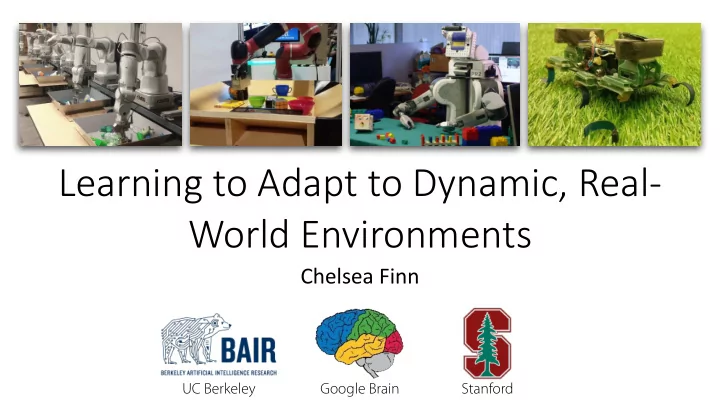
Learning to Adapt to Dynamic, Real- World Environments Chelsea Finn - - PowerPoint PPT Presentation
Learning to Adapt to Dynamic, Real- World Environments Chelsea Finn UC Berkeley Google Brain Stanford Savva et al. 19 Photorealistic simulators The real world is unmatched. Unmatched rich, multi-agent interactions diversity in terms of
Google Brain UC Berkeley Stanford
Can robots learn something from simulation that can help them adapt quickly?
Unmatched in terms of: diversity rich, multi-agent interactions fidelity messiness Photorealistic simulators
Savva et al. ‘19
Randomization
Sadeghi et al. RSS ‘17
Real world will always require some amount of adaptation.
The real world is unmatched.
Quick primer on few-shot meta-learning Challenges in applications to robotics: Meta-learning across families
Rapid, online adaptation to drastic changes in dynamics Can robots learn something from simulation that can help them adapt quickly? from other data from past experience Adaptability is important, regardless of whether you are using simulation.
Given 1 example of 5 classes: Classify new examples
meta-training training classes
… …
held-out classes
5-way, 1-shot image classifica5on (MiniImagenet) regression, reinforcement learning, any ML problem Can replace image classificaCon with:
diagram adapted from Duan et al. ‘17
Given a small amount of experience Learn to solve a task By learning how to learn many other tasks:
Inputs: Outputs:
Inputs: Outputs: Data: Data: Why is this view useful? Reduces the problem to the design & optimization of f.
Recurrent network
(LSTM, NTM, Conv)
Santoro et al. ’16, Duan et al. ’17, Wang et al. ’17, Munkhdalai & Yu ’17, Mishra et al. ’17, …
Snell et al. ‘17 Vinyals et al. ‘16
Hochreiter et al. ’01 Andrychowicz et al. ’16
Li & Malik ‘16 Santoro et al. ’16 Ravi & Larochelle ‘17
and many many more approaches
+ expressive, general + applicable to range of problems
Tenenbaum ’99 Fei-Fei et al. ’05 Lake et al. ‘11
Key idea: Train over many tasks, to learn parameter vector θ that transfers
training data for new task pretrained parameters
[test-time]
Finn, Abbeel, Levine. Model-Agnostic Meta-Learning for Fast Adaptation of Deep Networks. ICML ‘17
Finn, Abbeel, Levine. Model-Agnostic Meta-Learning for Fast Adaptation of Deep Networks. ICML ‘17
two tasks: running backward, running forward
excellent “meta-test-time” learning efficiency but how long did it take to meta-train? Finn et al., Model-Agnostic Meta-Learning. ‘17 100s of millions of steps (about one month if it was in real time…)
Rakelly*, Zhou*, Quillen, Finn, Levine. Efficient Off-Policy Meta-Reinforcement learning via Probabilistic Context Variables
Rakelly*, Zhou*, Quillen, Finn, Levine. Efficient Off-Policy Meta-Reinforcement learning via Probabilistic Context Variables
Idea 1: use stochastic latent context to represent task-relevant knowledge
encapsulates information policy needs to solve current task models our uncertainty about how the task should be solved (turns out to be crucial for exploration) Rakelly*, Zhou*, Quillen, Finn, Levine. Efficient Off-Policy Meta-Reinforcement learning via Probabilistic Context Variables
Rakelly*, Zhou*, Quillen, Finn, Levine. Efficient Off-Policy Meta-Reinforcement learning via Probabilistic Context Variables
Idea 1: use stochastic latent context to represent task-relevant knowledge Idea 2: use efficient off-policy model-free RL for meta-training
Primer on few-shot meta-learning Can robots learn something that can help them adapt quickly? Challenges in applications to robotics: Rapid, online adaptation to drastic changes in dynamics Meta-learning across families
Primer on few-shot meta-learning Can robots learn something that can help them adapt quickly? Challenges in applications to robotics: Rapid, online adaptation to drastic changes in dynamics Meta-learning across families
Space of manipulation tasks
Goal: Learn a new variation of one of these task families with a small number of trials & sparse rewards Problem: Robot will have to explore every possible task. This work: Can we learn from one demonstration & a few trials?
Zhao, Jang, Kappler, Herzog, Khansari, Bai, Kalakrishnan, Levine, Finn. Watch-Try-Learn. ‘19
(to convey the task) (to figure out how to solve it)
Watch one task demonstration Try task in new situation Learn from demo & trial to solve task
Can we learn from one demonstration & a few trials? How can we train for this in a scalable way?
[batch off-policy collection]
Zhao, Jang, Kappler, Herzog, Khansari, Bai, Kalakrishnan, Levine, Finn. Watch-Try-Learn. ‘19
: demo + trial(s)
Compare:
Reinforcement learning from BC initialization requires 900 trials to match performance of WTL. Qualitative examples Quantitative results demo trial 1 trial 2 sliding grasping
Primer on few-shot meta-learning Can robots learn something that can help them adapt quickly? Challenges in applications to robotics: Rapid, online adaptation to drastic changes in dynamics Meta-learning across families
motor malfunction gradual terrain change
Nagabandi*, Clavera*, Liu, Fearing, Abbeel, Levine, Finn. Learning to Adapt in Dynamic Real-World Environments through Meta-RL
time
motor malfunction gradual terrain change
tasks are temporal slices of experience
Nagabandi*, Clavera*, Liu, Fearing, Abbeel, Levine, Finn. Learning to Adapt in Dynamic Real-World Environments via Meta-RL. ICLR ‘19
Nagabandi*, Clavera*, Liu, Fearing, Abbeel, Levine, Finn. Learning to Adapt in Dynamic Environments through Meta-RL. ICLR ‘19
gradient descent
Nagabandi*, Clavera*, Liu, Fearing, Abbeel, Levine, Finn. Learning to Adapt in Dynamic Environments through Meta-RL. ICLR ‘19
Meta-train on variable terrains Meta-test with slope, missing leg, payload, calibration errors
Meta-train on variable terrains Meta-test with slope, missing leg, payload, calibration errors
Nagabandi*, Clavera*, Liu, Fearing, Abbeel, Levine, Finn. Learning to Adapt in Dynamic Environments through Meta-RL. ICLR ‘19
with MAML (ours) model-based RL (no adaptation)
Meta-train on variable terrains Meta-test with slope, missing leg, payload, calibration errors
Nagabandi*, Clavera*, Liu, Fearing, Abbeel, Levine, Finn. Learning to Adapt in Dynamic Environments through Meta-RL. ICLR ‘19
model-based RL (no adaptation) with MAML (ours)
Can robots learn something that can help them adapt quickly? Quick primer on few-shot meta-learning
(and it’s extension to RL)
Challenges in applications to robotics: Adapt to new vision-based manipulation task
from only 1 demo & 1 trial
Adapt online to drastic changes in dynamics Key takeaway: Leverage previous data to optimize for fast adaptation
What is simulators useful for: algorithm development What it is not useful for: autonomous learning without human expertise
Typical sim2real pipeline:
randomization parameters for that task
iterate
Defeats the point of reinforcement learning!
(the autonomous acquisition of a breadth of skills) Computer vision: design better features? Sim2Real Counterargument: We will design better and better simulators of the world Go: incorporate human gameplay? Machine translation: incorporate grammar?
Learning from data is what consistently wins. better performance in the long run (3+ yrs) short-horizon wins (~3 yr)
Papers, data, and code linked at: people.eecs.berkeley.edu/~cbfinn
Anusha Nagabandi Ignasi Clavera
Simin Liu Pieter Abbeel Sergey Levine Kate Rakelly Deirdre Quillen Aurick Zhou Eric Jang Allan Zhou Daniel Kappler Alex Herzog Paul Wohlhart Mohi Khansari Yunfei Bai Mrinal Kalakrishnan