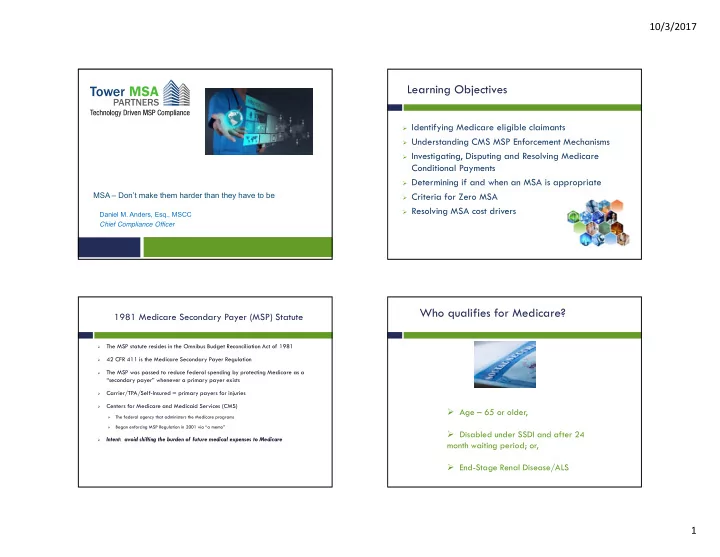
Learning Objectives Identifying Medicare eligible claimants - - PowerPoint PPT Presentation

learning objectives
SMART_READER_LITE
LIVE PREVIEW

Learning Objectives Identifying Medicare eligible claimants - - PowerPoint PPT Presentation

10/3/2017 Learning Objectives Identifying Medicare eligible claimants Understanding CMS MSP Enforcement Mechanisms Investigating, Disputing and Resolving Medicare Conditional Payments Determining if and when an MSA is appropriate


slide-1
SLIDE 1

10/3/2017 1

MSA – Don’t make them harder than they have to be

Daniel M. Anders, Esq., MSCC Chief Compliance Officer

  • Identifying Medicare eligible claimants
  • Understanding CMS MSP Enforcement Mechanisms
  • Investigating, Disputing and Resolving Medicare

Conditional Payments

  • Determining if and when an MSA is appropriate
  • Criteria for Zero MSA
  • Resolving MSA cost drivers

Learning Objectives

1981 Medicare Secondary Payer (MSP) Statute

  • The MSP statute resides in the Omnibus Budget Reconciliation Act of 1981
  • 42 CFR 411 is the Medicare Secondary Payer Regulation
  • The MSP was passed to reduce federal spending by protecting Medicare as a

“secondary payer” whenever a primary payer exists

  • Carrier/TPA/Self-Insured = primary payers for injuries
  • Centers for Medicare and Medicaid Services (CMS)
  • The federal agency that administers the Medicare programs
  • Began enforcing MSP Regulation in 2001 via “a memo”
  • Intent: avoid shifting the burden of future medical expenses to Medicare

Who qualifies for Medicare?

4

  • Age – 65 or older,
  • Disabled under SSDI and after 24

month waiting period; or,

  • End-Stage Renal Disease/ALS
slide-2
SLIDE 2

10/3/2017 2 MSP Compliance Requires Three Major Focuses

  • The Past:
  • Reimbursement of Conditional Payments (Medicare Lien)
  • The Present:
  • Medicare Medicaid SCHIP Extension Act (MMSEA) (The Treasure

Map)

  • The Future:
  • Medicare Set Asides (MSA): Allocation of Money for future

treatment

CMS MSP Enforcement Structure

Workers’ Compensation Review Contractor (WCRC) 10 CMS Regional Offices 6 Benefits Coordination & Recovery Center (BCRC) Commercial Repayment Center (CRC)

Section 111 Mandatory Insurer Reporting

What is Mandatory Insurer Reporting?

  • The purpose of Section 111 reporting is to enable CMS to pay

appropriately for Medicare-covered items and services furnished to Medicare beneficiaries.

  • Section 111 NGHP (Non-Group Health

Plan) reporting of applicable liability insurance (including self-insurance), no-fault insurance, and workers’ compensation claim information helps CMS determine when other insurance coverage is primary to Medicare. Mandatory Insurer Reporting allows Medicare to ‘follow the money’……

slide-3
SLIDE 3

10/3/2017 3 When Should Data Be Reported?

  • Reporting trigger events:
  • Accept Ongoing Responsibility for Medical (ORM)
  • Change to claim, injury or demographic information
  • Termination of ORM
  • Total Payment Obligation to Claimant (TPOC)

Why Section 111 Reporting Matters to You

  • Information provided to CMS through ORM or TPOC will have an

effect on conditional payment resolution process and WCMSA review process.

  • If an RRE has reported an ICD-9 /ICD-10 as part of ORM, any payments

made by Medicare for such ICDs will be considered conditional payments.

  • Even if such codes were not related to the claim,

CMS will seek reimbursement from either the primary payer or applicable plan pre-settlement,

  • r from the beneficiary or his counsel

post-settlement.

  • If an RRE reports ICD-9 or ICD-10 as part of ORM
  • r TPOC, and an MSA is submitted to CMS for

approval, such codes may be included in the MSA.

  • Even if such codes were not related to the claim,

but were mistakenly reported, CMS may include such future treatment in the MSA.

  • Align S111 reporting with claims management execution
  • Report only accepted ICD10 codes
  • Modify ORM immediately when injuries / body parts are denied to

remove denied ICD10 codes

  • Review edit / error reports and make corrections ASAP
  • Verify TPOCs are reported as soon as possible
  • Ensure Recovery Agent is aware of responsibility

Best Practices – Section 111 Reporting

  • RREs can no longer look at Section 111 in isolation

Medicare’s Past Interest - Conditional Payments

slide-4
SLIDE 4

10/3/2017 4

What Are Conditional Payments?

  • 42 CFR §411.21 defines a conditional payment as a

Medicare payment for services/treatment for which another payer is responsible or may have an obligation to pay.

  • A primary payer must reimburse

Medicare for conditional payments Medicare has been made when:

  • Claim is settled
  • Indemnity is settled and medicals are left open,
  • RRE reports acceptance of ORM via MMSEA Section 111

Mandatory Insurer Reporting (MIR).

14

When are conditional payments made?

Improper billing by provider Denied claim by primary payer Other insurance presented by the claimant Improper Coordination of Benefits

15

Recovery Methods and Exposure

  • Direct Recovery: Demand from CMS via Contractors
  • Interest Accrual
  • Referral to U.S. Department of Treasury
  • Lawsuit for Double-Damages
  • Private Cause of Action Lawsuit

16

Commercial Repayment Center - CRC

  • As of 10/5/2015, identifies and recovers conditional

payments for all new* recovery cases where CMS pursues recovery directly from an applicable plan as the identified debtor. (Workers’ compensation, liability and no-fault claims)

  • CRC also oversees a separate Group Health Plan

recovery program

  • CRC contract currently held by CGI Federal

*Note on definition of “new”

slide-5
SLIDE 5

10/3/2017 5

What is CRC’s Recovery Process?

Employer/Insurer Reports ORM Conditional Payment Notice issued Dispute 30 days from CPN date Demand/ Initial Determination (120 days to appeal – Interest begins to accrue after 60 days) Pay/Appeal Failure to Respond (Intent to Refer Letter 90 days after Demand) Referral to Treasury (150 days after Demand) 18

Examples of CP Correspondence: No-Claims Paid

  • No Claims Paid Letter: From CRC - an indication that Medicare currently has not

made any conditional payments as of date of letter.

19

Examples of Correspondence: CPN/SOR

  • Statement of Reimbursement(SOR): From CRC – Lists contended conditional

payments made by Medicare.

20

Examples of Correspondence: Demand

  • Demand – Request for repayment; 60 days to repay or interest may accrue;

appeal rights.

slide-6
SLIDE 6

10/3/2017 6

21

Examples of Correspondence: ITR

  • Intent to Refer – Delinquent demand – can come from CRC or BCRC.

 Initial Determination or Demand Letter advises debtor

(applicable plan in this case) of the amount owed to Medicare and requests reimbursement within 60 days. A courtesy copy is sent to the plan’s recovery agent, the beneficiary and the beneficiary’s attorney or other

  • representative. The demand letter includes the following:
  • The beneficiary’s name and HICN;
  • Date of accident/incident;
  • A claims listing of all related claims paid by Medicare for which

Medicare is seeking reimbursement from the plan;

  • The total demand amount (amount of money owed) and information on

administrative appeal rights.

  • Options: Pay or Appeal. Do not ignore.

Initial Determination Letter from CRC

23

Bases for Disputing or appealing

  • Policy limits exhaustion (No-fault)
  • Causation

– Treatment is unrelated to the claimed injury – Judicial decision has found the treatment unrelated

  • r not reasonable or necessary.

– Statutory process has found the treatment to not be reasonable or necessary. – Case has been completely denied.

  • Important, with a CPN there is only 30 days from the

date on the Notice to submit a dispute.

1

Redetermination – Must be requested within 120 days of the Initial Determination (Appeal handled by the Commercial Repayment Center)

2

  • Reconsideration – Must be requested within 180 days of receipt of the

Redetermination (Appeal handled by Qualified Independent Contractor)

3

  • Administrative Law Judge (ALJ) hearing – Must be requested within 60

days of receipt of Reconsideration determination

4

  • Departmental Appeals Board (DAB) – Must be requested within 60 days
  • f ALJ decision

5

  • Federal Court Review – Must be filed within 60 days of DAB decision

Appeals Process

slide-7
SLIDE 7

10/3/2017 7

 Confirmation Letter: If the CRC receives payment in full, it will issue

a letter stating that the specified debt has been resolved. The letter will also note that new cases may be created if the applicable plan maintains ORM or the CRC receives information on additional items

  • r services paid by Medicare during the period of ORM.

 Interest: Interest on the debt accrues from date of the demand letter

and, if the debt is not resolved within 60 days, is assessed for each 30 day period the debt remains unresolved.

 Recovery put on hold pending appeal: If plan requests an appeal,

the debt will not be referred to the Department of Treasury while the appeal is being processed, but interest will continue to accrue.

 Pay while on appeal: The applicable plan may choose to pay the

demand amount while appealing to avoid the accrual and assessment of interest.

 Interest calculator available on CMS website

Payment to CRC + Interest Accrual

26

Treasury Department Debt Collection Activities

  • Internal

– Demand Letters – Telephone calls – Treasury Offset Program (TOP) – Administrative wage garnishment – Credit bureau reporting

  • External

– Private Collection Agencies (PCAs)

Best Practices - Conditional Payments

  • Update claim ICD-9 / ICD-10 codes immediately when denials occur.
  • Make certain all claims are reported to BCRC.
  • Treat CP Letters & CP Notices the same. Dispute immediately…. Don’t wait for

Demand/Initial Determination Letter.

  • Identify unauthorized treatment / unrelated illnesses & injuries.
  • Accept only compensable injury(ies).
  • Exclude pre-existing / co-morbid conditions.
  • Determine if claimant claimed that injury

exacerbated or aggravated the condition.

  • Determine whether claimant alleged that injury or

condition was caused or worsened as a result of the accident/incident/exposure.

  • Determine obviously unrelated conditional

payments and compare to what is contained in the medical records.

  • Review settlement language to see what injuries, if any, were specifically released
  • r whether release is a general release of any and all injuries.

Protecting Medicare’s Future Interest - WCMSA

slide-8
SLIDE 8

10/3/2017 8 Do you need an MSA to settle your WC claim – Key Considerations

Is medical being settled? Has claimant applied for Social Security Disability

  • r 62 ½ or older?

Is claimant

  • therwise

Medicare eligible? Settlement Amount? Above or below CMS MSA Review Thresholds?

CMS Submission and Review Thresholds

  • Why seek CMS approval?
  • The ‘certainty’ associated with CMS’s approval of amount

“If the parties to a WC settlement do not receive CMS approval, CMS is not bound by the amount stipulated by the parties, and it may refuse to pay for claim-related medical expenses, even if the services would have normally been covered by Medicare” (WCMSA Reference Guide version 2.5, April 2016)

  • CMS review thresholds
  • Claimant is a Medicare beneficiary and total settlement amount

is greater than $25,000.00; or

  • Claimant has a reasonable expectation of Medicare enrollment

within 30 months of settlement date and anticipated total settlement amount for future medical expenses and disability/lost wages over the life or duration of the settlement agreement is expected to be greater than $250,000.00

  • What if settlement is below review thresholds?

Documents required for MSA Completion and Submission

 Documents required to complete MSA Report  Completed referral form (online, faxed or mailed)  Medical records and Rx histories for the last 2 years.  Payment history for the last 2 years  Claimant’s Medicare or Social Security Disability status (if available or we will

investigate)

 Any court orders or judicial determinations  If submission to CMS is requested:  Executed Consent to Release form  Method of funding: Lump or Annuity  Method of administering: Self or Professional  Estimated settlement amount  Draft or final settlement documents

MSA Preparation & Mitigation Strategies

slide-9
SLIDE 9

10/3/2017 9

 Zero MSA – Claim denial: Claim denied

in entirety and no medical/indemnity payments or settlements

 Zero MSA – Medical basis: Treating

physician opines in writing that future care is not required for WC injury

 Zero MSA – Judicial decision: Judicial

decision or court order based on merits of the case, outlines insurer has no responsibility for future medical care on accepted body part

Zero MSAs

Best Practice – Identify Obstacles Before MSA

  • Index early / often – Intervene – don’t wait for MSA
  • Identify / address denied body parts – remove unrelated ICD-10 codes
  • Address spinal cord stimulator (SCS) recommendations1
  • Used only as late/last resort for chronic, intractable pain
  • All other pharma, surgical, medical, psychological – failed
  • Claimant must be screened– Psych / Neuro evaluation
  • Must prove demonstrable pain relief - trial
  • Address surgical recommendations
  • Leverage state jurisdictional options to

challenge necessity

  • Pharmacy – Identify PBM triggers
  • Challenge compound topical medications
  • Identify multiple prescribers
  • Morphine equivalent dosage - > 90 MG
  • Challenge inappropriate treatment via jurisdictional options
  • Block discontinued medications when changes are made

1Medicare National Coverage Determination (NCD)-Electrical Nerve Stim (160.7)

CMS Review Potential Outcomes

Once submitted, CMS will generate the following letters: Once submitted, CMS will generate the following letters:

Receipt acknowledgment Receipt acknowledgment Below threshold Below threshold Development Development Denial Denial Zero set aside Zero set aside Approval Approval Closeout – docs not received from claimant timely Closeout – docs not received from claimant timely

CMS WCMSA Re-Reviews

  • When to consider re-review
  • If you think CMS has made
  • bvious mistakes
  • Math errors
  • Fee schedule errors
  • You have additional evidence, not previously considered

by CMS which was dated prior to the submission.

  • New policy: MSA was submitted to CMS in the past one to

four years and a new MSA would result in a change to the prior MSA approval of $10,000 or 10%, whichever is greater.

slide-10
SLIDE 10

10/3/2017 10 Best Practices - Protecting Medicare’s & Your Interests

  • Start with the right physician – Identify doctors who deliver the best outcomes
  • don’t settle.
  • Report only covered ICD codes (S111) / remove denied body parts ASAP.
  • Be proactive to address CP Letters / CP Notices – Send to Tower ASAP.
  • Be proactive to address surgical, SCS, injection recommendations

immediately - don’t wait for MSA.

  • Leverage state jurisdictional options to enforce

compliance.

  • Be aware of gaps in treatment – CP exposure
  • Obtain written agreement & track progress – remain involved through

treatment modification.

  • Ensure that you obtain CMS accepted language to document change
  • Report ORM termination / TPOC ASAP.

Questions?

Contact Information: Daniel M. Anders Chief Compliance Officer (Direct) (847) 946-2880 Daniel.anders@towermsa.com