Learning Objectives Compounding Sterile Preparations 1. To - - PDF document

learning objectives
SMART_READER_LITE
LIVE PREVIEW

Learning Objectives Compounding Sterile Preparations 1. To - - PDF document

10/4/2014 Learning Objectives Compounding Sterile Preparations 1. To challenge current practices in your sterile preparations areas by becoming aware of Learning from Past Mistakes to recent compounding errors in the USA that have resulted in


slide-1
SLIDE 1

10/4/2014 1

Catherine Cone, PharmD, BCPS, PhC

Compounding Sterile Preparations Learning from Past Mistakes to Prevent Future Ones – A Review of USP <797>

Learning Objectives

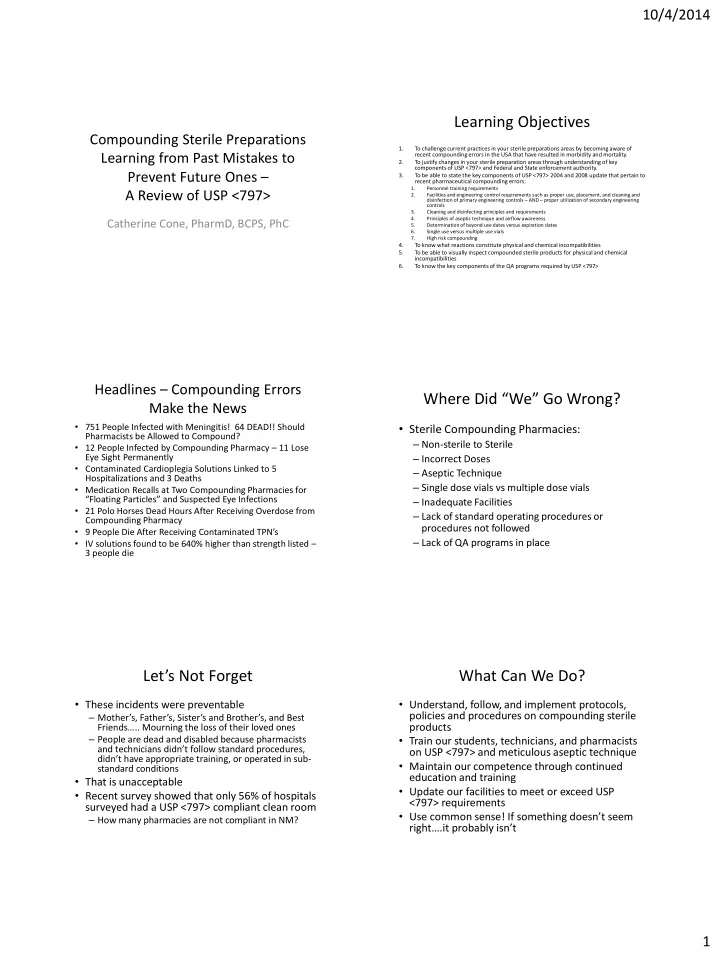
1. To challenge current practices in your sterile preparations areas by becoming aware of recent compounding errors in the USA that have resulted in morbidity and mortality. 2. To justify changes in your sterile preparation areas through understanding of key components of USP <797> and Federal and State enforcement authority. 3. To be able to state the key components of USP <797> 2004 and 2008 update that pertain to recent pharmaceutical compounding errors:

1. Personnel training requirements 2. Facilities and engineering control requirements such as proper use, placement, and cleaning and disinfection of primary engineering controls – AND – proper utilization of secondary engineering controls 3. Cleaning and disinfecting principles and requirements 4. Principles of aseptic technique and airflow awareness 5. Determination of beyond use dates versus expiration dates 6. Single use versus multiple use vials 7. High risk compounding

4. To know what reactions constitute physical and chemical incompatibilities 5. To be able to visually inspect compounded sterile products for physical and chemical incompatibilities 6. To know the key components of the QA programs required by USP <797>

Headlines – Compounding Errors Make the News

  • 751 People Infected with Meningitis! 64 DEAD!! Should

Pharmacists be Allowed to Compound?

  • 12 People Infected by Compounding Pharmacy – 11 Lose

Eye Sight Permanently

  • Contaminated Cardioplegia Solutions Linked to 5

Hospitalizations and 3 Deaths

  • Medication Recalls at Two Compounding Pharmacies for

“Floating Particles” and Suspected Eye Infections

  • 21 Polo Horses Dead Hours After Receiving Overdose from

Compounding Pharmacy

  • 9 People Die After Receiving Contaminated TPN’s
  • IV solutions found to be 640% higher than strength listed –

3 people die

Where Did “We” Go Wrong?

  • Sterile Compounding Pharmacies:

– Non-sterile to Sterile – Incorrect Doses – Aseptic Technique – Single dose vials vs multiple dose vials – Inadequate Facilities – Lack of standard operating procedures or procedures not followed – Lack of QA programs in place

Let’s Not Forget

  • These incidents were preventable

– Mother’s, Father’s, Sister’s and Brother’s, and Best Friends….. Mourning the loss of their loved ones – People are dead and disabled because pharmacists and technicians didn’t follow standard procedures, didn’t have appropriate training, or operated in sub- standard conditions

  • That is unacceptable
  • Recent survey showed that only 56% of hospitals

surveyed had a USP <797> compliant clean room

– How many pharmacies are not compliant in NM?

What Can We Do?

  • Understand, follow, and implement protocols,

policies and procedures on compounding sterile products

  • Train our students, technicians, and pharmacists
  • n USP <797> and meticulous aseptic technique
  • Maintain our competence through continued

education and training

  • Update our facilities to meet or exceed USP

<797> requirements

  • Use common sense! If something doesn’t seem

right….it probably isn’t

slide-2
SLIDE 2

10/4/2014 2

United States Pharmacopeia (USP)

  • History

– Founded in 1820 – Legislation in 1848

  • Drug Import-Act made the USP the official compendium for the US

– Federal Food and Cosmetic Act in 1938

  • Gave USP the authority and responsibility via the FDA for standards of

strength, quality, purity, packaging, and labeling

  • Technically they (FDA) can investigate and potentially charge offenses

if USP is not followed

– However, they usually leave that to the states

  • Potentially relevant USP chapters include: <71> on sterility testing,

<85> on endotoxins, <788> on particulate matter, <797> on compounding sterile products, <1075> on good compounding practices, <1116> on microbiological evaluation, <1191> on stability considerations, <823> on radiopharm, and the upcoming <800> on chemotherapy

Chapter <797> - Purpose

To describe practices and conditions to prevent harm to individuals, including death to patients that could result from:

  • 1. Non-sterility
  • 2. Bacterial endotoxins
  • 3. Variability in intended strength of ingredients
  • 4. Physical and chemical contaminants
  • 5. Inappropriate quality of ingredients

Main Sections of <797>

  • Responsibilities of personnel
  • Compounded Sterile Preparations (CSPs) risk

levels

  • Personnel training and evaluation
  • Immediate use CSPs
  • Single dose vs. multiple dose
  • Hazardous drugs (USP <800> is the next

publication), radiopharmaceuticals, allergen extracts

  • Verification of CSPs

Main Sections of <797>

  • Quality control
  • Automatic compounding devices for parenteral

nutrition

  • Checks and tests on finished products
  • Storage and beyond use dating
  • Maintaining sterility, purity, and stability of

dispensed and distributed CSPs

  • Patient training
  • Patient monitoring and adverse event reporting
  • Quality assurance programs

USP <797>

Condensed into 4 main areas

  • 1. Compounding personnel: responsibilities in

implementation of USP <797>

  • 2. Facilities
  • 3. Compounding sterile preparations
  • 4. Quality assurance programs

21 Dead Polo Horses

slide-3
SLIDE 3

10/4/2014 3 Pharmacist Sent to Jail; Little Girls Loses Her Life

What do these last two cases have in common?

Eric Cropp Emily Jerry

Compounding Personnel

  • Must have adequate training including:

– Didactic training on USP <797> requirements

  • Proof: Written examination must be completed at least once yearly for non-hazardous

compounding; twice yearly with hazardous

– Hands-on (skills development)

  • Development of meticulous aseptic technique
  • Proof: Personnel must pass once yearly (non-hazardous) gloved fingertip touch testing,

media fill challenge testing, show competence in aseptic technique

  • Proof: Personnel must pass twice yearly (hazardous) gloved fingertip touch testing,

media fill challenge testing, show competence in aseptic technique

– Certified training through CNM for technicians – it’s the only technician training program that is currently certified in this state to my knowledge – At College of Pharmacy students use the American Society of Health System’s Pharmacy (ASHP) Compounding Sterile Preparations Video Guide and Workbook to Chapter <797> to learn didactic information

  • Student’s practice in a lab setting to develop compounding skills and aseptic technique

prior to being allowed to compound at a patient care facility

  • Student training is done over a 2 semester (2 X 16 weeks) period
  • Proof: Students must pass written USP <797> test, gloved fingertip touch test, and media

fill challenge test (they cannot proceed to rotations without passing)

Compounding Personnel

  • Basics of Aseptic Compounding – personnel

training should include:

– Proper aseptic technique(s) – Understanding of Laminar Airflow Hood (LAFH)

  • peration termed Primary Engineering Controls (PEC)

– Environmental controls termed Secondary Engineering Controls (SEC) – Filling and checking intravenous (IV) orders

  • Correct therapy, correct dosing, calculations, accuracy of fill,

ability to check for potential contamination or leaks, and labeling

  • Stress double checks prior to dispensing

Compounding Personnel

– Personnel hygiene and garbing

  • Personnel must wash hands with warm water and anti-

septic from hands to elbow for 30 seconds

– Nail pick and gentle scrub – Rinse and dry with lint free towel – Humans shed 106 skin cells per hour » Severe scrubbing increases skin cell shed – No artificial nails, make-up, piercings, outer-clothing, etc. should be worn in to the clean room areas

Compounding Personnel Compounding Personnel

  • The number one reason for virus/bacteria/

spores transfer to a patient is: TOUCH CONTAMINATION

  • To decrease touch contamination

– Thorough washing, garbing, and sanitizing is mandatory – Aseptic technique must be perfected

slide-4
SLIDE 4

10/4/2014 4

Compounding Personnel

  • Garbing for work in an IV consists of:

– Scrubs – Head cover – Face mask (+ beard cover if needed) – Gown – Booties (shoe covers) – Sterile gloves

  • Chemotherapy – if no sterile chemo gloves; most will double

glove with sterile glove on outside. Sterile chemo gloves are available at this time.

– Hand sanitizer can and should be used over gloves

  • Special cleaners do exist for use with gloves

Contamination

Infected eye after contaminated intravitreal injection Post mortem of a brain from one of the fungal meningitis patients

Example of Sterile Compounding Facility Set Up

Enter Here Buffer Area Pass-through Ante-room

Primary Engineering Control

Ante-room: garbing, hand washing, medications Buffer area: separates ante- room from the PEC Primary Engineering Control(s) - PEC Secondary Engineering Control(s) - SEC

Facilities

Environmental controls

  • Air Quality

– Classified according to number of particles per meter cubed of air in your ante-room, buffer area, and LAFH’s – PEC: LAFH’s and glove boxes must be tested at ISO Class 5 ISO Classification Levels – ISO 8 3,520,000/m3 – IS0 7 352,000/m3 – IS0 6 35,200/m3 – IS0 5 3,520/m3

Facilities

  • Environmental controls
  • Air Quality

– Classified according to number of particles per meter cubed of air in your ante-room, buffer area, and laminar airflow hoods (LAFH) – SEC: Typically, the surrounding room or “buffer area” must be tested at an ISO Class 7 ISO Classification Levels – ISO 8 3,520,000/m3 – IS0 7 352,000/m3 – IS0 6 35,200/m3 – IS0 5 3,520/m3

Facilities

  • Environmental controls
  • Air Quality

– Classified according to number of particles per meter cubed of air in your ante-room, clean room, and LAFH’s – SEC: Ante-room must be tested at an ISO Class 8 ISO Classification Levels – ISO 8 3,520,000/m3 – IS0 7 352,000/m3 – IS0 6 35,200/m3 – IS0 5 3,520/m3

slide-5
SLIDE 5

10/4/2014 5

Facilities

  • Non-hazardous compounding

– Secondary Engineering Controls - SEC

– Airflow from buffer area to ante-room must be positive pressure and flow at 0.02 to 0.05 inch water column pressure (you can get electronic devices to measure this) » If ante-room is not separated from buffer then the air velocity should reach 40 feet/minute across the line of demarcation from the buffer to designated ante room area – Air exchange should be set at 30/hour unless your LAFH can provide at least 15/hour, then your room air can be set as low as 15/hour Buffer Area

Passthrough

Anteroom

Primary Engineering Control

Facilities

  • Non-hazardous compounding (continued)

– Keep traffic flow to a minimum in these areas – Wipe all ingredients down with a disinfectant prior to entering buffer and PEC – NO SINKS allowed near PEC

  • Serratia Marcescens outbreak in TPNs

– 9 people died….

  • The ante-room sink should not be

located close to PEC and best further away from buffer area too

– No boxes or cartons located in SEC or PEC

Facilities

  • Hazardous Compounding
  • PEC should be a designed for comprehensive personnel

safety – a glove box or biologic safety cabinet for example

– Vented to outside only (must be HEPA filtered)

  • The buffer area should be ISO Class 7 negative pressure

with no less than 0.01 inch water column negative pressure separating ante-room

– Ante-room will be positive pressure relative to pharmacy and buffer area – If glove box is utilized outside a traditional buffer with ante- room set up other conditions must be met Buffer Area

Passthrough

Anteroom

Primary Engineering Control

Laminar Airflow Hoods (LAFH)

  • Three types

– Horizontal LAFHs – Vertical LAFHs (AKA biologic safety cabinets) – Compounding Aseptic Isolators (CAI) or Compounding Aseptic Containment Isolators (CACI)

  • Commonly referred to as glove boxes

Horizontal LAFH

Horizontal Laminar Airflow Hood

  • 1. Pre-filter
  • 2. Blower
  • 3. HEPA filter
  • 4. First air

1 2 3 4

Vertical LAFH (Biologic Safety Cabinet)

Vertical Laminar Airflow Hood

  • 1. Air intake (note 2 areas)
  • 2. Blower
  • 3. HEPA filter
  • 4. First air
  • 5. HEPA filtered air exhausted to
  • utside

1 2 3 4 5 1

slide-6
SLIDE 6

10/4/2014 6

Compounding Aseptic Isolator

CAI or CACI (i.e. glove box)

  • 1. Compartment to add

medications

  • 2. Gloves (to manipulate inside

“box”) Note: Airflow varies (flow control vs dilution control) 1 2

Facilities

Cleaning and Disinfecting

  • Cleaning

– What can be used to clean a LAFH?

  • Disinfecting

– What can we use to disinfect a LAFH?

Facilities

Cleaning and Disinfecting

  • Cleaning

– can be accomplished using either sterile water or sterile 70% isopropyl alcohol – Some medications dissolve in water and some in alcohol

  • Use the one that cleans up the spill
  • Disinfecting

– Sterile 70% isopropyl alcohol, bleach (chlorines), hydrogen peroxide, ammonium, phenolics, iodophors

  • Some recommend rotating disinfecting agents

Compounding Sterile Preparations

  • Factors to consider:

– Maintenance of equipment and environment

  • PEC and SEC controls

– Proper hand hygiene – Personal protective equipment – Aseptic technique

Compounding Sterile Preparations

  • Aseptic technique

– Critical site awareness

  • Needles, syringes, vials and ampules, admixture

(piggyback) bags

– What parts can you touch? What parts can’t you touch?!

– Airflow awareness

  • HEPA filter

– Is it vertical or horizontal hood? – Don’t ever block airflow; technique is essential and must be practiced

Compounding Sterile Preparations

  • Aseptic technique (continued)

– Infection and particle control

  • Wipe down supplies prior to entering buffer area
  • Disinfect ampules, vials, ports and allow to dry at least 30 seconds

– Drying effect lyses cell walls

  • Do not push syringe through outer wrapping/packaging

– Introduces particles into the compounding area

  • Do not remove hands from LAFH bench/first air

– If you do, you must re-sanitize!

– Ensure proper technique with vials or ampules

  • Bevel up to reduce coring through stoppers
  • Maintain proper pressure in vials
  • May use milking technique to pull solutions from vials
  • May use a see-saw technique when inverting vials so as to NOT block first air
  • Break ampules away from HEPA filter
  • Always use a filter needle with ampules then change to regular needle
slide-7
SLIDE 7

10/4/2014 7

Compounding Sterile Preparations

  • Mixing and checking admixtures

– Port should have been disinfected prior to injecting medication – Always check final product for particulate matter and incompatibilities

  • Remember the 64 NECC deaths – there was clearly particulate

matter in the vials visible to the eye

  • Will light affect the product? Should it be refrigerated?

– Label and dose checks

  • Don’t forget auxiliary labels if appropriate
  • Know difference between a Beyond Use Date and Expiration Date

– Understand what constitutes “batch compounding” and when products must be sent for sterility and/or stability testing!

Compounding Sterile Preparations

  • Determining beyond use dates (BUD)

– Use manufacturer package insert first and then USP <797> BUD second

  • You must send your product out for stability testing if you

want to use them for longer than either the manufacturer or USP <797> dates allow

– Be prepared – it may not be what you want to hear!

– Watch for physical or chemical incompatibilities when mixing!

  • Be aware of products that may crystalize, leach, hydrolyze,

degrade quickly, oxidate, displace ions, form gas, or cause complexation or sorption

Examples of Incompatibilities Quality Assurance Programs

  • Person in Charge – should be knowledgeable in

USP <797> and QA (“expert” is the term USP <797> uses)

  • First – Policies and procedures should be written

and formal and in general should:

– Be specific and focus on quality – Include elements of training and education – Be readily accessible by all pharmacy personnel – Be descriptive, so that it’s clear how your program

  • perates
  • USP <797> has sample P&P’s topics areas

Quality Assurance Programs

  • Second – QA program should observe, inspect

and/or monitor at a minimum the following:

  • Air quality
  • Disinfection processes
  • Personal protective equipment
  • Review of orders and packages of ingredients for

identity and accuracy

  • Inspection for particulate matter
  • Inspection of labeling

Quality Assurance Programs

  • Examples of how this can be accomplished:

– Facilities

  • Documentation of certification of PEC

– PEC monitoring (is it working properly everyday?) » Don’t wait for 6 month certification – monitor and inspect daily

  • SEC certification – particle counts, air exchanges, pressure, HEPA filtration

– Daily monitoring of airflow, environment, refrigeration, etc. » Temperature, airflow, humidity, light, sound, air exchange

  • Design or workflow of sterile compounding areas

– Personnel

  • Training and testing

– Fingertip touch testing – Media fill challenge testing – Written test on USP <797>

– Product

  • End product testing where appropriate
slide-8
SLIDE 8

10/4/2014 8

Questions?

  • References:

– USP <797> - Available for purchase on website www.usp.org – Ochoa PS, Vega JA. Concepts in Sterile Preparations and Aseptic Technique. Jones and Bartlett Learning 2014. – Cone C, Felton L, Bachyrycz A. Pharmaceutical Compounding – USP <797> Sterile Preparations. Remington Pharmaceutical Sciences. Chapter 42. 2012.