Learning Objectives Explain how mental health topics are integrated - - PDF document

learning objectives
SMART_READER_LITE
LIVE PREVIEW

Learning Objectives Explain how mental health topics are integrated - - PDF document

APNA 30th Annual Conference Session 4032: October 22, 2016 Integrating Mental Health Topics into a FNP Curriculum Shonda Phelon DNP, FNP BC, APMHNP BC, GNP BC Sueanne Davidson DNP, FNP BC www.muw.edu THE SPEAKERS HAVE NO CONFLICTS


slide-1
SLIDE 1

APNA 30th Annual Conference Session 4032: October 22, 2016 Phelon 1

www.muw.edu

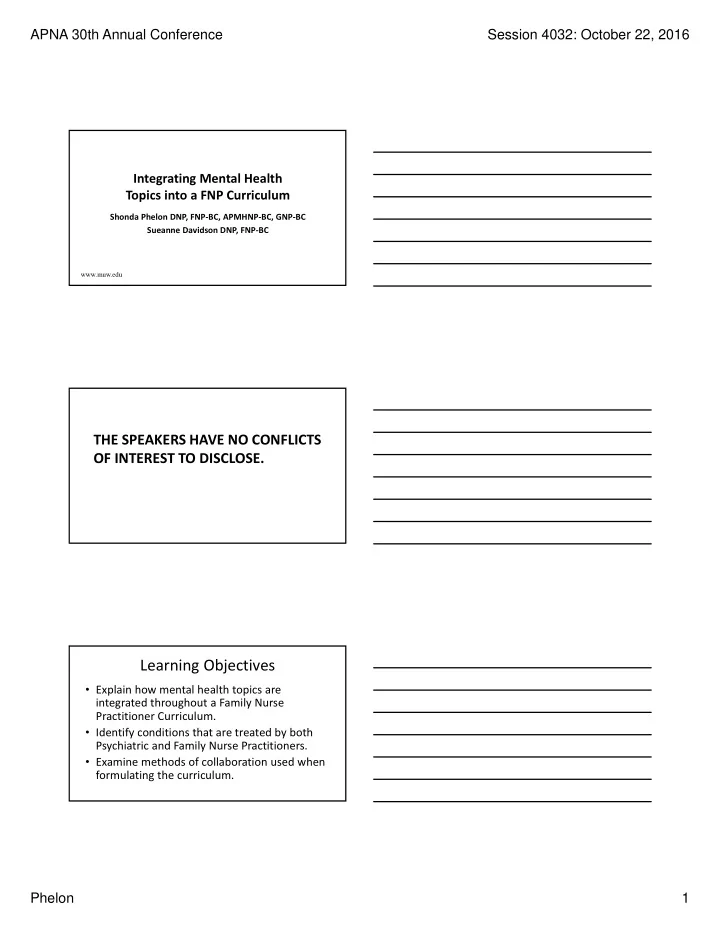
Integrating Mental Health Topics into a FNP Curriculum

Shonda Phelon DNP, FNP‐BC, APMHNP‐BC, GNP‐BC Sueanne Davidson DNP, FNP‐BC

THE SPEAKERS HAVE NO CONFLICTS OF INTEREST TO DISCLOSE.

Learning Objectives

  • Explain how mental health topics are

integrated throughout a Family Nurse Practitioner Curriculum.

  • Identify conditions that are treated by both

Psychiatric and Family Nurse Practitioners.

  • Examine methods of collaboration used when

formulating the curriculum.

slide-2
SLIDE 2

APNA 30th Annual Conference Session 4032: October 22, 2016 Phelon 2

Purpose

  • Identify and explain how mental health topics

were integrated into the FNP Curriculum.

The Problem

  • About 50% of all primary care visits involve a

mental health complaint.

  • Only about 50% of those treated in primary

care receive appropriate treatment.

  • Shortage of Mental Health Providers
  • FNP’s are often the ONLY provider for patients

Why do patients choose PCP for tx?

  • FNP’s often a first point of access for Mental Health

Treatment.

  • Patients are often very comfortable in discussing

mental health issues.

  • Established relationship with primary care provider
  • “I am not crazy.”
  • Less stigma walking into primary care setting then

mental health setting.

slide-3
SLIDE 3

APNA 30th Annual Conference Session 4032: October 22, 2016 Phelon 3

Problems in Primary Care

  • Unrecognized
  • Undertreated
  • Depression and Anxiety often treated with

inadequate dose of medication or therapy alone

  • Screening often done with little follow through.

8

Morbidity and Mortality in People with Serious Mental Illness

  • Die 25 years earlier than the general population
  • Suicide and injury account for 30‐40% of excess

mortality

  • 60% of premature deaths—due to medical

conditions such as cardiovascular, pulmonary and infectious diseases.

  • Imperative that FNP’s understand these risks

8

Background

  • Mississippi University for Women
  • First NP program started 1976
  • Only totally Face to Face Program in the State
  • Past tracks Family, Gerontology, Pediatrics
  • Consortium with other schools
slide-4
SLIDE 4

APNA 30th Annual Conference Session 4032: October 22, 2016 Phelon 4

Conditions routinely treated by both FNP’s and PMHNP’s in MS

  • Depression
  • Anxiety Disorders
  • ADD/ADHD
  • Delirium
  • Dementia
  • Substance Abuse

Curriculum Integration

  • 1. First Semester
  • a. NU 503 Advanced Health Assessment
  • b. NU 521 Science of Diagnostic Reasoning
  • c. NU 508 Advanced Nursing Theory
  • d. NU 508 Advanced Nursing Research and Evidenced Based Strategies
  • 2. Second Semester
  • a. Nu 501 Advanced Pharmacology
  • b. NU 503 Family Practice Management
  • c. NU 503 Lab Family Practice Clinical Practicum/Case Studies
  • 3. Third Semester
  • a. NU 506/506 Lab Family Practice Management and Clinical Practicum
  • b. NU 516 Population Health for Advanced Practice
  • c. NU 570 Advanced Health Policy and Politics
  • d. NU 597 Research Presentations
  • e. Final Clinical Exam and Case Study

Health Assessment Diagnostic Reasoning

  • Holistic Approach
  • Therapeutic Communication
  • Health Interview focusing on health promotion

and determination of risk factors

  • Basic overview of Psychiatric Disorders
  • Labs and testing to rule out/in mental disorders
slide-5
SLIDE 5

APNA 30th Annual Conference Session 4032: October 22, 2016 Phelon 5

Mental Health Screening and Assessment Patient Identifiers

  • Medically unexplained physical symptoms
  • High symptom count
  • High severity of the presenting somatic complaint
  • Chronic pain
  • Symptoms more than 6 weeks
  • Rated as a “difficult encounter”
  • Recent stress
  • Low self rating of worth
  • High use of health care
  • Substance Abuse

Advanced Nursing Theory/Research

  • Psychosocial Theories: Erickson, Roy’s

Adaptation Model, Peplau, Johnson’s Behavioral System Model, Family Theory, Comfort Theory, Bandura’s Self Efficacy Theory

  • Research and Evidence Based Practice

Advanced Pharmacology

  • Antidepressants
  • Antipsychotics
  • Stimulants
  • Mood Stabilizers
  • Anxiety Medication
  • Agents for Dementia
  • Choosing the appropriate agent
  • Medications causing psychiatric symptoms
  • Geriatric Considerations
slide-6
SLIDE 6

APNA 30th Annual Conference Session 4032: October 22, 2016 Phelon 6

Family Practice Management

  • ADD/ADHD
  • Common Childhood Psychiatric Illness
  • Mood Disorders
  • Anxiety Disorders
  • Thought Disorders
  • Suicide
  • Delirium
  • Dementia
  • Geriatric Mental Health Issues

Clinical Practicum/Case Studies

  • Settings‐high in mental health disorders
  • Pediatric Rotation‐Exposure to ADD/ADHD

management

  • Clinical Evaluations‐mental health issues

explored and addressed

  • 5 case studies

Population Health and Health Policy

  • Substance Abuse and Treatment
  • Societal Violence Assessment and Prevention
  • Mental Health Reform
  • Improving Mental Health Access
  • Achieving Mental Health Parity
  • Telehealth
  • Mississippi Medicaid Expansion
  • Social Policies for Children
  • Politics of the Pharmaceutical Industry
slide-7
SLIDE 7

APNA 30th Annual Conference Session 4032: October 22, 2016 Phelon 7

Clinical Research Projects

  • Depression Identification in Patients with Chronic Pain‐

MSN

  • Suicide Screening in Primary Care Patients Diagnosed

with Depression‐MSN

  • Depression Screening in Patients with CAD‐MSN
  • Interpersonal Violence Screening‐MSN
  • Suicide Prevention in Primary Care‐DNP
  • Increasing Parental Self Efficacy through Education‐

DNP

Focus on Collaboration

  • Interprofessional Collaboration is stressed.
  • Collaboration is taught as part of holistic patient

management.

  • Students are taught to develop network of

mental health resources.

  • Faculty collaborate with each other in faculty

based practice.

Outcomes

  • DNP Suicide Project presented at AANP and NNPS
  • MSN Suicide Screening Assessment presented at

MNA Convention

  • MSN Depression Screening in CV Disease

presented at AANP

  • Faculty/Student Presentation on Interpersonal

Violence Screening at AANP

  • Faculty Presenting collaboratively on MH topics
slide-8
SLIDE 8

APNA 30th Annual Conference Session 4032: October 22, 2016 Phelon 8

Future Goals

  • Faculty/students involved in Addiction Research
  • Faculty pursing Addiction Counseling Certification
  • Faculty pursing Mental Health NP certification
  • CE Program for Preceptors addressing Mental

Health Topics

  • Add a Psychiatric NP Certification option to DNP

program

References

  • Alligood, Martha Raile. Nursing theorists and their work. Elsevier Health Sciences, 2014.
  • American Psychiatric Association. (2013). DSM 5. American Psychiatric Association.
  • Bartels, S. J., Dums, A. R., Oxman, T. E., Schneider, L. S., Areán, P. A., Alexopoulos, G. S., & Jeste, D. V. (2014). Evidence‐based

practices in geriatric mental health care

  • Bickley, L., & Szilagyi, P. G. (2012). Bates' guide to physical examination and history‐taking. Lippincott Williams & Wilkins.
  • Duffy, E. G. (2015). HEALTH CARE POLICY: IMPLICATIONS FOR ADVANCED NURSING PRACTICE. Advanced Practice Nursing:

Core Concepts for Professional Role Development, 167.

  • Edmunds, M. W., & Mayhew, M. S. (2013). Pharmacology for the primary care provider. Elsevier Health Sciences.
  • Fitzgerald, M. (2015). Nurse Practitioner Certification Examination and Practice Preparation. FA Davis.
  • Hollier, A. (2016). Clinical Guidelines in Primary Care. Advanced Practice Education Associates
  • Mason, D. J., Leavitt, J. K., & Chaffee, M. W. (2013). Policy and Politics in Nursing and Healthcare‐Revised Reprint. Elsevier

Health Sciences.

  • Polit, D. F., & Beck, C. T. (2013). Essentials of nursing research: Appraising evidence for nursing practice. Lippincott Williams &

Wilkins.

  • Resnick, B., & Pacala, J. T. (2012). 2012 Beers criteria. Journal of the American Geriatrics Society, 60(4), 612‐613.
  • Stahl, S. M. (2013). Stahl's essential psychopharmacology: neuroscientific basis and practical applications. Cambridge

university press.

  • Uphold, C. R., & Graham, M. V. (2013). Clinical guidelines in family practice. Barmarrae Books.