Learning Objectives Pharmacist Pharmacy Technician 1. Describe - - PDF document

learning objectives
SMART_READER_LITE
LIVE PREVIEW

Learning Objectives Pharmacist Pharmacy Technician 1. Describe - - PDF document

9/29/2016 Revenue Opportunities and Documentation Requirements for Ambulatory Care Pharmacist Clinical Services Melanie A. Dodd, Pharm.D., Ph.C., BCPS Vice-Chair, Department of Pharmacy Practice and Administrative Sciences College of


slide-1
SLIDE 1

9/29/2016 1

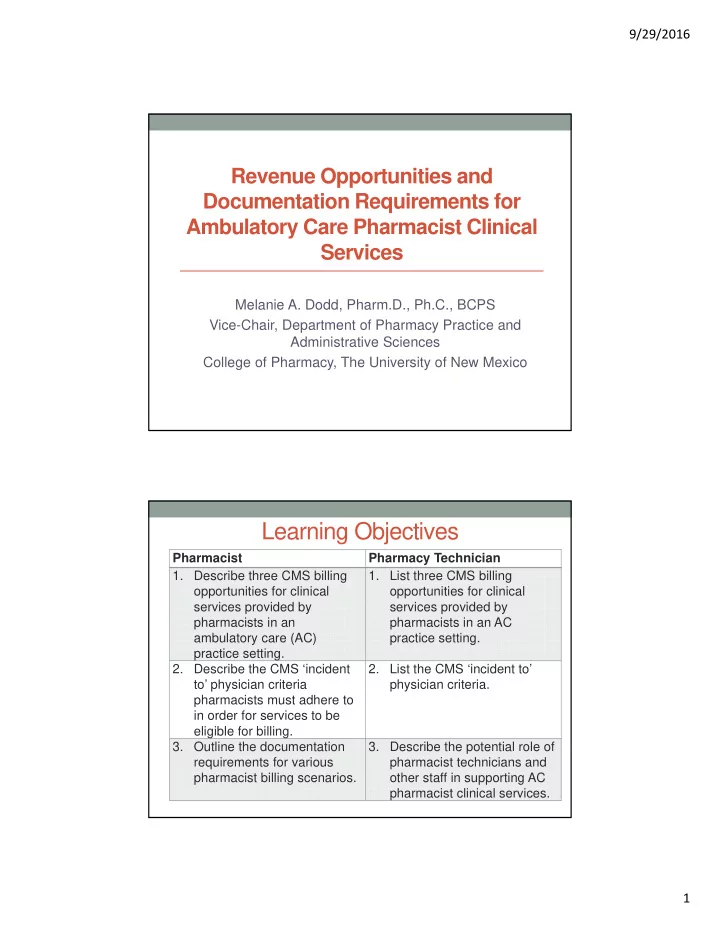
Revenue Opportunities and Documentation Requirements for Ambulatory Care Pharmacist Clinical Services

Melanie A. Dodd, Pharm.D., Ph.C., BCPS Vice-Chair, Department of Pharmacy Practice and Administrative Sciences College of Pharmacy, The University of New Mexico

Learning Objectives

Pharmacist Pharmacy Technician 1. Describe three CMS billing

  • pportunities for clinical

services provided by pharmacists in an ambulatory care (AC) practice setting. 1. List three CMS billing

  • pportunities for clinical

services provided by pharmacists in an AC practice setting. 2. Describe the CMS ‘incident to’ physician criteria pharmacists must adhere to in order for services to be eligible for billing. 2. List the CMS ‘incident to’ physician criteria. 3. Outline the documentation requirements for various pharmacist billing scenarios. 3. Describe the potential role of pharmacist technicians and

  • ther staff in supporting AC

pharmacist clinical services.

slide-2
SLIDE 2

9/29/2016 2

What is your current practice setting?

A.Community pharmacy B.Ambulatory clinic within health-

system

C.Inpatient hospital, but looking to

expand to ambulatory care

D.Managed care E.Other

Which Statement Reflects Your Pharmacist Billing Knowledge Best?

  • A. This is all new to me!
  • B. I have some knowledge of billing,

but interested in learning more.

  • C. I understand how to bill incident

to physician, annual wellness visits, transitional care management, diabetes self management education/training, and chronic care management.

slide-3
SLIDE 3

9/29/2016 3

Are you currently billing for ambulatory care pharmacist services?

  • A. Yes, I am currently billing

Medicare, Medicaid, or other insurance payers

  • B. Yes, I bill patients directly
  • C. No, but my services are paid for

by value added services within my organization

  • D. No, but I’d like to learn how

ASHP Practice Advancement Initiative

(formerly Pharmacy Practice Model Initiative (PPMI)) Ambulatory Care Summit Recommendations (AJHP 2014:71:1390-1.)

  • Defining Ambulatory Care Pharmacy Practice (1.1-1.5)
  • Patient Care Delivery and Integration (2.1-2.8)
  • Sustainable Business Models (3.1-3.5)
  • Outcomes Evaluation (4.1-4.7)
  • PAI Ambulatory Care and Hospital Self-assessment
  • http://www.ashpmedia.org/pai/
slide-4
SLIDE 4

9/29/2016 4

Sustainable Business Models (PAI 3.1-3.5)

  • 3.1 Pharmacists must be recognized as healthcare

providers

  • 3.2 The value proposition for pharmacists who provide AC

services must be articulated and promoted for internal and external stakeholders

  • 3.3 Technology solutions must be able to attribute

pharmacists’ interventions toward achieving standard measures that validate patient and population-based

  • utcomes in AC settings

Sustainable Business Models (PAI 3.1-3.5)

  • 3.4 Services provided by pharmacists who provide AC

services should achieve a set of quality and costs measures, be supported by payment model(s), and be valued by demonstrated improvements in patient

  • utcomes
  • 3.5 Pharmacy and other AC leaders should continuously

identify and evaluate solutions to market and deliver financially viable pharmacists' services to patients and

  • ther healthcare stakeholders.
slide-5
SLIDE 5

9/29/2016 5

Recognized Provider Status

Health care professional who conducts patient visits and bills for their services under their own provider number

National Provider Identifier (NPI)

Pharmacists must have an NPI if want to bill as a provider Free online application (CMS form 10114)

https://www.cms.gov/Medicare/CMS-Forms/CMS- Forms/downloads/CMS10114.pdf NPI gives pharmacists a national provider number, but not recognized national provider status

slide-6
SLIDE 6

9/29/2016 6

National Pharmacist Provider Status

  • Title XVIII Social Security Act
  • Providers recognized by Medicare Part B
  • House of Representatives Bill 592 and Senate Bill 314
  • Pharmacy and Medically Underserved Areas Enhancement Act
  • Medicare Part D, varies by PDP
  • Commercial payers, limited to individual contracts
  • Self-insured employers, limited to individual contracts

New Mexico Provider Status

  • Pharmacist clinicians
  • New Mexico Medicaid Fee-for-Service
  • Provider type 320
  • Bill using Evaluation and Management (E&M) codes under physician
  • Patient-centered medical homes
  • Chapter 43 of 2010 New Mexico laws
  • Expanded eligibility for recognition as offering medical homes
  • Pharmacist Clinicians
slide-7
SLIDE 7

9/29/2016 7

What are you billing opportunities?

(See handout) 1.

What is your setting?

  • Physician-based clinic (private practice)
  • Physician outpatient clinic that is NOT financially tied to a hospital

(the physician group owns the practice under a separate business tax ID number)

  • Hospital-based outpatient clinic
  • Physician outpatient clinic that is financially tied to a hospital (one tax ID number)
  • Community pharmacy

2.

What are your credentials?

  • Pharmacist clinician
  • Certified diabetes educator (CDE)

ll

Billing Options

New Mexico

CPT billing codes Practice Setting

PB=physician based HB=hospital based

2016 Medicare Payment

Diabetes self-management training (DSMT) G0108 (individual visit) G0109 (group visit) all G0108 = $52.07 G0109 = $13.97 CLIA-Waived Lab variable per POC test all fixed per CPT code Medication Therapy Management (MTM) 99605, 99606, 99607 pharmacy, employer, health plan variable per payer Incident to physician: Office visit in a PHYSICIAN-BASED (aka, non-hospital) clinic 99211-99215 (PB) PB 99211 = $19.03 99212 = $41.88 99213 = $70.87 99214 = $104.59 99215 = $141.34 Incident to physician: Office visit in a HOSPITAL-BASED

  • utpatient clinic

G0463 (HB) HB G0463 = $102.12 Incident to physician: Transitional Care Management (TCM) with RPh part of team 99496 (within 7d D/C) 99495 (within 14d D/C) PB & HB 99496 = $224.70 (PB) $158.56 (HB) 99495 = $159.26(PB) $109.58 (HB) CMS Annual Wellness Visit (AWV) G0438 (initial,once/lifetime) G0439 (subseq, annual) PB & HB PB/HB: G0438 = $166.95 PB/HB: G0439 = $112.81 Chronic Care Management (CCM) 99490 (20 minutes/month) PB & HB PB: $39.63 monthly HB: $31.07monthly
slide-8
SLIDE 8

9/29/2016 8

DOCUMENTATION REQUIREMENTS

Documentation Requirements

  • Document each and every patient encounter.
  • Be accurate and thorough in the documentation as the medical

record becomes a legal document.

  • There is no requirement for the physician or supervising provider to

sign off on all Pharmacist’s service.

  • Best Practice would include a review by the pharmacist of other

health care providers documentation, including the primary care provider or other specialties. (Be aware of your quality improvement)

  • The documentation should also include recording of phone calls,

letters, faxes, etc. to/with/from the patient’s physician or patient communicating the services.

slide-9
SLIDE 9

9/29/2016 9

Documentation Requirements (continued)

  • Progress notes must substantiate the service performed (level of

care) and be signed by the Pharmacist.

  • Documentation should show a review of the pertinent patient

medical history, medication profile, interventions, recommendations for optimizing medication therapy, referrals, treatment compliance, and communications with other healthcare professionals.

  • Documentation should show any administrative functions

(including patient and family communications) relative to the patient’s care. Ex: Use of translator or communication with care taker or family member who is managing the patient’s medications, prepares meals, provides transportation.

  • Any follow-up care planned should be recorded in the medical

record.

MEDICATION THERAPY MANAGEMENT (MTM)

slide-10
SLIDE 10

9/29/2016 10

ll

Billing Options

New Mexico

CPT billing codes Practice Setting

PB=physician based HB=hospital based

2016 Medicare Payment

Diabetes self-management training (DSMT) G0108 (individual visit) G0109 (group visit) all G0108 = $52.07 G0109 = $13.97 CLIA-Waived Lab variable per POC test all fixed per CPT code Medication Therapy Management (MTM) 99605, 99606, 99607 pharmacy, employer, health plan variable per payer Incident to physician: Office visit in a PHYSICIAN-BASED (aka, non-hospital) clinic 99211-99215 (PB) PB 99211 = $19.03 99212 = $41.88 99213 = $70.87 99214 = $104.59 99215 = $141.34 Incident to physician: Office visit in a HOSPITAL-BASED

  • utpatient clinic

G0463 (HB) HB G0463 = $102.12 Incident to physician: Transitional Care Management (TCM) with RPh part of team 99496 (within 7d D/C) 99495 (within 14d D/C) PB & HB 99496 = $224.70 (PB) $158.56 (HB) 99495 = $159.26(PB) $109.58 (HB) CMS Annual Wellness Visit (AWV) G0438 (initial,once/lifetime) G0439 (subseq, annual) PB & HB PB/HB: G0438 = $166.95 PB/HB: G0439 = $112.81 Chronic Care Management (CCM) 99490 (20 minutes/month) PB & HB PB: $39.63 monthly HB: $31.07monthly

MTM services

  • MTM services include but are not limited to:
  • 1. Performing or obtaining necessary assessments of the patient’s health status;
  • 2. Formulating a medication treatment plan;
  • 3. Selecting, initiating, modifying or administering medication therapy;
  • 4. Monitoring and evaluating the patient’s response to therapy
  • 5. Perform a comprehensive medication review to identify, resolve, and prevent

medication-related problems, including adverse drug events;

  • 6. Documenting the care delivered and communicating to the patients primary care

provider

  • 7. Provide verbal education and training to enhance patient understanding and

appropriate use of his/her medications

  • 8. Provide information support services and resources designed to enhance patient

adherence with his/her therapeutic regimens

  • 9. Coordinate and integrate medication therapy management services within the broader

health care-management services being provided to the patient.

  • 10. Provide other services such as immunizations, anticoagulation management, disease

management, etc.

slide-11
SLIDE 11

9/29/2016 11

Medication Therapy Management (MTM) CPT Codes

  • Time Based Codes:

Documentation of total time spent face to face with the patient must be added in your note. CPT 99605 initial 15 minutes, new patient CPT 99606 initial - 15 minutes, established patient CPT 99607 each additional 15 minutes (List separately in addition to code for primary service)

‘INCIDENT TO’ PHYSICIAN

slide-12
SLIDE 12

9/29/2016 12

ll

Billing Options

New Mexico

CPT billing codes Practice Setting

PB=physician based HB=hospital based

2016 Medicare Payment

Diabetes self-management training (DSMT) G0108 (individual visit) G0109 (group visit) all G0108 = $52.07 G0109 = $13.97 CLIA-Waived Lab variable per POC test all fixed per CPT code Medication Therapy Management (MTM) 99605, 99606, 99607 pharmacy, employer, health plan variable per payer Incident to physician: Office visit in a PHYSICIAN-BASED (aka, non-hospital) clinic 99211-99215 (PB) PB 99211 = $19.03 99212 = $41.88 99213 = $70.87 99214 = $104.59 99215 = $141.34 Incident to physician: Office visit in a HOSPITAL-BASED

  • utpatient clinic

G0463 (HB) HB G0463 = $102.12 Incident to physician: Transitional Care Management (TCM) with RPh part of team 99496 (within 7d D/C) 99495 (within 14d D/C) PB & HB 99496 = $224.70 (PB) $158.56 (HB) 99495 = $159.26(PB) $109.58 (HB) CMS Annual Wellness Visit (AWV) G0438 (initial,once/lifetime) G0439 (subseq, annual) PB & HB PB/HB: G0438 = $166.95 PB/HB: G0439 = $112.81 Chronic Care Management (CCM) 99490 (20 minutes/month) PB & HB PB: $39.63 monthly HB: $31.07monthly

Hospital-Based Outpatient Clinic Incident to Physician

Setting: Physician outpatient clinic that is financially tied to a hospital (one tax ID number)

Hospital Physician Outpatient Clinic

slide-13
SLIDE 13

9/29/2016 13

Every time a recognized provider sees a patient in a hospital-based outpatient clinic Bill a Professional Fee (PF) for cognitive services by the physician group Bill a separate Facility Fee (FF) from the hospital to cover overhead expenses

In a hospital-based outpatient clinic, incident to physician services provided by a pharmacist can be billed to Medicare via facility fee only. No professional fees are billed to a payer unless a payer recognizes pharmacists as providers e.g., New Mexico Medicaid.

&

2016 CMS Facility Fee-Only Billing

CPT G0463 billing code goes on the CMS form 1450 (aka UB-04 form) to bill Medicare The payment from Medicare is received in the form of an APC code, specifically APC 5012 ~ $102.12 Patient co-pay is 20%, thus ~ $20.43 Effective January 1, 2016

slide-14
SLIDE 14

9/29/2016 14

Key CMS Manual Regulations for Billing Incident to Physician

  • Hospital Outpatient Services, Coverage of Outpatient

Therapeutic Services Incident to a Physicians Services

  • Medicare Benefit Policy Manual Chapter 6, Section

20.5.2

https://www.cms.gov/Regulations-and- Guidance/Guidance/Manuals/downloads/bp102c06.pdf

  • Services and Supplies Furnished Incident To a

Physician’s/NPP’s Professional Service

  • Medicare Benefit Policy Manual Chapter 15,

Section 60.1

https://www.cms.gov/Regulations-and- Guidance/Guidance/Manuals/Downloads/bp102c15.pdf

Determine CMS Facility Fee Payment

Look up Hospital Outpatient Prospective Payment (HOPPS) Facility Fee Payment Rates (determined annually):

www.cms.gov/Medicare/Medicare‐Fee‐for‐Service‐ Payment/HospitalOutpatientPPS/Addendum‐A‐and‐Addendum‐B‐Updates.html

  • Select most recent date (i.e., January 2016)
  • Under “related links,” select “Addendum B”
  • Read and “Accept” the agreement to access the document
  • Select Excel spreadsheet
  • Search under “G0463 (the corresponding APC is 5012)
slide-15
SLIDE 15

9/29/2016 15

CMS Criteria-Billing ‘Incident to’ Physician in a Hospital-Based Outpatient Clinic

  • 1. Direct Supervision – physician or non-physician

practitioner (NPP) must:

  • Be present in the same building & immediately

available

  • Be prepared to step in and perform the service
  • “Clinically appropriate” to supervise the service
  • NPP = nurse practitioner, physician assistant,

clinical nurse specialist, nurse midwife, clinical psychologist

CMS Criteria-Billing Incident to Physician in a Hospital-Based Outpatient Clinic

  • 2. Continued Physician-Patient Relationship
  • The patient must be an established

patient

  • The physician must personally perform

the initial service for each new condition, make the initial diagnosis, and establish a plan of care which includes the subsequent incidental services

slide-16
SLIDE 16

9/29/2016 16

CMS Criteria-Billing Incident to Physician in a Hospital-Based Outpatient Clinic

  • 3. Must be an integral though incidental part of a

physician's or non-physician practitioner’s services

  • 4. The services are of the type commonly rendered

without charge or included in the physician’s bill

  • 5. Of a type that are commonly furnished in

physician’s offices or clinics

CMS Criteria-Billing Incident to Physician in a Hospital-Based Outpatient Clinic

  • 6. Must be furnished on a physician’s or non-physician

practitioner’s “order”

  • 7. Must have employee relationship with hospital as an

employee, leased employee, or independent contractor

  • 8. Services provided are within the scope of practice

for the pharmacist as dictated by the State pharmacy practice act

slide-17
SLIDE 17

9/29/2016 17

Physician-Based Outpatient Clinic

Setting: Physician outpatient clinic that is NOT financially tied to a hospital (the physician group owns the

practice under a separate business tax ID number)

Hospital Physician Outpatient Clinic

Determine CMS Physician Fee Schedule Payment per CPT Codes

Look up Professional Fee Payment Rates (determined annually, varies per region):

https://www.cms.gov/apps/physician-fee-schedule/license- agreement.aspx

  • Select first search option in web browser
  • Select “Accept”
  • Select PRICING INFORMATION; RANGE OF HCPCS

CODES

  • Select SPECIFIC LOCALITY
  • Enter HCPC as “99211 - 99215” or any CPT code
  • Select modifier as “ALL MODIFIERS”; and select

carrier/MAC locality (i.e. New Mexico)

  • HIT SUBMIT
slide-18
SLIDE 18

9/29/2016 18

CMS Physician-Based Outpatient Clinic Rules

  • 2016 Physician Fee Schedule – clarification noted in the background

section regarding billing incident to physician by auxiliary personnel. It clearly states that the supervising provider should bill and get paid for incident to services provided by auxiliary personnel just as if the supervising provider were personally providing the service. Thus, pharmacists meeting all the incident to criteria and documentation criteria can have their services billed for using CPT 99211-99215 and paid at 100% the physician rate (or 85% of the MD rate, if a NPP is supervising). Recommend that your confirm interpretation with your

  • rganization’s billing staff as this is new clarification.
  • Final Rule Posted in official Federal Registrar 11-16-15
  • http://www.gpo.gov/fdsys/pkg/FR-2015-11-16/pdf/2015-

28005.pdf

  • Pages 71065-71068 and 71372
  • Pre-Release posed 10-30-15
  • https://s3.amazonaws.com/public-inspection.federalregister.gov/2015-

28005.pdf

  • Pages 497-508 and 1299-1300

CMS Physician-Based Outpatient Clinic Rules

  • Pertains to Auxiliary Personnel

who may be an employee, leased employee, or independent contractor of the physician….thus, must be a direct financial expense to the physician or non-physician practitioner (NPP)

  • Direct Supervision definition is

different: physician or NPP must be in same “suite”

All prior Incident-to Physician Rules apply, in addition to:

*Exception: New Mexico Medicaid fee-for-service will bill professional fee under physician if a pharmacist clinician (not ‘incident to’).

slide-19
SLIDE 19

9/29/2016 19

Pop Quiz

If you are providing an incident to physician service in a physician- based clinic, what CPT codes would you use? If you are providing the exact same service as above in hospital based clinic, what CPT would you use?

DOCUMENTATION OF EVALUATION AND MANAGEMENT (E&M) SERVICES

slide-20
SLIDE 20

9/29/2016 20

Components of E&M Visit

 Key components that are considered part of an

E/M visit :

  • History
  • Examination
  • Medical decision making

 Each of these components have specific key

points that are considered when selecting a CPT code.

History Components Chief Complaint (CC)

The medical record should clearly reflect

the chief complaint.

  • “Patient is being seen today for…”
  • “Patient returns today for follow-up on... “

If ‘incident to’ billing be sure to include source of referral and physician “in suite” as appropriate.

slide-21
SLIDE 21

9/29/2016 21

History of Present Illness--HPI

HPI is documentation directly related to the present episode

  • f care.

8 elements–details describing the current presentation. Status of 3 chronic conditions may also be counted in lieu

  • f HPI.

Elements of HPI

  • Location (where)
  • Duration (how long)
  • Timing (when)
  • Quality (what is it like)
  • Severity (i.e. pain scale)
  • Modifying factors (what has been done)
  • Context (what created symptom)
  • Associated signs/symptoms (what else is

happening)

slide-22
SLIDE 22

9/29/2016 22

HPI Example

Example:

  • Patient states she has been having right wrist (location)

discomfort (quality) for 3 months (duration). States she has taken Tylenol to relieve the pain (modifying factors).

History Component : Review of Systems (ROS)

  • Constitutional (fever,

weight loss)

  • Eyes
  • Ears, nose, mouth,

throat

  • Cardiovascular
  • Respiratory
  • Gastrointestinal
  • Genitourinary
  • Musculoskeletal
  • Integumentary (skin

and/or breast)

  • Neurological
  • Psychiatric
  • Endocrine
  • Hematologic/lymphatic
  • Allergic/immunologic

 Review of Systems include:

slide-23
SLIDE 23

9/29/2016 23

Review of Systems (ROS)

A complete ROS would include 10 or more systems or

documentation of positives or pertinent negatives and a statement of “all others negative”.

Do not say “ROS negative”, you must demonstrate that

they were reviewed with the patient.

Review of Systems Example

Example:

  • “Denies fever (const). Occasional rapid

heartbeat(card/vasc). Positive for asthma(resp). All

  • ther systems negative.”
slide-24
SLIDE 24

9/29/2016 24

History Component: Past History (PFSH)

Past medical history

  • Prior illnesses and injuries, operations, hospitalizations,

current medications, allergies, age appropriate immunization, etc.

Family history

  • Health status or cause of death of parents, siblings, and

children; Diseases related to the HPI or ROS; Hereditary

  • r high risk diseases

Past History (continued)

Social history

  • Marital Status, living arrangements, current

employment, occupational history, use of drugs/alcohol, educational history, (new for 2015) military history, etc.

New patients, initial admission, consults= all 3 needed Established Patient = 2 out of 3 needed

slide-25
SLIDE 25

9/29/2016 25

CC: Follow-up visit for diabetes and hypertension HPI: Ms. Smith is an 75-year old female referred by her PCP for diabetes and hypertension management. She complains of feeling dizzy and sweaty 2-3 times a week after her 30-minute morning walk. Her symptoms resolve after eating breakfast. Her fasting blood sugar is usually between 80-100 mg/dL. She continues to take lisinopril 20 mg qam. Her morning blood pressure is usually 130/80. ROS: Denies fever, shortness of breath, chest pain; Complains of dizziness and sweating 2-3 times per walk after walking; All other symptoms negative Social history: Non-smoker

  • Selecting the level of history: Example

Selecting the Level of History

slide-26
SLIDE 26

9/29/2016 26

The Exam

Provider’s “Hands on” Type and content of exam based on

clinical judgment and nature of presenting problem

Statement of “Abnormal” is not sufficient

1995 Exam Elements

The following body areas are recognized:

 Head, including the face  Neck  Chest, including breasts and axillae  Abdomen  Genitalia, groin, buttocks  Back, including spine  Each extremity

slide-27
SLIDE 27

9/29/2016 27

Exam: Organ systems

 Constitutional (e.g., vital

signs, general appearance)

 Eyes  Ears, nose, mouth and throat  Cardiovascular  Respiratory  Gastrointestinal  Genitourinary

 Musculoskeletal  Skin  Neurologic  Psychiatric  Hematologic/lymphatic/immun-

  • logic

Note: Cannot mix and match body area and organ systems  Divided into three sections: 1.

Number of Diagnosis or Treatment Options

2.

Amount and Complexity of Data Reviewed

3.

Risk of Complications, and/or Morbidity or Mortality

Medical Decision Making

slide-28
SLIDE 28

9/29/2016 28

History Exam Medical decision making Typical face- to-face time (minutes) 99201 Problem-focused Problem-focused Straight- forward 10 99202 Expanded problem-focused Expanded problem-focused Straight- forward 20 99203 Detailed Detailed Low 30 99204 Comprehensive Comprehensive Moderate 45 99205 Comprehensive Comprehensive High 60

New Patients*

*All 3 components must be met. History Exam Medical decision making Typical face-to-face time (minutes) 99211 Not required Not required Not required 5 99212 Problem- focused Problem- focused Straight- forward 10 99213 Expanded problem- focused Expanded problem- focused Low 15 99214 Detailed Detailed Moderate 25 99215 Comprehensive Comprehensive High 40

Established Patients*

*2 of 3 components must be met.

slide-29
SLIDE 29

9/29/2016 29

Case Example

  • CC: New referral by PCP for CHF management
  • HPI: Mr. Garcia is a 75 year-old male who complains of SOB with

walking to the mailbox and swelling in his ankles daily.

  • ROS: Denies fever, chest pain; all other systems negative except as

noted in HPI

  • SH: Former smoker, 1 ppd X 25 years
  • Medications: Lisinopril 20 mg qam, furosemide 10 mg qam
  • Objective: VS: BP 136/80, HR 88, T 37C, O2 sat 93%, Wt. 77 kg (dry

73 kg)

  • CV: RRR, nl S1, S2; LE 1+ edema to ankle bil.; Pulm: CTA
  • Assessment/Plan: ???
  • How would you bill?

MEDICARE ANNUAL WELLNESS VISIT

slide-30
SLIDE 30

9/29/2016 30

ll

Billing Options

New Mexico

CPT billing codes Practice Setting

PB=physician based HB=hospital based

2016 Medicare Payment

Diabetes self-management training (DSMT) G0108 (individual visit) G0109 (group visit) all G0108 = $52.07 G0109 = $13.97 CLIA-Waived Lab variable per POC test all fixed per CPT code Medication Therapy Management (MTM) 99605, 99606, 99607 pharmacy, employer, health plan variable per payer Incident to physician: Office visit in a PHYSICIAN-BASED (aka, non-hospital) clinic 99211-99215 (PB) PB 99211 = $19.03 99212 = $41.88 99213 = $70.87 99214 = $104.59 99215 = $141.34 Incident to physician: Office visit in a HOSPITAL-BASED

  • utpatient clinic

G0463 (HB) HB G0463 = $102.12 Incident to physician: Transitional Care Management (TCM) with RPh part of team 99496 (within 7d D/C) 99495 (within 14d D/C) PB & HB 99496 = $224.70 (PB) $158.56 (HB) 99495 = $159.26(PB) $109.58 (HB) CMS Annual Wellness Visit (AWV) G0438 (initial,once/lifetime) G0439 (subseq, annual) PB & HB PB/HB: G0438 = $166.95 PB/HB: G0439 = $112.81 Chronic Care Management (CCM) 99490 (20 minutes/month) PB & HB PB: $39.63 monthly HB: $31.07monthly

CMS Annual Wellness Visit (AWV) Billing

Implemented January 2011

  • Initial preventive physical

examination, IPPE, using CPT G0402 known as welcome to Medicare physical

  • Must be performed by MD or NPP

May NOT be provided by a pharmacist

  • G0438 (initial Annual Wellness

Visit) or G0439 (subseq Annual Wellness Visit)

  • AWV must NOT be billed within 12

months of a previous billing of a G0402, G0438, or G0439

May be provided by a pharmacist

slide-31
SLIDE 31

9/29/2016 31

AWV Provided by a Pharmacist

Do NOT need to meet all the incident to rules

Do need to meet “direct physician supervision” rule – defined as supervising provider immediately available and in the suite at the time of the AWV

Bill under the supervising provider NPI

https://questions.cms.gov/faq.php?id=5005&faqId=3515 http://www.physiciansfirst.com/uploads/images/documents/awv.pdf http://wpsmedicare.com/j5macpartb/training/on_demand/_files/2013-0723- incident-to-services-handout.pdf

Medicare Annual Wellness Visit Initial and Subsequent

Health Risk Assessment

(Initial/Subsequent)

Establish/Update the list of

current providers and suppliers

  • Health Risk Assessment
  • Demographic data
  • Self-assessment of

health status

  • Psychosocial risks
  • Behavior risks
  • Activities of daily living

(ADLs)

  • Instrumental ADLs
  • Acquire Update of

Beneficiary Information

  • Required Element
slide-32
SLIDE 32

9/29/2016 32

Medicare Annual Wellness Visit: Initial and Subsequent

Establish/Update

medical/family history

Review functional ability

and level of safety (initial)

  • Medical events in immediate

family

  • Past medical and surgical

history

  • Use of, or exposure to,

medications and supplements

  • Assess:
  • Ability to successfully

perform ADLs

  • Fall risk
  • Hearing impairment
  • Home safety

Acquire Update of Beneficiary Information Required Element

Begin Assessment (Initial and Subsequent AWV)

Assess Detect any cognitive

impairment

Depression screening

(on initial AWV only)

Obtain the following measurements:

  • Weight and blood pressure;

and

  • Other routine measurements

as deemed appropriate

  • Cognitive and depression

screening scores

  • Begin Assessment
  • Required Elements
slide-33
SLIDE 33

9/29/2016 33

Counsel Beneficiary (Initial and Subsequent AWV)

Establish/Update the written

screening schedule for next 5-10 years

Establish/Update the list of

risk factors and conditions for which interventions are recommended

Furnish personalized health

advice to the beneficiary and a referral, to health education

  • r preventive counseling

programs Written screening schedule:

  • Age-appropriate preventative

services Include any risk factors or conditions

  • List of treatment options and

associated risks/benefits Includes referrals to programs

  • Community-based lifestyle

interventions, weight loss

  • Fall prevention, Nutrition
  • Physical activity. Tobacco-

use

  • Counsel Beneficiary
  • Required Elements

Let’s Get Started!!

Discuss the Following Questions with Colleagues:

  • 1. Where will the actual clinic space be? Will you

need to scout out/build out space?

  • 2. Is there strong physician and administrative

support? If so, who?

  • 3. Select one billing opportunity of interest and

determine all the criteria that must be followed.

  • 4. What are your next steps to successfully

implement a billing opportunity?

Billing Options

New Mexico CPT billing codes Practice Setting

PB=physician based HB=hospital based

2016 Medicare Payment

Diabetes self- management training (DSMT) G0108 (individual visit) G0109 (group visit) all G0108 = $52.07 G0109 = $13.97 CLIA-Waived Lab variable per POC test all fixed per CPT code Medication Therapy Management (MTM) 99605, 99606, 99607 pharmacy, employer, health plan variable per payer Incident to physician: Office visit in a PHYSICIAN-BASED (aka, non-hospital) clinic 99211-99215 (PB) PB 99211 = $19.03 99212 = $41.88 99213 = $70.87 99214 = $104.59 99215 = $141.34 Incident to physician: Office visit in a HOSPITAL- BASED outpatient clinic G0463 (HB) HB G0463 = $102.12 Incident to physician: Transitional Care Management (TCM) with RPh part of team 99496 (within 7d D/C) 99495 (within 14d D/C) PB & HB 99496 = $224.70 (PB) $158.56 (HB) 99495 = $159.26(PB) $109.58 (HB) CMS Annual Wellness Visit (AWV) G0438 (initial,once/lifeti me) G0439 (subseq, annual) PB & HB PB/HB: G0438 = $166.95 PB/HB: G0439 = $112.81 Chronic Care Management (CCM) 99490 (20 minutes/month) PB & HB PB: $39.63 monthly HB: $31.07monthly

slide-34
SLIDE 34

9/29/2016 34

Questions