LEARNING OBJECTIVES 1. W hy doesnt Ehlers-Danlos Syndrome(EDS) - - PDF document

learning objectives
SMART_READER_LITE
LIVE PREVIEW

LEARNING OBJECTIVES 1. W hy doesnt Ehlers-Danlos Syndrome(EDS) - - PDF document

James Kundart OD MEd FAAO FCOVD-A 6/17/18 Opt 707 Pediatric Ocular Disease LEARNING OBJECTIVES 1. W hy doesnt Ehlers-Danlos Syndrome(EDS) present more often with high m yopia, keratoconus, and lacquer cracks in Bruchs membrane?


slide-1
SLIDE 1

James Kundart OD MEd FAAO FCOVD-A Opt 707 Pediatric Ocular Disease 6/17/18 1 EHLERS-DANLOS SYNDROME AND THE EYE

2018 V IC TO R IA CO N FER EN C E JA M ES KU N D A RT O D M ED FA AO FCO V D -A PA C IFIC U N IV ERSITY CO LLEG E O F O PTO M ETRY FIN A N C IA L D ISC LO SU R E: N OTH IN G TO D ISC LO SE http://w w w.ncbi.nlm .nih.gov/pm c/articles/PM C3504533/figure/F1/

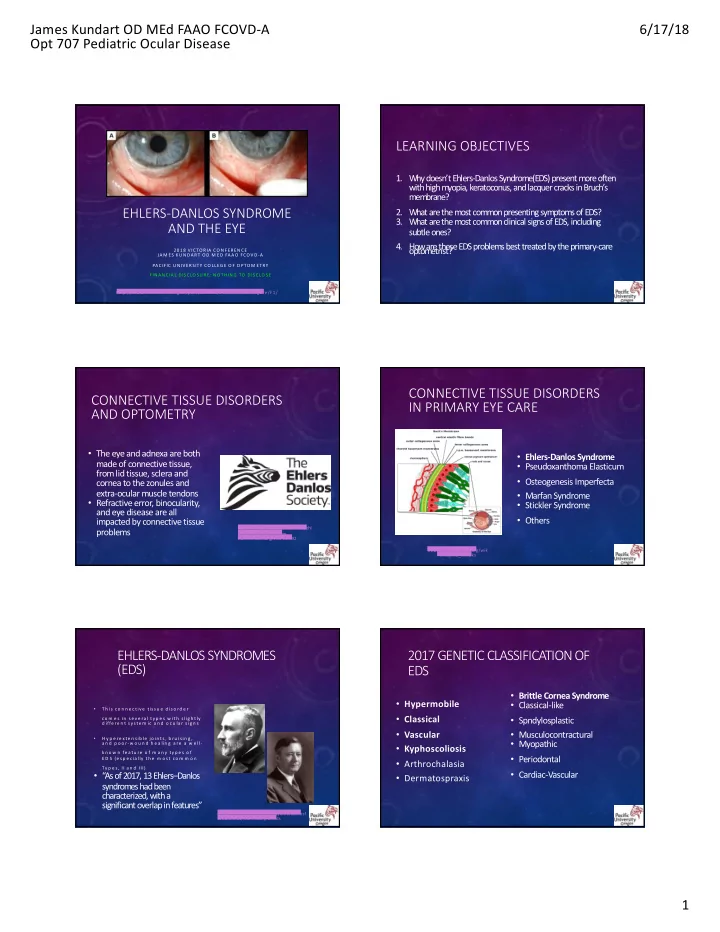
LEARNING OBJECTIVES

  • 1. W

hy doesn’t Ehlers-Danlos Syndrome(EDS) present more often with high m yopia, keratoconus, and lacquer cracks in Bruch’s membrane?

  • 2. W

hat are the most common presenting symptoms of EDS?

  • 3. W

hat are the most common clinical signs of EDS, including subtle ones?

  • 4. How are these EDS problems best treated by the primary-care
  • ptometrist?

CONNECTIVE TISSUE DISORDERS AND OPTOMETRY

  • The eye and adnexa are both

made of connective tissue, from lid tissue, sclera and cornea to the zonules and extra-ocular muscle tendons

  • Refractive error, binocularity,

and eye disease are all impacted by connective tissue problems

https://www.pressrelease.com/news/ehl ers-danlos-society-receives- transformational-gift-for-119892

CONNECTIVE TISSUE DISORDERS IN PRIMARY EYE CARE

  • Ehlers-Danlos Syndrome
  • Pseudoxanthoma Elasticum
  • Osteogenesis Imperfecta
  • MarfanSyndrome
  • Stickler Syndrome
  • Others

https://en.wikipedia.org/wik i/Angioid_streaks

EHLERS-DANLOS SYNDROMES (EDS)

  • T h is c o n n e c tiv e tis s u e d is o rd e r

c o m e s in s e v e ra l ty p e s w ith s lig h tly d iffe re n t sy ste m ic a n d o c u la r s ig n s

  • H y p e re x te n s ib le jo in ts , b ru is in g ,

a n d p o o r-w o u n d h e a lin g a re a w e ll- k n o w n fe a tu re o f m a n y ty p e s o f E D S (e s p e c ia lly th e m o st c o m m o n Ty p e s , II a n d III)

  • “As of 2017, 13 Ehlers–Danlos

syndromes had been characterized, with a significant overlap in features”

https://sites.google.com/site/ehlerdanlosf

  • rdummies/the-history-of-eds

2017 GENETIC CLASSIFICATION OF EDS

  • Hypermobile
  • Classical
  • Vascular
  • Kyphoscoliosis
  • Arthrochalasia
  • Dermatospraxis
  • Brittle Cornea Syndrome
  • Classical-like
  • Spndylosplastic
  • Musculocontractural
  • Myopathic
  • Periodontal
  • Cardiac-Vascular
slide-2
SLIDE 2

James Kundart OD MEd FAAO FCOVD-A Opt 707 Pediatric Ocular Disease 6/17/18 2 MOST COMMON: HYPERMOBILE EHLERS-DANLOS SYNDROME

  • “Characterized prim

arily by joint hyperm

  • bility affecting both large

and sm all joints, w hich m ay lead to recurrent joint dislocations and subluxations (partial dislocation)

  • In general, people w

ith this type have soft, sm

  • oth and velvety skin

w ith easy bruising and chronic pain

  • f the m

uscles and/or bones”

https://www.pressrelease.com/news/ehl ers-danlos-society-receives- transformational-gift-for-119892

CLASSICAL-TYPE EHLERS-DANLOS SYNDROME

  • Associated with extremely elastic

(stretchy), smooth skin that is fragile and bruises easily, wide, atrophic scars (flat or depressed scars), and joint hypermobility

  • M
  • lluscoidpseudotumors

(calcified hematomas over pressure points such as the elbow) and spheroids (fat- containing cysts on forearms and shins) are also frequently seen

https://rarediseases.info.nih.gov/diseases/6322/ehlers-danlos-syndromes

VASCULAR-TYPE EHLERS-DANLOS SYNDROME

  • ”Characterized by thin,

translucent skin that is extremely fragile and bruises easily

  • Characteristic facial features

including large eyes, a thin nose, and lobelessears

  • Joint hypermobility is

present, but generally confined to the small joints (fingers, toes)”

https://rarediseases.info.nih.gov/diseases/6322/ehlers-danlos-syndromes

KYPHOSCOLIOSIS-TYPE EHLERS-DANLOS SYNDROME

Associated with severe hypotonia at birth, delayed motor development, progressive scoliosis (present from birth), and scleral fragility

  • Affected people may also

have easy bruising; fragile arteries that are prone to rupture; unusually small corneas; and osteopenia (low bone density)”

https://www.scoliosisassociates.com/conditions/ehlers-danlos-syndrome/

BRITTLE CORNEA VARIANT OF EHLERS-DANLOS SYNDROME (RARE)

  • Brittle Cornea Syndrome

(BCS) is “characterized by thin cornea, early onset progressive keratoglobus and blue sclerae”

  • Like blue sclera, this is rare

in ambulatory patients

http://www.cityeye.com.au/patient-information/

BRITTLE CORNEA SYNDROME: PRESENTATION AND ANT SEGOCT

h ttp s://w w w .n cb i.n lm .n ih .g o v /p m c/a rticle s/P M C 3 6 5 9 0 0 6 /

slide-3
SLIDE 3

James Kundart OD MEd FAAO FCOVD-A Opt 707 Pediatric Ocular Disease 6/17/18 3 SYSTEMIC SYMPTOMS OF EHLERS-DANLOS SYNDROME

  • In general, these patients

are athletic, so diagnosis

  • f EDS is often delayed
  • Mild hypermobility may

have some advantages for pregnancy and childbirth

  • But not much later in life,

the number of surgeries they have may exceed their age

http://www.marieclaire.co.uk/opinion/ehlers-danlos-syndrome-living-with-eds-and- finding-treatment-10731

INFLAMMATORY DISEASES AND EDS

h ttp s://w w w .n cb i.n lm .n ih .g o v /p m c /a rticle s/P M C 5 2 0 9 7 3 4 /

AUTOIMMUNE AND EDS: BECHET DISEASE IN THE NFL/CHOROID

h ttp ://w w w .scie lo .b r/scie lo .p h p ? scrip t= sci_ a rtte x t& p id = S 0 0 0 4 - 2 7 4 9 2 0 1 7 0 0 0 2 0 0 0 6 9 & ln g = e n & n rm = iso & tln g = e n

AUTOIMMUNE AND EDS: FIBROMYALGIA AND THE CORNEA

h ttp s://w w w .n cb i.n lm .n ih .g o v /p m c/a rticle s/P M C 4 8 0 4 2 7 3 /

AUTOIMMUNE AND EDS: RHEUMATOID ARTHRITIS

h ttp ://w e b e ye .o p h th .u io w a .e d u /e ye fo ru m /a tla s/p a g e s/S cle ro m a la cia -in -R A /in d e x.h tm

RA AND SCLEROMALACIA

h ttp ://w e b e ye .o p h th .u io w a .e d u /e ye fo ru m /a tla s/p a g e s/S cle ro m a la cia -in -R A /in d e x.h tm

slide-4
SLIDE 4

James Kundart OD MEd FAAO FCOVD-A Opt 707 Pediatric Ocular Disease 6/17/18 4 RHEUMATOID ARTHRITIS AND EDS: JOINT SUPPORT RING SPLINTS

h ttp s://yo u tu .b e /tW M jl0 iL k 5 0

OTHER OCULAR CONSEQUENCES OF EHLERS-DANLOS SYNDROME

  • Exposure Keratitis
  • Corneal Hysteresis
  • Refractive Error
  • Strabismus
  • Postural Orthostatic

Tachycardia Syndrome

https://decisionmakerplus.net/case-report-post/exposure-keratopathy-secondary-to- lagophthalmos-2/#1454791209937-f372e282-b6d16c55-bb67

  • 1. EXPOSURE KERATITIS AND EDS

https://decisionmakerplus.net/case-report-post/exposure-keratopathy-secondary-to- lagophthalmos-2/#1454791209937-f372e282-b6d16c55-bb67

TREATING DRY EYE IN EDS: ANT-INFLAMMATORIES

h ttp s://w w w .slid e sh a re .n e t/d ra jayslid e /d ry-e ye -1 9 8 0 8 7 4 7 h ttp s://w w w .g o o d rx.co m /fm l? d ru g -n a m e = fm l

TREATING DRY EYE IN EDS: SALAGEN (ORAL PILOCARPINE)

h ttp s://w w w .g o o d rx.co m /sa la g e n ? d ru g -n a m e = S a la g e n

2 .CORNEAL HYSTERESIS IN EDS: OCULAR RESPONSE ANALYZER

http://www.reichert.com/product_details.cfm?pcId=652&skuId=2976&skuTk=1036239258#.WnG8xK2ZOu4

slide-5
SLIDE 5

James Kundart OD MEd FAAO FCOVD-A Opt 707 Pediatric Ocular Disease 6/17/18 5 WHY YOU WON’T OFTEN SEE BLUE SCLERA IN EDS

  • Blue sclera is norm

al in new borns and the elderly

  • Adult patients w

ith thin blue sclerae have a brittle cornea and ectasia risk

  • The w

eak cornea and sclera puts the patient at risk for retinal detachm ent and globe rupture w ith ocular injury

https://globalgenes.org/raredaily/ehlers-danlos-syndrome-6-spells-multiple-problems-for-dagmara/

WHY REFRACTIVE SURGERY IS CONTRAINDICATED IN EDS

http://www.reviewofcontactlenses.com/content/d/irregular_cornea/c/60783/

TREATING POST-LASIK ECTASIA IN EDS: SCLERAL CONTACT LENSES

http://lasikadvisory.blogspot.com /2013/03/avedro- ccl-treatm ent-for-kerataconus-or.htm l

SCLERAL LENSES TREAT POST- LASIK ECTASIA AND DRY EYE IN EDS

  • Corneal transplants are a

particular challenge for m

  • st

ED S patients w ith keratoconus due to risk of a ruptured globe

  • Preceding penetrating

keratoplasty , a 360 degree conjunctival peritom y m ust be done

  • D

escem et’sm em brane from the donor eye has to be sutured on in a ring first, follow ed by a PK m

  • nths later

h ttp ://g lo b a lre fra ctive so lu tio n s. co m /scle ra lle n se s.h tm l

TREATING POST-LASIK ECTASIA: KERARING

http://w w w.ijo.in/article.asp?issn=0301- 4738;year=2011;volum e=59;issue=6;spage=437;epage=443;aulast=Tunc;type=3

ANTERIOR SEGMENT OCT FOR EDS AFTER KERARING

http://www.ijo.in/article.asp?issn=0301- 4738;year=2011;volume=59;issue=6;spage=437;epage=443;aulast=Tunc;type=3

slide-6
SLIDE 6

James Kundart OD MEd FAAO FCOVD-A Opt 707 Pediatric Ocular Disease 6/17/18 6 TREATING ECTASIA IN EDS WITH CORNEAL COLLAGEN CROSS-LINKING

h ttp ://w w w .co rn e a clin ic.co m /co lla g e n cro sslin k in g .h tm l

  • 3. REFRACTIVE ERROR IN EDS
  • M
  • st casual references to

Ehlers-Danlos syndrome and the eye report high m yopia in these patients

  • W

hile scleral or corneal hyperextensibility would logically result in m yopia, these patients are often too sick to report to us in an ambulatory setting

  • But they may have another

connective tissue disorder

h ttp s://m e d ica lp ictu re s.n e t/stick le r-sy n d ro m e -p ictu re s/

HIGH MYOPIA IN EDS? OD: -8.00 D, OS: -14.00 D

W rig h t 3 , fig u re 1 2 -1

EDS DIFFERENTIAL DIAGNOSIS: STICKLER SYNDROME

  • Also called H

ereditary Progressive Arthro- O phthalm

  • pathy is an

autosom al-dom inant connective tissue disease

  • Like M

arfan, it causes very high m yopia and possible retinal detachm ent

  • It is seen as frequently as one in

7,500 patients

  • O

ne characteristic feature is a vitreous veil, as seen here

W rig h t, F ig u re 5 -5 , p a g e 2 4 1

AMBLYOPIA, STRABISMUS AND STICKLER SYNDROME

  • O

ne w ay in w hich a Stickler patient can present is w ith strabism us secondary to retinal detachm ent

  • In this Stickler patient, an RD

in O S resulted in LET

  • If the eye turn occurs before age

2, it is am blyogenic

  • M
  • re often, the poor V

A in the strabism iceye is because the detachm ent affects the m acula and is not true am blyopia

https://medicalpictures.net/stickler-syndrome-pictures/

ANTERIOR SEGMENT FEATURES OF STICKLER SYNDROME: CATARACT

W rig h t, H a n d b o o k o f Pe d ia tric R e tin a l D ise a se , F ig u re 6 -5 , p a g e 1 8 4

slide-7
SLIDE 7

James Kundart OD MEd FAAO FCOVD-A Opt 707 Pediatric Ocular Disease 6/17/18 7 POSTERIOR SEGMENT FEATURES OF STICKLER SYNDROME

  • Other anterior segment

complications are rare

  • For example, glaucoma is only

seen in 5% of Stickler cases, although ocular HTN can occur

  • However, congenital, progressive

m yopia is universally seen

  • Retinal detachment is common
  • Seen here is a “peripheral area of

circumferential lattice degeneration” , an early sign

W rig h t, F ig u re 5 -6 , p a g e 2 4 1

RADIAL LATTICE DEGENERATION IN STICKLER SYNDROME

  • M

inor ocular traum a can cause vitreous hem

  • rrhage and/or

retinal detachm ents

  • The vitreous is typically liquified

w ith m idperipheral circum ferential condensations

  • Radial perivascular patches of

lattice degeneration are present in the posterior pole or m id- periphery

  • These patients have a 50%

lifetim e risk of retinal detachm ent!

http://webeye.ophth.uiowa.edu/eyeforum/atlas/pages/radial-lattice-in-Sticklers-syndrome.html

PROGRESSION OF LATTICE DEGENERATION IN STICKLER SYNDROME

W rig h t, H a n d b o o k o f Pe d ia tric R e tin a l D ise a se , F ig u re s 6 -3 a n d 6 -4 , p a g e 1 8 3

SYSTEMIC FEATURES OF STICKLER SYNDROME

W rig h t, H a n d b o o k o f Pe d ia tric R e tin a l D ise a se , F ig u re s 6 -6 a n d 6 -7 , p a g e 1 8 5

FACIAL FEATURES OF STICKLER SYNDROME

h ttp ://sy n d ro m e p ictu re s.co m /stick le r-sy n d ro m e -p ictu re s/

SYSTEMIC FEATURES OF STICKLER SYNDROME

  • Sensorineuralhearing loss

(25% )

  • H

igh arched palate (25% )

  • Progressive arthropathy(joint

disease), becom ing pronounced by 4

th or 5 th decade of life

  • Conversely

, instead of stiffness, som e have hyperextensible joints

  • M

itral valve prolapse is seen in alm

  • st half (45%

)

h ttp ://sy n d ro m e p ictu re s.co m /stick le r-sy n d ro m e -p ictu re s/

slide-8
SLIDE 8

James Kundart OD MEd FAAO FCOVD-A Opt 707 Pediatric Ocular Disease 6/17/18 8 TREATING STICKLER SYNDROME

  • M

any of these patients m ay need laser photocoagulation for retinal holes and tears

  • Som

e w ill need vitrectom yand scleral buckling for RD

  • Like M

arfan, you w ill w ant to have these patients tested for heart and valve defects

  • A

H aberm an Feeder baby bottle can be used for Stickler babies w ith arched palate

h ttp s://e n .w ik ip e d ia .o rg /w ik i/H a b e rm a n _ Fe e d e r

  • 4. STRABISMUS IN EDS: CN VI AND

CAVERNOUS SINUS LEAKAGE

http://w w w .nejm .org/na101/hom e/literatum /publisher/m m s/journals/content/nejm /2011/nejm _2011.364.issue- 8/nejm icm 1006035/production/im ages/large/nejm icm 10 06035_f1.jpeg http://imagebank.asrs.org/file/8032/carotid- cavernous-fistula

LISTENING FOR ORBITAL BRUIT IN CAROTID-CAVERNOUS FISTULA

https://w w w.ncbi.nlm .nih.gov/ books/NBK289/ http://im agebank.asrs.org/file/8033/c arotid-cavernous-fistula

TREATING INDIRECT FISTULA AND DI: DIAMOX (ACETAZOLAMIDE)

h ttp s://w w w .g o o d rx.co m /a ce ta zo la m id e ? d ru g -n a m e = a ce ta zo la m id e

  • 5. POSTURAL ORTHOSTATIC

TACHYCARDIA SYNDROME IN EDS

https://w w w.top10hom erem edies.com /wp- content/uploads/2016/09/postural-tachycardia.jpg

VISUAL SNOW AND POTS

http://robertjrgraham.com/wp- content/uploads/2010/10/page1-1001-full.gif https://m edia.giphy.com /m edia/q4A u83JRI550Q /giphy.gif

slide-9
SLIDE 9

James Kundart OD MEd FAAO FCOVD-A Opt 707 Pediatric Ocular Disease 6/17/18 9 VF LOSS IN A 12 YO WITH EDS: CURED WITH GATORADE?!?

(THANKS TO DRS. DIEP& NGUYEN)

h ttp ://co m m o n s.p a cificu .e d u /co o fa c/2 4 /

BOTTOM LINES ON EHLERS-DANLOS SYNDROME

  • EDS tests all your optometric

skills, from anterior to posterior segment

  • W

hile there are many structure effects of EDS, the patient wants you to treat their symptoms

  • These patients will bring in

multiple generations of their family with varying penetrance of the disease

QUESTIONS? THANK YOU!

James Kundart OD MEd FAAO Professor Pacific University College of Optometry 3D Performance Clinic Kundart@pacific.edu

h ttp ://g e n e sth a td o n tfit.b lo g sp o t.co m /2 0 1 4 /0 8 /e d s- a rticle -a b o u t-h o w -b o d y-w ith -e d s.h tm l

READINGS AND REFERENCES

  • Today’s lecture was inspired by The Handbook of Pediatric

Eye and Systemic Disease, edited by Kenneth Wright. MD.

  • See chapter 5, called “Connective Tissue, Skin, and Bone

Disorders’, by Elias Traboulsi.

  • Ehlers-Danlos Syndrome has a great entry at Epocrates
  • nline if you upgrade to the disease database:

https://online.epocrates.com/noFrame/showPage.do?met hod=diseases&MonographId=570&ActiveSectionId=11