
SLIDE 1
1
Leadership Approaches and Issues
Organizational Management Chapter 11
- Trust: The Foundation of
Leadership Approaches and Issues Organizational Management Chapter - - PDF document
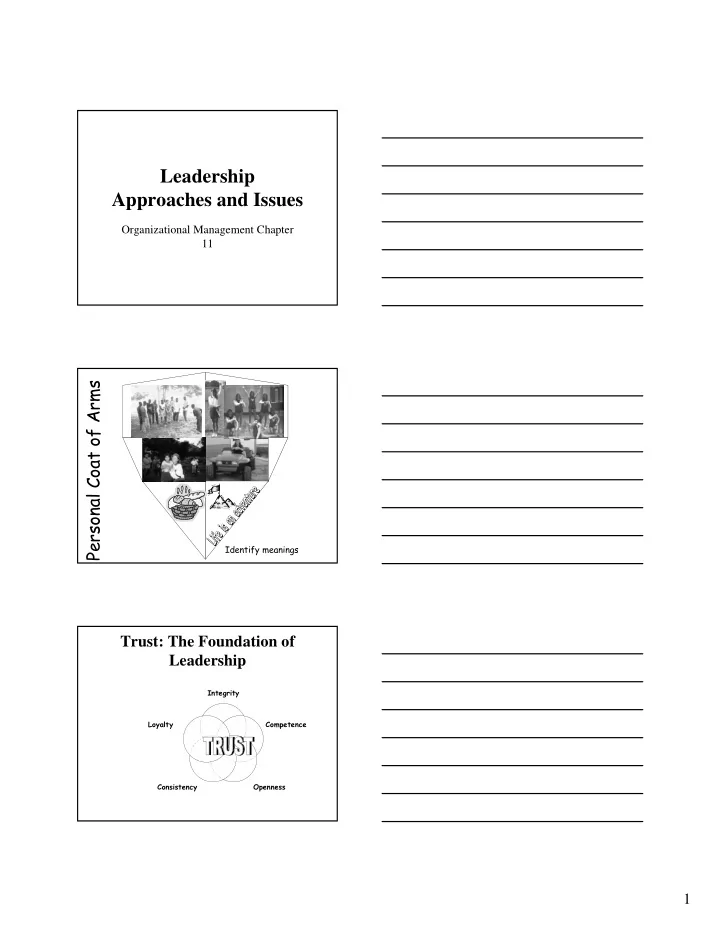
Leadership Approaches and Issues Organizational Management Chapter 11 Trust: The Foundation of Leadership
Low High High
Path Clarification Increase Rewards
Leader defines what follower must do to attain work outcomes Leader clarifies follower’s work role Follower has increased knowledge & confidence to accomplish outcomes Follower displays increased effort & motivation Organizational work outcomes are accomplished Leader learns follower’s needs Leader matches follower’s needs to re- wards if work outcomes are accomplished Leader increases value of work
Bass, Leadership: Good, Better, Best 1985
Lack sufficient info Problem unclear Acceptance by others
Adequate time Have all expertise Confident/capable of
Others will accept
Little or no time
consultative group
Transactional Charismatic Transformational
Vision Unconven- tional behavior Sensitive
needs Environ- mental sensitivity Personal risk
On November 18, 1978, over 900 members of a religious group led by the Reverend Jim Jones were killed in an apparent mass suicide. The megalomaniac Jones convinced most of his followers to drink a cyanide
suicide or murder. Charles Milles Manson (born 1934-NOV-11) is a person with an unusual ability to dominate others. He assembled a destructive cult around himself, which the media later called The Family. At one time, it numbered in excess of 100 individuals at the Spahn Ranch some 30 miles northwest of Los Angeles CA. Manson was referred to both as "God" and "Satan" by his followers. As the family's guru, he claimed to be a reincarnation of Jesus Christ.
Vision Charisma Symbolism Empowerment Intellectual stimulation Integrity Emotional intelligence
Evokes superior imagery Well-articulated Realizable Inspiration is value-centered
Challenge the process Be enthusiastic Help other to act Set the example Celebrate achievements
Directs actions of others
Tasks Rewards Structures
Exception (active)
Exception (passive)
Consideration
"
Reliance on
Headship Paternalism Director
United States Taiwan Sweden Philippines Italy India Hong Kong Great Britain Germany France Canada Brazil Australia
Achievement- Oriented Participative Supportive Directive
Selection
Review specific requirements for the job. Use tests that identify personal traits associated with
leadership, measure self-monitoring, and assess emotional intelligence.
Conduct personal interviews to determine candidate’s
fit with the job.
Training
Recognize the all people are not equally trainable. Teach skills that are necessary for employees to become
effective leaders.
Provide behavioral training to increase the development
potential of nascent charismatic employees.
Assessment
Your own
Follower’s
Situational
Temperance Silence Order Resolution Frugality Industry Sincerity Justice Moderation Cleanliness Tranquility Chastity Humility
CEO more interested in protecting career status
CEO wants to be popular with direct reports
CEO wants to ensure decisions are correct. CEO desires harmony. CEO fears being vulnerable.
Lencioni, Patrick, “The Five Temptations of a CEO”, 1998
Choose trust over invulnerability Choose conflict over harmony Choose clarity over certainty Choose accountability over popularity Choose results over status
Lencioni, Patrick, “The Five Temptations of a CEO”, 1998