LCCMR ID: 219-G Project Title: CO2 Sequestration (Mineral - - PDF document

lccmr id 219 g
SMART_READER_LITE
LIVE PREVIEW

LCCMR ID: 219-G Project Title: CO2 Sequestration (Mineral - - PDF document

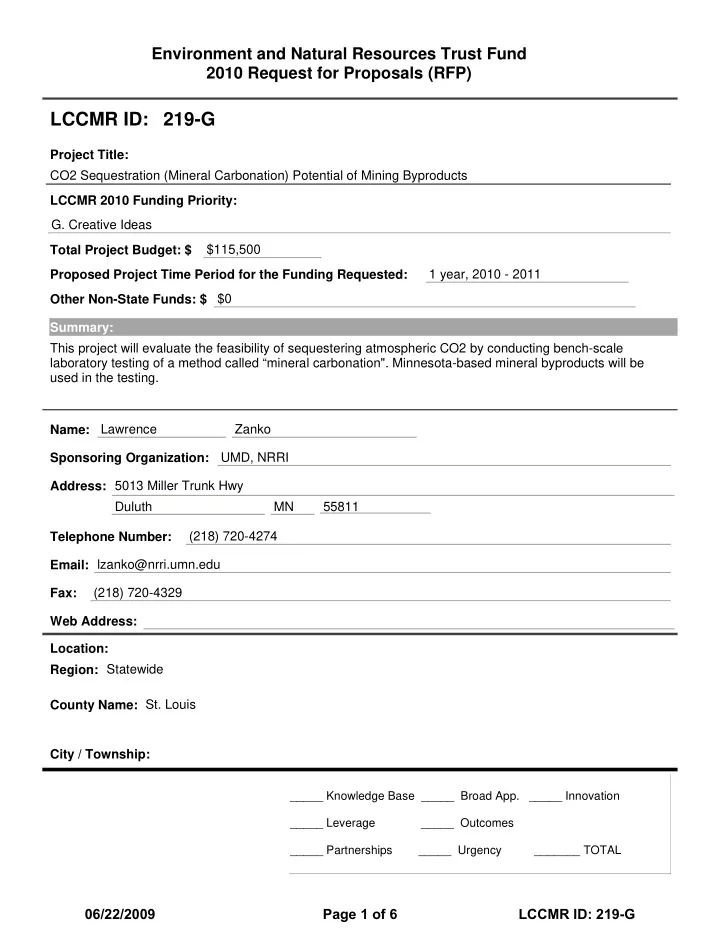
Environment and Natural Resources Trust Fund 2010 Request for Proposals (RFP) LCCMR ID: 219-G Project Title: CO2 Sequestration (Mineral Carbonation) Potential of Mining Byproducts LCCMR 2010 Funding Priority: G. Creative Ideas Total Project


slide-1
SLIDE 1

Environment and Natural Resources Trust Fund 2010 Request for Proposals (RFP)

CO2 Sequestration (Mineral Carbonation) Potential of Mining Byproducts $115,500 1 year, 2010 - 2011 $0 Lawrence Zanko UMD, NRRI 5013 Miller Trunk Hwy Duluth MN 55811 (218) 720-4274 (218) 720-4329 lzanko@nrri.umn.edu

  • St. Louis

This project will evaluate the feasibility of sequestering atmospheric CO2 by conducting bench-scale laboratory testing of a method called “mineral carbonation". Minnesota-based mineral byproducts will be used in the testing. Project Title: Total Project Budget: $ Proposed Project Time Period for the Funding Requested: Other Non-State Funds: $ Name: Sponsoring Organization: Address: Telephone Number: Email: Fax: Web Address: County Name: City / Township: Region: Summary: Statewide

LCCMR ID: 219-G

LCCMR 2010 Funding Priority:

  • G. Creative Ideas

Location:

_____ Knowledge Base _____ Broad App. _____ Innovation _____ Leverage _____ Outcomes _____ Partnerships _____ Urgency _______ TOTAL

06/22/2009 Page 1 of 6 LCCMR ID: 219-G

slide-2
SLIDE 2

PROJECT TITLE: CO2 Sequestration (Mineral Carbonation) Potential of Mining Byproducts

  • I. PROJECT STATEMENT

It is accepted that climate change is being driven by ever-increasing levels of atmospheric carbon dioxide (CO2). As long as society burns fossil fuels to generate power and drive many

  • f our industrial processes, CO2 will continue to be released into the atmosphere. Methods for

sequestering CO2 in ways that prevent or reduce its atmospheric release are under intense study worldwide. In response, this project will evaluate the feasibility of sequestering atmospheric CO2 by conducting bench-scale laboratory testing of a method called “mineral carbonation”. Minnesota-based mineral byproducts will be used in the testing. Magnesium silicate minerals such as olivine (Mg2SiO4) are identified as key CO2 reactants in the mineral carbonation process, with CO2 being tied up in the end-product, magnesite (MgCO3), a geologically stable mineral (the accompanying attachment illustrates and presents additional background information about the concept). About 1.6 tons of olivine can theoretically carbonate 1 ton of CO2, assuming 100% conversion (Gerdemann et al., 2003). Magnesium silicates such as olivine are common non-ore minerals in the Cu-Ni ores of the Duluth Complex, and olivine alone comprises about 25% of typical ore. The proposers believe mineral carbonation is especially relevant to the State of Minnesota, because mining byproducts generated by likely non-ferrous mining activities may very well be a vast source of inexpensive CO2

  • sequestering minerals.

The mineral processing and mineral chemistry emphasis of this study would be the logical and timely step to follow up on the 2008 Minnesota Geological Survey report on CO2 sequestration potential in Minnesota that was funded by the Legislature, and an anticipated literature review

  • n the potential for application of mineral carbonation in Minnesota proposed for funding by the

Minerals Coordinating Committee in the coming biennium. The Minnesota Geological Survey finds the proposed LCCMR study to be fully compatible with its work, and supports the proposal. Magnesium silicate-bearing byproducts (e.g., mineral tailings) that are representative of future non-ferrous mineral production will be the focus of this investigation.

  • A battery of physical, chemical, and mineralogical tests will be performed to guide follow-

up bench- and/or pilot scale mineral carbonation testing.

  • The carbonation tests will be performed under various physical and chemical operating

conditions.

  • CO2

sequestration efficiency and energy consumption will be used as a measure of the

  • verall potential and practicality of this concept.

The proposed work could have a significant impact on how similar CO2 sequestration systems are approached, developed and applied, not only in Minnesota but worldwide where similar minerals are available. Importantly, it represents an attempt to make a scientifically sound and environmentally beneficial and responsible use of readily available materials that would

  • therwise be considered a waste or byproduct of an emerging mining industry. As such, the

proposal addresses two LCCMR funding priority areas simultaneously with a creative approach (G) to the reduction of carbon and other greenhouse gas emissions (B), and offers a holistic approach to natural resource use and management, a prerequisite to sustainability.

06/22/2009 Page 2 of 6 LCCMR ID: 219-G

slide-3
SLIDE 3
  • II. DESCRIPTION OF PROJECT RESULTS

Result 1: Characterize byproduct size, chemistry, and mineralogy Budget: $ 7,500 Result 2: Determine byproduct’s CO2 Result 3: Produce olivine-rich concentrate (ORC) for further testing Budget: $ 8,200 removal from a gas stream Budget: $ 13,000 Result 4: Use Result 2 to test ORC Budget: $ 7,800 Result 5: Fluidized bed testing of “as-is” byproduct and ORC, via 2&4 Budget: $ 17,800 Result 6: Test “as is” byproduct in an aqueous slurry at various pressures Budget: $ 20,500 Result 7: Test ORC under several of the best conditions, via 5 Budget: $ 14,000 Result 8: Ongoing mineralogical characterization and data analysis Budget: $ 12,500 Result 9: Reporting Budget: Total Budget: $115,500 $ 14,200 Result (1-9) and associated Deliverables (1-n) Completion Date

  • 1. Byproduct size distribution(1), chemistry(2), mineralogy(3)

9-1-2010

  • 2. Determination of variables such as temperature, gas flow rate and gas

composition on byproduct’s ability to absorb CO2 10-1-2010 (1)

  • 3. An olivine- rich concentrate (ORC) for further testing (1)

12-1-2010

  • 4. Test results using olivine concentrate (1)

1-1-2011

  • 5. The effect of improved gas-solid contact on the absorption of CO2

2-1-2011 (1)

  • 6. Determination of the effect of variables on the ability of byproduct to

absorb CO2 3-15-2011 (1)

  • 7. Determination of the effect of variables on the ability of byproduct to

absorb CO2 4-15-2011 (1)

  • 8. X-ray diffraction patterns, mineral images, and chemistry (1) and data

analysis (2) 5-15-2011

  • 9. Final report including all results and recommendations (1)

6-30-2011

  • III. PROJECT STRATEGY
  • A. Project Team/Partners

NRRI’s Coleraine Minerals Research Laboratory (CMRL) and the Duluth-based Economic Geology Group (EGG) will conduct the research. CMRL will perform the majority of the laboratory testing outlined above; the EGG will be responsible for performing the mineral characterization work required for assessing any changes imparted by the various carbonation process steps. Engineers, scientists, and technicians from both CMRL and EGG will collaborate on experimental design, laboratory work, data interpretation, and report writing. Key personnel include: Lawrence Zanko, EGG – will be the project’s Principal Investigator (PI), and Blair Benner, CMRL – will be co-PI, and manage and oversee the mineral carbonation process. John Heine, EGG – will be project geologist/scientist responsible for mineral characterization

  • studies. Harvey Thorleifson, Ph.D., Director, Minnesota Geological Survey (MGS), will be a

project cooperator/advisor.

  • B. Timeline Requirements

One year (12 months): For this concept to be practical, mineral carbonation reactions should be measurable and quantifiable within relatively short time periods. This will allow the tests

  • utlined above to be performed within a one year period.
  • C. Long-Term Strategy

Should the results of the proposed project show promise, especially within the context of previous and ongoing MGS investigations, the logical next step would be to conduct a pilot- scale study. Longer-term investments to support a pilot-scale study would be proportional to the current request. The goal would be to leverage additional funding via sources such as the United States Department of Energy (DOE) or Environmental Protection Agency (EPA).

06/22/2009 Page 3 of 6 LCCMR ID: 219-G

slide-4
SLIDE 4

C:\Documents and Settings\dgriffit\My Documents\ML2010\RFP\2010 Proposals - JUNE FINALS\219-G - Zanko Lawrence 0509-2-163 - Budget

BUDGET ITEM (See list of Eligible & Non-Eligible Costs, p. 13) PI and Engineer(s) (includes salary and fringe) Scientist(s) and Technician(s) (includes salary and fringe) Equipment/Tools/Supplies: includes fluidized bed reactor tube, fittings, piping, tubing, gases, reagents and glassware Travel: Mileage Duluth-Coleraine, meeting attendance, etc. Additional Budget Items: TOTAL PROJECT BUDGET REQUEST TO LCCMR SOURCE OF FUNDS AMOUNT Status Other Non-State $ Being Applied to Project During Project Period: Other State $ Being Applied to Project During Project Period:

  • $

In-kind Services During Project Period:

  • $

Remaining $ from Current Trust Fund Appropriation (if applicable): Funding History:

  • $
  • V. OTHER FUNDS

Project Budget

  • IV. TOTAL PROJECT REQUEST BUDGET (1 year)

AMOUNT 43,860 $ 115,500 $

  • $

5,000 $ 65,540 $ 1,100 $

06/22/2009 Page 4 of 6 LCCMR ID: 219-G

slide-5
SLIDE 5

Mineral Carbonation Conceptualization Example of Potential Magnitude

  • 540,000 tons: Annual CO2 sequestration potential for byproduct olivine at 25%

carbonation efficiency for a typical-size, Minnesota-based, mining operation. Even at 5% efficiency, over 100,000 tons of CO2 could be sequestered.

  • 150,000 tons: The inherent annual reduction in CO2 attributable to the energy savings
  • f incidental grinding. This value is based on: 1) the estimated 15 kWh/ton energy-

saving advantage the concept has over “virgin” olivine sources, because the crushing and fine grinding required for increasing the reactivity of the olivine for mineral carbonation will have already been done during ore processing; and 2) a typical coal- fired power plant produces 1.5lbs of CO2 per kWh of electricity.

  • 10 tons: A conservative estimate of the amount of CO2 a single person generates every

year based on typical living activities (transportation, heating/cooling, eating, etc.)

06/22/2009 Page 5 of 6 LCCMR ID: 219-G

slide-6
SLIDE 6

2010 LCCMR Project Manager Qualifications

  • Mr. Zanko is a Research Fellow and Group Leader for By-Product Reuse and

Remediation within the Minerals Division of the Center for Applied Research and Technology Development of the Natural Resources Research Institute (NRRI), University of Minnesota Duluth. He has worked in the minerals field and has conducted geological, mineral resource and minerals industry-related applied research for most of his 26-year career. Since his start with NRRI in 1988, he has participated in or led a broad spectrum of research projects – often conducted in cooperation with private industry – dealing with non-ferrous minerals, ferrous minerals, industrial minerals (most recently focusing on construction aggregates), contaminated sediment remediation and reuse, and related policy issues. He regularly interacts and collaborates with public and private sector professionals and academicians in the geological, minerals, transportation, and environmental fields, inside and outside Minnesota. He is a graduate of the University of Minnesota – Twin Cities, where he received bachelor degrees in Geological Engineering and Microbiology, and a Masters degree in Geological Engineering. Lawrence Zanko, NRRI Blair Benner is director of the Minerals Beneficiation Program within the Minerals Division at the Coleraine Minerals Research Laboratory. He has over 30 years of research and development experience in mineral processing and extractive metallurgy: 10 years with emphasis on base metals and 20 years of primarily iron ore processing research and

  • development. His research has been carried from the bench scale and applied to

commercial operations. Most recently his focus has been directed toward the application

  • f mineral processing techniques for environmental clean up.

Blair Benner, NRRI-CMRL Background M.S. Extractive and Chemical Metallurgy, Stanford University, 1971 B.S. Metallurgy, Penn State, 1969 Organization Description NRRI was established in 1983 to encourage economic growth for Minnesota’s natural resources-based industries while keeping watch over that growth’s impact on the environment. http://www.nrri.umn.edu/default/about.htm 06/22/2009 Page 6 of 6 LCCMR ID: 219-G