LCCMR ID: 104-D-2.3 Project Title: 2.3 - MeCC 6 - Restoring Our - - PDF document

lccmr id 104 d 2 3
SMART_READER_LITE
LIVE PREVIEW

LCCMR ID: 104-D-2.3 Project Title: 2.3 - MeCC 6 - Restoring Our - - PDF document

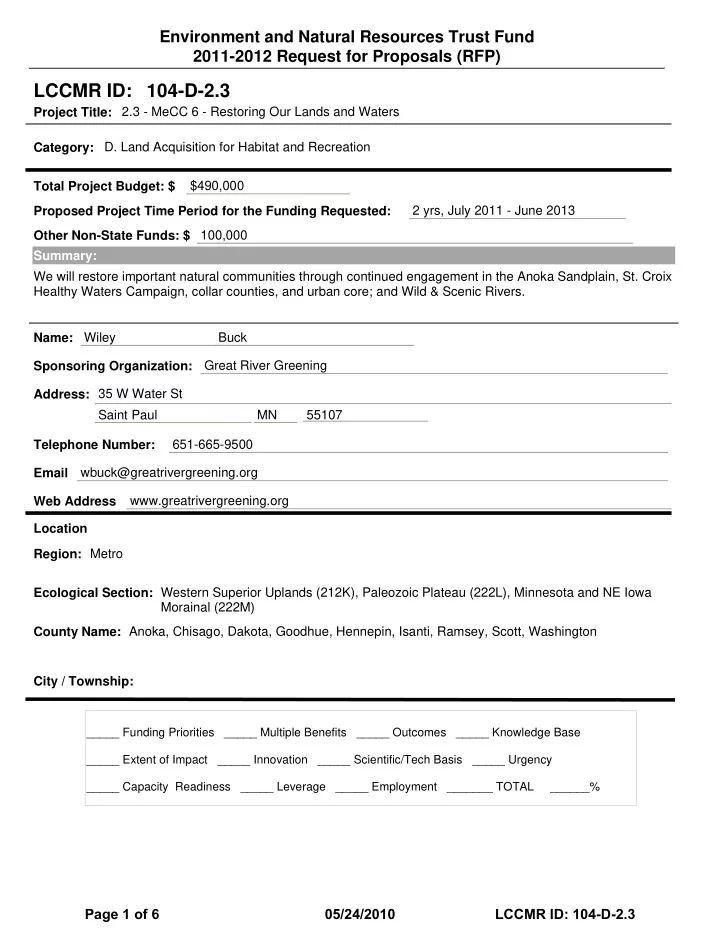
Environment and Natural Resources Trust Fund 2011-2012 Request for Proposals (RFP) LCCMR ID: 104-D-2.3 Project Title: 2.3 - MeCC 6 - Restoring Our Lands and Waters Category: D. Land Acquisition for Habitat and Recreation Total Project Budget:


slide-1
SLIDE 1

Environment and Natural Resources Trust Fund 2011-2012 Request for Proposals (RFP)

2.3 - MeCC 6 - Restoring Our Lands and Waters $490,000 2 yrs, July 2011 - June 2013 100,000 Wiley Buck Great River Greening 35 W Water St Saint Paul MN 55107 651-665-9500 wbuck@greatrivergreening.org www.greatrivergreening.org Anoka, Chisago, Dakota, Goodhue, Hennepin, Isanti, Ramsey, Scott, Washington We will restore important natural communities through continued engagement in the Anoka Sandplain, St. Croix Healthy Waters Campaign, collar counties, and urban core; and Wild & Scenic Rivers. Project Title: Total Project Budget: $ Proposed Project Time Period for the Funding Requested: Other Non-State Funds: $ Name: Sponsoring Organization: Address: Telephone Number: Email Web Address County Name: City / Township: Region: Summary: Metro Location Ecological Section: Western Superior Uplands (212K), Paleozoic Plateau (222L), Minnesota and NE Iowa Morainal (222M)

_____ Funding Priorities _____ Multiple Benefits _____ Outcomes _____ Knowledge Base _____ Extent of Impact _____ Innovation _____ Scientific/Tech Basis _____ Urgency _____ Capacity Readiness _____ Leverage _____ Employment _______ TOTAL ______%

Category:

  • D. Land Acquisition for Habitat and Recreation

LCCMR ID: 104-D-2.3

Page 1 of 6 05/24/2010 LCCMR ID: 104-D-2.3

slide-2
SLIDE 2

2011-2012 MAIN PROPOSAL

PROJECT TITLE: MeCC6-2.3: Restoring our Lands and Waters

  • I. PROJECT STATEMENT

Much of the remaining natural habitat within the Greater Twin Cities metropolitan area is threatened by conversion, fragmentation, invasive species, development, altered hydrology, and climate change. Restoration and management of these habitats is needed to save Minnesota’s natural heritage for future generations, protect rare and declining species, protect our clean water, reconnect habitat corridors, and serve as an avenue to connect residents with their local

  • environment. In the end, long-term support for natural areas and their ongoing protection and

management among local residents will be the only way to safeguard these treasures through

  • time. Great River Greening’s efforts to build that connection locally through volunteer events will

play a key role in building that link. Great River Greening will work with an array of local, state, and federal government agencies, non-profit organizations and individuals – as part of the Metro Conservation Corridors Partnership –

to undertake a diverse array of restoration projects that serve to meet our project goals of: 1)

reducing habitat fragmentation, 2) enhancing habitat quality, 3) reconnecting habitat corridors, and 4) building connections with local communities. Our objectives through this grant are to: 1) restore 336 acres of upland habitat, 2) restore 1,250 linear feet of shoreland habitat, and 3) engage at least 500 community members through at least 5 volunteer events at project sites. We have identified 11 important restoration projects – based on criteria of ecological significance, partner commitment, opportunity, and community importance – that will be poised for action during the grant timeline. These specific projects are identified below, and are exemplary of our continued engagement in the Anoka Sandplain, St. Croix Healthy Waters Campaign, collar counties, urban core, and State Wild & Scenic Rivers within the Greater Twin Cities Metro Area. Work conducted on private lands will have long-term easements in place. Species lists will be based on DNR, DNR/Great River Greening, and USDA Plants Database lists, following local ecotype guidelines.

  • II. DESCRIPTION OF PROJECT ACTIVITIES

Activity 1: Restoration of Upland Habitats within Corridors Budget: $ 360,000 We will restore 333 acres (133 ac LCCMR, 200 ac match) of upland habitat (forests, woodlands, savanna and prairie) through control of invasive species, seeding/planting, prescribed fire, establishment mowing and associated activities. Project success will be evaluated by project partners and follow-up activities will be designed to address on-going management needs as they emerge. Restoration plans will be developed for project sites per Trust Fund specifications. Outcome Completion Date

  • 1. Belwin Lake Edith Savanna Understory Establishment (65 acres)

June 2013

  • 2. South Washington WD Corridor Prairie Establishment (35) acres

June 2013

  • 3. Belwin Sauers Pond Grassland Establishment (32 acres)

June 2013

  • 4. Battle Creek Regional Park Savanna Restoration (75 acres)

June 2013

  • 5. Pilot Knob Roadbed Defragmentation (1 acre)

June 2013

Page 2 of 6 05/24/2010 LCCMR ID: 104-D-2.3

slide-3
SLIDE 3
  • 6. DNR Wild & Scenic (W&S) River Easement Restoration (30 acres)

June 2013

  • 7. Minn Land Trust Rum River Easement Restoration (30 acres)

June 2013

  • 8. NPS St. Croix Wild & Scenic River Restoration (10 acres)

June 2013

  • 9. Minnehaha Falls Park Restoration (20 acres)

June 2013

  • 10. Spot Maintenance/Enhancement of 26 existing MeCC projects (10 ac)

June 2013 Activity 2: Restoration of Wetland/Shoreland Habitat within Corridors Budget: $ 130,500 We will restore 3ac (1.7ac LCCMR) acres of wetland habitat and .25mi (.14mi LCCMR) linear feet of shoreline through control of invasive species, seeding/planting, and associated activities. Project success will be evaluated by project partners and follow-up activities will be designed to address on-going management needs as they emerge. Restoration plans will be developed for project sites per Trust Fund specifications. Outcome Completion Date

  • 1. Cedar Creek Farm Regional Park Shoreland Restoration (750 feet)

June 2013

  • 2. Heritage Village Park Wetland & Shoreland Restoration (500 ft, 3 acres)

June 2013

  • III. PROJECT STRATEGY
  • A. Project Team/Partners

Project partners will include: Great River Greening (Recipient; Contributing); South Washington Watershed District (Contributing); City of Inver Grove Heights (Contributing); Minnehaha Creek Watershed District (Contributing); Belwin Conservancy (Contributing); Scott County Parks (Contributing); Scott Watershed Management Organization (Contributing); Minnesota DNR Wild & Scenic Rivers Program (Contributing); Minnesota Land Trust (Contributing); City of Mendota Heights (Contributing); National Park Service (Contributing); Ramsey County Parks (Contributing) Great River Greening’s professional field crew – led by experienced, trained, and licensed personnel – will be undertaking much of this proposed work. Contracts, when needed, will be awarded on a competitive, experience, and performance basis; licensed if required.

  • B. Timeline Requirements

All projects will require at least a full field season for implementation and follow-up maintenance to ensure restoration activities are a success. Several projects – specifically oak savanna and prairie restorations – will benefit from a full two years of restoration activities, including year 2 mowing, invasive species control and other follow-up activities. Many of these projects will require a modest amount of follow-up management action beyond the timeframe of this grant. As appropriate and as needed, we envision including these needs in a following request via the MeCC Partnership for FY 2013-2014.

  • C. Long-Term Strategy and Future Funding Needs

The need and opportunities for restoration in project areas will continue into the foreseeable future, especially in light of climate change, increasing development pressures, and other

  • threats. Great River Greening – as a non-profit conservation organization – is committed to

working with our partners into the future to identify resources to alleviate their financial burdens in managing lands where these investments have been placed. Where appropriate, and where the need exists, we envision ENRTF as one of several funding streams to that end.

Page 3 of 6 05/24/2010 LCCMR ID: 104-D-2.3

slide-4
SLIDE 4

BUDGET ITEM Personnel: Ecologists, Field Crew, Volunteer Coordinator, Admin (~ 2.5 FTE for 2 years); 22% average benefit rate incl. 401k match Contracts: Restoration Contracts: site prep, prairie installation, establishment mowing, large boom spraying, tree removal by e.g. Minnesota Native Landscapes, PRI, Applied Ecological Services, Outback Nursery, Mike's Tree Service, MCC, farmers and other local partners. Equipment/Tools/Supplies: ATV Seed Harvester (8K) Acorn harvester, chainsaws, brushsaws, gloves, glasses, Rx burn equipment (7K) Seeds, plugs, plants, mulch, erosion control blankets (110.5K ) Travel: Mileage reimbursement at federal rate Other: Volunteer Event expenses (tents/tables/chairs, portable toiles, overngiht security,approved food and beverage) for 5 large public events, 7 small group event, ~500 volunteers total. TOTAL ENVIRONMENT & NATURAL RESOURCES TRUST FUND $ REQUEST SOURCE OF FUNDS AMOUNT Status Other Non-State $ Being Applied to Project During Project Period:Scott County WMO; Minnehaha Creek Watershed District; Ramsey County Parks; National Park Service; South Washington Watershed District; Belwin Conservancy; City of Inver Grove Heights; City of Mendota Heights; Private landowners with DNR or Minn Land Trust Easements. 500,000 $ 100K Sec. 400K Pend. Other State $ Being Applied to Project During Project Period:

  • $

In-kind Services During Project Period: Belwin Lake Edith and Sauers Pond: 10K mow, harrow, seed NPS St. Croix River Easements: 5K, hand crew work Heritage Village Park: 20K earthwork, grading 35,000 $ Secured Remaining $ from Current ENRTF Appropriation (if applicable): 2008 MeCC IV Unspent (all Legally Obligated): 9K 2009 MeCC V Unspent: 139K, with 40K Not Legally Obligated, but in advanced negotiations (All figures as of April 2010) 148,000 $ Unspent Funding History: 2009 Phase V* - $155,000 ENRTF, match $TBD 2008 Phase IV* - $111,000 ENRTF, match $TBD 2007 Phase III - $60,000 ENRTF, match • $90K non-state+$31K state 2005 Phase II - $100,000 ENRTF, match $202,000 non-state 2003 Phase I - $124,000 ENRTF, match >$100,000 non-state 550,000 $

2011-2012 Detailed Project Budget

  • IV. TOTAL TRUST FUND REQUEST BUDGET 2 years

AMOUNT 5,000 $ 20,000 $ 90,000 $

  • V. OTHER FUNDS

250,000 $ 490,000 $ 125,000 $

Page 4 of 6 05/24/2010 LCCMR ID: 104-D-2.3

slide-5
SLIDE 5

# # # # # # # # # #

Pilot Knob Belwin (2) Heritage Village Park Minnehaha Falls Cedar Lake Farm Cannon Wild & Scenic River

  • St. Croix Wild & Scenic River

Rum Wild & Scenic River South Wash. Corridor Battle Creek Reg Pk

Rice Dakota Goodhue Anoka Hennepin Scott Isanti Chisago Washington Le Sueur Sherburne Ramsey Carver Wright

MeCCVI - 2.3 Restoring Our Lands and Waters

Page 5 of 6 05/24/2010 LCCMR ID: 104-D-2.3

slide-6
SLIDE 6

Organization Description

The nonprofit Great River Greening leads and promotes community based restoration of natural areas and open spaces. Our team of experienced ecologists and landscape ecologists bring multiple years’ combined experience managing native habitats, conducting natural resource inventories, fundraising for restoration projects on public lands, and engaging over 20,000 volunteers. We have a regional reputation at all levels of community and government. For example the Department

  • f Natural Resources (DNR) has come to us for numerous partnerships: management for the Eagle

Creek Aquatic Management Area (AMA) adjacent to private housing, the landowner incentive program for the Franconia – Scandia corridor, and restoration of Afton State Park, to name only a few. We are also a member of the Metro Conservation Corridors, a government-nonprofit collaboration of ten partners that has legislative funding for metro area protection and management.

Project Highlights

  • Flint Hills Resources, Rosemount − This ongoing project is designed to restore and reconstruct

prairie, savanna and oak woodland areas on the 700-acre Flint Hills property. It is part of the larger Pine Bend Bluffs Natural Area, which has been identified by the DNR County Biological Survey as a site of high statewide biological significance. Greening continues to work with Flint Hills employee and community volunteers to implement the management plan designed by the DNR.

  • Mounds Park Bluffs, Saint Paul − This ongoing project is located near culturally significant Native

American burial mounds. The Bluffs, which overlook the Mississippi River and downtown Saint Paul, are also heavily used for their scenic value. The restorative design focuses on reducing erosion without obstructing the view, invasive species abatement and periodic prescribed burns.

  • Pilot Knob, Mendota – Overlooking the Minnesota Valley and Fort Snelling, the site is widely

recognized for its historical and cultural significance. Greening, in collaboration with Mdewakanton Dakota, City of Mendota and other partners are restoring oak savanna and prairie to this 24-acre

  • site. In a ‘top tier’ township for SGCN needs and opportunities, this site is also being managed for

non-game birds and native snakes.

  • Pond-Dakota Mission Park, Bloomington - The site of historic Oak Grove Mission and the 1856

Gideon and Agnes Pond House, this historically important site is situated along and overlooks the Minnesota Valley NWR. Restoration of oak savanna and mesic woodland is occurring at the site

  • ver the next two years.

Project Manager

Wiley Buck, Restoration Ecologist (M.S., Wildlife Conservation, University of Minnesota) is responsible for project development and management, particularly for multi-year restoration projects such as Metro Conservation Corridors, a cooperative effort for protection and acquisition in priority areas of the metro, and Bucks and Buckthorn, a youth hunter and ecological education project. He served as Greening’s conservation director in 2004 and 2005. Wiley gained his restoration expertise through his experience with McHenry County Conservation District, The Nature Conservancy, Chicago Wilderness, and the Minnesota DNR’s Scientific and Natural Areas Program (SNA).

Page 6 of 6 05/24/2010 LCCMR ID: 104-D-2.3