LCCMR ID: 061-B Project Title: Groundwater Recharge: Nicols Fen, - - PDF document

lccmr id 061 b
SMART_READER_LITE
LIVE PREVIEW

LCCMR ID: 061-B Project Title: Groundwater Recharge: Nicols Fen, - - PDF document

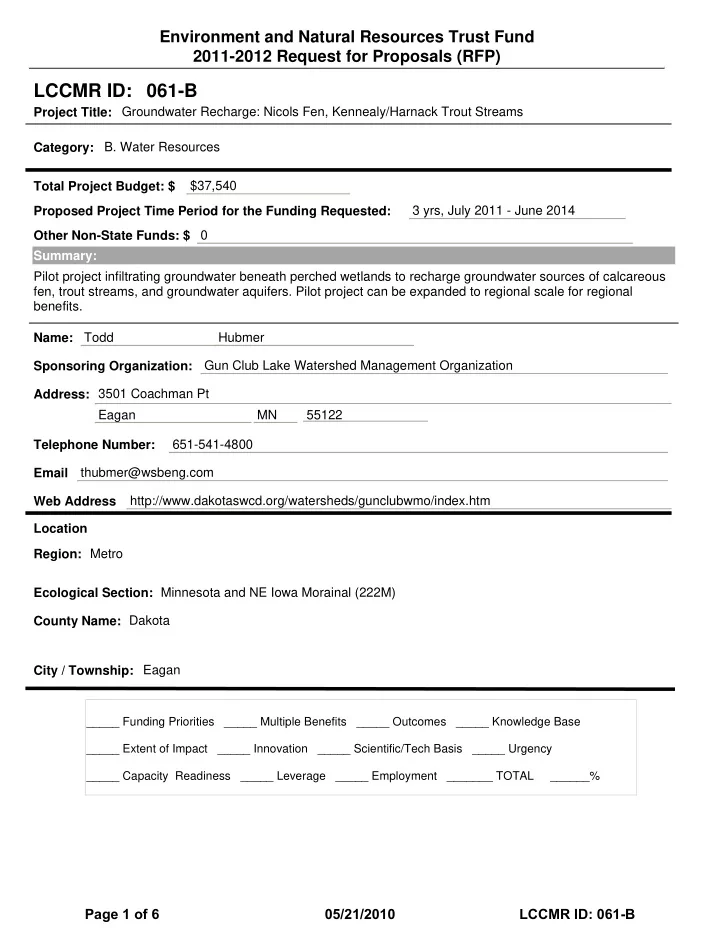
Environment and Natural Resources Trust Fund 2011-2012 Request for Proposals (RFP) LCCMR ID: 061-B Project Title: Groundwater Recharge: Nicols Fen, Kennealy/Harnack Trout Streams Category: B. Water Resources Total Project Budget: $ $37,540


slide-1
SLIDE 1

Environment and Natural Resources Trust Fund 2011-2012 Request for Proposals (RFP)

Groundwater Recharge: Nicols Fen, Kennealy/Harnack Trout Streams $37,540 3 yrs, July 2011 - June 2014 Todd Hubmer Gun Club Lake Watershed Management Organization 3501 Coachman Pt Eagan MN 55122 651-541-4800 thubmer@wsbeng.com http://www.dakotaswcd.org/watersheds/gunclubwmo/index.htm Dakota Eagan Pilot project infiltrating groundwater beneath perched wetlands to recharge groundwater sources of calcareous fen, trout streams, and groundwater aquifers. Pilot project can be expanded to regional scale for regional benefits. Project Title: Total Project Budget: $ Proposed Project Time Period for the Funding Requested: Other Non-State Funds: $ Name: Sponsoring Organization: Address: Telephone Number: Email Web Address County Name: City / Township: Region: Summary: Metro Location Ecological Section: Minnesota and NE Iowa Morainal (222M)

_____ Funding Priorities _____ Multiple Benefits _____ Outcomes _____ Knowledge Base _____ Extent of Impact _____ Innovation _____ Scientific/Tech Basis _____ Urgency _____ Capacity Readiness _____ Leverage _____ Employment _______ TOTAL ______%

Category:

  • B. Water Resources

LCCMR ID: 061-B

Page 1 of 6 05/21/2010 LCCMR ID: 061-B

slide-2
SLIDE 2

2011-2012 MAIN PROPOSAL

PROJECT TITLE: Groundwater Recharge: Nicols Fen, Kennealy/Harnack Trout Streams

  • I. PROJECT STATEMENT

The Gun Club Lake Watershed (Watershed) contains numerous lakes and wetlands which are situated in depressions and collect significant surface water runoff volumes. Because there are no major creeks or rivers, the majority of surface water runoff is conveyed through ponds and wetlands to the Minnesota River with minimal recharge of groundwater. The significant urban development in the watershed has had a negative affect on the groundwater recharge and resources such as Nicols Fen and two trout streams: Kennealy Creek and Harnack Creek. This project is an implementation component of the 2002 MnDNR Metor Greenways Planning Grant and the 2008 MnDNR Conservation Partnership Grant for the evaluation of the fen and trout streams. The goal of this project is to retrofit existing urban environments to transfer surface water runoff into natural ground water infiltration and recharge groundwater aquifers. Many wetlands in the Watershed are characterized by a perched condition above the ground water by a restrictive or confining layer. This offers a unique opportunity to utilize the natural infiltration of the permeable soils beneath the existing wetlands to recharge the downstream groundwater dependent resources including Nicols Fen and Kennealy and Harnack trout streams. An additional benefit

  • f this project is the reduction of the overall volume of surface water runoff and recharging the

source of drinking water to the users of the aquifer. This project will be a pilot program to monitor the effectiveness of the methodology for groundwater recharge in the Watershed. The project will involve the installation of an infiltration system at a qualifying wetland site. Water which previously flowed out of wetlands through storm sewer pipes will be redirected to an underground infiltration system that will lie below the confining layer that is perching the wetland hydrology. The volume of infiltrated surface water providing groundwater recharge will be monitored and quantified as a measure of the success

  • f the project. In addition, we propose to monitor total phosphorus and other parameter to

determine if significant pollutants are being removed from downstream surface waters. The benefits from this project are numerous and have regional significance. They include, but are not limited to:

  • recharging source water for Nicols Fen and Kennealy and Harnack trout streams
  • increasing infiltration;
  • recharging aquifers in a region dependent on ground water resources for public

consumption;

  • reducing overall cost associated with purchasing land for accomplishing groundwater

recharge;

  • surface water runoff volume reduction.
  • II. DESCRIPTION OF PROJECT ACTIVITIES

Activity 1: Identify Project Site Location Budget: $ 2,000 A suitable location will be identified through review of existing documentation (e.g. Watershed Management Plan), data analysis, agency collaboration and input, soil borings (if necessary), and field site visits.

Page 2 of 6 05/21/2010 LCCMR ID: 061-B

slide-3
SLIDE 3

Outcome Completion Date

  • 1. Determine suitability of site (soils, hydrology, constructability)

July-August 2011

  • 2. Hold agency coordination meeting

July 2011

  • 3. Make recommendation and present to Watershed Board

August 2011 Activity 2: Install Groundwater Recharge Infiltration System Budget: $ 23,000 Designed and construct the infiltration system in the pilot program project location. This will involve excavation and directional boring. Outcome Completion Date

  • 1. Installation of groundwater recharge infiltration system

September 2011 Activity 3: Monitor Infiltration Rates and Pollutants Budget: $ 9,500 Infiltration rates of the system will be monitored for two years with four monitoring samples for pollutants collected each year for a total of eight samples. Outcome Completion Date

  • 1. Monitor infiltration volumes and pollutants

October 2013 Activity 4: Compile Results, Analyze, and Report Budget: $3,040 The data will be compiled, analyzed, and summarized in a Project Report. The success of the project will be assessed and the results will be provided to Eagan, Mendota Heights, and Inver Grove Heights. The findings will also be submitted for presentation at the Water Resources Convergence and this project may serve as a model for future installations of these groundwater recharge systems. Outcome Completion Date

  • 1. Compile and analyze data

November 2013

  • 2. Assess success of the pilot project, present results in Report

December 2013

  • 3. Develop a project model for implementation at other locations

December 2013

  • III. PROJECT STRATEGY
  • A. Project Team/Partners

The project teams will be comprised of Watershed staff, Watershed consultant staff, a construction contractor for installation of the groundwater recharge system, and possibly Agency staff as needed for project input. The majority of the planning, design, monitoring and reporting will be completed by the technical consulting staff of the Gun Club Lake Watershed Management Organization (GCLWMO) and funding will by managed by the GCLWMO Board.

  • B. Timeline Requirements

The project will need to be initiated as soon as funding is available. Design and installation can be completed in the fall of 2011 with monitoring beginning immediately. Monitoring will need to be initiated no later that the fall of 2011 to ensure two full years of monitoring data are collected. The project is anticipated to be completed within the timeframe as required by the grant conditions.

  • C. Long-Term Strategy and Future Funding Needs

This project will not require additional funding. It is the goal of the project, however, to produce a feasible and effective ground water recharge system for long term implementation and regional installation by other government and private entities. Implementation of strategy will include presentation to local governments, watersheds, and water resource professionals to ensure the success of this project is shared for the benefit of all watersheds.

Page 3 of 6 05/21/2010 LCCMR ID: 061-B

slide-4
SLIDE 4

BUDGET ITEM Personnel: WMO Engineer ($96/hr: $34.78 salary;$61.22 overhead, benefits) WMO Hydrologist ($76/hr: $27.53 salary; $48.47 overhead, benefits) WMO Technical Staff ($68/hr: $24.64 salary; $43.36 overhead, benefits) Contracts: Infiltration system installation contractor (TBD by competitive bid) Equipment/Tools/Supplies: Infiltration Rate Monitoring Equipment (Stage Recorder) Additional Budget Items: TOTAL ENVIRONMENT & NATURAL RESOURCES TRUST FUND $ REQUEST SOURCE OF FUNDS AMOUNT Status Other Non-State $ Being Applied to Project During Project Period: WMO can contribute up to $15,000 to overall project costs. 15,000 $ Other State $ Being Applied to Project During Project Period: NA In-kind Services During Project Period: WMO Board of Managers: Administration

  • f grant, project oversight, project review (40hrs)

$2,000 Remaining $ from Current ENRTF Appropriation (if applicable): NA Funding History: NA

2011-2012 Detailed Project Budget

  • IV. TOTAL TRUST FUND REQUEST BUDGET - 2 years

AMOUNT 1,000 $

  • V. OTHER FUNDS

37,540 $ NA 4,100 $ 8,200 $ 1,240 $ 23,000 $

Page 4 of 6 05/21/2010 LCCMR ID: 061-B

slide-5
SLIDE 5

Page 5 of 6 05/21/2010 LCCMR ID: 061-B

slide-6
SLIDE 6

2011-2012 Attachment Item #6

Project Manager Qualifications and Organization Description Project Manager – Todd Hubmer, PE (WSB & Associates) Todd has over 18 years of experience in the field of water resources engineering. He has been responsible for completing numerous hydrologic and hydraulic analyses for drainage systems in a wide variety of water resource, environmental, and municipal

  • projects. Todd is also an expert in water quality and quantity modeling and very familiar

with the processes involved in monitoring various Best Management Practices. He has managed multiple innovative stormwater quality projects in the past, examples include but are not limited to: St. Anthony Water Reuse Facility, Brooklyn Center Underground Regional Treatment Facility, and Roseville Biofiltration and Wetland Enhancement

  • Project. In addition, Todd has successfully administered FEMA, Watershed District,

County, State Aid, FHWA, MnDOT, Met Council, MnDNR Metro Greenways, MnDNR Conservation Partnership grants and many other grant and public finance projects. He is fully capable of successfully managing this groundwater recharge grant. Todd serves as the Technical Consultant for the Gun Club Lake Watershed Management Organization and is knowledgeable in the conditions, characteristics, and needs of the Gun Club Lake Watershed. Organization Description – Gun Club Lake Watershed Management Organization The Gun Club Lake Watershed Management Organization (GCLWMO) was formed on June l, 1985 through a joint powers agreement. The Gun Club Lake Watershed is located in the east-central portion of the Minneapolis-St. Paul seven county metropolitan

  • area. The GCLWMO goals are broad and wide reaching. They include:
  • Protect and conserve the groundwater resource and encourage the

infiltration of properly treated surface water to recharge groundwater;

  • Coordinate intercommunity and/or interagency storm water runoff, flooding, and
  • ther water quality issues;
  • Maintain or improve the quality of water in lakes, streams, or rivers within or in

proximity to the GCLWMO boundary;

  • Protect and enhance water-based recreational facilities and fish and wildlife

habitat;

  • Educate the public on pertinent water resource management issues and increase

public participation in water management activities;

  • Protect existing wetlands and restore diminished or drained wetlands;
  • Prevent and minimize the effects of sedimentation from erosion-prone areas.

The GCLWMO’s purpose is to preserve, protect, enhance, and restore water resource systems within the Gun Club Lake Watershed to meet the purposes set forth in the Surface Water Management Act.

Page 6 of 6 05/21/2010 LCCMR ID: 061-B