Laying a Solid Foundation for Learning: Lessons from the Kom MLE - - PowerPoint PPT Presentation

laying a solid foundation for learning lessons from the
SMART_READER_LITE
LIVE PREVIEW

Laying a Solid Foundation for Learning: Lessons from the Kom MLE - - PowerPoint PPT Presentation

Laying a Solid Foundation for Learning: Lessons from the Kom MLE Project in Cameroon Paul FrankSIL LEAD and SIL International What is MLE? Mother tongue-based multilingual education (MTB- MLE or just MLE) Using the childs


slide-1
SLIDE 1

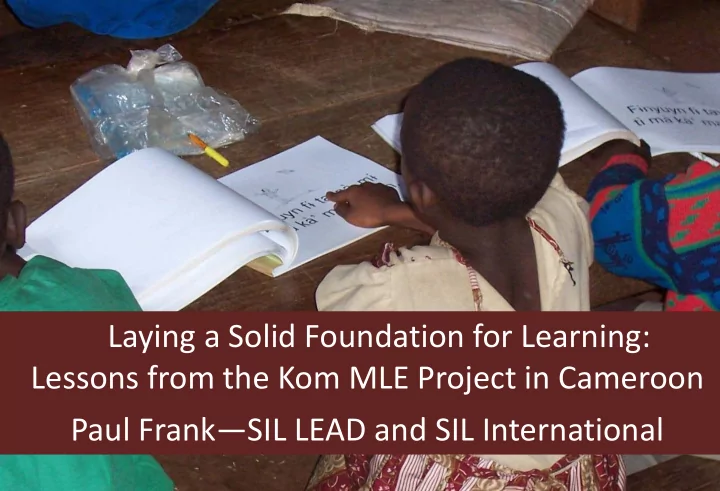
Laying a Solid Foundation for Learning: Lessons from the Kom MLE Project in Cameroon Paul Frank—SIL LEAD and SIL International

slide-2
SLIDE 2

What is “MLE”?

  • Mother tongue-based multilingual education (MTB-

MLE or just MLE)

  • Using the child’s mother tongue as the initial

language of instruction

  • Introducing an additional language or languages

subsequently, first in oral form, and later in written form

  • “Mother tongue”, “Home language”, “First

language”, “A language the child understands well”

slide-3
SLIDE 3

Why use an MLE approach?

  • Children can learn if they understand
  • Easier to teach reading when the child knows the

language

  • Greater educational success
  • True even for the second language
slide-4
SLIDE 4

Why isn’t MLE used more often?

  • Official language more valuable?
  • Move to the new language quickly
  • Using first language waste of time or hindrance?
slide-5
SLIDE 5

Kom Education Pilot Project (KEPP)

  • English-speaking North West Region of Cameroon
  • Approximately 250,000 speakers
  • Kom is primary language in the area
  • School staff speak Kom
  • English is primary language of instruction
  • Performance very poor
slide-6
SLIDE 6

What was the intervention?

  • Grades 1-3: Kom is language of instruction
  • Students also learn oral English
  • Third grade: learn to read and write in English
  • Fourth grade: transition to English
slide-7
SLIDE 7

Baseline

  • Reading comprehension in English:

– 4% after one year of school – only 20% in Class 6

  • Math scores:

– under 10% – even counting under 15%

  • Some children in Class 4 “had never held a pencil or

written on a piece of paper”

slide-8
SLIDE 8

120 100 80 60 40 20 25 20 15 10 5

Scores (Percent) Percent of Students

18.36 13.13 335 59.57 25.04 323 Mean StDev N English KEPP Program

Histogram of Overall Performance - Grade 1

One year—comparison of scores

slide-9
SLIDE 9

Comparison on sub-tests

10 20 30 40 50 60 70 Reading Math Oral English Average Score (Percentage) Test Components English-medium Kom-medium

slide-10
SLIDE 10

Comparison on reading sub-tests

10 20 30 40 50 60 70 80 Word identification Grammar Reading comprehension Overall Average Score (Percentage) Test Components English-medium Kom-medium

slide-11
SLIDE 11

Specific features of the intervention

  • Children learn to read in Kom
  • Reading out loud to students
  • Phonics to teach decoding
  • Integrated reading curriculum
  • Questioning strategies to promote comprehension

and reasoning

slide-12
SLIDE 12

And there’s more!

  • 10 minutes daily for independent reading or

writing

  • English language development
  • Instruction in math
  • Teacher training
  • Teacher support
slide-13
SLIDE 13

Results after five years

slide-14
SLIDE 14

Conclusions after five years

  • Use of mother tongue has brought significant

improvements

  • Gains of more than 60%
  • Stronger reading comprehension, oral proficiency,

knowledge of English

slide-15
SLIDE 15
slide-16
SLIDE 16

The difficulties of early exit programs

  • “Early exit”: complete transition to another

language early in primary school

  • “Late exit”: use the mother tongue throughout

primary

  • Late exit programs have stronger outcomes
  • Kom project shows weaker outcomes
slide-17
SLIDE 17

In their own words…

slide-18
SLIDE 18

Questions? Comments?

slide-19
SLIDE 19

Credits

  • Dr. Stephen L. Walter, Professor Graduate Institute
  • f Applied Linguistics, Dallas, Texas USA
  • Dr. Kristine Tramell, International Consulant in

Literacy and Education, SIL International

  • Kain Godfrey Chuo, Literacy Specialist, SIL

Cameroon