Launch and Presentation ASIA-PACIFIC TRADE AND INVESTMENT REPORT - - PDF document

launch and presentation asia pacific trade and investment
SMART_READER_LITE
LIVE PREVIEW

Launch and Presentation ASIA-PACIFIC TRADE AND INVESTMENT REPORT - - PDF document

02/11/2015 Launch and Presentation ASIA-PACIFIC TRADE AND INVESTMENT REPORT 2015 Supporting Participation in Value Chains Dr. Shamshad Akhtar Under-Secretary-General of the United Nations and Executive Secretary UN Economic and Social


slide-1
SLIDE 1

02/11/2015 1

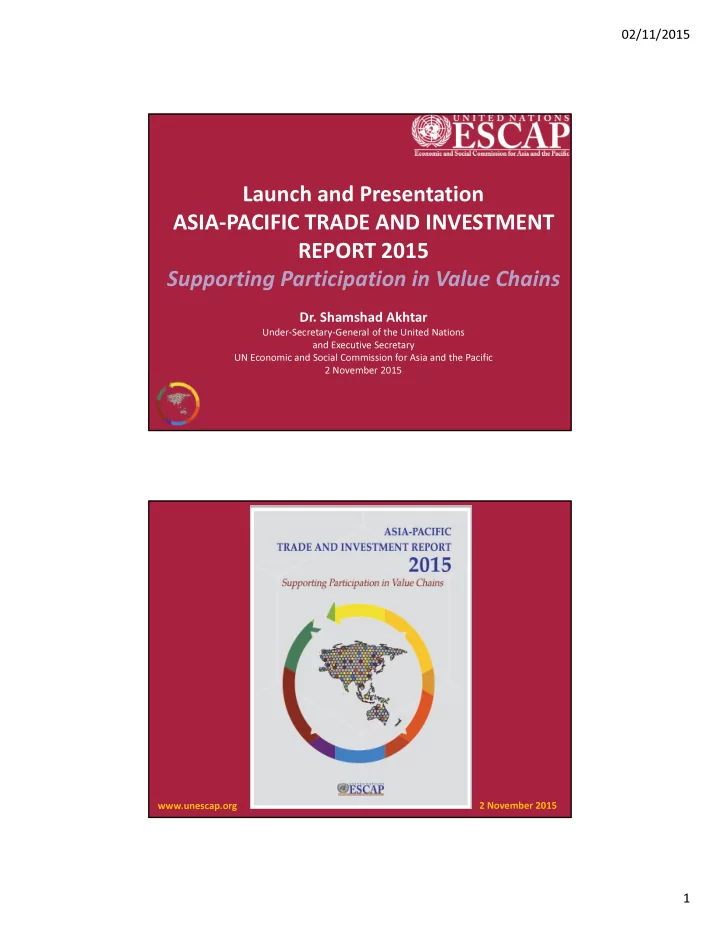
Launch and Presentation ASIA-PACIFIC TRADE AND INVESTMENT REPORT 2015 Supporting Participation in Value Chains

  • Dr. Shamshad Akhtar

Under-Secretary-General of the United Nations and Executive Secretary UN Economic and Social Commission for Asia and the Pacific 2 November 2015 www.unescap.org 2 November 2015

slide-2
SLIDE 2

02/11/2015 2

Outline

  • Comprehensive assessment of recent trends in trade and investment flows and

policies

  • Trade agreements and facilitation
  • Global value chains (GVCs) are changing the patterns of trade and investment and

allow for new means of regional integration

  • Need to better understand the nature of the developing countries’ participation

and challenges faced by them

  • Backed by empirical analysis and anecdotal evidence, the Report provides a range
  • f policy options for different stages of participation in global value chains; entry,

expanding and upgrading

  • Online compendium of country briefs with up-to-date facts on their participation in

trade, investment, regional trade agreements available in English and in the language of each country

PART I: RECENT TRENDS AND DEVELOPMENTS

slide-3
SLIDE 3

02/11/2015 3

Outcome for 2014:

Asia-Pacific, export growth %

Total exports grew by 1.6% in 2014 and were weak in the first half of 2015. Excluding China, exports from the region fell 0.4% in 2014. No indication

  • f

merchandise export growth recovery in 2015 but trends could improve by 2016.

Outcome for 2014:

Asia-Pacific, import growth %

Total imports fell by 0.9% in 2014. China’s slowing production has resulted in the fall of regional intermediate and commodity imports. Imports by the Russian Federation dropped by -30% in real terms (2014).

slide-4
SLIDE 4

02/11/2015 4

Prospects for 2015-2016:

China’s slowdown one of the factors weighing on the growth outlook

Source: Calculations by ESCAP and ECLAC

Growth in exports from the region at 5.1% and imports at 6.1% in 2014 Region’s exports almost doubled

  • ver 2005-20014

Other commercial services in total exports increased from 38% to 45% and of travel services grew from 28% to 31%. Almost half regional services exports from four economies: China, India, Japan, and Singapore Access to services also linked to GVC participation.

APTIR 2015: Services Trade

Region remains a net importer of commercial services.

Services export growth (%) outperforming merchandise trade but both downward

slide-5
SLIDE 5

02/11/2015 5

Services export by major economies (%)

Region received $533 b, 43% of total global inflows in 2014, with China the largest recipient $129 billion in 2014. Outflows from developing economies in the region up by 20%, reach $450 b Investment in services sector catching up with manufacturing. Steady increases in recent years in M&A activity reaching $123 b in 2014, compared with $279 b for greenfield.

Asia and the Pacific inflows % share of global FDI

slide-6
SLIDE 6

02/11/2015 6

Intra-regional FDI flows Selected Countries, 2012-2014

Flows between subregions concentrated in key ‘corridors’

Trade facilitation and costs: 1% increase in TF implementation reduces costs by 2.3%

WTO TFA will become the new standard for trade facilitation. Trade costs of North and Central Asian economies remain about three times higher than those of East and South-East Asia. A 1% increase in the level

  • f trade facilitation

implementation is associated with a decrease in trade costs of 2.3%.

slide-7
SLIDE 7

02/11/2015 7

Trade policies direction

Type of measure World Asia-Pacific region Import 196 62

  • f which tariffs

(86) (35) Export 54 35 Other 22 11 Total 272 108 Type of measure World Asia-Pacific region Import 265 67

  • f which tariffs

(228) (47) Export 21 13 Other 5 Total 291 80

Increasing restrictive measures across the region, dominated by behind-the-border non- tariff measures. Economies in the region accounted for 40% of all trade-restrictive measures introduced globally but only 27% of liberalizing measures. Need for further progress in extending preferences for LDCs to services trade.

New trade restrictive measures New liberalizing measures

Trade interventions continue in restrictive direction

slide-8
SLIDE 8

02/11/2015 8

Mega trade agreements

Aggregate shares in %

PART II: SUPPORTING PARTICIPATION IN VALUE CHAINS

slide-9
SLIDE 9

02/11/2015 9

Region plays a major role on GVC supply side: 43% of global intermediate exports & 39% of global imports . Not yet a major source

  • f final demand, but in

post-crisis period, the core of final demand has started to shift towards the region. GVCs participation: 90% concentrated on 10 Asian countries. The low-income countries are largely bypassed by GVCs.

Global Value Chains: Stylized facts on Asia and the Pacific participation

Shares in global exports of GVC-intermediate products, 2013

More than 65% of the GVC intermediate imports by Asia-Pacific economies are sourced within the region

  • -shows the rising role of

South-South trade. The destination

  • f

intraregional intermediate exports by all income groups has been shifting from high-income destinations toward the middle income ones. South-South trade in the regional value chains rose between 22 to 43 percentage points during the period 1995 to 2013 depending

  • n

income levels.

GVCs enhance intraregional shifting of intra-regional intermediate
slide-10
SLIDE 10

02/11/2015 10

Services are a significant input in manufacturing production and exports globally and regionally. Services contributed 29% to the regional industrial exports in 2009. Exports of high-tech industrial sectors participating in GVC, especially transport equipment, tend to have higher services content than

  • ther sectors (37%).

Share of imported services in industrial exports increased from 7.6% in 1995 to 11.1% in

  • 2009. Particularly rapid

increase for business services

GVCs and services value added in gross industrial exports: 1995-2009

  • Trade cost reduction
  • Development of soft infrastructure
  • Improvement in market access through regional economic integration
  • Mutual recognition of standards and efforts toward standardization of rules
  • Focused

promotion

  • f

LDCs participation (hard infrastructure, trade facilitation)

  • Best practice regulatory regimes
  • Investment in technologies to improve productivity needed for migration to

higher value-added GVC segments

Global Value Chains: Where to intervene?

slide-11
SLIDE 11

02/11/2015 11

From technology diffusion to national upgrading – the role of absorptive capacity

Global Value Chains can support technology transfer and innovation GVC Participation: Key policy priorities for different stages

  • Hard Infrastructure: connectivity , energy and logistics
  • Domestic regulatory reforms
  • Trade and investment liberalization and trade facilitation

Securing entry to GVCs

  • Competitive environment and strong domestic services
  • Preferential trade agreements to support regional integration
  • Soft infrastructure: open financial services backed by strong regulation, education

and training to increase absorptive capacity of firms and workers, ICT development

Expanding participation in GVCs

  • Building innovative, human and firm capital
  • Governance and intellectual property protection
  • Harmonization of rules and standards with international norms
  • Openness to FDI and imported technology

Upgrading within GVCs and creating new GVCs

slide-12
SLIDE 12

02/11/2015 12

Summing up

  • Trade-led growth strategies will be difficult to implement in weakened external

environment.

  • Many economies impacted by slowing growth in China, but also new
  • pportunities from structural reforms in large emerging economies overall.
  • Countries need upgraded policies to adjust to the ‘new normal’ of slower trade

growth. GVCs continue to reshape regional trade and investment. GVCs are reshaping approaches to trade and investment policies at all levels. Soft and hard connectivity.

  • Further efforts needed to strengthen regional trade architecture, maintain open

trade policies, and boost trade facilitation.

Thank you. For a copy of the full report and country briefs please visit: www.unescap.org