Lattice-Theoretic Data Flow Analysis Framework Lattices Define - - PDF document

lattice theoretic data flow analysis framework lattices
SMART_READER_LITE
LIVE PREVIEW

Lattice-Theoretic Data Flow Analysis Framework Lattices Define - - PDF document

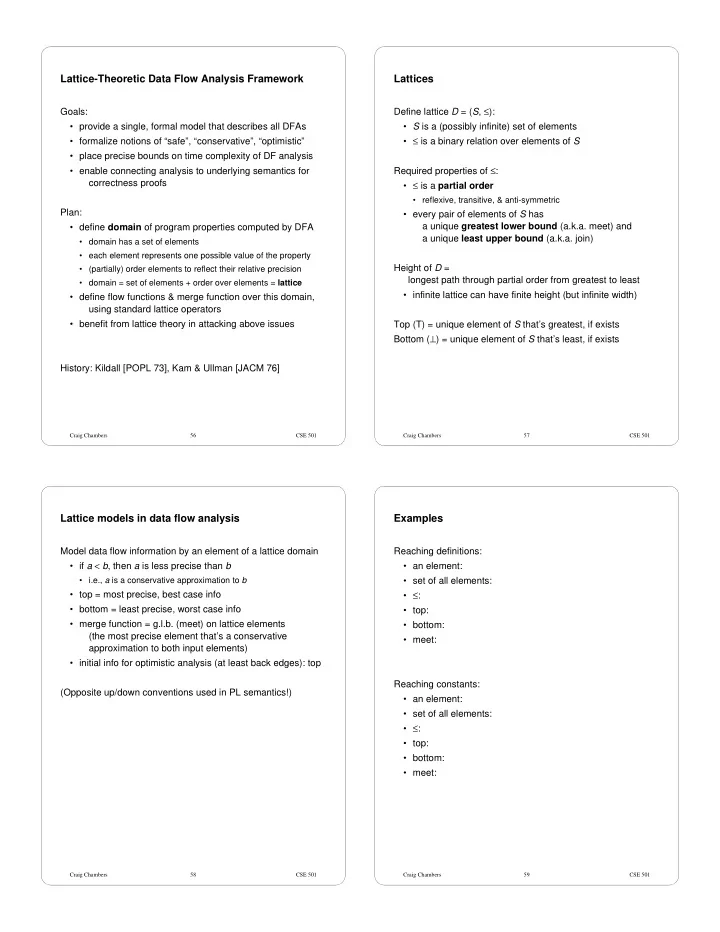
Lattice-Theoretic Data Flow Analysis Framework Lattices Define lattice D = ( S , ): Goals: provide a single, formal model that describes all DFAs S is a (possibly infinite) set of elements is a binary relation over elements of


slide-1
SLIDE 1

Craig Chambers 56 CSE 501

Lattice-Theoretic Data Flow Analysis Framework

Goals:

  • provide a single, formal model that describes all DFAs
  • formalize notions of “safe”, “conservative”, “optimistic”
  • place precise bounds on time complexity of DF analysis
  • enable connecting analysis to underlying semantics for

correctness proofs Plan:

  • define domain of program properties computed by DFA
  • domain has a set of elements
  • each element represents one possible value of the property
  • (partially) order elements to reflect their relative precision
  • domain = set of elements + order over elements = lattice
  • define flow functions & merge function over this domain,

using standard lattice operators

  • benefit from lattice theory in attacking above issues

History: Kildall [POPL 73], Kam & Ullman [JACM 76]

Craig Chambers 57 CSE 501

Lattices

Define lattice D = (S, ≤):

  • S is a (possibly infinite) set of elements
  • ≤ is a binary relation over elements of S

Required properties of ≤:

  • ≤ is a partial order
  • reflexive, transitive, & anti-symmetric
  • every pair of elements of S has

a unique greatest lower bound (a.k.a. meet) and a unique least upper bound (a.k.a. join) Height of D = longest path through partial order from greatest to least

  • infinite lattice can have finite height (but infinite width)

Top (T) = unique element of S that’s greatest, if exists Bottom (⊥) = unique element of S that’s least, if exists

Craig Chambers 58 CSE 501

Lattice models in data flow analysis

Model data flow information by an element of a lattice domain

  • if a < b, then a is less precise than b
  • i.e., a is a conservative approximation to b
  • top = most precise, best case info
  • bottom = least precise, worst case info
  • merge function = g.l.b. (meet) on lattice elements

(the most precise element that’s a conservative approximation to both input elements)

  • initial info for optimistic analysis (at least back edges): top

(Opposite up/down conventions used in PL semantics!)

Craig Chambers 59 CSE 501

Examples

Reaching definitions:

  • an element:
  • set of all elements:
  • ≤:
  • top:
  • bottom:
  • meet:

Reaching constants:

  • an element:
  • set of all elements:
  • ≤:
  • top:
  • bottom:
  • meet:
slide-2
SLIDE 2

Craig Chambers 60 CSE 501

Some typical lattice domains

Powerset lattice: set of all subsets of a set S

  • ordered by ⊆ or ⊇
  • top & bottom = ∅ & S, or vice versa
  • height = |S| (infinite if S is infinite)
  • “a collecting analysis”

A lifted set: a set of incomparable values, plus top & bottom

  • e.g., reaching constants domain, for a particular variable:
  • height = 3 (even though width is infinite!)

Two-point lattice: top and bottom

  • computes a boolean property

Single-point lattice: just bottom

  • trivial do-nothing analysis

T ⊥ x=0 x=1 x=2 ... x=-1 x=-2 ...

Craig Chambers 61 CSE 501

Tuples of lattices

Often helpful to break down a complex lattice into a tuple of lattices, one per variable/stmt/... being analyzed Formally: DT = <ST, ≤T> = (D = <S, ≤>)N

  • ST = S1 × S2 × ... × SN
  • element of tuple domain is a tuple of elements from each

variable’s domain

  • ith component of tuple is info about ith variable/stmt/...
  • <..., d1i, ...> ≤T <..., d2i, ...> ≡ d1i ≤ d2i, ∀i
  • i.e. pointwise ordering
  • meet: pointwise meet
  • top: tuple of tops
  • bottom: tuple of bottoms
  • height(DT) = N * height(D)

Powerset(S) lattice is isomorphic to a tuple of two-point lattices,

  • ne two-point lattice element per element of S
  • i.e., a bit-vector!

Craig Chambers 62 CSE 501

Example: reaching constants

How to model reaching constants for all variables? Informally: each element is a set of the form {..., x → k, ...}, with at most one binding for x One lattice model: a powerset of all x → k bindings

  • S = pow({ x → k | ∀x, ∀k })
  • ≤ = ⊆
  • height?

Another lattice model: N-tuple of 3-level constant prop. lattices, for each of N variables

  • (

)N

  • height?

Are they the same? If not, which is better? T ⊥ x=0 x=1 x=2 ... x=-1 x=-2 ...

Craig Chambers 63 CSE 501

Analysis of loops in lattice model

Consider: (Assume B(dhead) computes dbackedge) Want solution to constraints: dhead = dentry ∩ dbackedge dbackedge = B(dhead) Let F(d) = dentry ∩ B(d) Then want fixed-point of F: dhead = F(dhead)

B

dentry dbackedge dhead

slide-3
SLIDE 3

Craig Chambers 64 CSE 501

Iterative analysis in lattice model

Iterative analysis computes fixed-point by iterative approximation: F0 = dentry ∩ T = dentry F1 = dentry ∩ B(F0) = F(F0) = F(dentry) F2 = dentry ∩ B(F1) = F(F1) = F(F(F0)) = F(F(dentry)) . . . Fk = dentry ∩ B(Fk-1) = F(Fk-1) = F(F(...(F(dentry))...)) until Fk+1 = dentry ∩ B(Fk) = F(Fk) = Fk Is k finite? If so, how big can it be?

Craig Chambers 65 CSE 501

Termination of iterative analysis

In general, k need not be finite Sufficient conditions for finiteness:

  • flow functions (e.g. F) are monotonic
  • lattice is of finite height

A function F is monotonic iff: d2 ≤ d1 ⇒ F(d2) ≤ F(d1)

  • for application of DFA, this means that giving a flow function

at least as conservative inputs (d2 ≤ d1) leads to at least as conservative outputs (F(d2) ≤ F(d1)) For monotonic F over domain D, the maximum number of times that F can be applied to itself, starting w/ any element of D, w/o reaching fixed-point, is height(D)-1

  • start at top of D
  • for each application of F, either it’s a fixed-point, or the

result must go down at least one level in lattice

  • eventually must hit a fixed-point

(which will be the best fixed-point) or bottom (which is guaranteed to be a fixed-point), if D of finite height

Craig Chambers 66 CSE 501

Complexity of iterative analysis

How long does iterative analysis take? l: depth of loop nesting n: # of stmts in loop t: time to execute one flow function k: height of lattice

Craig Chambers 67 CSE 501

Another example: integer range analysis

For each program point, for each integer-typed variable, calculate (an approximation to) the set of integer values that can be taken on by the variable

  • use info for constant folding comparisons,

for eliminating array bounds checks, for (in)dependence testing of array accesses, for eliminating overflow checks What domain to use?

  • what is its height?

What flow functions to use?

  • are they monotonic?
slide-4
SLIDE 4

Craig Chambers 68 CSE 501

Example

for i := 0 to N-1 ... a[i] ... end ... i >= 0 && i < N? t := a[i] ... i := i + 1 i := 0 i <= N-1?

Craig Chambers 69 CSE 501

Widening operators

If domain is tall, then can introduce artificial generalizations (called widenings) when merging at loop heads

  • ensure that only a finite number of widenings are possible
  • not easy to design the “right” widening strategy

Craig Chambers 70 CSE 501

A generic worklist algorithm for lattice-theoretic DFA

Maintain a mapping from each program point to info at that point

  • optimistically initialize all pp’s to T

Set initial pp’s (e.g. entry/exit point) to their correct values Maintain a worklist of nodes whose flow functions need to be evaluated

  • initialize with all nodes in graph
  • include explicit meet & widening-meet nodes

While worklist nonempty do Remove a node from worklist Evaluate the node’s flow function, given current info on predecessor/successor pp’s, allowing it to change info on predecessor/successor pp’s If any pp info changed, then put adjacent nodes on worklist (if not already there) For faster analysis, want to follow topological order

  • number nodes in topological order
  • remove nodes from worklist in increasing topological order

Craig Chambers 71 CSE 501

Sharlit

A data flow analyzer generator [Tjiang & Hennessy 92]

  • analogous to YACC

User writes basic primitives:

  • control flow graph representation
  • nodes are instructions, not basic blocks
  • domain (“flow value”) representation and key operations
  • init
  • copy
  • is_equal
  • meet
  • flow functions for each kind of instruction
  • action routines to optimize after analysis

Sharlit generates iterative dataflow analyzer from these pieces + easy to build, extend − not highly efficient, so far...

slide-5
SLIDE 5

Craig Chambers 72 CSE 501

Path compression

Can improve analysis efficiency by summarizing effect of sequences of nodes User can define path compression operations to collapse nodes together

  • collapse linear sequence of nodes

⇒ summarizes effect of whole BB in a single node

  • presumes a fixed GEN/KILL bit-vector structure to be effective
  • collapse trees ⇒ extended BB’s
  • collapse merges & loops as in interval analysis
  • use simplification to analyze reducible parts efficiently
  • use iteration to handle nonreducible parts

+ gets efficiency, preserves modularity & generality − doesn’t support data-dependent flow functions, cannot simulate optimizations during analysis Performance results for code quality of generated optimizer, but not for compilation speed of optimizer

Craig Chambers 73 CSE 501

Vortex IDFA framework

Like Sharlit, except a compiler library rather than a compiler-compiler User defines a subclass of AnalysisInfo to represent elements of domain

  • copy
  • merge (lattice g.l.b. operator)
  • generalizing_merge (g.l.b. with optional widening)
  • as_general_as (lattice ≤ operator)

User invokes traverse to perform analysis: cfg.traverse(direction, is_iterative?, initial_analysis_info, λ(rtl, info){ rtl.flow_fn(info) }) Flow function returns an AnalysisResult: one of

  • keep instruction and continue analysis w/ updated info(s)
  • delete instruction/constant-fold branch
  • replace instruction with instruction or subgraph

ComposedAnalysis supports running multiple analyses interleaved at each instruction

Craig Chambers 74 CSE 501

Features of Vortex IDFA

Big idea: separate analyses and transformations, make framework compose them appropriately

  • don’t have to simulate the effect of transformations during

analysis

  • can run analyses in parallel if each provides opportunities

for the other

  • sometimes can achieve strictly better results this way than if run

separately in a loop

  • more general transformations supported (e.g. inlining) than

Sharlit Exploit inheritance & closures Analysis speed is not stressed

  • no path compression
  • no “compilation” of analysis with framework

[Vortex’s interprocedural analysis support discussed later]