Latest Litigation Developments Bringing and Defending Claims and - - PowerPoint PPT Presentation

latest litigation developments
SMART_READER_LITE
LIVE PREVIEW

Latest Litigation Developments Bringing and Defending Claims and - - PowerPoint PPT Presentation

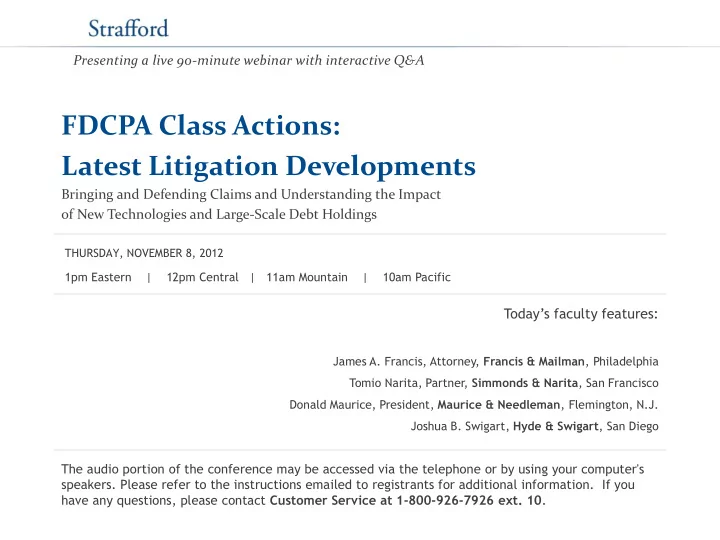
Presenting a live 90-minute webinar with interactive Q&A FDCPA Class Actions: Latest Litigation Developments Bringing and Defending Claims and Understanding the Impact of New Technologies and Large-Scale Debt Holdings THURSDAY, NOVEMBER 8,


slide-1
SLIDE 1

FDCPA Class Actions: Latest Litigation Developments

Bringing and Defending Claims and Understanding the Impact

  • f New Technologies and Large-Scale Debt Holdings

Today’s faculty features:

1pm Eastern | 12pm Central | 11am Mountain | 10am Pacific

The audio portion of the conference may be accessed via the telephone or by using your computer's

  • speakers. Please refer to the instructions emailed to registrants for additional information. If you

have any questions, please contact Customer Service at 1-800-926-7926 ext. 10.

THURSDAY, NOVEMBER 8, 2012

Presenting a live 90-minute webinar with interactive Q&A

James A. Francis, Attorney, Francis & Mailman, Philadelphia Tomio Narita, Partner, Simmonds & Narita, San Francisco Donald Maurice, President, Maurice & Needleman, Flemington, N.J. Joshua B. Swigart, Hyde & Swigart, San Diego

slide-2
SLIDE 2

Tips for Optimal Quality

Sound Quality If you are listening via your computer speakers, please note that the quality of your sound will vary depending on the speed and quality of your internet connection. If the sound quality is not satisfactory and you are listening via your computer speakers, you may listen via the phone: dial 1-866-320-7825 and enter your PIN when prompted. Otherwise, please send us a chat or e-mail sound@straffordpub.com immediately so we can address the problem. If you dialed in and have any difficulties during the call, press *0 for assistance. Viewing Quality To maximize your screen, press the F11 key on your keyboard. To exit full screen, press the F11 key again.

slide-3
SLIDE 3

Continuing Education Credits

For CLE purposes, please let us know how many people are listening at your location by completing each of the following steps:

  • In the chat box, type (1) your company name and (2) the number of

attendees at your location

  • Click the word balloon button to send

FOR LIVE EVENT ONLY

slide-4
SLIDE 4

FDCPA CLASS ACTIONS: LATEST LITIGATION DEVELOPMENTS

Donald Maurice Maurice & Needleman dsm@mnlawpc.com (908) 237-4570 Tomio Narita Simmonds & Narita LLP tnarita@snllp.com (415) 283-1010 Joshua B. Swigart Hyde & Swigart (619) 233-7770 James A. Francis Francis & Mailman, P.C. (215) 735-8600

slide-5
SLIDE 5

LEGAL DISCLAIMER This information is not intended to be legal advice and may not be used as legal

  • advice. Legal advice must be tailored to

the specific circumstances of each case. Every effort has been made to assure this information is up-to-date. It is not intended to be a full and exhaustive explanation of the law in any area, however, nor should it be used to replace the advice of your own legal counsel

slide-6
SLIDE 6

6 REASONS FDCPA CASES UNIQUELY SUITED FOR CLASS TREATMENT

1) Strict Liability Statute 2) Objective Least Sophisticated

Consumer Standard

3) FDCPA specifically contemplates class

actions as an enforcement mechanism

4) Class Representatives Can Recover

Individual AND Class Damages;

5) Cases Are Premised Upon Form

Collection Communications and Automated Practices

6) Damages Factors are Uniform;

6

slide-7
SLIDE 7

FDCPA IS A STRICT LIABILITY STATUTE

 Intent/knowledge/scienter irrelevant for most

provisions (some exceptions—1692d(5), e(4) and e(5) and bona fide error defense);

 No need for individualized ―reasonable

person‖/negligence analysis;

 See e.g. McCullough v. Johnson, Rodenburg &

Lauinger, LLC, 637 F.3d 939 (9th Cir. 2011)

7

slide-8
SLIDE 8

LEAST SOPHISTICATED CONSUMER STANDARD

 Letters/Communications Interpreted by an

  • bjective standard of the ―least sophisticated

consumer‖

 No need for individual class member inquiries

See Larocque v. TRS Recovery Services, Inc., __ F.R.D.___, 2012 WL 2921191 (D. Me. July 17, 2012 (certifying 3 classes)

8

slide-9
SLIDE 9

FDCPA CONTEMPLATES CLASS ACTIONS

DCs liable for: ―in the case of a class action, such amount for each named plaintiff as could be recovered [in an individual action] AND ―such amount as the court may allow for all other class members, without regarding to a minimum individual recovery, not to exceed the lesser

  • f $500,000 or 1 per centum of the net worth of the debt

collector‖. Section 1692k(a)(2)(B). See also Weiss v. Regal Collections, 385 F.3d 337, 345 (3d Cir. 2004) (―[r]epresentative actions, therefore, appear to be fundamental to the statutory structure of the FDCPA‖).

9

slide-10
SLIDE 10

CLASS REPS CAN RECOVER BOTH INDIVIDUAL AND CLASS DAMAGES

 Section 1692k(a)(2)(B) Relaxes Fed. R. Civ. P

Rule 23 adequacy requirement;

 Reps can explicitly recover more than Class

Members See Fry v. Hayt, Hayt & Landau, 198 F.R.D. 461, 472 (E.D. Pa. 2000)

10

slide-11
SLIDE 11

FORM COMMUNICATIONS AND AUTOMATED PRATICES

Collection Industry Premised Upon Use of:

  • form collection letters
  • automated calls
  • Use of ―talk offs‖ and

―scripts

11

slide-12
SLIDE 12

OVERWHELMING AUTHORITY FOR CERTIFYING FDCPA

CASES PREMISED UPON FORM COLLECTION LETTERS

 See Maxwell v. Arrow Fin. Servs., LLC, 2004 WL 719278 (N.D. Ill. Mar. 31, 2004)

(certifying statutory damages MFDCPA class based upon uniform collection practices); Gordon v. Corporate Receivables, 2010 WL 376386, *2 (D. R.I. Jan. 27, 2010) (commonality requirement ―easily met‖ and R. 23(b)(3) superiority and predominance found resulting in a certified class of recipients of form letters which were in violation of the FDCPA); Pettway v. Harmon Law Offices, P.C., 2005 WL 2365331, *12 (D. Mass. Sep. 27, 2005) (recipients of a form letter in violation of the FDCPA certified as a class); Silva v. National Telewire Corp., 2000 WL 1480269, *2-4 (D.N.H. Sept. 22, 2000) (class certified where class included recipients of a form letter found in violation of the FDCPA); Garland v. Cohen & Krassner, 2011 WL 6010211, *6 (E.D.N.Y. Nov. 29, 2011) (class certification predicated on a form letter which violated the FDCPA);

12

slide-13
SLIDE 13

OVERWHELMING AUTHORITY FOR CERTIFYING FDCPA

CASES PREMISED UPON FORM COLLECTION LETTERS

 see also Weiss v. Regal Collections, 385 F.3d 337, 345 (3d Cir. 2004)

(―[r]epresentative actions, therefore, appear to be fundamental to the statutory structure of the FDCPA‖); Castro v. Collecto, Inc., 634 F.3d 779, 782 (5th Cir. 2011) (certified FDCPA class predicated upon form letters sent to consumers that violated the FDCPA); Murray v. GMAC Mortg. Corp., 434 F.3d 948, 952-53 (7th Cir. 2006) (class certification statutory damages, under sister statute FCRA, appropriate in case of form letter that allegedly failed to make proper firm offer disclosure); Gonzales v. Arrow Financial Services, LLC, 233 F.R.D. 577 (S.D. Cal. 2006) (certifying class of recipients of a form letter issued by defendant debt collector); Gonzales v. Arrow Financial Services, LLC, 660 F.3d 1055, 1064 (9th Cir. 2011) (Ninth Circuit declined review of class certification); Hunt v. Check Recovery Systems, Inc., 241 F.R.D. 505 (N.D. Cal. Mar. 21, 2007) (certification of an FDCPA class predicated on form letter sent to members to collect for fees stemming from dishonored checks); Petrolito v. Arrow Financial Services, LLC, 221 F.R.D. 303 (D. Conn. 2004) (uniform collection practice that violated FDCPA presents certifiable class action).

13

slide-14
SLIDE 14

DAMAGES FACTORS UNIFORM

Statutory Damages Factors Are Defendant Oriented:

  • Frequency and persistence of non-

compliance;

  • Nature of noncompliance;
  • Resources of the debt collector;
  • Number of persons adversely affected;
  • Extent to which action was intentional;

Section 1692k(b)(2)

14

slide-15
SLIDE 15

CHALLENGING THE CLASS REP

The class representative’s claims must be

―typical‖ of other class members and the rep must be ―adequate‖ – i.e., they will ―fairly and adequately protect the interests of the class.‖ See Fed. Rule Civ.

  • Proc. 23(a)(3), 23(a)(4).

Defendants look for ways that the class

rep claims will distract from the litigation

  • r arguments that the rep has interests

that conflict with class

Careful research prior to deposition and

taking a thorough deposition is key

15

slide-16
SLIDE 16

CLASS REP HELD NOT ADEQUATE

 Beck v. Maximus, Inc., 457 F.3d 291 (3d Cir.

2006) (remanding to determine if BFE defense rendered class rep atypical and inadequate)

 Savino v. Computer Credit, Inc., 164 F.3d 81

(2d Cir. 1998) (denying cert; rep testified inconsistently on whether he received letter at issue)

 Dotson v. Portfolio Recovery Associates, 2009

WL 1559813 (E.D. Pa. June 3, 2009) (denying cert; unique defenses re: plaintiff’s credibility and cognitive disabilities)

16

slide-17
SLIDE 17

CLASS REP NOT ADEQUATE (CONT.)

 Fried v. National Action Financial Servs.,

Inc., 2011 WL 1547257 (D.N.J. April 20, 2011) (unique defense; class rep consented to third party contact)

 Wymer v. Huntington Bank Charleston, N.A.,

2011 WL 5526314 (S.D.W.Va. Nov. 14, 2011) (unique defense; whether rep actually owed a ―debt‖ following his bankruptcy)

 Richburg v. Palisades Collection LLC, 247

F.R.D. 457 (E.D. Pa. Jan. 28, 2008) (unique defense; whether class rep acknowledged debt and tolled SOL)

17

slide-18
SLIDE 18

CLASS REP FOUND ADEQUATE

 Meyer v. Portfolio Recovery Associates, _ F.3d

_, 2012 WL 4840814 (9th Cir. 2012) (TCPA class certified; class rep had multiple criminal convictions for offenses involving dishonesty)

 Sykes v. Mel Harris And Associates, 2012 WL

3834802 (S.D.N.Y. Sept. 4, 2012) (FDCPA class certified; BFE defenses, validity of debt not major focus of case)

 Herrera v. LCS Fin. Servs, 274 F.R.D. 666

(N.D. Cal. June 1, 2011) (FDCPA class certified; class rep committed perjury on loan application)

18

slide-19
SLIDE 19

HOW CREDITORS ARE BEING SUED

  • Creditors generally are not going to be liable

under the FDCPA, but minimal collector participation eliminates the creditor exemption. See e.g., Larson v. Evanston Northwestern Healthcare Corp.,

1999 U.S. Dist. LEXIS 11380 (N.D. Ill. July 19, 1999)

  • Creditors face FDCPA-type exposure under

certain state laws – e.g., CA, FL, GA, PA, TX

  • Common law claims – Creditors sued in FDCPA

class actions using alternative common law claims, like negligence; IIED; Invasion of Privacy. See Tourgeman v. Collins Financial Services, Inc., 2012 WL 3731807 (S.D. Cal. Aug. 29, 2012)(msj for Dell Financial Services on negligence claim); Colorado Capital v. Owens, 227 F.R.D. 181 (E.D.N.Y. 2005) (negligent hiring)

19

slide-20
SLIDE 20

THE NET WORTH LIMITATION PROVIDES A

CEILING, NOT A FLOOR

 The net worth cap is a ―protective‖ provision

designed to prevent large damage awards. Sanders v. Jackson, 209 F.3d 998, 1002 (7th

  • Cir. 2000).

 Court must consider the 1692k(b)(2) factors

to determine how much if any to award, including ―the frequency and persistence of noncompliance by the debt collector, the nature of such noncompliance, the resources

  • f the debt collector, the number of persons

adversely affected, and the extent to which the debt collector's noncompliance was intentional.‖

20

slide-21
SLIDE 21

JERMAN V. CARLISLE – A ROADMAP TO

ZERO DAMAGES

 After the plaintiff prevailed in U.S.

Supreme Court in FDCPA class action, zero damages awarded on remand. See Jerman v. Carlisle, et al., 2011 WL 1434679 (N.D. Ohio April 14, 2011)

No frequency or persistence; one letter

to each class member

Nature of noncompliance was ―trivial‖ No class member ―adversely affected‖ Noncompliance was not intentional

21

slide-22
SLIDE 22

USING DUKES IN FDCPA CLASS ACTIONS

Dukes is a strong reminder that a

―rigorous analysis‖ of Rule 23 requirements must occur and class certification is never routine. Wal-Mart Stores, Inc. v. Dukes, 131 S.Ct. 2541, 2550 (2011) (―an exception to the usual rule that litigation is conducted by and on behalf of the individual parties only‖).

Class members must have ―suffered the

same injury‖ and commonality requires ―common answers‖. Id. at 2551.

22

slide-23
SLIDE 23

DENYING FDCPA CLASS WITH DUKES

Thorne v. ARM, Inc., 2012 WL 3090039

(S.D.Fla. June 28, 2012) (no proof of numerous class members with section 1692d(6) claims)

Marshall v. Bonded Adjustment Co., 2012

WL 3044246 (E.D. Wash. July 25, 2012) (individual issues on whether class members improperly billed for ―accepted‖ medical claims)

Soto v. Commercial Recovery Systems,

2011 WL 6024514 (N.D.Cal. Dec. 5, 2011) (individual issues on whether homes were

  • wner occupied)

23

slide-24
SLIDE 24

CLASS SIZE

A class action may not be maintained unless ―the class is so numerous that joinder of all members is impracticable.‖ Fed.R.Civ.Pro. Rule 23(a)(1)

Georgine v. Amchem Products, Inc., 83 F.3d

610, 626 n.11 (3rd Cir. 1996), aff’d, Amchem Products, Inc. v. Windsor, 521 U.S. 591, 117 S.Ct. 2231 (1997) (millions of members)

Town of New Castle v. Yonkers Contracting

Co., 1993 U.S. Dist. LEXIS 17492 (S.D.N.Y.

  • Dec. 13, 1993) (15 members)

24

slide-25
SLIDE 25

CLASS SIZE AND DAMAGES

TOO MANY MEMBERS AND NOT ENOUGH MONEY

 Atwood v. Johnson, 2011 U.S. Dist. LEXIS 84988

(D. Minn. Aug. 1, 2011) (paltry recoveries are against the interests of class members)

 Jancik v. Cavalry Portfolio Services, LLC, No. 06-

3104, 2007 U.S. Dist. LEXIS 49500, 2007 WL 1994026 (D.Minn. July 3, 2007)(―Defendant should not be allowed to avoid paying damages simply because each individual plaintiff will receive only a small recovery.‖)

25

slide-26
SLIDE 26

CLASS DAMAGES

§ 1692k(a)(2)(B)(ii) – ―[]such amount as the court may allow for all other class members, without regard to a minimum individual recovery . . .‖

Thomas v. NCO Financial Systems, Inc.,

  • No. Civ.A.00-5118, 2002 WL 1773035, at

*4, n.2 (E.D. Pa. July 31, 2002)

McCall v. Drive Fin. Servs., L.P., 440 F.

  • Supp. 2d 388 (E.D. Pa. 2006)

26

slide-27
SLIDE 27

PUTATIVE CLASSES AND RULE 68 FILINGS

 Timing of Filing – Prior to the certification of the

class.

 Precertification Effects  Full Individual Relief – Warren v. Sessoms & Rogers,

P.A., 2012 U.S. App. 552 (4th Cir. 2012).

 Effects on the Putative Class - Pitts v. Terrible, Inc.,

653 F.3d 1081 (9th Cir. 2011)

27

slide-28
SLIDE 28

LOSS OF SUBJECT MATTER JURISDICTION

Does service of Rule 68 to class representative, prior to class cert., deprive the Court of subject matter jurisdiction?

Sandoz v. Cingular Wireless, LLC, 553 F.3d 913 (5th

  • Cir. 2008) – Yes

Damasco v. Clearwire Corp., 662, F.3d 891 (7th Cir. 2011). – Yes

Pitts v. Terrible, Inc., 653 F.3d 1081 (9th Cir. 2011) – No

28

slide-29
SLIDE 29

CLASS DISCOVERY – PRE-CERTIFICATION

 Bifurcation of Discovery  The Merits v. Class Paradox; Ryabyshchuk v.

Citibank; 11-CV-1236 IEG(WVG) [Docket No. 31] (S.D. Cal. 2012), but what was the real effect?

 Rule 23 and its Limitations  Is Typicality Going To Be An Issue? Garcia v.

Solomon, Grindle, 11-CV-1805 DMS(BLM) [Docket

  • No. 40], (S.D. Cal. 2012)

29

slide-30
SLIDE 30

CLASS DISCOVERY – PRE-CERTIFICATION

 Communication with Putative Class Members  Purposes – What purpose would class counsel need to

contact putative class members pre-certification?

 Generally. BelAire – West Landscape, Inc., v.

Superior Court, (2007) 149 Cal.App.4th 554; Pioneer Electronics (USA), Inc. v. Superior Court, (2007) 40 Cal.4th 360.

 Federal Treatment. Bottoni v. Sallie Mae, Inc., 2012

U.S. Dist. LEXIS 76451 (N.D. Cal. 2012).

 Limitations, Protective Orders and Burden Shifting.

30

slide-31
SLIDE 31

CLASS DISCOVERY – PRE-CERTIFICATION

 Specific Examples and Communication  Adams v. AllianceOne, 08-CV-00248 JAH(WVG)

[Docket No. 44]

 Initial Communication Approved and Sent  Follow-up Communication  Results?

31

slide-32
SLIDE 32

CLASS REPRESENTATIVE REPLACEMENT

 Class Representative Lacks Standing  State Court Treatment. CashCall, Inc. v. Superior

Court, 159 Cal. App. 4th 273.

 Ability to Substitute Class Representatives  Standing From Inception Issue.  CA State Court – See CashCall

32

slide-33
SLIDE 33

CLASS REPRESENTATIVE REPLACEMENT

 Federal Courts – Not So Quick……  Lidie v. California, 478 F.2d 552 (9th Cir. 1973)  Lierboe v. State Farm Mutual Automobile Insurance

Co., 350 F.3d 1018 (9th Cir. 2003)

 Zapien v. Washington Mutual, Inc., 2008 U.S. Dist.

LEXIS 67137 (S.D. Cal. 2008)

33

slide-34
SLIDE 34

ARBITRATION & CLASS WAIVER

AT&T Mobility LLC v. Concepcion, 131 S.

  • Ct. 1740 (U.S. 2011) (1,488 total cites as of

10/25/2012)

 Purpose of FAA is to promote arbitration  Class arbitration would destroy informality of

arbitration

 Class arbitration not envisioned by FAA  It would increase risk to defendants

34

slide-35
SLIDE 35

POST CONCEPCION

Bellows v. Midland Credit Mgmt., 2011

U.S. Dist. LEXIS 48237 (S.D. Cal. May 4, 2011)

Yaqub v. Experian Info. Solutions, Inc.,

2011 U.S. Dist. LEXIS 156427 (C.D. Cal. June 10, 2011)

Lucy v. Bay Area Credit Servs. LLC, 792

  • F. Supp. 2d 320 (D. Conn. 2011)

Wilson v. Cash Am. Int'l, Inc., 2012 U.S.

  • Dist. LEXIS 12240 (N.D. Tex. Feb. 1,

2012)

35

slide-36
SLIDE 36

POST CONCEPCION

Hagy v. Demers & Adams, LLC, 2012 U.S.

  • Dist. LEXIS 12699 (S.D. Ohio Feb. 2,

2012)

Gray v. Suttell & Assocs., 2012 U.S. Dist.

LEXIS 77906 (E.D. Wash. Mar. 16, 2012))

Shaffer v. HSBC Bank Nev., 2012 U.S.

  • Dist. LEXIS 69818 (S.D. W. Va. May 18,

2012)

Sweiger v. Calvary Portfolio Servs., LLC,

2012 U.S. Dist. LEXIS 73909 (W.D. Pa. May 29, 2012)

36

slide-37
SLIDE 37

POST CONCEPCION

Italian Colors Rest. v. Am. Express Travel

Related Servs. Co. (In re Am. Express

  • Merchs. Litig.), 667 F.3d 204 (2d Cir.

2012) (“Amex III”) rehearing den. 681 F.3d 139 (2d Cir. 2012), pet. for cert. filed No 12-133, 7/30/12

37