Late submissions lose 25% the first day, 50% the second day and on - - PDF document

late submissions lose 25 the first day 50 the second day
SMART_READER_LITE
LIVE PREVIEW

Late submissions lose 25% the first day, 50% the second day and on - - PDF document

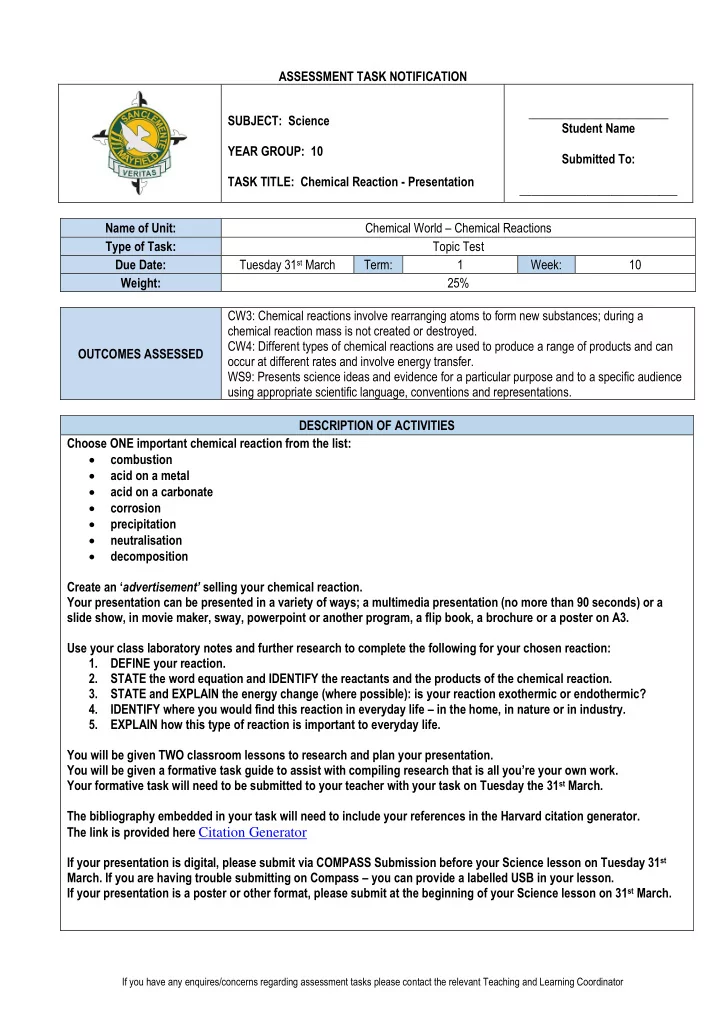
ASSESSMENT TASK NOTIFICATION _______________________ SUBJECT: Science Student Name YEAR GROUP: 10 Submitted To: TASK TITLE: Chemical Reaction - Presentation __________________________ Name of Unit: Chemical World Chemical Reactions


slide-1
SLIDE 1

If you have any enquires/concerns regarding assessment tasks please contact the relevant Teaching and Learning Coordinator

ASSESSMENT TASK NOTIFICATION SUBJECT: Science YEAR GROUP: 10 TASK TITLE: Chemical Reaction - Presentation _______________________ Student Name Submitted To: __________________________ Name of Unit: Chemical World – Chemical Reactions Type of Task: Topic Test Due Date: Tuesday 31st March Term: 1 Week: 10 Weight: 25% OUTCOMES ASSESSED CW3: Chemical reactions involve rearranging atoms to form new substances; during a chemical reaction mass is not created or destroyed. CW4: Different types of chemical reactions are used to produce a range of products and can

  • ccur at different rates and involve energy transfer.

WS9: Presents science ideas and evidence for a particular purpose and to a specific audience using appropriate scientific language, conventions and representations. DESCRIPTION OF ACTIVITIES Choose ONE important chemical reaction from the list:

  • combustion
  • acid on a metal
  • acid on a carbonate
  • corrosion
  • precipitation
  • neutralisation
  • decomposition

Create an ‘advertisement’ selling your chemical reaction. Your presentation can be presented in a variety of ways; a multimedia presentation (no more than 90 seconds) or a slide show, in movie maker, sway, powerpoint or another program, a flip book, a brochure or a poster on A3. Use your class laboratory notes and further research to complete the following for your chosen reaction:

  • 1. DEFINE your reaction.
  • 2. STATE the word equation and IDENTIFY the reactants and the products of the chemical reaction.
  • 3. STATE and EXPLAIN the energy change (where possible): is your reaction exothermic or endothermic?
  • 4. IDENTIFY where you would find this reaction in everyday life – in the home, in nature or in industry.
  • 5. EXPLAIN how this type of reaction is important to everyday life.

You will be given TWO classroom lessons to research and plan your presentation. You will be given a formative task guide to assist with compiling research that is all you’re your own work. Your formative task will need to be submitted to your teacher with your task on Tuesday the 31st March. The bibliography embedded in your task will need to include your references in the Harvard citation generator. The link is provided here Citation Generator If your presentation is digital, please submit via COMPASS Submission before your Science lesson on Tuesday 31st

  • March. If you are having trouble submitting on Compass – you can provide a labelled USB in your lesson.

If your presentation is a poster or other format, please submit at the beginning of your Science lesson on 31st March.

slide-2
SLIDE 2

If you have any enquires/concerns regarding assessment tasks please contact the relevant Teaching and Learning Coordinator

METHOD OF SUBMISSION Late submissions lose 25% the first day, 50% the second day and on the third day no grade is given. Sources that have been used in your assignment need to be acknowledged in a reference list. Computer / printer malfunctions are not considered a valid excuse for submitting an assessment late. Extensions must be requested from the TLC five days before the due date Assessment requirements and penalties are explained in full in Assessment Guidelines. It is the responsibility of students to have read and understood the task and marking guidelines and submitted their own work and referenced any work used from other sources and have not plagiarised the work of others. FEEDBACK Individual feedback will be given within the marking guidelines rubric indicating strengths and areas for development. MARKING RUBRIC You will be assessed on your ability to meet rubric criteria attached.

  • Define a chemical reaction.
  • State the word equation.
  • Identify the reactants and products.
  • State and explain the energy change (where possible)
  • Identify where you find this reaction and explain its importance in everyday life.
  • Present your chemical reaction advertisement for an audience, clearly

communicating the usefulness and importance of your reaction, using appropriate scientific language for your audience, conventions and representations.

  • Write information in your own words and provide a bibliography.
slide-3
SLIDE 3

If you have any enquires/concerns regarding assessment tasks please contact the relevant Teaching and Learning Coordinator

MARKING RUBRIC

GRADE CRITERIA E D C B A

KNOWLEDGE AND UNDERSTANDING

  • Student demonstrated

a limited understanding to define a chemical reaction, state the word equation, identify the reactants and products, state and explain the energy change.

  • Student demonstrated

a basic understanding to define a chemical reaction, state the word equation, identify the reactants and products, state and explain the energy change.

  • Student demonstrated

a sound understanding to define a chemical reaction, state the word equation, identify the reactants and products, state and explain the energy change.

  • Student demonstrated

a thorough understanding to define a chemical reaction, state the word equation, identify the reactant and products, state and explain the energy change.

  • Student

demonstrated an extensive understanding to define a chemical reaction, state the word equation, identify the reactant and products, state and explain the energy change.

  • Student identifies

some uses and applications for where this reaction is found

  • No explanations for its

importance in everyday life.

  • Student identifies

some uses and applications for where this reaction is found

  • Limited explanations

for its importance in everyday life.

  • Student details the

uses and applications for where this reaction is found

  • Explanations for its

importance in everyday life provided.

  • Student details

thoroughly the uses and applications for where this reaction is found

  • Detailed explanations

for its importance in everyday life provided.

  • Student details

extensively the uses and applications for where this reaction is found

  • Thorough

explanations for its importance in everyday life provided. WORING SCIENTIFICALLY

  • Students do not submit

formative research template and evidence

  • f research being all

their own work.

  • No bibliography

provided

  • Students submit

formative research template with little evidence of research being all their own work.

  • Bibliography

incomplete. Harvard generator not utilised.

  • Students submit

formative research template and some evidence of research being all their own work.

  • Bibliography detailing

2 sources provided in Harvard generator.

  • Students submit

formative research template and evidence

  • f research being all

their own work.

  • Bibliography detailing

2 sources provided in Harvard generator.

  • Students submit

formative research template and evidence of research being all their own work, showing comprehensive rewriting in their own words,

  • Bibliography

detailing TWO sources provided in Harvard generator.

  • Presentation

information is poorly presented.

  • No images included.
  • No attempt to ‘sell’

Chemical reaction.

  • Presentation includes

presented information.

  • No images included.
  • Information is

somewhat accessible.

  • Little attempt to ‘sell’

chemical reaction.

  • Presentation includes

adequately presented information, including images.

  • Information is

accessible.

  • Chemical reaction is

adequately ‘sold’.

  • Presentation includes

proficiently presented information, including images.

  • Information is succinct

and accessible.

  • Chemical reaction is

capably ‘sold’.

  • Presentation

includes skilfully presented information, including images.

  • Information is

succinct and easily accessed.

  • Chemical reaction is

expertly ‘sold’.

slide-4
SLIDE 4

If you have any enquires/concerns regarding assessment tasks please contact the relevant Teaching and Learning Coordinator

MARKING GUIDELINES CRITERIA – KNOWLEDGE AND UNDERSTANDING GRADE Student demonstrates extensive knowledge and understanding of chemical reactions, the rearrangement

  • f atoms, the energy transfer involved and its applications in the real world.

A Student demonstrates thorough knowledge and understanding of chemical reactions, the rearrangement

  • f atoms, the energy transfer involved and its applications in the real world.

B Student demonstrates sound knowledge and understanding of chemical reactions, the rearrangement of atoms, the energy transfer involved and its applications in the real world. C Student demonstrates basic knowledge and understanding of chemical reactions, the rearrangement of atoms, the energy transfer involved and its applications in the real world. D Student demonstrates elementary knowledge and understanding of chemical reactions, the rearrangement of atoms, the energy transfer involved and its applications in the real world. E CRITERIA – WORKING SCIENTIFICALLY GRADE Student effectively presents a chemical reaction advertisement to the class using appropriate scientific language, conventions and representations. A Student systematically presents a chemical reaction advertisement to the class using appropriate scientific language, conventions and representations. B Student presents a chemical reaction advertisement to the class using appropriate scientific language, conventions and representations. C Student presents a chemical reaction advertisement to the class using appropriate scientific language, conventions and representations, at a basic level. D Student presents a chemical reaction advertisement to the class using appropriate scientific language, conventions and representations, at an elementary level. E

STUDENT SELF REFLECTION Strengths Areas for development