
SLIDE 1
LARP PS2 Budget Guidance FY10 By Lab: k$ By Task: k$ LBNL 262 - - PowerPoint PPT Presentation
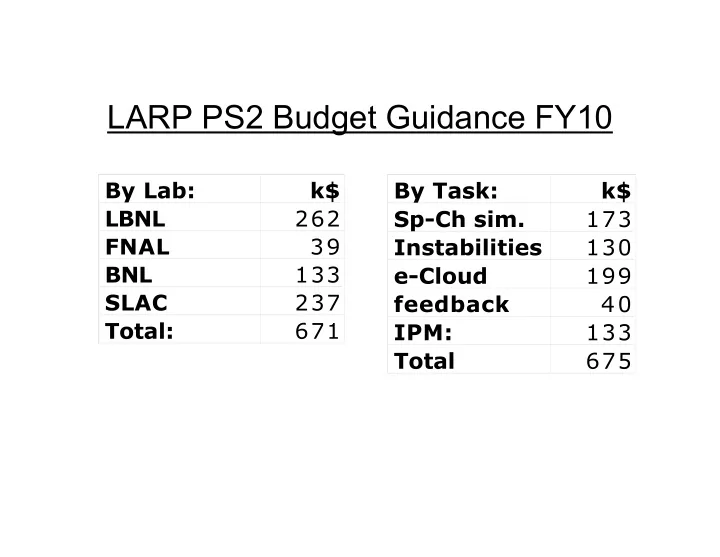
LARP PS2 Budget Guidance FY10 By Lab: k$ By Task: k$ LBNL 262 Sp-Ch sim. 173 FNAL 39 Instabilities 130 BNL 133 e-Cloud 199 SLAC 237 feedback 40 Total: 671 IPM: 133 Total 675 By Lab & Project FY10 PersonYear tot SLAC
PersonYear tot SLAC LBNL FNAL BNL Travel & M&S Space-charge tracking, collim 0.6 0.50 0.13 15 $ Instability 0.5 0.5 0.0 5 $ e-cloud 0.7 0.25 0.5 15 $ Feedbacks 0.1 0.125 0.0 5 $ IPM & Phase-space diagnostic 0.5 0.5 8 $ Total FY10 2.5 0.875 1.0 0.13 0.5 48 $ FY10
– Setup model, 1st simulations, compare solvers, est. numerical stability.
– 1st estimates single bunch: wave, TMCI, Res. Wall, s/c impedance, IBS, mb growth rates
– Refine build-up assessment, compare PS2-MI, initiate effect
simulations?
– Acquire parameters (esp. rf cavity), initial estimates.
– (no activity in FY09)
– Long-term sim. W/ ML/I, Impact & Synergia, iterate as req’d. Begin studying mitigation measures, begin implementing energy ramp.
– Build impedance model based on available data. Investigate components (based on ext. designs), s-b growth rates & characteristics of impedance.
– E-Cloud impact on beam w/ uniform-focusing model, instab. Threshold, study parameter space,
– Acquire parameters (esp. rf cavity), initial estimates, conceptual design of f/b system.
– Gather up & analyse specifications, estimate performance for state-of-the-art designs
Project Lead Lead lab FY09 FY10 FY11 FY12 Space-charge Tracking & Collimation
Spentzouris LBNL/FNAL Implement PS2 model in ML/I, Impact, and
model, perform first space- charge simulations at injection (no ramp), investigate solver parameters and establish numerical stability of space- charge model, compare results from different codes: Perform long term simulations with ML/I, Impact, and Synergia to characterize space- charge effects on beam shape. Comparisons and checks between codes, update/iterate lattice parameters, especially rf as they become available, interface with PS2 design team. Begin investigation of space- charge mitigation
proposal, begin development for incorporating ramp Continue to iterate with PS2 design team
document findings on beam-shape (halo) generation Finalize & document findings of space- charge mitigation
Design Report. Begin development of necessary infrastructure for interface with collimator design codes; model tests; comparison between codes; deliver prototype with interface to at least
code Impedances & Instabilities
SLAC First estimates of single bunch instabilities, microwave, transverse mode coupling instabilities, evaluate space charge impedance, intrabeam scattering growth rates, Resistive wall, multi-bunch transverse instability Build impedance model using best available data or from components of existing machines, numerical calculation
components, e.g. rf bellows, kickers, BPM’s, transitions, estimate single bunch growth rates and characteristics of instabilities Refine and iterate with PS2 design group Write impedance and instabilities section in the PS2 conceptual design report. Begin vacuum system hardware design investigations (if possible/desired by SLAC & CERN). e-Cloud Simulations
LBNL/SLAC Refine assessments
up, Compare electron- cloud build-up at the PS2 against MI
assessment of e- cloud effect on beam (dipoles only at first). Assess need to combine space charge with ecloud simulations Continue assessment
beam for full ring with uniform-focusing lattice model. Estimate threshold of e-cloud density. Explore parameter space, Secondary emission model, PS2 design parameters are changing. Assess ecloud mitigation
assessment ready by June 2010, Refine assessment of impact of e-cloud on beam by incorporating a realistic lattice
re-assessments to continue as needed,
mitigation strategies. Incorporate details of the vacuum hardware into e-cloud
Design Report Bunch-by-Bunch Feedbacks
SLAC Acquire parameters (rf cavities), initial estimates of growth rates Couple-Bunch stability studies - Conceptual design of feedback systems. Conceptual design of feedback systems and
Report. Ionization Profile Monitor
BNL/SLAC Analyze specs. Estimate performance for state-of-the-art designs Select subsystems, conceptual designs Write Design Report
– It is still early, so they may not have one yet – Nevertheless, a generic outline is not hard to write down