
SLIDE 1
event.cwi.nl/lsde
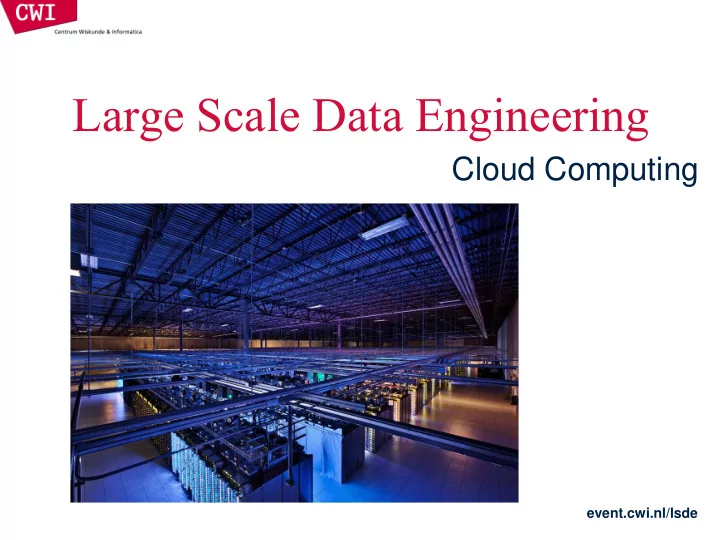
Large Scale Data Engineering Cloud Computing event.cwi.nl/lsde - - PowerPoint PPT Presentation
Large Scale Data Engineering Cloud Computing event.cwi.nl/lsde Cloud computing What? Computing resources as a metered service (pay as you go) Ability to dynamically provision virtual machines Why? Cost: capital vs.
event.cwi.nl/lsde
www.cwi.nl/~boncz/bads www.cwi.nl/~boncz/bigdatacourse event.cwi.nl/lsde
– Computing resources as a metered service (“pay as you go”) – Ability to dynamically provision virtual machines
– Cost: capital vs. operating expenses – Scalability: “infinite” capacity – Elasticity: scale up or down on demand
– Benefits to cloud users – Business case for cloud providers
www.cwi.nl/~boncz/bads www.cwi.nl/~boncz/bigdatacourse event.cwi.nl/lsde
Hardware Operating System App App App
Traditional Stack
Hardware OS App App App Hypervisor OS OS
Virtualized Stack
www.cwi.nl/~boncz/bads www.cwi.nl/~boncz/bigdatacourse event.cwi.nl/lsde
– Why buy machines when you can rent cycles? – Examples: Amazon’s EC2, Rackspace
– Give me nice API and take care of the maintenance, upgrades – Example: Google App Engine
– Just run it for me! – Example: Gmail, Salesforce
www.cwi.nl/~boncz/bads www.cwi.nl/~boncz/bigdatacourse event.cwi.nl/lsde
– 1960s – MULTICS – Concept of a Shared Computing Utility – 1970s – IBM Mainframes – rent by the CPU-hour. (Fast/slow switch.)
– 1990s-2000s – Rent machines for months/years, keep them close to the network access point and pay a flat rate. Avoid running your own building with utilities!
– Early 2000s - Submit jobs to a remote service provider where they run
Deep Capacity Computing on Demand (50 cents/hour)
www.cwi.nl/~boncz/bads www.cwi.nl/~boncz/bigdatacourse event.cwi.nl/lsde
– 1960s – OS-VM, VM-360 – Used to split mainframes into logical partitions. – 1998 – VMWare – First practical implementation on X86, but at significant performance hit. – 2003 – Xen paravirtualization provides much perf, but kernel must assist. – Late 2000s – Intel and AMD add hardware support for virtualization.
www.cwi.nl/~boncz/bads www.cwi.nl/~boncz/bigdatacourse event.cwi.nl/lsde
– IBM AS/400, DEC VAX
– IBM PC, Windows (1-7) – Linux takes the server market (2000-) – Hardware innovation focused on Gaming/Video (GPU), Laptop
– Ultramobile (tablet,phone) .➔ ARM – Server ➔ x86 still but much more influence on hardware design
– Amazon SSD cards (FusionIO) – Google network Routers
www.cwi.nl/~boncz/bads www.cwi.nl/~boncz/bigdatacourse event.cwi.nl/lsde
– We want to update 1 percent of the records
– Each update takes ~30 ms (seek, read, write) – 108 updates = ~35 days
– Assume 100MB/s throughput – Time = 5.6 hours(!)
Source: Ted Dunning, on Hadoop mailing list
www.cwi.nl/~boncz/bads www.cwi.nl/~boncz/bigdatacourse event.cwi.nl/lsde
handled in the first tier by – PHP or ASP pages – Associated logic
services are fast and very nimble
the second tier
1 1 1 1 1 1 1 1 1
Index DB
Shards
2 2 2 2 2 2
user user
www.cwi.nl/~boncz/bads www.cwi.nl/~boncz/bigdatacourse event.cwi.nl/lsde
response – Web servers, Content Delivery Networks (CDNs)
asynchronously – like Kafka (streaming data), Cassandra (key-value store)
– Scheduled to share resources – Run frameworks like Hadoop and Spark (data analysis) or Presto (distributed databases) – Perform the heavy lifting
www.cwi.nl/~boncz/bads www.cwi.nl/~boncz/bigdatacourse event.cwi.nl/lsde
– Processing
little while) – Data
without any delay at all – Control information
decentralised cloud management infrastructure
www.cwi.nl/~boncz/bads www.cwi.nl/~boncz/bigdatacourse event.cwi.nl/lsde
responsiveness of tier-one services
– So the inner services (here, a database and a search index stored in a set of files) are shielded from the online load – We need to replicate data within our cache to spread loads and provide fault-tolerance – But not everything needs to be fully replicated – Hence we often use shards with just a few replicas
www.cwi.nl/~boncz/bads www.cwi.nl/~boncz/bigdatacourse event.cwi.nl/lsde
components to be run in parallel, how long do we need to wait? – Answer: as long as the slowest read
– Duh… we still wait till the slowest write finishes
same resource? – Also known as replicas – We wait the same time, but when do we make the individual writes visible?
Replication solves one problem but introduces another
www.cwi.nl/~boncz/bads www.cwi.nl/~boncz/bigdatacourse event.cwi.nl/lsde
– Are all the replicas applying updates in the same order?
– What if the leader replies to the end user but then crashes and it turns
20
www.cwi.nl/~boncz/bads www.cwi.nl/~boncz/bigdatacourse event.cwi.nl/lsde
– “You can have just two from Consistency, Availability and Partition Tolerance”
paramount
reach some service
cannot be validated and might be stale!
www.cwi.nl/~boncz/bads www.cwi.nl/~boncz/bigdatacourse event.cwi.nl/lsde
– Think about YouTube videos. Would consistency be an issue here? – What about the Amazon “number of units available” counters. Will people notice if those are a bit off?
www.cwi.nl/~boncz/bads www.cwi.nl/~boncz/bigdatacourse event.cwi.nl/lsde
www.cwi.nl/~boncz/bads www.cwi.nl/~boncz/bigdatacourse event.cwi.nl/lsde
standard configurations for its own business.
virtualization to perform “server consolidation”
service for the world.”
www.cwi.nl/~boncz/bads www.cwi.nl/~boncz/bigdatacourse event.cwi.nl/lsde
www.cwi.nl/~boncz/bads www.cwi.nl/~boncz/bigdatacourse event.cwi.nl/lsde
www.cwi.nl/~boncz/bads www.cwi.nl/~boncz/bigdatacourse event.cwi.nl/lsde
Instance Instance Instance
Firewall Internet EC2
Private IP Private IP Public IP snapshot
Manager
SSH
www.cwi.nl/~boncz/bads www.cwi.nl/~boncz/bigdatacourse event.cwi.nl/lsde
www.cwi.nl/~boncz/bads www.cwi.nl/~boncz/bigdatacourse event.cwi.nl/lsde
–Start and stop instances whenever you like, costs are rounded up to the nearest hour. (Worst price)
–Pay up front for one/three years in advance. (Best price) –Unused instances can be sold on a secondary market.
–Specify the price you are willing to pay, and instances get started and stopped without any warning as the market changes.
www.cwi.nl/~boncz/bads www.cwi.nl/~boncz/bigdatacourse event.cwi.nl/lsde
usage
Purpose (SSD) or Magnetic, plus 2 million I/Os (with Magnetic) and 1 GB
www.cwi.nl/~boncz/bads www.cwi.nl/~boncz/bigdatacourse event.cwi.nl/lsde
www.cwi.nl/~boncz/bads www.cwi.nl/~boncz/bigdatacourse event.cwi.nl/lsde
accounting, and access control. A bucket can hold any number of objects, which are files of up to 5TB. A bucket has a name that must be globally unique.
– http://bucket.s3.amazonaws.com/object – POST a new object or update an existing object. – GET an existing object from a bucket. – DELETE an object from the bucket – LIST keys present in a bucket, with a filter.
the interactive web interface.)
www.cwi.nl/~boncz/bads www.cwi.nl/~boncz/bigdatacourse event.cwi.nl/lsde
Direct quote from the Amazon developer API: “Updates to a single key are atomic….” “Amazon S3 achieves high availability by replicating data across multiple servers within Amazon's data centers. If a PUT request is successful, your data is safely
S3, which can take some time, and so you might observe the following behaviors:
– A process writes a new object to Amazon S3 and immediately attempts to read it. Until the change is fully propagated, Amazon S3 might report "key does not exist." – A process writes a new object to Amazon S3 and immediately lists keys within its
– A process replaces an existing object and immediately attempts to read it. Until the change is fully propagated, Amazon S3 might return the prior data. – A process deletes an existing object and immediately attempts to read it. Until the deletion is fully propagated, Amazon S3 might return the deleted data.”
www.cwi.nl/~boncz/bads www.cwi.nl/~boncz/bigdatacourse event.cwi.nl/lsde
www.cwi.nl/~boncz/bads www.cwi.nl/~boncz/bigdatacourse event.cwi.nl/lsde
www.cwi.nl/~boncz/bads www.cwi.nl/~boncz/bigdatacourse event.cwi.nl/lsde
www.cwi.nl/~boncz/bads www.cwi.nl/~boncz/bigdatacourse event.cwi.nl/lsde
where it can be updated incrementally. Unlike an instance store, an EBS volume is persistent.
accessed in its entirety.)
– CREATE a new volume (1GB-1TB) – COPY a volume from an existing EBS volume or S3 object. – MOUNT on one instance at a time. – SNAPSHOT current state to an S3 object.
www.cwi.nl/~boncz/bads www.cwi.nl/~boncz/bigdatacourse event.cwi.nl/lsde
Direct quote from the Amazon developer API: “Updates to a single key are atomic….” “Amazon S3 achieves high availability by replicating data across multiple servers within Amazon's data centers. If a PUT request is successful, your data is safely
S3, which can take some time, and so you might observe the following behaviors:
– A process writes a new object to Amazon S3 and immediately attempts to read it. Until the change is fully propagated, Amazon S3 might report "key does not exist." – A process writes a new object to Amazon S3 and immediately lists keys within its
– A process replaces an existing object and immediately attempts to read it. Until the change is fully propagated, Amazon S3 might return the prior data. – A process deletes an existing object and immediately attempts to read it. Until the deletion is fully propagated, Amazon S3 might return the deleted data.”
www.cwi.nl/~boncz/bads www.cwi.nl/~boncz/bigdatacourse event.cwi.nl/lsde
where it can be updated incrementally. Unlike an instance store, an EBS volume is persistent.
accessed in its entirety.)
– CREATE a new volume (1GB-1TB) – COPY a volume from an existing EBS volume or S3 object. – MOUNT on one instance at a time. – SNAPSHOT current state to an S3 object.
www.cwi.nl/~boncz/bads www.cwi.nl/~boncz/bigdatacourse event.cwi.nl/lsde
www.cwi.nl/~boncz/bads www.cwi.nl/~boncz/bigdatacourse event.cwi.nl/lsde
S3
Hardware OS App App App Hypervisor OS OS
Virtualized Stack
S3 Hardware OS App App App Hypervisor OS OS
Virtualized Stack
S3 Hardware OS App App App Hypervisor OS OS
Virtualized Stack
S3 Hardware OS App App App Hypervisor OS OS
Virtualized Stack
S3 Hardware OS App App App Hypervisor OS OS
Virtualized Stack
S3 Hardware OS App App App Hypervisor OS OS
Virtualized Stack
S3 S3 Hypervisor App OS S3 S3
www.cwi.nl/~boncz/bads www.cwi.nl/~boncz/bigdatacourse event.cwi.nl/lsde
– Data blocks are replicated over the cluster – All (many) nodes in the Amazon clusters contribute their disk to S3
– if nodes go down or instances hang, the data is safe in S3 – disk access speed depends on network and caching (!)
– One can get access to dedicated (flash) disk, for controllable I/O – Amazon makes no persistence or reliability guarantees (when you boot, it is empty). Makes it hard to use.
www.cwi.nl/~boncz/bads www.cwi.nl/~boncz/bigdatacourse event.cwi.nl/lsde
vaults, while an archive is a single object.
– All operations are asynchronous and notified via SNS. – Vault listings are updated once per day. – Archive downloads may take up to four hours. – Only 5% of total data can be accessed in a given month.
– Storage: $0.01 per GB-month – Operations: $0.05 per 1000 requests – Data Transfer: Like S3, free within AWS.
www.cwi.nl/~boncz/bads www.cwi.nl/~boncz/bigdatacourse event.cwi.nl/lsde
– Virtualization – Caching, Replication, Sharding – Eric Brewer’ CAP theorem: can’t have:
– EC2: Instance types, pricing models, & other terminology – Storage: EBS/S3/Glacier