
SLIDE 1
Land Policy
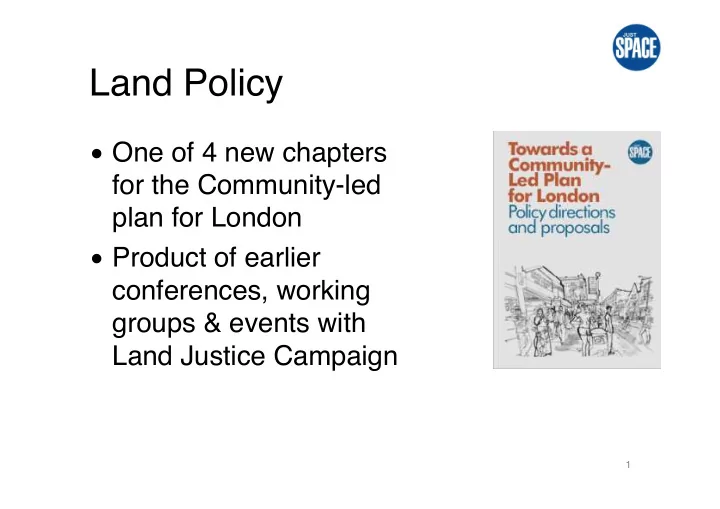
- One of 4 new chapters
for the Community-led plan for London
- Product of earlier
conferences, working groups & events with Land Justice Campaign
1
Land Policy One of 4 new chapters for the Community-led plan for - - PowerPoint PPT Presentation
Land Policy One of 4 new chapters for the Community-led plan for London Product of earlier conferences, working groups & events with Land Justice Campaign 1 Problems: City cursed by rent & land Expression and generator
1
drive plans, displace low- and middle-income homes, workplaces
impoverish people & prevent other spending
fail to capture property wealth/income or to supply services & infrastructure
2 2
3
4
Less than 20% of growth is more housing; most is price increase
5
the whole of the stock, not just new development
underlying value of land and all uplifts, rather than just the
kept idle, LVT encourages better use of land
variety of lower density and non-profit uses.
the market work better, more ‘efficiently’, and not an approach whose first principle is to take more land use decisions out of the market, priorities being set through political debate and participatory planning.
specify precisely the permitted use and maximum density for every plot of land
6
– Research & education – National/international discussions
– Viability – Disposal of public land (NHS etc) – Existing Use Value in CPOs – Local government finance review
7
– Mayor should lower land price expectations by
flexibility
without flexibility
35%”affordability” will become 50%
much more affordable, relating them to local incomes, not local market rents
social housing equally across all renewal schemes over which he has any planning or financial leverage
– Require that TfL and other Mayoral-family lands that are disposed of for housing development are used substantially for social housing or other social purposes
8
do things together in a great diversity of
evolved over a long period. It enables owners to secure —as rents and as capital gains— a huge and growing share of the social product, concentrating wealth and lowering the standard of living for many people in the society.
especially strong profit opportunities alongside unique impoverishment. As land value has mushroomed, there is lots of money being made; more of it could go on what we need and less be distributed as profits and capital gains.
9