Laboratorio Nacional de Fusin, CIEMAT, Spain 1/ 31 CORE TRANSPORT - - PowerPoint PPT Presentation

laboratorio nacional de fusi n ciemat spain
SMART_READER_LITE
LIVE PREVIEW

Laboratorio Nacional de Fusin, CIEMAT, Spain 1/ 31 CORE TRANSPORT - - PowerPoint PPT Presentation

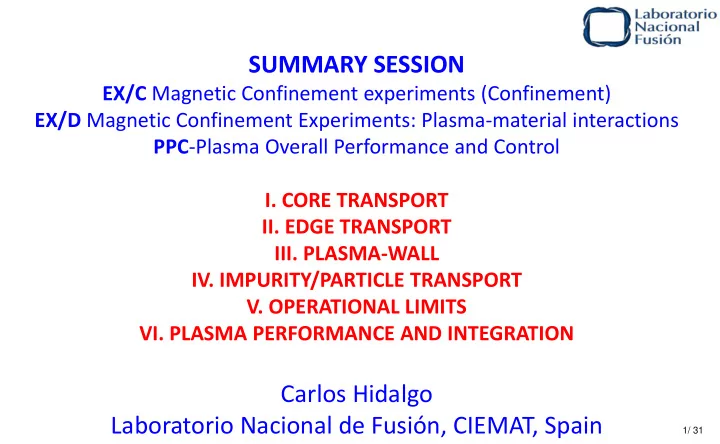
SUMMARY SESSION EX/C Magnetic Confinement experiments (Confinement) EX/D Magnetic Confinement Experiments: Plasma-material interactions PPC -Plasma Overall Performance and Control I. CORE TRANSPORT II. EDGE TRANSPORT III. PLASMA-WALL IV.


slide-1
SLIDE 1

1/ 31

SUMMARY SESSION

EX/C Magnetic Confinement experiments (Confinement) EX/D Magnetic Confinement Experiments: Plasma-material interactions PPC-Plasma Overall Performance and Control

  • I. CORE TRANSPORT
  • II. EDGE TRANSPORT
  • III. PLASMA-WALL
  • IV. IMPURITY/PARTICLE TRANSPORT
  • V. OPERATIONAL LIMITS
  • VI. PLASMA PERFORMANCE AND INTEGRATION

Carlos Hidalgo Laboratorio Nacional de Fusión, CIEMAT, Spain

slide-2
SLIDE 2

2/ 31

CORE TRANSPORT EMPIRICAL ACTUATORS

 HEATING  ROTATION  MAGNETIC TOPOLOGY  FUELLING Efficient in existing devices Limited in next step devices Pellet [EXC186 Valovic MAST]

TOWARDS BASIC UNDERSTANDING

1) Flux-gradient, heating and transport [EXP39 Yoshida JT-60U], [EXC543 Anderson HSX], [EXP237 Inagaki LHD], [EXP414 Vershkov T-10] / [EXC421 Razumova] / [70/506 Ren NCTX] / [85/605 Vermare TS] / [EXC321 Challis JET], [EXC481 Neudatchin T-10] / [EXC656 Ernst DIIID],high density operation [EXC33 Mizuuchi H-J], [EXC577 Hong KSTAR] 2) Momentum transport [EXC590 Ohsima H-J] [EXC443 Zhao J-TEXT mover RMPs], [EXC138 Lee KSTAR], [EXC284 Xu TEXTOR], [EXC393 Shi KSTAR], [EXC483 Tala AUG], [EXC306 Kobayashi H-J], [EXC406 Lee KSTAR], [EXC526 Severo TCABR], [EXC581 Na KSTAR], [EXC522 McKee DIIID], [EXC101 Lee KSTAR] 3) Code validation [EXC112 Porte TCV] / [EXC121 Field MAST] / [EXC249 Mordijck DIIID] / [EXC317 Stroth exp vs GK] / [EXC428 Altukhov FT-2] / [83/585 Sabot TEM] / [EXC648 Howard AlcatorCmod] Te Critical Gradient [EXC278 Smith DIIID], EXC418 Yokoyama LHD]

slide-3
SLIDE 3

3/ 31

TRANSPORT in high beta regimes, an echo for the fundamental unity and connectedness of fusion plasmas

95

IPB98(y,2) scaling experiment

– –

  • Weak confinement degradation with power

in high b plasmas due to increase in pedestal pressure and pressure peaking (by collisionality and suprathermal pressure [TH324 Garcia]). [EXC321 Challis JET]

slide-4
SLIDE 4

4/ 31

TRANSPORT: flux-gradient relation

Dynamic method to study turbulence and turbulent transport, showing hysteresis in the flux-gradient relation [EXC237 Inagaki LHD]

High-k measurement region

Non-local transport / turbulence spreading (EXC506 Ren NSTX) Quantifying and understanding the level of profile stiffness in the plasma core in reactor relevant conditions (high beta, fast particle effects) is an outstanding issue with promissing results

3/2 NTM Interplay between non-local transport and MHD [Ji / HL-2A]

slide-5
SLIDE 5

5/ 31

TRANSPORT, physics understanding and empirical actuators (ECRH)

Controlling gradients and transport by ECRH and TEM [EXC656 Ernst DIIID] ECRH Heating, transport and rotation [EXC39 Yoshida JT-60U]

slide-6
SLIDE 6

6/ 31

MOMENTUM TRANSPORT: driving / damping mechanisms

Role of radially sheared Er × B flows on residual stress [EXC284 Xu TEXTOR] NC transport and intrinsic rotation [EXD374 Battaglia DIIID] Interplay between NBI/ECRH and pedestal torques [EXC393 Shi KSTAR] / [EXC483 Tala AUG] LOC-SOC transition occurs but no reversal in core rotation is detected. Dependency w.r.t collisionality is observed [EXC581 Na KSTAR]. Reduction in electron density with ECRH and transition from ITG to TEM without a reversal in toroidal rotation [EXC249 Mordijck DIIID] Turbulence behaviour approaching burning plasma relevant parameters (low rotation) [EXC522 McKee DIIID]

slide-7
SLIDE 7

7/ 31

CODE VALIDATION: Great challenge due to the existence of multiple plasma scales

GK (GENE) validation using advanced fluctuation diagnostics AUG [EXC317 Stroth] Ion and electron heat fluxes GK and Alcator Cmod [EXC648 Howard] Temperature fluctuatiom decreases as edge triangularity goes from positive to negative. Full global nonlinear simulations are required [EXC112 Porte TCV].

Validated simulations would have important consequences for predicting burning plasma scenarios

slide-8
SLIDE 8

8/ 31

EDGE TRANSPORT AND PEDESTAL EMPIRICAL ACTUATORS  HEATING  MAGNETIC TOPOLOGY PLASMA SCENARIOS: L-H power threshold [EXC351 Verdoolaege], [EXC432 Lorenzini RFXmod], [EXC434 Delabie JET], [EXC446 Gurchenko FT-2] / [EXC153 Hahn KSTAR] Conflict in optimization criteria: ELM control and confinement TOWARDS BASIC UNDERSTANDING 1) TRIGGER OF L-H TRANSITION: [EXC61 KobayashI JT60M], [EXC194 Estrada TJII], [EXC285 Dong HL-2A], [EXC384 Cheng HL-2A ], [ EXC539 Schmitz DIIID] / [EXC619 Cziegler AlcatorCmod], [EXC575 BelokurovTUMAN-3M] 2) PEDESTAL STABILITY AND PROFILES: triangularity [EXC195 de la Luna JET,], edge modes [EXC253 Zhong HL-2A], [EXC43 Xu EAST], [EXC88 Gao EAST], EP-Hmode [EXC618 Gehardt NSTX], Enhanced pedestal H-mode without turbulent reduction [EXC545 Canik DIIID-NSTX], edge non-stiffness Lmode [EXC170 Merle TCV], micro-tearing [EXC361 Hillesheim MAST], [EXC427 Kong HL-2A], [EXC429 Maggi JET], , I-mode regime [EXC612 Hubard], [EXD209 Golfinopouls Alcatorcomd]. GAMs [EXC112 Porte TCV] / [EXC242 Melnikov T-10] / [EXC564 Yu HT-7], [EXC444 Bulanin Globus-M] 3) ELM CONTROL (3-D EFFECTS): Pellet/Li injection [EXD62 Wang EAST], RMPs [EXD205 Nazikian DIIID] [EXD655 Ahn NSTX-DIIID], [EXC290 Nie HL-2A], SMBI[EXC303 Yu HL-2A/EAST/KSTAR], [EXC403 Lee KSTAR], / [EXC536 Orlov DIIID], RMP and particle pump-out [EXC607 Jakubowski] , RMP and detachement [ EXD488 OHNO LHD], Strike line striation [EXD630 Schmitz], [EXC269 Evans LHD-DIIID],
slide-9
SLIDE 9

9/ 31

Scenario development (L-H power threshold) the whole mirrored in the smallest parts

Isotope effect in GAM/transport [EXC446 Gurchenko FT-2] in consistentcy with previous results in TEXTOR

𝐹 ×𝐶 𝑈∇ 𝑜 𝑜

α

δ – (a) (b

Impurities / neutrals and magnetic configuration [EXC434 Delabie JET]

[EXC432 Lorenzini] RFXmod; isotope effect in Quasi-Single- Helicity state. TCV] L-H threshold is 20% higher in both H and He than D

Stimulated L-H transition SMBI [EXC153 Hahn KSTAR]

H-mode operation is expected to marginal in H but possible in He [EXC344 Sips]/[EXC351 Verdoolaege]

slide-10
SLIDE 10

10/ 31

Trigger of the L-H transition: role of dynamical flows

Recent experiments, HL-2A [EXC285 Dong], DIIID [EXC539 Schmitz], TJ-II [EXC19 Estrada], AlcatorCmod [EXC619 Cziegler], has pointed out towards a synergistic role of turbulence-driven flows (ZFs) and pressure gradient driven flows in the triggering and evolution of the L-H transition.

Trigger linked to Er /presure gradients In HL-2A Turbulence driven flows triggers to transition to LCO Pressure gradient increase later and locks in the H-mode in DIIID

Further R&D should be centred on identifying key players for H-mode transition in order to trigger it at reduced Pinput

slide-11
SLIDE 11

11/ 31

Pedestal transport and stability: key for global performance and power exhaust

Positive influence of triangularity on confinement has not been recovered in ILW due to higher collisionality in consistency with P-B expectations [EXC195 de la Luna JET] Searching for Microtearing modes at the pedestal in MAST using novel diagnostic techniques and comparison with GK [EXD361 Hillesheim]

Qualitative agreement with P-B model, but missing physics needs to be addressed to provide full predictive of pedestal structure (including role of neutrals and impurities)

At high neutral recycling, pedestals are found in stable. Then, additional physics is required to explain the onset of the ELM

  • instability. Beneficial effect of N2 seeding [EXC429 Maggi JET]
slide-12
SLIDE 12

12/ 31

I-Mode with edge temperature pedestal while density profile remains unchanged from L-mode [ EXC612 Hubbard]

No/Small ELM H98~1.2, bn~1.2, Te0~3.5keV, Wdia~120kJ

Long-pulse H-mode operation with edge coherent mode in EAST; GYRO simulations suggest DTEM [EXC43 Xu]

Pedestal transport and stability: alternative regimes New regimes (as an alternative to type I EMLs) to a burning plasma scenarios look promising.

QH-mode maintained to high Greenwald fraction in strongly shaped plasma [PPC243 Solomon DIIID] / [TH/2-2 Snyder]

slide-13
SLIDE 13

13/ 31

Strike line striation as signature for 3-D boundary formation [ EXD630 Schmitz] Comparison of Li-granule triggered ELMs with intrinsic type-I ELMs [EXD62 Wang EAST]

ELMs control

Active ELM control have been demostrated including magnetic perturbations, pellet injection, SMBI (Supersonic Molecular Beam Injection), edge current control

slide-14
SLIDE 14

14/ 31

Power Exhaust: 3-D effects and ELMs control

M3D-C1 simulation of amplification and screening of resonant poloidal harmonics [EXC205 NazikiaN]

  • h

11 coils 5 coils

ELM control witH a reduced number of I- coils [EXC536 Orlov DIIID]

Control of ELMs by magnetic perturbations have been achieved, but there is not yet completeness of understanding of ELM suppresion mechanisms

Modulate ECH analysis shows a spontaneous bifurcation at the heat transport across the island, observed in both DIIID and LHD [EXC269 Evans]

slide-15
SLIDE 15

15/ 31

PLASMA-WALL / PLASMA EXHAUST

 MAGNETIC TOPOLOGY  OPERATION AT HIGH DENSITY / detachment  LIQUID METALS  PLASMA CONDITIONING  EROSION-DEPOSITION- RETENTION-DUST  PW (LONG-PULSE)  DIAGNOSTICS  MODELLING  SOL width

 INNOVATIVE CONFIGURATIONS: SNOWFLAKE [EXD124 Duval TCV] [EXD352 Calabro EAST] [EXD497 Soukhanovskii DIIID] / SUPER-X / STELLARATORS Impurity seeding [EXD556 Mukai LHD], [EXD82 Kallenbach AUG] / [EXD660 McLean DIIID], W divertor [EXD632 Herrmann AUG], [EXD514 Wishmeier] liquid metals as alternative PFC [EXD159 Verkov T-11M], [EXD513 Mazzitelli FTU]/[EXD664 Mirnov T11M] Li [EXD81 Maingi NSTX-EAST], [EXD426 Shcherbak T-11M], GDC [EXD126 Douai], ICRH [EXD600 Wauters JET], isotopic change[EXD268 Loarer JET] [EXD122 Rubel JET] / [EXD273 Brezinsek JET] / [25/356 Rudakov DIIID] / [EXD650 Halitovs], [EXD136 Shoji LHD], [EXD390 Hong KSTAR], [EXD92 Schmid], [EXD450 Zushi QUEST], mixed materials [EXD670 Scotti NSTX] [EXD280 Kasahara LHD], [EXD282 Hanada QUEST], W [EXD476 Tsitrone WEST] Stray light / Divertor [EXD634 Kukushkin ITER JET], [EXD662 Reichle ITER], Electromagnetic effects [EXD502 Spolaore] [EXD123 Harrison MAST], [EXD514 Wishmeier] Extrapolating SOL width from present machines to ITER :[EXD96 Birkenmeier AUG],

slide-16
SLIDE 16

16/ 31

Innovative exhaust magnetic configurations

Power distributed to all 4 SPs but not reproduced yet by EMC3-Eirene. No evidence of scrape-off layer broadening. Transport in the private flux region [EXD124 Duval TCV]

Enhancement of heat transport

and heat redistribution among additional strike points [EXD497 Soukhanovskii DIIID]

Snowflake configuration: Encouraging results on DIIID, NSTX and TCV (and just first results in EAST) with activation of extra divertor legs.

Snowflake scenario IN EAST [EXD352 Calabro EAST]

slide-17
SLIDE 17

17/ 31

Lithium Capillary-pore-system CPS limiters with closed circulation loop [EXD159 Vertkov T11M] CPS experiments in FTU [EXC513 Mazzitelli] / TJII [Tabares] Lithium conditioning and confinement: NSTX / EAST [EXD81 Maingi] / [PD Jackson DIIID]

CPS is a promising solution with a need to find the best candidate material (Li/Sn/Ga) that fits all the necessary properties. Alternative power exhaust solutions need to be vigorously pursued.

Power exhaust, liquid metals

slide-18
SLIDE 18

18/ 31

Plasma detachment and integrated control

2014

AUG achieved the ITER required PD conditions for about half the values of the critical parameter Psep/R [EXD82 Kallenbach AUG]

Divertor detachment is a key to ITER mission. Robust target power flux control schemes need to be further tested across machines for a reliable application to ITER

Integrated control

Power exhaust and core performance Power exhaust and magnetic topology Plasma detachment is effectively stabilized with RMP [EXD488 Ohno] 3-D fields have impact on divertor detachement [EXD655 Ahn NSTX-DIIID] In stellarators the larger perturbation field (larger island) leads to detachement stabilization [ OV Kobayashi]

slide-19
SLIDE 19

19/ 31

Boundary diagnostics and edge validated simulations

EMC3-EIRENE modelling and experimental results from imaging

  • f lobe structures that form due to RMPs . The coherence

imaging data support modelling predictions that the ion flow velocity within lobes differs from the unperturbed SOL [ EXD Harrison MAST]

PLASMA DIAGNOSTICS: 2D characterization with Te below 1 eV essential for comparing simulation codes to experiment [EXD660 McLean DIIID]

Understanding of processes leading to divertor detechment is currently incomplete requiring further development of validated simulations [divertor asymmetries, neutral model, kinetic effects] [EXD514 Wishmeier]

slide-20
SLIDE 20

20/ 31

SOL transport and particle/impurity sources

Transition from ion sheath-connected scaling to resistive blob regime as density increases with possible impact on backbround erosion, consistent role of finite ion temperature dynamics [EXD96 Birkenmeier AUG]

In JET-ILW deposition and fuel inventory are strongly reduced (20x ) in comparison to JET-C. [EXD122 Rubel / Exp273 Brezinsek JET]. Melting of W by ELM heat loads [EXD235 Matthews JET/ITER]

Advances on retention, melting during ELMs, mixed materials, SOL width and ion dynamics.

slide-21
SLIDE 21

21/ 31

IMPURITY / PARTICLE TRANSPORT AND SOURCES

EMPIRICAL ACTUATORS  CORE HEATING  MHD  SOURCES AND FUELLING  REAL TIME CONTROL Efficient to avoid impurity accumulation in existing devices [ECRH / EXC301 Klyuchnikov T-10], [NBI EXP310 Yoshinuma LHD], [ICRH/MHD EXC330 Valisa JET] fuelling + ICRH + pumping [EXC187 Nunes JET], [EXC195 de la Luna JET], source location [EXC228 Sudo LHD], [EXD161 Cui HL-2A], N puffing [EX244D Mazzotta FTU], melting of W [EXD235 Matthews JET], [EXD392 Murakami LHD], [EXC690 Joffrin JET], Neutrals/core [EXC305 Fujii LHD] ELM (control with gas) + Sawtooth (ICRH Heating) [EXC Lennholm173 JET] TOWARDS BASIC UNDERSTANDING

Optimum profiles for achieving high fusion gain without impurity accumulation?

1) ROLE OF HEATING ON GRADIENTS (NEOCLASSICAL effects) [EXC330 Valisa JET] 2) ROLE OF HEATING ON TURBULENT driven transport [EXC575 KSTAR], [NBI EXP310 Yoshinuma LHD], 3) Flux surface plasma POTENTIAL ASYMMETRIES [OV4 Sánchez TJ-II] 4) Strong inertia and electrostatic forces resulting in POLOIDAL ASYMMETRIES (High Z) [EXC224 Mazon AUG] / [EXC236 Camenen TCV] / [EXPC330 Valisa JET] [EXP458 Hogeweij ITER] 5) ASYMMETRIES AND NC TRANSPORT [EXC534 Viezzer AUG] 6) MODELLING IMPURITY/PARTICLE SOURCES AND TRANSPORT [EXD392 Murakami LHD], modelling / power exhaust [EXD514 Wischmeir]

slide-22
SLIDE 22

22/ 31

Physics basis for avoiding impurity accumulation: neoclassical and anomalous mechanisms

In-out impurity density asymmetry in the pedestal consistent divergence-free flows, which does not lead to a significant deviation from neoclassical transport l[EXC534 Viezzer AUG]

  • First direct observation flux surface plasma potential

asymmetries consistent with MC calculations [Sánchez TJ-II].

slide-23
SLIDE 23

23/ 31

EGDE IMPURITY/PARTICLE SOURCES: the importance of apparently insignificant details

The corner configuration has the best energy confinement (green) in [EXP690 Joffrin JET] Neutral transport based

  • n high dynamic range

Balmer a spectroscopy [ EXC305 Fujii LHD] Impurity source location is essential for determining impurity transport properties [EXC228 Sudo LHD]

slide-24
SLIDE 24

24/ 31

Particle confinement of Carbon in T-10, showing imputiies removal during central ECRH [EXC301 Klyuchnikov T-10] Reversal of C convection velocity with NBI heating (impurity hole) [EXP310 LHD ] MHD + ICRH controls W Neoclassical transport is the dominant channel in the core for W, affected by centrifugal forces and electrostatic poloidal asymmetries. [WXC330 Valisa JET]

Heating and MHD to control core accumulation

slide-25
SLIDE 25

25/ 31

OPERATIONAL LIMITS AND DISRUPTIONS

 DISRUPTIONS: MGI, SMBI, MAGNETIC PERTURBATIONS  DENSITY LIMIT

Mitigation with SMBI/ MGI [EXC495 Dong J-TEXT] / Runaway control[EXC500 Carnevale FTU] Configuration [EXC177 Kirneva TCV] / [EXC245 Spizzo FTU-RFX]

slide-26
SLIDE 26

26/ 31

Runaway-control in the FTU tokamak, for position and ramp-down control of disruption- generated RE [EXC500 Carnevale]

OPERATINAL LIMITS and DISRUPTIONS CONTROL

High density is associated with the destabilization of edge resonating magnetic islands and perspectives of ECRH to overcome the critical edge density (RFP / FTU) [ EXC425 Spizzo] Plasma configuration and density limit [EXC177 Kirneva TCV]

slide-27
SLIDE 27

27/ 31

PLASMA PERFORMANCE AND CONTROL FUELLING BREAKDOWN CONTROL

Fuelling He [PPC98 Romanelli ITER] Plasma initiation ITER [PPC255 Mineev] Ohmic breakdown [PPC571 Yoo KSTAR] Modelling non-inductive ramp-up [PPC Poli 542] [EXC72 Mitarai STOR-M] Magnetic and kinetic control [PPC190 Moreau] Fast vertical control [PPC201 Mueller KSTAR, EAST, NSTX], [PPC248 Gribov ITER] Design, prototype and manucturing in-vessel coils ITER [PPC691 Encheva ITER] Control with non-asisymmetric coils [PPC376 Hawryluk DIIID] Real time control NTMs / ECRH OPERATIONAL [PPC430 Reich AUG], [PPC553 Kim KSTAR] Control plasma profiles [PPC636 Felici TCV, AUG ITER] Physics model based control (q, betaN) [PPC520 Barton DIIID] Magnetic conf (Snowflake) Divertor detachment CONTROL [PPC379 Kolemen DIIID] Control burn in ITER feedback [PPC599 Kessel] / L-H transition

PLASMA SCENARIO DEVELOPMENT

Towards Steady state conditions / hybrid scenario [PPC277 Petty DIIID] Scenarios for ITER operation [EXC344 Sips] Integration operation of the ITER-Like Wall at JET [EXC433 Giroud JET] /[EXC187 Nunes JET] ITER scenarios at AUG [EXC606 Schweinzer] High inductance for steady-state operation [9/335 DIIID Ferron] ITER BASELINE Q=10 [EXC342 Luce DIIID] Operation difficulties at low applied torque Scenario in LHD [PPC348 Nagaoka LHD] Plasma scenario development HL-2M [2/163 SONG HL-2M] Quiescent H-mode [PPC243 Solomon DIIID] Fully non-inductive scenario for Steady State Operation [EXC681 Gong EAST/DIIID] Compativility of ITB and steady-stae operation [23/661 garofalo DIIID] DEMO physics [PPC448 Wenninger]

slide-28
SLIDE 28

28/ 31

PLASMA CONTROL

SnowFlake Divertor control [EXD379 Koleman DIIID] Real time control NTMs / ECRH main actuator FULLY OPERATIONAL [PPC430 Reich AUG]

slide-29
SLIDE 29

29/ 31

Development of the Q=10 Scenario on AUG. Operation at q95=3 demonstrated at H98y2=1, bN ~2, n/nGW=fGW ~0.85; alternative scenario q95=3.6 under investigation. BUT, Integration of ELM mitigation not achieved; No stationary behavior with N-seeding [EXC606 Schweinzer] ITER-like conditions H98y2=1, bN ~1.9 (low torque, electron heating and radiative operation) BUT, challenge operation due to

  • nset of TM.

[PPC342 Luce DIIID]

Plasma performance and integration:

Towards ITER integrated scenario development: equilibrated ion/electron temperatures, low injected torque, low rho and collisionality, ELM control, divertor compatibility

slide-30
SLIDE 30

30/ 31

Plasma performance and integration

High temperature regime has been significantly expanded in helical plasmas [EXD348 Nagaoka] JET: Integrated performance with N-seeding and divertor compatibility W accumulation control achieved with ICRH and gas puffing. Energy confinement to H98(y,2) ≈ 1 achieved at Ip =2.5 MA, work ongoing to higher current. [EXC433 Giroud JET] / [EXC187 Nunes JET]. But operation in plasmas with high momentum input and need for ELM control.

slide-31
SLIDE 31

31/ 31

Final remark Great contributions for the development of ITER / DEMO plasma scenarios including both: I. engineering approach i.e. use of empirical control parameters to avoid possible fusion showstoppers I. physics research i.e. basic understanding of underlying mechanism for predicting burning plasma with confidence

Acknowledgements: I appreciate very much stimulating discusions and supporting material provided by my colleagues and IAEA organization.