Labor of Love Labor of Love PERMIT 182 Customer Service Rules - - PDF document

labor of love labor of love
SMART_READER_LITE
LIVE PREVIEW

Labor of Love Labor of Love PERMIT 182 Customer Service Rules - - PDF document

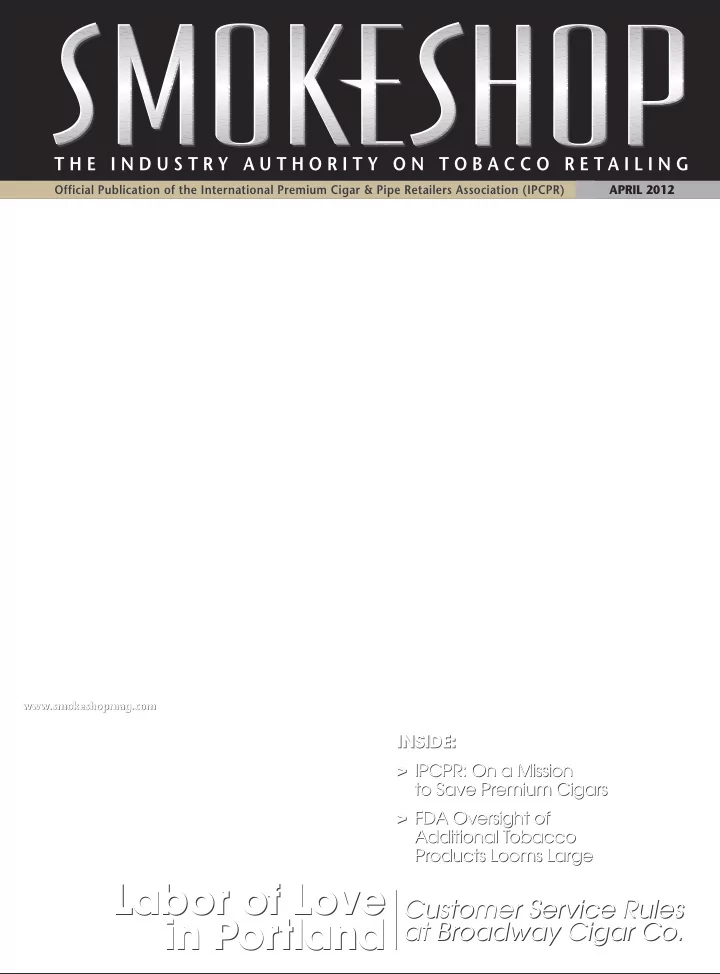
T H E I N D U S T R Y A U T H O R I T Y O N T O B A C C O R E T A I L I N G Official Publication of the International Premium Cigar & Pipe Retailers Association (IPCPR) APRIL 2012 www.smokeshopmag.com www.smokeshopmag.com INSIDE:


slide-1
SLIDE 1

T H E I N D U S T R Y A U T H O R I T Y O N T O B A C C O R E T A I L I N G

Official Publication of the International Premium Cigar & Pipe Retailers Association (IPCPR) APRIL 2012

INSIDE: > IPCPR: On a Mission to Save Premium Cigars > FDA Oversight of Additional Tobacco Products Looms Large

PRSRTD STD US POSTAGE PAID PERMIT 182 MIDLAND MI

Labor of Love in Portland Labor of Love in Portland

www.smokeshopmag.com www.smokeshopmag.com

INSIDE: > IPCPR: On a Mission to Save Premium Cigars > FDA Oversight of Additional Tobacco Products Looms Large

Customer Service Rules at Broadway Cigar Co. Customer Service Rules at Broadway Cigar Co.

slide-2
SLIDE 2

52

SMOKESHOP April 2012

T

he 2009 Family Smoking Pre- vention and Tobacco Control Act (“Tobacco Control Act”) signifi- cantly changed the regulatory landscape for tobacco products, giving the Food and Drug Administration immediate jurisdiction over certain tobacco prod-

  • ucts. Specifically, the Tobacco Control Act

requires FDA to regulate cigarettes, roll- your-own tobacco and smokeless tobac- co and permits FDA to regulate other tobacco products, such as cigars, pipe tobacco and electronic cigarettes. FDA must issue regulations to assert authority

  • ver the latter group.

All signs indicate that FDA regula- tion of these tobacco products will come later this year. In April 2011, FDA wrote a letter to industry stakeholders indicat- ing that FDA intended to assert authori- ty over all “tobacco products,” which are defined under the Tobacco Control Act as any product “made or derived from tobacco that is intended for human consumption” but that is not a “drug,” “device” or combination product under the Food, Drug and Cosmetic Act (“FD&C Act”). FDA’s action came on the heels of the District of Columbia Circuit Court of Appeals’ decision in Sottera, Inc. v. Food & Drug Administration, (D.C. Cir. 2010), in which the court concluded that FDA lacked authority to regulate electronic cigarettes under the FD&C Act, but that FDA had authority to regulate electron- ic cigarettes as “tobacco products” under the Tobacco Control Act. FDA’s letter to stakeholders advised that FDA intended to propose a regulation that would extend the agency’s “tobacco product” authority to other tobacco

  • products. Those tobacco products pre-

sumably would include electronic ciga- rettes, pipe tobacco, cigars and dissolv- able tobacco (which FDA has deter- mined is not covered by its existing authority over smokeless tobacco). Later that year, in July 2011, FDA advised interested parties that it antici- pated issuing so-called “deeming” regu- lations, subjecting these additional tobacco products to its jurisdiction, by October 2011. FDA did not issue the reg- ulations in October, and on October 14, 2011, Senators Richard Blumenthal (D- CT), Frank Lautenberg (D-NJ) and Sherrod Brown (D-OH) wrote to FDA Commissioner Dr. Margaret Hamburg to request FDA’s action to regulate these tobacco products. The Senators urged FDA to “move swiftly” to issue the deeming regulations, and requested that FDA update its progress on the regula- tions and its timeline for releasing the

  • regulations. The Senators also requested

a meeting with Commissioner Hamburg to discuss the matter in more detail. Based on FDA’s prior commitment to issue the regulations in October, and the Senators’ urgent request, industry

  • bservers expected that FDA would

issue the regulations shortly. However, as of mid-March 2012, FDA still had not issued the deeming regulations. In April 2012, FDA further reaffirmed its intent to issue deeming regulations, when it sent letters to electronic cigarette manufacturers requesting information regarding the safety of electronic ciga-

  • rettes. The letters note that FDA has

authority under the Tobacco Control Act to regulate electronic cigarettes, and that it intends to do so. The letters requested information from manufacturers regard- ing consumer complaints and “adverse event issues,” reports of “consumer mis- use,” descriptions of product labeling and systems in place to review consumer complaints and adverse events. In the meantime, there is legislation pending in Congress that would exempt so-called “traditional large and premium cigars” from FDA’s reach. The bill, which has been introduced in both the Senate and House of Representatives,” defines a “traditional and premium cigar” as a roll

  • f tobacco wrapped in leaf tobacco, con-

taining no filter, and weighing at least six pounds per 1,000 count. The bill would remove such cigars from FDA’s potential authority under the Tobacco Control Act. Thus, under the legislation, “traditional” cigars would not be subject to FDA’s authority, whereas smaller cigars that are

REGULATION FOCUS

>

FDA: On the Verge of Regulating Cigars, Pipe Tobacco, & E-Cigarettes?

The wheels are turning and all signs point to the likelihood of the FDA asserting jurisdiction over additional tobacco products by regulation.

>BY TROUTMAN SANDERS TOBACCO TEAM
slide-3
SLIDE 3

54

SMOKESHOP April 2012 more similar to cigarettes would be potentially subject to FDA’s authority. The bill, which was introduced in 2011, remains in committee and has not been scheduled for a hearing. DEEMING REGULATIONS— A SQUARE PEG IN A ROUND HOLE? When FDA issues the deeming regula- tions, the proposed regulations will be followed by a period of notice and com- ment, during which stakeholders will have an opportunity to shape how FDA will regulate these additional tobacco

  • products. As FDA considers its deeming

regulations, it will need to consider whether the existing regulatory land- scape for cigarettes, roll-your-own tobacco, and smokeless tobacco can or should apply in the same ways to cigars, pipe tobacco and electronic cigarettes. In doing so, FDA will need to address sev- eral areas in which the current require- ments may be ill-suited for these prod-

  • ucts. These issues are discussed below.

TOBACCO CONTROL ACT’S PURPOSE As FDA considers its regulations, it will be important to consider the Tobacco Control Act’s purpose, as outlined in the law’s preamble. The preamble addresses the health effects of tobacco use, and dis- cusses court proceedings in which the major cigarette companies were found to have continued “to target and market to youth,” to have “dramatically increased their advertising and promotional spending in ways that encourage youth to start smoking subsequent to the sign- ing of the Master Settlement Agree- ment,” and to have “designed their ciga- rettes to precisely control nicotine deliv- ery levels and provide doses of nicotine sufficient to create and sustain addiction while also concealing much of their nico- tine-related research.” One could argue that Congress’ rationale for enacting the Tobacco Control Act is inapplicable, or

  • nly partially applicable to other tobacco
  • products. For example, Congress enact-

ed the Tobacco Control Act in light of the undisputed health effects of cigarettes and the prior marketing conduct by the major cigarette companies. This ration- ale is arguably inapplicable to other types of tobacco products, such as elec- tronic cigarettes, where the evidence of adverse health effects is scant and there has been no demonstrated pattern of marketing conduct. NEW PRODUCT REQUIREMENTS Under Section 905 of the Tobacco Control Act, if a company proposes to sell a new tobacco product (one that was not com- mercially marketed as of February 15, 2007, or a product that has been changed since February 15, 2007), the company must first show that the product is “sub- stantially equivalent” to a pre-February 15, 2007 tobacco product or that any modifications to a pre-February 15, 2007 tobacco product are minor changes that do not present different public health

  • issues. The product cannot be sold to

consumers unless FDA has approved the product, although there was a limited exemption for products introduced prior to March 22, 2011. The ostensible purpose of the “sub- stantial equivalence” requirements is to make sure that any new tobacco prod- ucts are not more harmful than existing tobacco products. The substantial equiv- alence requirements prompted the intro- duction of several new tobacco products after the Tobacco Control Act’s passage

REGULATION FOCUS

>

>The FDA will need to consider whether the

existing regulatory landscape for cigarettes, roll- your-own tobacco, and smokeless tobacco can or should apply in the same ways to cigars, pipe tobacco and electronic cigarettes.

slide-4
SLIDE 4

but before the March 22, 2011 deadline. Any products introduced after March 22, 2011 are subject to FDA approval before they can be sold to consumers. Manufacturers that introduced products before March 22, 2011 were required only to submit a substantial equivalence report, but FDA did not have to approve the products prior to their introduction. The substantial equivalence require- ments for “new tobacco products” pres- ent unique issues for other tobacco prod- ucts that would be subject to FDA author- ity under the deeming regulations. For example, as applied to traditional ciga- rettes, any pre-February 15, 2007 ciga- rettes are grandfathered, and products that are substantially equivalent or have minor modifications to the pre-February 15, 2007 products may continue to be sold as long as the manufacturer submitted an appropriate and timely substantial equiv- alence report. As applied to other tobacco products, such as electronic cigarettes, few were sold before the grandfather date

  • f February 15, 2007, and the products

have changed since since they were first

  • introduced. A showing of substantial

equivalence may therefore be difficult. A more significant problem is the fact that, under a literal application of the Tobacco Control Act’s substantial equivalence requirements, no post- February 15, 2007 product (or any prod- uct that has changed since then) can be sold without FDA approval unless: (1) the product was sold before March 22, 2011, and (2) the manufacturer submit- ted a substantial equivalence report before March 22, 2011. This was impossi- ble for manufacturers of cigars, pipe tobacco and electronic cigarettes, which were not subject to the Tobacco Control Act on March 22, 2011. If these require- ments are strictly applied to these tobac- co products, all post-February 15, 2007 products would have to be removed from the market, and could not be sold until FDA has approved the substantial equivalence filing. However, no such report could be filed or considered by FDA until FDA has promulgated final regulations governing these tobacco

  • products. In order to avoid a severe dis-

ruption in the market for these products, FDA’s deeming regulations will need to account for this issue. NICOTINE CARTRIDGE VERSUS E-CIGARETTE ELECTRONICS The Tobacco Control Act applies only to “tobacco products,” and as discussed above, a “tobacco product” is defined as a product made or derived from tobacco and intended for human consumption, including any component, part or acces- sory of a tobacco product. This would clearly encompass the nicotine car- tridges in electronic cigarettes to the extent they contain nicotine derived from tobacco. However, an open ques- tion is whether FDA will also assert jurisdiction over the electronic ciga- rette’s electronic components, a task that the agency may be ill-suited to face. REMOTE SALES Section 906 of the Tobacco Control Act requires FDA to issue regulations gov- erning the remote sale of tobacco prod- ucts, such as through the Internet. FDA has not yet issued those regulations, apparently concluding that such regula- tions may be moot in light of the Prevent All Cigarette Trafficking (“PACT”) Act’s restrictions on the remote sale of ciga- rettes, smokeless tobacco and roll-your-

  • wn tobacco. However, the PACT Act is

inapplicable to other tobacco products, such as cigars, pipe tobacco and elec- tronic cigarettes. It is therefore possible that FDA will consider issuing regula- tions governing these products. An

REGULATION FOCUS

>

slide-5
SLIDE 5

argument can be made that the rationale for limiting remote sales of cigarettes, smokeless and roll-your-own does not apply to these products, although pre- sumably there should at least be mecha- nisms for ensuring that the remote pur- chaser of these products is not a minor. FDA’s consideration of this issue is criti- cal for electronic cigarettes, which are sold primarily outside typical distribu- tion channels, but also for cigars and pipe tobacco, where sales on the Internet appear to have increased since the PACT Act’s passage. FLAVORING Under Section 907 of the Tobacco Control Act, cigarettes cannot have a “character- izing flavor” (other than tobacco or men- thol), such as strawberry, cinnamon, grape, etc. In other words, although ciga- rettes can have licorice flavoring (as most do), the licorice flavoring cannot predom- inate, nor could the product be described as a “licorice” cigarette. Smokeless tobac- co is not subject to the characterizing fla- vor prohibition. Since the characterizing flavor prohibition took effect, sales of fla- vored cigars, pipe tobacco, and other tobacco products appear to have flour-

  • ished. Although it is unclear whether

FDA would have authority to limit char- acterizing flavors of these products, FDA will likely consider these issues in draft- ing its deeming regulations. ADVERTISING AND MARKETING RESTRICTIONS The Tobacco Control Act required the FDA to re-promulgate advertising and marketing regulations that FDA had

  • riginally issued in 1996. (The Supreme

Court vitiated those regulations after determining that FDA lacked congres- sional authority to regulate tobacco products.) Those regulations specifically apply only to cigarettes and smokeless

  • tobacco. FDA presumably will consider

whether to apply those requirements to

  • ther tobacco products.

Those requirements include: (1) Samples—free samples of cigarettes are prohibited, and free samples of smoke- less tobacco are permitted in limited cir- cumstances; (2) Sales to Minors—the regulations have restrictions on sales to minors, such as age verification require- ments and limitations on self-service dis- plays; (3) Minimum Package Size—ciga- rettes may be sold only in packages of at least 20; (4) Advertising—the regulations have a number of prohibitions regarding

  • utdoor and color advertising, although

a First Amendment challenge by a num- ber of cigarette manufacturers resulted in an injunction against these prohibi- tions; and (5) Gift Restrictions—the reg- ulations prohibit manufacturers for dis- tributing non-tobacco items bearing a tobacco brand name, or giving free items (such as hats, t-shirts, etc.) in exchange for tobacco purchases. Assuming FDA has the authority to apply these advertising and marketing restrictions to additional tobacco prod- ucts (and it is not clear it does), FDA will need to consider how these restrictions will apply to other products. The case for prohibiting sales to minors seems clear, but will FDA limit self-service displays

  • f cigars or e-cigarettes? Will FDA seek

to ban sampling of e-cigarettes, which is arguably critical for a growing industry,

  • r will it seek to limit sampling as it does

with smokeless tobacco? Minimum package size requirements seem inap- propriate for more expensive products like cigars and e-cigarettes. HEALTH WARNINGS The Tobacco Control Act mandates a number of new warning labels for ciga- rettes and smokeless tobacco, including

slide-6
SLIDE 6

58

SMOKESHOP April 2012 graphic pictures for cigarettes. There are no defined warning labels for other tobacco products, such as cigars, pipe tobacco, and e-cigarettes, although FDA presumably will consider mandating such labels through regulations. USER FEES FDA’s enforcement of the Tobacco Control Act is funded by user fees paid by tobacco manufacturers and importers. Since FDA currently regulates only ciga- rettes, smokeless and roll-your-own, the user fees are currently paid by manufac- turers and importers of those products. As FDA expands its jurisdiction to cover

  • ther tobacco products, manufacturers

and importers of those products will be subject to their proportionate share of the user fees. The user fees are calculated based on federal excise tax payments. This presents an issue for electronic cigarettes, upon which no federal excise taxes are levied. There is therefore no way under current law to subject electronic cigarettes to FDA user fees. Assuming FDA has the authority—and it is not clear it does—FDA may consider ways to require e-cigarette manufacturers to pay a share of FDA administration costs. CONCLUSION Since the Tobacco Control Act’s passage in 2009, and certainly since FDA first specifically signaled its intent to regulate

  • ther tobacco products in April 2011, the

industry has apprehensively awaited these regulations. Such apprehension is

  • justified. As manufacturers of cigarettes,

roll-your-own tobacco and smokeless tobacco can already attest, FDA authority has added significant regulatory burdens in an already heavily-regulated industry. Manufacturers of cigars, pipe tobacco and electronic cigarettes will soon see those same regulatory burdens. However, potentially even more dis- concerting for the industry is the fact that current FDA requirements may be ill- suited for other tobacco products, and if applied literally, could result in a severe disruption in these companies’ business-

  • es. The industry will no doubt evaluate

FDA’s forthcoming regulations with a critical eye, and would be well-advised to participate actively in that process. Troutman Sanders Tobacco Team, Troutman Sanders LLP , 1001 Haxall Point, Richmond, Va. 23219, Tel: (804) 697-1317, Fax: (804) 697-1339; Email: tobacco@troutmansanders.com, Web: www.troutmansanders.com.

REGULATION FOCUS

>

>As manufacturers of cigarettes, RYO, and smoke-

less tobacco can already attest, FDA authority has added significant regulatory burdens in an already heavily-regulated industry. Manufacturers of cigars, pipe tobacco and electronic cigarettes will soon see those same regulatory burdens.

CHEROKEE PIPE TOBACCO Available in 8 oz., 16 oz., and 5 lb. bags in

Original, Menthol and Mellow

Warning: This product contains/produces chemicals known to the state of California to cause cancer, and birth defects or other reproductive harm

CHEROKEE LARGE CIGARS Available in 100s in Red, Blue, Menthol Green, Cherry and Cosmopolitan. Come see us at Booth # 509 at the NATO Show