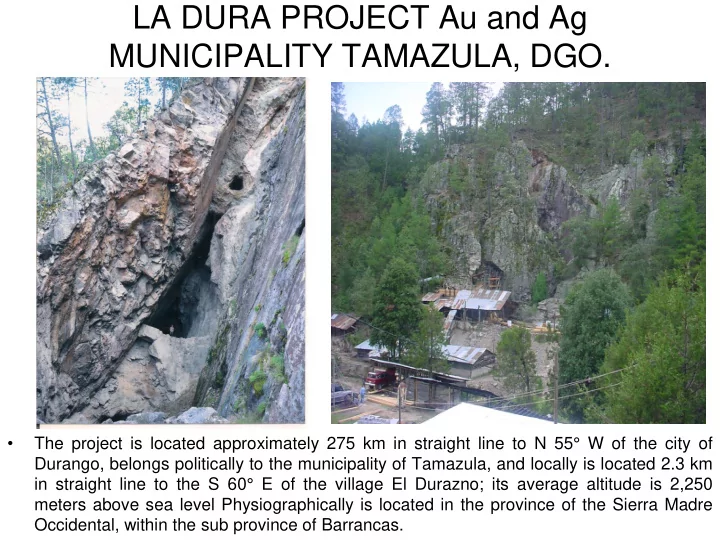
SLIDE 16 MINING WORKS
- As mentioned, the mine has been worked for some time, so there is enough development
works, such as the carvings on the San Manuel ore shoot in the SE part and over the Chinacá ore shoot to the NW, which are inaccessible from surface and at depth of 100 and 70 meters respectively. The mine is fairly stable, you can see the ancient carvings.
- Larger works are located in the La Dura mine, there are great eaten covering the
thickness of the breccia between faults 1 and 2, and 2 and 3 faults being styled this 120 m long with depths of 138 m; these consist of 6 levels and 2 sublevels and added more than 1000 m between fronts, cruises, wells and raising; the recesses that are level 0 (2,240 m) communicated to surface. The total exploitation of the 0 level between 1 and 2 faults indicates that there was mineralization in these and in the encasing rock in disseminated form, also that into the back of the vein-fault 1 was observed native silver disseminated in the rhyolitic Tuff, which characterizes the site exploited between these faults.
- There is a main shot of manteo ranging from level 1 up to surface (40m) also account with
2 inclined interior shots, one that goes from level 1 to level 4 (San Silverio shot), 79m length and the other from level 1 to level 5 (new shot), 102m length.
- Between level 3 and level 4 was discovered in 1997 Giovana ore shoot which gave
values with an average grade of 91 g/t Au and 4,240 g/t Ag. Very similar laws to the Chinacá ore shoot (1971).
- Towards the SE portion of the faults there are superficial works, carved on the first two
structures with total development of 155m between mines, cruises and wells, being La Gloria (2,280 m.a.s.l.), El Divisadero and La Obra Azul, these works communicated to the NW and kicking off the large carvings of the La Dura mine.
- The mining work and manteo are up to date, there is no development to 'block' mineral.