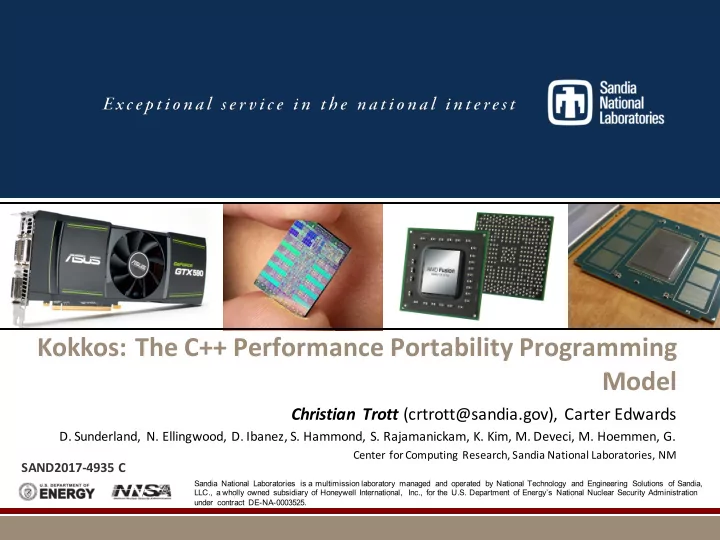
Kokkos: The C++ Performance Portability Programming Model Christian - - PowerPoint PPT Presentation

kokkos the c performance portability programming model
SMART_READER_LITE
LIVE PREVIEW

Kokkos: The C++ Performance Portability Programming Model Christian - - PowerPoint PPT Presentation

Kokkos: The C++ Performance Portability Programming Model Christian Trott (crtrott@sandia.gov), Carter Edwards D. Sunderland, N. Ellingwood, D. Ibanez, S. Hammond, S. Rajamanickam, K. Kim, M. Deveci, M. Hoemmen, G. Center for Computing Research,


slide-1
SLIDE 1

Sandia National Laboratories is a multimission laboratory managed and operated by National Technology and Engineering Solutions of Sandia, LLC., a wholly owned subsidiary of Honeywell International, Inc., for the U.S. Department of Energy’s National Nuclear Security Administration under contract DE-NA-0003525.

Kokkos: The C++ Performance Portability Programming Model

Christian Trott (crtrott@sandia.gov), Carter Edwards

  • D. Sunderland, N. Ellingwood, D. Ibanez, S. Hammond, S. Rajamanickam, K. Kim, M. Deveci, M. Hoemmen, G.

Center for Computing Research, Sandia National Laboratories, NM

SAND2017-4935 C

slide-2
SLIDE 2

New Programming Models

§ HPC is at a Crossroads

§ Diversifying Hardware Architectures § More parallelism necessitates paradigm shift from MPI-only

§ Need for New Programming Models

§ Performance Portability: OpenMP 4.5, OpenACC, Kokkos, RAJA, SyCL, C++20?, … § Resilience and Load Balancing: Legion, HPX, UPC++, ...

§ Vendor decoupling drives external development

2

slide-3
SLIDE 3

New Programming Models

§ HPC is at a Crossroads

§ Diversifying Hardware Architectures § More parallelism necessitates paradigm shift from MPI-only

§ Need for New Programming Models

§ Performance Portability: OpenMP 4.5, OpenACC, Kokkos, RAJA, SyCL, C++20?, … § Resilience and Load Balancing: Legion, HPX, UPC++, ...

§ Vendor decoupling drives external development

3

What is Kokkos? What is new? Why should you trust us?

slide-4
SLIDE 4

Kokkos: Performance, Portability and Productivity

DDR# HBM# DDR# HBM# DDR# DDR# DDR# HBM# HBM#

Kokkos#

LAMMPS# Sierra# Albany# Trilinos#

https://github.com/kokkos

slide-5
SLIDE 5

Performance Portability through Abstraction

Kokkos Execution Spaces (“Where”) Execution Patterns (“What”) Execution Policies (“How”)

  • N-Level
  • Support Heterogeneous Execution
  • parallel_for/reduce/scan, task spawn
  • Enable nesting
  • Range, Team, Task-Dag
  • Dynamic / Static Scheduling
  • Support non-persistent scratch-pads

Memory Spaces (“Where”) Memory Layouts (“How”) Memory Traits

  • Multiple-Levels
  • Logical Space (think UVM vs explicit)
  • Architecture dependent index-maps
  • Also needed for subviews
  • Access Intent: Stream, Random, …
  • Access Behavior: Atomic
  • Enables special load paths: i.e. texture

Parallel Execution Data Structures

Separating of Concerns for Future Systems…

slide-6
SLIDE 6

Capability Matrix

6 Implementation Technique Parallel Loops Parallel Reduction Tightly Nested Loops Non-tightly Nested Loops Task Parallelism Data Allocations Data Transfers Advanced Data Abstractions

Kokkos C++ Abstraction X X X X X X X X OpenMP Directives X X X X X X X

  • OpenACC

Directives X X X X

  • X

X

  • CUDA

Extension (X)

  • (X)

X

  • X

X

  • OpenCL

Extension (X)

  • (X)

X

  • X

X

  • C++AMP

Extension X

  • X
  • X

X

  • Raja

C++ Abstraction X X X (X)

  • TBB

C++ Abstraction X X X X X X

  • C++17

Language X

  • (X)

X (X) (X) Fortran2008 Language X

  • X

(X)

slide-7
SLIDE 7

Example: Conjugent Gradient Solver

§ Simple Iterative Linear Solver § For example used in MiniFE § Uses only three math operations:

§ Vector addition (AXPBY) § Dot product (DOT) § Sparse Matrix Vector multiply (SPMV)

§ Data management with Kokkos Views:

7 View<double*,HostSpace,MemoryTraits<Unmanaged> > h_x(x_in, nrows); View<double*> x("x",nrows); deep_copy(x,h_x);

slide-8
SLIDE 8

CG Solve: The AXPBY

8

void axpby(int n, View<double*> z, double alpha, View<const double*> x, double beta, View<const double*> y) { parallel_for("AXpBY", n, KOKKOS_LAMBDA ( const int& i) { z(i) = alpha*x(i) + beta*y(i); }); }

§ Simple data parallel loop: Kokkos::parallel_for § Easy to express in most programming models § Bandwidth bound § Serial Implementation: § Kokkos Implementation:

void axpby(int n, double* z, double alpha, const double* x, double beta, const double* y) { for(int i=0; i<n; i++) z[i] = alpha*x[i] + beta*y[i]; }

slide-9
SLIDE 9

CG Solve: The AXPBY

9

void axpby(int n, View<double*> z, double alpha, View<const double*> x, double beta, View<const double*> y) { parallel_for("AXpBY", n, KOKKOS_LAMBDA ( const int& i) { z(i) = alpha*x(i) + beta*y(i); }); }

§ Simple data parallel loop: Kokkos::parallel_for § Easy to express in most programming models § Bandwidth bound § Serial Implementation: § Kokkos Implementation:

void axpby(int n, double* z, double alpha, const double* x, double beta, const double* y) { for(int i=0; i<n; i++) z[i] = alpha*x[i] + beta*y[i]; }

Parallel Pattern: for loop

slide-10
SLIDE 10

CG Solve: The AXPBY

10

void axpby(int n, View<double*> z, double alpha, View<const double*> x, double beta, View<const double*> y) { parallel_for("AXpBY", n, KOKKOS_LAMBDA ( const int& i) { z(i) = alpha*x(i) + beta*y(i); }); }

§ Simple data parallel loop: Kokkos::parallel_for § Easy to express in most programming models § Bandwidth bound § Serial Implementation: § Kokkos Implementation:

void axpby(int n, double* z, double alpha, const double* x, double beta, const double* y) { for(int i=0; i<n; i++) z[i] = alpha*x[i] + beta*y[i]; }

String Label: Profiling/Debugging

slide-11
SLIDE 11

CG Solve: The AXPBY

11

void axpby(int n, View<double*> z, double alpha, View<const double*> x, double beta, View<const double*> y) { parallel_for("AXpBY", n, KOKKOS_LAMBDA ( const int& i) { z(i) = alpha*x(i) + beta*y(i); }); }

§ Simple data parallel loop: Kokkos::parallel_for § Easy to express in most programming models § Bandwidth bound § Serial Implementation: § Kokkos Implementation:

void axpby(int n, double* z, double alpha, const double* x, double beta, const double* y) { for(int i=0; i<n; i++) z[i] = alpha*x[i] + beta*y[i]; }

Execution Policy: do n iterations

slide-12
SLIDE 12

CG Solve: The AXPBY

12

void axpby(int n, View<double*> z, double alpha, View<const double*> x, double beta, View<const double*> y) { parallel_for("AXpBY", n, KOKKOS_LAMBDA ( const int& i) { z(i) = alpha*x(i) + beta*y(i); }); }

§ Simple data parallel loop: Kokkos::parallel_for § Easy to express in most programming models § Bandwidth bound § Serial Implementation: § Kokkos Implementation:

void axpby(int n, double* z, double alpha, const double* x, double beta, const double* y) { for(int i=0; i<n; i++) z[i] = alpha*x[i] + beta*y[i]; }

Iteration handle: integer index

slide-13
SLIDE 13

CG Solve: The AXPBY

13

void axpby(int n, View<double*> z, double alpha, View<const double*> x, double beta, View<const double*> y) { parallel_for("AXpBY", n, KOKKOS_LAMBDA ( const int& i) { z(i) = alpha*x(i) + beta*y(i); }); }

§ Simple data parallel loop: Kokkos::parallel_for § Easy to express in most programming models § Bandwidth bound § Serial Implementation: § Kokkos Implementation:

void axpby(int n, double* z, double alpha, const double* x, double beta, const double* y) { for(int i=0; i<n; i++) z[i] = alpha*x[i] + beta*y[i]; }

Loop Body

slide-14
SLIDE 14

CG Solve: The AXPBY

14

void axpby(int n, View<double*> z, double alpha, View<const double*> x, double beta, View<const double*> y) { parallel_for("AXpBY", n, KOKKOS_LAMBDA ( const int& i) { z(i) = alpha*x(i) + beta*y(i); }); }

§ Simple data parallel loop: Kokkos::parallel_for § Easy to express in most programming models § Bandwidth bound § Serial Implementation: § Kokkos Implementation:

void axpby(int n, double* z, double alpha, const double* x, double beta, const double* y) { for(int i=0; i<n; i++) z[i] = alpha*x[i] + beta*y[i]; }

slide-15
SLIDE 15

CG Solve: The Dot Product

15

double dot(int n, View<const double*> x, View<const double*> y) { double x_dot_y = 0.0; parallel_reduce("Dot",n, KOKKOS_LAMBDA (const int& i,double& sum) { sum += x[i]*y[i]; }, x_dot_y); return x_dot_y; }

§ Simple data parallel loop with reduction: Kokkos::parallel_reduce § Non trivial in CUDA due to lack of built-in reduction support § Bandwidth bound § Serial Implementation: § Kokkos Implementation:

double dot(int n, const double* x, const double* y) { double sum = 0.0; for(int i=0; i<n; i++) sum += x[i]*y[i]; return sum; }

slide-16
SLIDE 16

CG Solve: The Dot Product

16

double dot(int n, View<const double*> x, View<const double*> y) { double x_dot_y = 0.0; parallel_reduce("Dot",n, KOKKOS_LAMBDA (const int& i,double& sum) { sum += x[i]*y[i]; }, x_dot_y); return x_dot_y; }

§ Simple data parallel loop with reduction: Kokkos::parallel_reduce § Non trivial in CUDA due to lack of built-in reduction support § Bandwidth bound § Serial Implementation: § Kokkos Implementation:

double dot(int n, const double* x, const double* y) { double sum = 0.0; for(int i=0; i<n; i++) sum += x[i]*y[i]; return sum; }

Parallel Pattern: loop with reduction

slide-17
SLIDE 17

CG Solve: The Dot Product

17

double dot(int n, View<const double*> x, View<const double*> y) { double x_dot_y = 0.0; parallel_reduce("Dot",n, KOKKOS_LAMBDA (const int& i,double& sum) { sum += x[i]*y[i]; }, x_dot_y); return x_dot_y; }

§ Simple data parallel loop with reduction: Kokkos::parallel_reduce § Non trivial in CUDA due to lack of built-in reduction support § Bandwidth bound § Serial Implementation: § Kokkos Implementation:

double dot(int n, const double* x, const double* y) { double sum = 0.0; for(int i=0; i<n; i++) sum += x[i]*y[i]; return sum; }

Iteration Index + Thread-Local Red. Varible

slide-18
SLIDE 18

CG Solve: The Dot Product

18

double dot(int n, View<const double*> x, View<const double*> y) { double x_dot_y = 0.0; parallel_reduce("Dot",n, KOKKOS_LAMBDA (const int& i,double& sum) { sum += x[i]*y[i]; }, x_dot_y); return x_dot_y; }

§ Simple data parallel loop with reduction: Kokkos::parallel_reduce § Non trivial in CUDA due to lack of built-in reduction support § Bandwidth bound § Serial Implementation: § Kokkos Implementation:

double dot(int n, const double* x, const double* y) { double sum = 0.0; for(int i=0; i<n; i++) sum += x[i]*y[i]; return sum; }

slide-19
SLIDE 19

CG Solve: The SPMV

§ Loop over rows § Dot product of matrix row with a vector § Example of Non-Tightly nested loops § Random access on the vector (Texture fetch on GPUs)

19

void SPMV(int nrows, const int* A_row_offsets, const int* A_cols, const double* A_vals, double* y, const double* x) { for(int row=0; row<nrows; ++row) { double sum = 0.0; int row_start=A_row_offsets[row]; int row_end=A_row_offsets[row+1]; for(int i=row_start; i<row_end; ++i) { sum += A_vals[i]*x[A_cols[i]]; } y[row] = sum; } }

slide-20
SLIDE 20

CG Solve: The SPMV

§ Loop over rows § Dot product of matrix row with a vector § Example of Non-Tightly nested loops § Random access on the vector (Texture fetch on GPUs)

20

void SPMV(int nrows, const int* A_row_offsets, const int* A_cols, const double* A_vals, double* y, const double* x) { for(int row=0; row<nrows; ++row) { double sum = 0.0; int row_start=A_row_offsets[row]; int row_end=A_row_offsets[row+1]; for(int i=row_start; i<row_end; ++i) { sum += A_vals[i]*x[A_cols[i]]; } y[row] = sum; } }

Outer loop over matrix rows

slide-21
SLIDE 21

CG Solve: The SPMV

§ Loop over rows § Dot product of matrix row with a vector § Example of Non-Tightly nested loops § Random access on the vector (Texture fetch on GPUs)

21

void SPMV(int nrows, const int* A_row_offsets, const int* A_cols, const double* A_vals, double* y, const double* x) { for(int row=0; row<nrows; ++row) { double sum = 0.0; int row_start=A_row_offsets[row]; int row_end=A_row_offsets[row+1]; for(int i=row_start; i<row_end; ++i) { sum += A_vals[i]*x[A_cols[i]]; } y[row] = sum; } }

Inner dot product row x vector

slide-22
SLIDE 22

CG Solve: The SPMV

§ Loop over rows § Dot product of matrix row with a vector § Example of Non-Tightly nested loops § Random access on the vector (Texture fetch on GPUs)

22

void SPMV(int nrows, const int* A_row_offsets, const int* A_cols, const double* A_vals, double* y, const double* x) { for(int row=0; row<nrows; ++row) { double sum = 0.0; int row_start=A_row_offsets[row]; int row_end=A_row_offsets[row+1]; for(int i=row_start; i<row_end; ++i) { sum += A_vals[i]*x[A_cols[i]]; } y[row] = sum; } }

slide-23
SLIDE 23

CG Solve: The SPMV

23

void SPMV(int nrows, View<const int*> A_row_offsets, View<const int*> A_cols, View<const double*> A_vals, View<double*> y, View<const double*, MemoryTraits< RandomAccess>> x) { #ifdef KOKKOS_ENABLE_CUDA int rows_per_team = 64;int team_size = 64; #else int rows_per_team = 512;int team_size = 1; #endif parallel_for("SPMV:Hierarchy", TeamPolicy< Schedule< Static > > ((nrows+rows_per_team-1)/rows_per_team,team_size,8), KOKKOS_LAMBDA (const TeamPolicy<>::member_type& team) { const int first_row = team.league_rank()*rows_per_team; const int last_row = first_row+rows_per_team<nrows? first_row+rows_per_team : nrows; parallel_for(TeamThreadRange(team,first_row,last_row),[&] (const int row) { const int row_start=A_row_offsets[row]; const int row_length=A_row_offsets[row+1]-row_start; double y_row; parallel_reduce(ThreadVectorRange(team,row_length),[=] (const int i,double& sum) { sum += A_vals(i+row_start)*x(A_cols(i+row_start)); } , y_row); y(row) = y_row; }); }); }

slide-24
SLIDE 24

CG Solve: The SPMV

24

void SPMV(int nrows, View<const int*> A_row_offsets, View<const int*> A_cols, View<const double*> A_vals, View<double*> y, View<const double*, MemoryTraits< RandomAccess>> x) { #ifdef KOKKOS_ENABLE_CUDA int rows_per_team = 64;int team_size = 64; #else int rows_per_team = 512;int team_size = 1; #endif parallel_for("SPMV:Hierarchy", TeamPolicy< Schedule< Static > > ((nrows+rows_per_team-1)/rows_per_team,team_size,8), KOKKOS_LAMBDA (const TeamPolicy<>::member_type& team) { const int first_row = team.league_rank()*rows_per_team; const int last_row = first_row+rows_per_team<nrows? first_row+rows_per_team : nrows; parallel_for(TeamThreadRange(team,first_row,last_row),[&] (const int row) { const int row_start=A_row_offsets[row]; const int row_length=A_row_offsets[row+1]-row_start; double y_row; parallel_reduce(ThreadVectorRange(team,row_length),[=] (const int i,double& sum) { sum += A_vals(i+row_start)*x(A_cols(i+row_start)); } , y_row); y(row) = y_row; }); }); }

Team Parallelism over Row Worksets

slide-25
SLIDE 25

CG Solve: The SPMV

25

void SPMV(int nrows, View<const int*> A_row_offsets, View<const int*> A_cols, View<const double*> A_vals, View<double*> y, View<const double*, MemoryTraits< RandomAccess>> x) { #ifdef KOKKOS_ENABLE_CUDA int rows_per_team = 64;int team_size = 64; #else int rows_per_team = 512;int team_size = 1; #endif parallel_for("SPMV:Hierarchy", TeamPolicy< Schedule< Static > > ((nrows+rows_per_team-1)/rows_per_team,team_size,8), KOKKOS_LAMBDA (const TeamPolicy<>::member_type& team) { const int first_row = team.league_rank()*rows_per_team; const int last_row = first_row+rows_per_team<nrows? first_row+rows_per_team : nrows; parallel_for(TeamThreadRange(team,first_row,last_row),[&] (const int row) { const int row_start=A_row_offsets[row]; const int row_length=A_row_offsets[row+1]-row_start; double y_row; parallel_reduce(ThreadVectorRange(team,row_length),[=] (const int i,double& sum) { sum += A_vals(i+row_start)*x(A_cols(i+row_start)); } , y_row); y(row) = y_row; }); }); }

Distribute rows in workset over team-threads

slide-26
SLIDE 26

CG Solve: The SPMV

26

void SPMV(int nrows, View<const int*> A_row_offsets, View<const int*> A_cols, View<const double*> A_vals, View<double*> y, View<const double*, MemoryTraits< RandomAccess>> x) { #ifdef KOKKOS_ENABLE_CUDA int rows_per_team = 64;int team_size = 64; #else int rows_per_team = 512;int team_size = 1; #endif parallel_for("SPMV:Hierarchy", TeamPolicy< Schedule< Static > > ((nrows+rows_per_team-1)/rows_per_team,team_size,8), KOKKOS_LAMBDA (const TeamPolicy<>::member_type& team) { const int first_row = team.league_rank()*rows_per_team; const int last_row = first_row+rows_per_team<nrows? first_row+rows_per_team : nrows; parallel_for(TeamThreadRange(team,first_row,last_row),[&] (const int row) { const int row_start=A_row_offsets[row]; const int row_length=A_row_offsets[row+1]-row_start; double y_row; parallel_reduce(ThreadVectorRange(team,row_length),[=] (const int i,double& sum) { sum += A_vals(i+row_start)*x(A_cols(i+row_start)); } , y_row); y(row) = y_row; }); }); }

Row x Vector dot product

slide-27
SLIDE 27

CG Solve: The SPMV

27

void SPMV(int nrows, View<const int*> A_row_offsets, View<const int*> A_cols, View<const double*> A_vals, View<double*> y, View<const double*, MemoryTraits< RandomAccess>> x) { #ifdef KOKKOS_ENABLE_CUDA int rows_per_team = 64;int team_size = 64; #else int rows_per_team = 512;int team_size = 1; #endif parallel_for("SPMV:Hierarchy", TeamPolicy< Schedule< Static > > ((nrows+rows_per_team-1)/rows_per_team,team_size,8), KOKKOS_LAMBDA (const TeamPolicy<>::member_type& team) { const int first_row = team.league_rank()*rows_per_team; const int last_row = first_row+rows_per_team<nrows? first_row+rows_per_team : nrows; parallel_for(TeamThreadRange(team,first_row,last_row),[&] (const int row) { const int row_start=A_row_offsets[row]; const int row_length=A_row_offsets[row+1]-row_start; double y_row; parallel_reduce(ThreadVectorRange(team,row_length),[=] (const int i,double& sum) { sum += A_vals(i+row_start)*x(A_cols(i+row_start)); } , y_row); y(row) = y_row; }); }); }

slide-28
SLIDE 28

CG Solve: Performance

28

10 20 30 40 50 60 70 80 90 AXPBY-100 AXPBY-200 DOT-100 DOT-200 SPMV-100 SPMV-200 Performance [Gflop/s]

NVIDIA P100 / IBM Power8

OpenACC CUDA Kokkos OpenMP

10 20 30 40 50 60 AXPBY-100 AXPBY-200 DOT-100 DOT-200 SPMV-100 SPMV-200 Performance [Gflop/s]

Intel KNL 7250

OpenACC Kokkos OpenMP TBB (Flat) TBB (Hierarchical)

§ Comparison with other Programming Models § Straight forward implementation of kernels § OpenMP 4.5 is immature at this point § Two problem sizes: 100x100x100 and 200x200x200 elements

slide-29
SLIDE 29

Custom Reductions With Lambdas

§ Added Capability to do Custom Reductions with Lambdas § Provide built-in reducers for common operations

§ Add,Min,Max,Prod,MinLoc,MaxLoc,MinMaxLoc,And,Or,Xor,

§ Users can implement their own reducers § Example Max reduction:

29

double result parallel_reduce(N, KOKKOS_LAMBDA(const int& i, double& lmax) { if(lmax < a(i)) lmax = a(i); },Max<double>(result));

100 200 300 400 500 600 K80 P100 KNL

Bandwidth in GB/s

Reduction Performance

Sum Max MaxLoc

slide-30
SLIDE 30

New Features: MDRangePolicy

§ Many people perform structured grid calculations

§ Sandia’s codes are predominantly unstructured though

§ MDRangePolicy introduced for tightly nested loops § Usecase corresponding to OpenMP collapse clause § Optionally set iteration order and tiling:

30

void launch (int N0, int N1, [ARGS]) { parallel_for(MDRangePolicy<Rank<3>>({0,0,0},{N0,N1,N2}), KOKKOS_LAMBDA (int i0, int i1) {/*...*/}); } MDRangePolicy<Rank<3,Iterate::Right,Iterate::Left>> ({0,0,0},{N0,N1,N2},{T0,T1,T2})

100 200 300 400 500 600 KNL P100

Gflop/s

Albany Kernel

Naïve Best Raw MDRange

slide-31
SLIDE 31

New Features: Task Graphs

§ Task dags are an important class of algorithmic structures § Used for algorithms with complex data dependencies

§ For example triangular solve

§ Kokkos tasking is on-node § Future based, not explicit data centric (as for example Legion)

§ Tasks return futures § Tasks can depend on futures

§ Respawn of tasks possible § Tasks can spawn other tasks § Tasks can have data parallel loops

§ I.e. a task can utilize multiple threads like the hyper threads on a core or a CUDA block

31

Carter Edwards S7253 “Task Data Parallelism” , Right after this talk.

slide-32
SLIDE 32

New Features: Pascal Support

§ Pascal GPUs Provide a set of new Capabilities

§ Much better memory subsystem § NVLink (next slide) § Hardware support for double precision atomic add

§ Generally significant speedup 3-5x over K80 for Sandia Apps

32

20 40 60 80 100 120 140 160 4000 32000 256000 2048000

Million Atomsteps per Second Number of Atoms

LammpsTersoffPotential

K40 K80 P100 K40 Atomic K80 Atomic P100 Atomic 0.001 0.01 0.1 1 10 100 1000 1 8 64 512 4096

Bandwidth in GB/s Update Array Size

Atomic Bandwidth

slide-33
SLIDE 33

New Features: HBM Support

§ New architectures with HBM: Intel KNL, NVIDIA P100 § Generally three types of allocations:

§ Page pinned in DDR § Page pinned in HBM § Page migratable by OS or hardware caching

§ Kokkos supports all three on both architectures

§ For Cuda backend: CudaHostPinnedSpace,CudaSpace and CudaUVMSpace § E.g.: Kokkos::View<double*, CudaUVMSpace> a(”A”,N);

§ P100 Bandwidth with and without data Reuse

33

1 10 100 1000 0.125 0.25 0.5 1 2 4 8 16 32 64

Bandwidth GB/s Problem Size [GB]

HostPinned 1 HostPinned 32 UVM 1 UVM 32

slide-34
SLIDE 34

Upcoming Features

§ Support for OpenMP 4.5+ Target Backend

§ Experimentally available on github § CUDA will stay preferred backend § Maybe support for FPGAs in the future? § Help maturing OpenMP 4.5+ compilers

§ Support for AMD ROCm Backend

§ Experimentally available on github § Mainly developed by AMD § Support for APUs and discrete GPUs § Expect maturation fall 2017

34

slide-35
SLIDE 35

Beyond Capabilities

§ Using Kokkos is invasive, you can’t just swap it out

§ Significant part of data structures need to be taken over § Function markings everywhere

§ It is not enough to have initial Capabilities § Robustness comes from utilizations and experience

§ Different types of application and coding styles will expose different corner cases

§ Applications need libraries

§ Interaction with TPLs such as BLAS must work § Many library capabilities must be reimplemented in the programming model

§ Applications need tools

§ Profiling and Debugging capabilities are required for serious work

35

slide-36
SLIDE 36

Timeline

36 Initial Kokkos: Linear Algebra for Trilinos Restart of Kokkos: Scope now Programming Model Mantevo MiniApps: Compare Kokkos to other Models LAMMPS: Demonstrate Legacy App Transition Trilinos: Move Tpetra over to use Kokkos Views Multiple Apps start exploring (Albany, Uintah, …) Sandia Multiday Tutorial (~80 attendees) Sandia Decision to prefer Kokkos over other models Github Release of Kokkos 2.0 Kokkos-Kernels and Kokkos-Tools Release DOE Exascale Computing Project starts 2008 2011 2013 2012 2014 2016 2015 2017

slide-37
SLIDE 37

0" 2000" 4000" 6000" 8000" 10000" 12000" 14000" FOM+(Z/s)+

LULESH+Figure+of+Merit+Results+(Problem+60)+

HSW"1x16" HSW"1x32" P8"1x40"XL" KNC"1x224" ARM64"1x8" NV"K40"

Higher" is" Better"

Initial Demonstrations (2012-2015)

37

§ Demonstrate Feasibility of Performance Portability

§ Development of a number of MiniApps from different science domains

§ Demonstrate Low Performance Loss versus Native Models

§ MiniApps are implemented in various programming models

§ DOE TriLab Collaboration

§ Show Kokkos works for

  • ther labs app

§ Note this is historical data: Improvements were found, RAJA implemented similar optimization etc.

slide-38
SLIDE 38

Training the User-Base

§ Typical Legacy Application Developer

§ Science Background § Mostly Serial Coding (MPI apps usually have communication layer few people touch) § Little hardware background, little parallel programming experience

§ Not sufficient to teach Programming Model Syntax

§ Need training in parallel programming techniques § Teach fundamental hardware knowledge (how does CPU, MIC and GPU differ, and what does it mean for my code) § Need training in performance profiling

§ Regular Kokkos Tutorials

§ ~200 slides, 9 hands-on exercises to teach parallel programming techniques, performance considerations and Kokkos § Now dedicated ECP Kokkos support project: develop online support community § ~200 HPC developers (mostly from DOE labs) had Kokkos training so far

38

slide-39
SLIDE 39

Keeping Applications Happy

§ Never underestimate developers ability to find new corner cases!!

§ Having a Programming Model deployed in MiniApps or a single big app is very different from having half a dozen multi-million line code customers. § 538 Issues in 24 months § 28% are small enhancements § 18% bigger feature requests § 24% are bugs: often corner cases

39 100 200 300 400 500 600

Issues

Issues since 2015

Enhancements Feature Request Bug Compiler Issue Questions Other

§ Example: Subviews

§ Initially data type needed to match including compile time dimensions § Allow compile/runtime conversion § Allow Layout conversion if possible § Automatically find best layout § Add subviewpatterns

slide-40
SLIDE 40

Testing and Software Quality

Develop

Release Version

Compilers GCC (4.8-6.3), Clang (3.6-4.0), Intel (15.0-18.0), IBM (13.1.5, 14.0), PGI (17.3), NVIDIA (7.0-8.0) Hardware Intel Haswell, Intel KNL, ARM v8, IBM Power8, NVIDIA K80, NVIDIA P100 Backends OpenMP, Pthreads, Serial, CUDA

Warnings as Errors

Feature

Development/Tests

Review Tests

Master

Integration

Trilinos, LAMMPS, … Multi config integration test

Nightly, UnitTests

New Features are developed on forks, and branches. Limited number of developers can push to develop

  • branch. Pull requests are reviewed/tested.

Each merge into master is minor release. Extensive integration test suite ensures backward compatibility, and catching of unit-test coverage gaps.

slide-41
SLIDE 41

Building an EcoSystem

41 Algorithms

(Random, Sort)

Containers

(Map, CrsGraph, Mem Pool)

Kokkos

(Parallel Execution, Data Allocation, Data Transfer)

Kokkos – Kernels

(Sparse/Dense BLAS, Graph Kernels, Tensor Kernels)

Kokkos – Tools

(Kokkos aware Profiling and Debugging Tools)

Trilinos

(Linear Solvers, Load Balancing, Discretization, Distributed Linear Algebra)

Kokkos – Support Community

(Application Support, Developer Training)

Applications MiniApps std::thread OpenMP CUDA ROCm

slide-42
SLIDE 42

Kokkos Tools

42

§ Utilities

§ KernelFilter: Enable/Disable Profiling for a selection of Kernels

§ Kernel Inspection

§ KernelLogger: Runtime information about entering/leaving Kernels and Regions § KernelTimer: Postprocessinginformation about Kernel and Region Times

§ Memory Analysis

§ MemoryHighWater: Maximum Memory Footprint over whole run § MemoryUsage: Per Memory Space Utilization Timeline § MemoryEvents: Per Memory Space Allocation and Deallocations

§ Third Party Connector

§ VTune Connector: Mark Kernels as Frames inside of Vtune § VTune Focused Connector: Mark Kernels as Frames + start/stop profiling

https://github.com/kokkos/kokkos-tools

slide-43
SLIDE 43

Kokkos-Tools: Example MemUsage

§ Tools are loaded at runtime

§ Profile actual release builds of applications § Set via: export KOKKOS_PROFILE_LIBRARY=[PATH_TO_PROFILING_LIB]

§ Output depends on tool

§ Often per process file

§ MemoryUsage provides per MemorySpace utilization timelines

§ Time starts with Kokkos::initialize § HOSTNAME-PROCESSID-CudaUVM.memspace_usage

43

# Space CudaUVM # Time(s) Size(MB) HighWater(MB) HighWater-Process(MB) 0.317260 38.1 38.1 81.8 0.377285 0.0 38.1 158.1 0.384785 38.1 38.1 158.1 0.441988 0.0 38.1 158.1

slide-44
SLIDE 44

Kokkos-Kernels

44

§ Provide BLAS (1,2,3); Sparse; Graph and Tensor Kernels § No required dependencies other than Kokkos § Local kernels (no MPI) § Hooks in TPLs such as MKL or cuBLAS/cuSparse where applicable § Provide kernels for all levels of hierarchical parallelism:

§ Global Kernels: use all execution resources available § Team Level Kernels: use a subset of threads for execution § Thread Level Kernels: utilize vectorization inside the kernel § Serial Kernels: provide elemental functions (OpenMP declare SIMD)

§ Work started based on customer priorities; expect multi-year effort for broad coverage § People: Many developers from Trilinos contribute

§ Consolidate node level reusable kernels previously distributed over multiple packages

slide-45
SLIDE 45

Kokkos-Kernels: Dense Blas Example

45

5E+10 1E+11 1.5E+11 2E+11 2.5E+11 3 5 10 15

Performance GFlop/s Matrix Block Size

Batched DGEMM 32k blocks

MKL @ KNL KK @ KNL CUBLAS @ P100 KK @ P100 5E+10 1E+11 1.5E+11 2E+11 3 5 10 15

Performance GFlop/s Matrix Block Size

Batched TRSM 32k blocks

MKL @ KNL KK @ KNL CUBLAS @ P100 KK @ P100

§ Batched small matrices using an interleaved memory layout § Matrix sizes based on common physics problems: 3,5,10,15 § 32k small matrices § Vendor libraries get better for more and larger matrices

slide-46
SLIDE 46

Kokkos Users Spread

46

§ Users from a dozen major institutions § More than two dozen applications/libraries

§ Including many multi-million-line projects

Users USERS Backend Optimizations

slide-47
SLIDE 47

Further Material

§ https://github.com/kokkosKokkos Github Organization

§ Kokkos: Core library, Containers, Algorithms § Kokkos-Kernels: Sparse and Dense BLAS, Graph, Tensor (under development) § Kokkos-Tools: Profiling and Debugging § Kokkos-MiniApps: MiniApp repository and links § Kokkos-Tutorials: Extensive Tutorials with Hands-On Exercises

§ https://cs.sandia.gov Publications (search for ’Kokkos’)

§ Many Presentations on Kokkos and its use in libraries and apps

§ Talks at this GTC:

§ Carter Edwards S7253 “Task Data Parallelism”, Today 10:00, 211B § Ramanan Sankaran, S7561 “High Pres. Reacting Flows”, Today 1:30, 212B § Pierre Kestener, S7166 “High Res. Fluid Dynamics”, Today 14:30, 212B § Michael Carilli, S7148 “Liquid Rocket Simulations”, Today 16:00, 212B § Panel, S7564 “Accelerator Programming Ecosystems”, Tuesday 16:00, Ball3 § Training Lab, L7107 “Kokkos, Manycore PP”, Wednesday 16:00, LL21E 47

slide-48
SLIDE 48

http://www.github.com/kokkos