Knowledge Sharing A conceptualization is a map from the problem - - PowerPoint PPT Presentation

knowledge sharing
SMART_READER_LITE
LIVE PREVIEW

Knowledge Sharing A conceptualization is a map from the problem - - PowerPoint PPT Presentation

Knowledge Sharing A conceptualization is a map from the problem domain into the representation. A conceptualization specifies: What sorts of individuals are being modeled The vocabulary for specifying individuals, relations and properties


slide-1
SLIDE 1

Knowledge Sharing

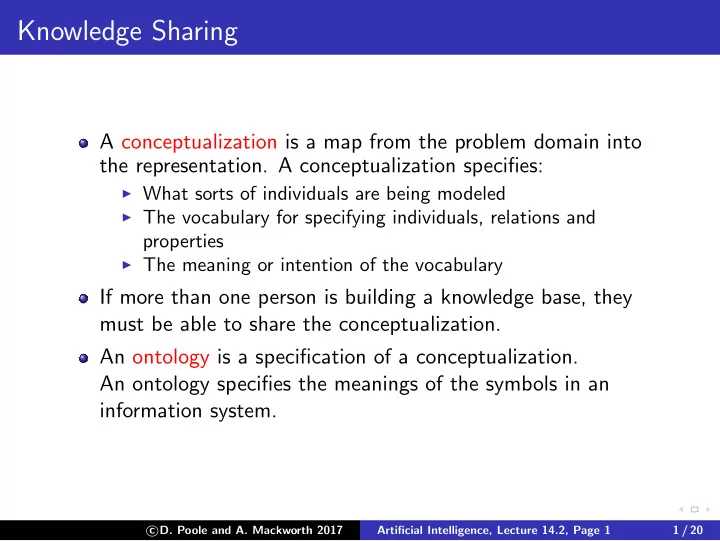
A conceptualization is a map from the problem domain into the representation. A conceptualization specifies:

◮ What sorts of individuals are being modeled ◮ The vocabulary for specifying individuals, relations and

properties

◮ The meaning or intention of the vocabulary

If more than one person is building a knowledge base, they must be able to share the conceptualization. An ontology is a specification of a conceptualization. An ontology specifies the meanings of the symbols in an information system.

c

  • D. Poole and A. Mackworth 2017

Artificial Intelligence, Lecture 14.2, Page 1 1 / 20

slide-2
SLIDE 2

Mapping from a conceptualization to a symbol

c

  • D. Poole and A. Mackworth 2017

Artificial Intelligence, Lecture 14.2, Page 2 2 / 20

slide-3
SLIDE 3

Semantic Web

Ontologies are published on the web in machine readable form. Builders of knowledge bases or web sites adhere to and refer to a published ontology:

◮ a symbol defined by an ontology means the same thing across

web sites that obey the ontology.

◮ if someone wants to refer to something not defined, they

publish an ontology defining the terminology. Others adopt the terminology by referring to the new ontology. In this way, ontologies evolve.

◮ Separately developed ontologies can have mappings between

them published.

c

  • D. Poole and A. Mackworth 2017

Artificial Intelligence, Lecture 14.2, Page 3 3 / 20

slide-4
SLIDE 4

Challenges of building ontologies

They can be huge: finding the appropriate terminology for a concept may be difficult.

c

  • D. Poole and A. Mackworth 2017

Artificial Intelligence, Lecture 14.2, Page 4 4 / 20

slide-5
SLIDE 5

Challenges of building ontologies

They can be huge: finding the appropriate terminology for a concept may be difficult. How one divides the world can depend on the application. Different ontologies describe the world in different ways. People can fundamentally disagree about an appropriate structure.

c

  • D. Poole and A. Mackworth 2017

Artificial Intelligence, Lecture 14.2, Page 5 4 / 20

slide-6
SLIDE 6

Challenges of building ontologies

They can be huge: finding the appropriate terminology for a concept may be difficult. How one divides the world can depend on the application. Different ontologies describe the world in different ways. People can fundamentally disagree about an appropriate structure. Different knowledge bases can use different ontologies. To allow KBs based on different ontologies to inter-operate, there must be mapping between ontologies. It has to be in user’s interests to use an ontology.

c

  • D. Poole and A. Mackworth 2017

Artificial Intelligence, Lecture 14.2, Page 6 4 / 20

slide-7
SLIDE 7

Challenges of building ontologies

They can be huge: finding the appropriate terminology for a concept may be difficult. How one divides the world can depend on the application. Different ontologies describe the world in different ways. People can fundamentally disagree about an appropriate structure. Different knowledge bases can use different ontologies. To allow KBs based on different ontologies to inter-operate, there must be mapping between ontologies. It has to be in user’s interests to use an ontology. The computer doesn’t understand the meaning of the symbols. The formalism can constrain the meaning, but can’t define it.

c

  • D. Poole and A. Mackworth 2017

Artificial Intelligence, Lecture 14.2, Page 7 4 / 20

slide-8
SLIDE 8

Semantic Web Technologies

XML the Extensible Markup Language provides generic syntax. tag . . . / or tag . . . . . . /tag. URI a Uniform Resource Identifier is a name of an individual (resource). This name can be shared. Often in the form of a URL to ensure uniqueness. RDF the Resource Description Framework is a language of triples OWL the Web Ontology Language, defines some primitive properties that can be used to define terminology. (Doesn’t define a syntax).

c

  • D. Poole and A. Mackworth 2017

Artificial Intelligence, Lecture 14.2, Page 8 5 / 20

slide-9
SLIDE 9

Main Components of an Ontology

Individuals the things / objects in the world (not usually specified as part of the ontology) Classes sets of individuals Properties between individuals and their values

c

  • D. Poole and A. Mackworth 2017

Artificial Intelligence, Lecture 14.2, Page 9 6 / 20

slide-10
SLIDE 10

Individuals

Individuals are things in the world that can be named. (Concrete, abstract, concepts, reified). Unique names assumption (UNA): different names refer to different individuals. The UNA is not an assumption we can universally make: “The Queen”, “Elizabeth Windsor”, etc. Without the determining equality, we can’t count! In OWL we can specify:

  • wl:SameIndividual(i1, i2)
  • wl:DifferentIndividuals(i1, i3)

c

  • D. Poole and A. Mackworth 2017

Artificial Intelligence, Lecture 14.2, Page 10 7 / 20

slide-11
SLIDE 11

Classes

A class is a set of individuals. E.g., house, building,

  • fficeBuilding

One class can be a subclass of another

  • wl:SubClassOf(house, building)
  • wl:SubClassOf(officeBuilding, building)

The most general class is owl:Thing. Classes can be declared to be the same or to be disjoint:

  • wl:EquivalentClasses(house, singleFamilyDwelling)
  • wl:DisjointClasses(house, officeBuilding)

Different classes are not necessarily disjoint. E.g., a building can be both a commercial building and a residential building.

c

  • D. Poole and A. Mackworth 2017

Artificial Intelligence, Lecture 14.2, Page 11 8 / 20

slide-12
SLIDE 12

Properties

A property is between an individual and a value. A property has a domain and a range. rdfs:domain(livesIn, person) rdfs:range(livesIn, placeOfResidence)

c

  • D. Poole and A. Mackworth 2017

Artificial Intelligence, Lecture 14.2, Page 12 9 / 20

slide-13
SLIDE 13

Properties

A property is between an individual and a value. A property has a domain and a range. rdfs:domain(livesIn, person) rdfs:range(livesIn, placeOfResidence) An ObjectProperty is a property whose range is an individual. A DatatypeProperty is one whose range isn’t an individual, e.g., is a number or string.

c

  • D. Poole and A. Mackworth 2017

Artificial Intelligence, Lecture 14.2, Page 13 9 / 20

slide-14
SLIDE 14

Properties

A property is between an individual and a value. A property has a domain and a range. rdfs:domain(livesIn, person) rdfs:range(livesIn, placeOfResidence) An ObjectProperty is a property whose range is an individual. A DatatypeProperty is one whose range isn’t an individual, e.g., is a number or string. There can also be property hierarchies:

  • wl:subPropertyOf(livesIn, enclosure)
  • wl:subPropertyOf(principalResidence, livesIn)

c

  • D. Poole and A. Mackworth 2017

Artificial Intelligence, Lecture 14.2, Page 14 9 / 20

slide-15
SLIDE 15

Properties (Cont.)

One property can be inverse of another

  • wl:InverseObjectProperties(livesIn, hasResident)

Properties can be declared to be transitive, symmetric, functional, or inverse-functional.

c

  • D. Poole and A. Mackworth 2017

Artificial Intelligence, Lecture 14.2, Page 15 10 / 20

slide-16
SLIDE 16

Properties (Cont.)

One property can be inverse of another

  • wl:InverseObjectProperties(livesIn, hasResident)

Properties can be declared to be transitive, symmetric, functional, or inverse-functional. (Which of these are only applicable to object properties?)

c

  • D. Poole and A. Mackworth 2017

Artificial Intelligence, Lecture 14.2, Page 16 10 / 20

slide-17
SLIDE 17

Properties (Cont.)

One property can be inverse of another

  • wl:InverseObjectProperties(livesIn, hasResident)

Properties can be declared to be transitive, symmetric, functional, or inverse-functional. (Which of these are only applicable to object properties?) We can also state the minimum and maximal cardinality of a property.

  • wl:minCardinality(principalResidence, 1)
  • wl:maxCardinality(principalResidence, 1)

c

  • D. Poole and A. Mackworth 2017

Artificial Intelligence, Lecture 14.2, Page 17 10 / 20

slide-18
SLIDE 18

Property and Class Restrictions

We can define complex descriptions of classes in terms of restrictions of other classes and properties. E.g., A homeowner is a person who owns a house.

c

  • D. Poole and A. Mackworth 2017

Artificial Intelligence, Lecture 14.2, Page 18 11 / 20

slide-19
SLIDE 19

Property and Class Restrictions

We can define complex descriptions of classes in terms of restrictions of other classes and properties. E.g., A homeowner is a person who owns a house. homeOwner ⊆ person∩{x : ∃h ∈ house such that x owns h}

c

  • D. Poole and A. Mackworth 2017

Artificial Intelligence, Lecture 14.2, Page 19 11 / 20

slide-20
SLIDE 20

Property and Class Restrictions

We can define complex descriptions of classes in terms of restrictions of other classes and properties. E.g., A homeowner is a person who owns a house. homeOwner ⊆ person∩{x : ∃h ∈ house such that x owns h}

  • wl:subClassOf(homeOwner,person)
  • wl:subClassOf(homeOwner,
  • wl:ObjectSomeValuesFrom(owns, house))

c

  • D. Poole and A. Mackworth 2017

Artificial Intelligence, Lecture 14.2, Page 20 11 / 20

slide-21
SLIDE 21

OWL Class Constructors

  • wl:Thing ≡ all individuals
  • wl:Nothing ≡ no individuals
  • wl:ObjectIntersectionOf(C1, . . . , Ck) ≡ C1 ∩ · · · ∩ Ck
  • wl:ObjectUnionOf(C1, . . . , Ck) ≡ C1 ∪ · · · ∪ Ck
  • wl:ObjectComplementOf(C) ≡ Thing \ C
  • wl:ObjectOneOf(I1, . . . , Ik) ≡ {I1, . . . , Ik}
  • wl:ObjectHasValue(P, I) ≡ {x : x P I}
  • wl:ObjectAllValuesFrom(P, C) ≡ {x : x P y → y ∈ C}
  • wl:ObjectSomeValuesFrom(P, C) ≡

{x : ∃y ∈ C such that x P y}

  • wl:ObjectMinCardinality(n, P, C) ≡

{x : #{y|xPy and y ∈ C} ≥ n}

  • wl:ObjectMaxCardinality(n, P, C) ≡

{x : #{y|xPy and y ∈ C} ≤ n}

c

  • D. Poole and A. Mackworth 2017

Artificial Intelligence, Lecture 14.2, Page 21 12 / 20

slide-22
SLIDE 22

OWL Predicates

rdf:type(I, C) ≡ I ∈ C rdfs:subClassOf(C1, C2) ≡ C1 ⊆ C2

  • wl:EquivalentClasses(C1, C2) ≡ C1 ≡ C2
  • wl:DisjointClasses(C1, C2) ≡ C1 ∩ C2 = {}

rdfs:domain(P, C) ≡ if xPy then x ∈ C rdfs:range(P, C) ≡ if xPy then y ∈ C rdfs:subPropertyOf(P1, P2) ≡ xP1y implies xP2y

  • wl:EquivalentObjectProperties(P1, P2) ≡ xP1y if and only if xP2y
  • wl:DisjointObjectProperties(P1, P2) ≡ xP1y implies not xP2y
  • wl:InverseObjectProperties(P1, P2) ≡ xP1y if and only if yP2x
  • wl:SameIndividual(I1, . . . , In) ≡∀j∀k Ij = Ik
  • wl:DifferentIndividuals(I1, . . . , In) ≡ ∀j∀k j = k implies Ij = Ik
  • wl:FunctionalObjectProperty(P) ≡ if xPy1 and xPy2 then y1 = y2
  • wl:InverseFunctionalObjectProperty(P) ≡

if x1Py and x2Py then x1 = x2

  • wl:TransitiveObjectProperty(P) ≡ if xPy and yPz then xPz
  • wl:SymmetricObjectProperty ≡ if xPy then yPx

c

  • D. Poole and A. Mackworth 2017

Artificial Intelligence, Lecture 14.2, Page 22 13 / 20

slide-23
SLIDE 23

Knowledge Sharing

One ontology typically imports and builds on other ontologies. OWL provides facilities for version control. Tools for mapping one ontology to another allow inter-operation of different knowledge bases. The semantic web promises to allow two pieces of information to be combined if

◮ they both adhere to an ontology ◮ these are the same ontology or there is a mapping between

them.

c

  • D. Poole and A. Mackworth 2017

Artificial Intelligence, Lecture 14.2, Page 23 14 / 20

slide-24
SLIDE 24

Example: Apartment Building

An apartment building is a residential building with more than two units and they are rented.

c

  • D. Poole and A. Mackworth 2017

Artificial Intelligence, Lecture 14.2, Page 24 15 / 20

slide-25
SLIDE 25

Example: Apartment Building

An apartment building is a residential building with more than two units and they are rented. Declaration(ObjectProperty(:numberOfunits)) FunctionalObjectProperty(:numberOfunits) ObjectPropertyDomain(:numberOfunits :ResidentialBuilding) ObjectPropertyRange(:numberOfunits ObjectOneOf(:two :one :moreThanTwo)) Declaration(Class(:ApartmentBuilding)) EquivalentClasses(:ApartmentBuilding ObjectIntersectionOf( :ResidentialBuilding ObjectHasValue(:numberOfunits :moreThanTwo) ObjectHasValue(:ownership :rental)))

c

  • D. Poole and A. Mackworth 2017

Artificial Intelligence, Lecture 14.2, Page 25 15 / 20

slide-26
SLIDE 26

Aristotelian definitions

Aristotle [350 B.C.] suggested the definition if a class C in terms

  • f:

Genus: the super-class Differentia: the attributes that make members of the class C different from other members of the super-class “If genera are different and co-ordinate, their differentiae are themselves different in kind. Take as an instance the genus ’animal’ and the genus ’knowledge’. ’With feet’, ’two-footed’, ’winged’, ’aquatic’, are differentiae of ’animal’; the species of knowledge are not distinguished by the same differentiae. One species of knowledge does not differ from another in being ’two-footed’.” Aristotle, Categories, 350 B.C.

c

  • D. Poole and A. Mackworth 2017

Artificial Intelligence, Lecture 14.2, Page 26 16 / 20

slide-27
SLIDE 27

Example: hotel ontology

Define the following: Room BathRoom StandardRoom - what is rented as a room in a hotel Suite RoomOnly

c

  • D. Poole and A. Mackworth 2017

Artificial Intelligence, Lecture 14.2, Page 27 17 / 20

slide-28
SLIDE 28

Example: hotel ontology

Define the following: Room BathRoom StandardRoom - what is rented as a room in a hotel Suite RoomOnly Hotel HasForRent AllSuitesHotel NoSuitesHotel HasSuitesHotel

c

  • D. Poole and A. Mackworth 2017

Artificial Intelligence, Lecture 14.2, Page 28 17 / 20

slide-29
SLIDE 29

Top-Level Ontology — Basic Formal Ontology (BFO)

1: if entity continues to exist through time then 2:

it is a continuant

3:

if it doesn’t need another entity for its existence then

4:

it is an independent continuant

5:

if it has matter as a part then

6:

it is a material entity

7:

if it is a single coherent whole then

8:

it is an object

9:

else it is an immaterial entity

10:

else it is a dependent continuant

11:

if it a region in space then

12:

it is a spatial region

13:

else if it is a property then

14:

if it is a property all objects have then

15:

it is a quality

16:

. . . role . . . disposition . . . function . . .

17: else

c

  • D. Poole and A. Mackworth 2017

Artificial Intelligence, Lecture 14.2, Page 29 18 / 20

slide-30
SLIDE 30

Continuants vs Occurrents

A continuant exists in an instance of time and maintains its identity through time. An occurrent has temporal parts. Continuants participate in occurrents. a person, a life, a finger, infancy: what is part of what?

c

  • D. Poole and A. Mackworth 2017

Artificial Intelligence, Lecture 14.2, Page 30 19 / 20

slide-31
SLIDE 31

Continuants vs Occurrents

A continuant exists in an instance of time and maintains its identity through time. An occurrent has temporal parts. Continuants participate in occurrents. a person, a life, a finger, infancy: what is part of what? a holiday, the end of a lecture, an email, the sending of an email, the equator, earthquake, a smile, a laugh, the smell of a flower

c

  • D. Poole and A. Mackworth 2017

Artificial Intelligence, Lecture 14.2, Page 31 19 / 20

slide-32
SLIDE 32

Continuants

a pen, a person, Newtonian mechanics, the memory of a past event:

c

  • D. Poole and A. Mackworth 2017

Artificial Intelligence, Lecture 14.2, Page 32 20 / 20

slide-33
SLIDE 33

Continuants

a pen, a person, Newtonian mechanics, the memory of a past event: objects

c

  • D. Poole and A. Mackworth 2017

Artificial Intelligence, Lecture 14.2, Page 33 20 / 20

slide-34
SLIDE 34

Continuants

a pen, a person, Newtonian mechanics, the memory of a past event: objects a flock of birds, the students in CS422, a card collection:

c

  • D. Poole and A. Mackworth 2017

Artificial Intelligence, Lecture 14.2, Page 34 20 / 20

slide-35
SLIDE 35

Continuants

a pen, a person, Newtonian mechanics, the memory of a past event: objects a flock of birds, the students in CS422, a card collection:

  • bject aggregates

c

  • D. Poole and A. Mackworth 2017

Artificial Intelligence, Lecture 14.2, Page 35 20 / 20

slide-36
SLIDE 36

Continuants

a pen, a person, Newtonian mechanics, the memory of a past event: objects a flock of birds, the students in CS422, a card collection:

  • bject aggregates

a city, a room, a mouth, the hole of a doughnut:

c

  • D. Poole and A. Mackworth 2017

Artificial Intelligence, Lecture 14.2, Page 36 20 / 20

slide-37
SLIDE 37

Continuants

a pen, a person, Newtonian mechanics, the memory of a past event: objects a flock of birds, the students in CS422, a card collection:

  • bject aggregates

a city, a room, a mouth, the hole of a doughnut: site

c

  • D. Poole and A. Mackworth 2017

Artificial Intelligence, Lecture 14.2, Page 37 20 / 20

slide-38
SLIDE 38

Continuants

a pen, a person, Newtonian mechanics, the memory of a past event: objects a flock of birds, the students in CS422, a card collection:

  • bject aggregates

a city, a room, a mouth, the hole of a doughnut: site the dangerous part of a city, part of Grouse Mountain with the best view:

c

  • D. Poole and A. Mackworth 2017

Artificial Intelligence, Lecture 14.2, Page 38 20 / 20

slide-39
SLIDE 39

Continuants

a pen, a person, Newtonian mechanics, the memory of a past event: objects a flock of birds, the students in CS422, a card collection:

  • bject aggregates

a city, a room, a mouth, the hole of a doughnut: site the dangerous part of a city, part of Grouse Mountain with the best view: fiat part of an object.

c

  • D. Poole and A. Mackworth 2017

Artificial Intelligence, Lecture 14.2, Page 39 20 / 20