
SLIDE 1
Picturing Subjugated Knowledge: An argument for creative criminology
Nicola Harding Manchester Metropolitan University @Creative_Crim @NicolaAHarding
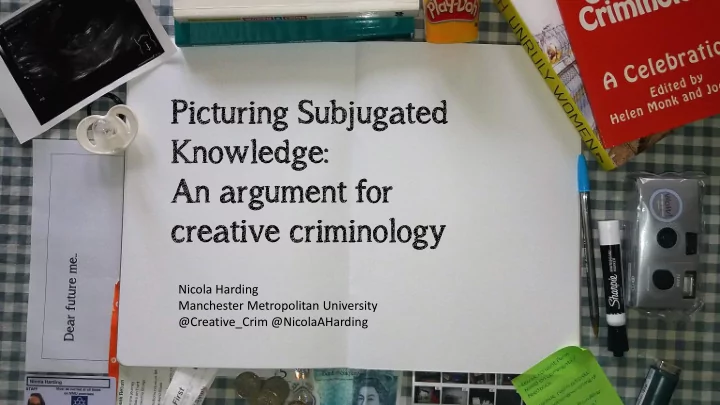
Knowledge: An argument for creative criminology Nicola Harding - - PowerPoint PPT Presentation
Picturing Subjugated Knowledge: An argument for creative criminology Nicola Harding Manchester Metropolitan University @Creative_Crim @NicolaAHarding Picturing Subjugated Knowledge Capturing the everyday experiences of criminalised
Nicola Harding Manchester Metropolitan University @Creative_Crim @NicolaAHarding
subject to community punishment and/or supervision.
Research (PAR).
mapping.
and contemporary theory. Implications for: theory, practice, and policy.
‘Creativity is any act, idea, or product that changes an existing domain, or that transforms an existing domain in to a new one. And the definition of a creative person is: someone whose thoughts or actions change a domain, or establish a new
cannot be changed without the explicit or implicit consent of a field responsible for it’ (Czikszentmihalyi, 1997, p. 28).
Visual criminology has been developed as a response to the dominance of text as knowledge within criminology, just as feminist criminology is a response to the problem of generalization and the androcentric nature of criminology. ‘brings attention to overlooked dimensions of crime and power relationships underpinning mainstream criminology’ (Henne & Shah, 2016, p. 2). A creative criminology offers analysis of the structures within which crime is created, inequalities replicated, and offers a critical mirror within which criminology as a discipline can reflect upon its limitations.
Theorist Desistance Theory This study Laub & Sampson (2003) Life course approach / adult transitions. ‘The love of a good woman’ All of the 28 women in the study reported experiencing domestic violence. Yet probation
relationships to reduce risk. Gottfredson and Hirschi (1990) Self-control & Maturation. Prioritises internal factors and individual maturation processes This study included first time offenders in late 40s and mid-50s. None of the women in the study had been juvenile offenders, were mature & had enormous responsibility in their lives. Maruna (2001) Identity & Change. Condemnation & Redemption scripts. ‘.. that process [of criminalisation] does not define me, I will not let it, I am not a bad
and it is not me as a person, I am not that person’ Sarah, Peer Mentor (2016)
towards multi-disciplinary research.
hierarchies of knowledge it presents.
action research.
rehabilitation.
https://doi.org/10.1093/bjc/azr089
Stanford: Stanford University Press.
Oxford Research Encyclopedia, Criminology and Criminal Justice. Oxford: Oxford University Press.
Lives: Delinquent Boys to Age 70. Cambridge, MA: Harvard University Press.
rebuild their lives. London: American Psychological Association.