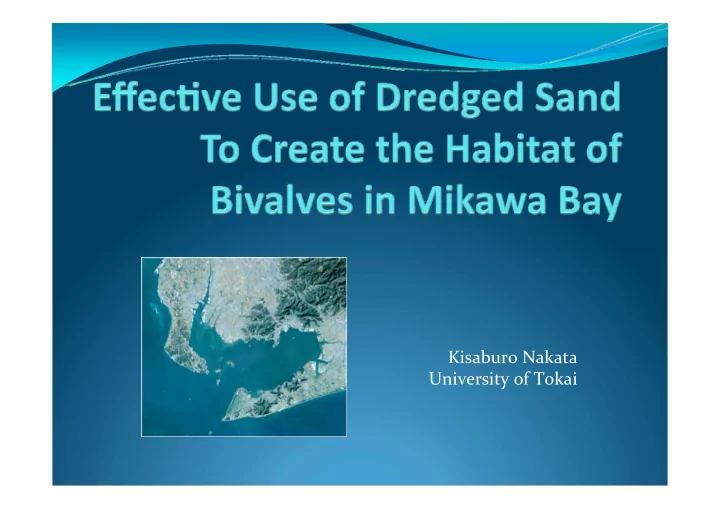
SLIDE 1 Kisaburo Nakata University of Tokai
SLIDE 2
Nakayama‐Channnel
The depth of water way dredging is planned to be
14.0m and the length 2700m, and the width, 700m to ensure the safety of ship course
The dredged sediment thickness is ca. 3m
SLIDE 3
The dredging work in Nakayama‐channel in Mikawa Bay
SLIDE 4 The dredged sand was used to create habitat in shallows
New habitat in
Nishiura area
Process of creating shallows
SLIDE 5
Tidal flat and shallows area in Mikawa Bay
Before 1951, there exist
large tidal flat area in the bay
Lost shallows are in red
color
620ha shallows are
created by using Nakayama‐ channel sand
SLIDE 6
Why the dredged sand was used to create shallows including tidal flat?
The formation of oxygen depleted water is the most
important issue in the bay system
Why oxygen is depleted in the bay bottom water? First, we consider that this is the typical
eutrophication problem, and that bulk loading control from terrestrial origin is countermeasure. But things are not so easy.
SLIDE 7
Even after 6 times bulk control of organic substance
and nutrients, the water quality is not improved.
After doing researches from several aspects, the main
reason why water quality has not been improved is revealed.
Loss of tidal flat area and shallows is the main reason,
at least, for oxygen depleted problem.
SLIDE 8 Circumstantial evidence
The relation between reclamation area and red tide frequency in Mikawa Bay : shows positive correlation Reclamation was done in the tidal flat area in almost cases
reclamation area
Red tide frequency
SLIDE 9 Redtide and Organic Particle deposition to sea floor
Red tide produces a lot
particles
Much organic matter in
the sediment surface induce oxygen consumption there
Oxygen depletion
SLIDE 10
Oxygen Depletion
What happens? Aoshio and mass
mortality
SLIDE 11 Oxygen depletion Eutophication Red tide
Increasing the
Organic particle deposition
Bacterial decomposition
supply<consume Nutrients supply; increasing Loading from land: increasing Reclamation; loss the tidal flat area Increase deposition Decrease the filter feeder such as bivalv Decrease fishery resouces
Mechanism of the formation of Mechanism of the formation of
- xygen depleted water mass
- xygen depleted water mass
SLIDE 12 Asari; short necked clam is one of the representative fauna in the shallows
Asari: bi‐valve, feeding
phytoplankton in the water column
Catch and resources of clam
SLIDE 13
Ecosystem Model
Using ecosystem model, DO variation in Mikawa Bay
from 1960 to 1990 is estimated
SLIDE 14 Ecological service in the tidal flat and shallows
Decomposition rate of organic matter Nutrients budget with ambient area Removal rate of nutrients (e.g. temporal reservation as biomass) Removal rate of suspended matter etc.
- Ecosystem model can consider all these
- processes. The last function is the most
effective in this case
SLIDE 15
Simulated sinking flux of organic particles in the bay
SLIDE 16 Clam resources and oxygen depletion
Oxygen depletion area;
model and observation
Correlation between
clam resources and
SLIDE 17
From model result, it is shown that oxygen depletion in Mikawa Bay is closely related to clam resources
Loading from the land decreased from 1980 Oxygen depletion did not decrease in 1980’s Habitat creation is the most effective countermeasure
SLIDE 18
Monitoring results in the new habitat
Species number and wet weight in three
representative habitat with elapsed time (unit; month)
SLIDE 19
Nitrogen budget in the new habitat based on the monitoring data using benthic ecosystem model
SLIDE 20
Nitrogen budget ; one of the method to evaluate the effectiveness of this work
Inflow organic nitrogen 1347.5 mgN/m2/day
inorganic nitrogen 667.3 mgN/m2/day
outflow organic nitrogen 1347.5 mgN/m2/day
inorganic nitrogen 667.3 mgN/m2/day Organic nitrogen disappears by 162.4 mgN/m2/day in the new habitat Multiply this value with 620 ha, removal flux becomes 1% of loading from rivers.
SLIDE 21 Conclusion
Here I explain why we create a new habitat for mainly
bi‐valve in the Mikawa Bay using dredged sand.
The method to evaluate whether the work is effective
- r not using benthic ecosystem model.
The model shows that the creating new shallow is very
effective and has a function of ecological services.
This is one of the good example for usage of dredged
materials.