Kinzie Industrial Corridor Fulton Market Innovation District Plan - - PowerPoint PPT Presentation

kinzie industrial corridor
SMART_READER_LITE
LIVE PREVIEW

Kinzie Industrial Corridor Fulton Market Innovation District Plan - - PowerPoint PPT Presentation

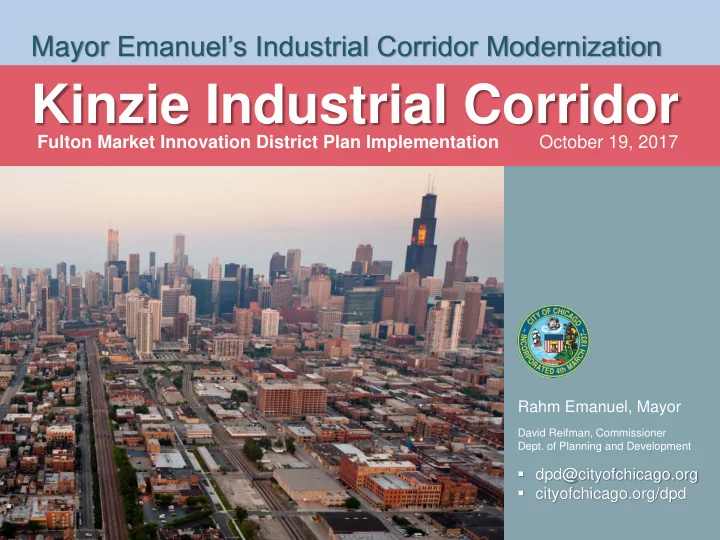
Mayor Emanuels Industrial Corridor Modernization Kinzie Industrial Corridor Fulton Market Innovation District Plan Implementation October 19, 2017 Rahm Emanuel, Mayor David Reifman, Commissioner Dept. of Planning and Development


slide-1
SLIDE 1
  • dpd@cityofchicago.org
  • cityofchicago.org/dpd

Rahm Emanuel, Mayor

David Reifman, Commissioner

  • Dept. of Planning and Development

Mayor Emanuel’s Industrial Corridor Modernization

Fulton Market Innovation District Plan Implementation October 19, 2017

Kinzie Industrial Corridor

slide-2
SLIDE 2

Agenda

1. Background

Fulton Market Innovation District Plan Approved by the Chicago Plan Commission on July 17, 2014

3. Next Steps

Council Committee to Review Ordinance

  • 2. Plan Commission Actions
  • Planned Manufacturing District Repeal

Section 17-13-0711 of the Chicago Zoning Ordinance states that the Plan Commission is responsible for monitoring the effectiveness of planned manufacturing districts and must recommend to the City Council changes in or repeal of a designated district

  • Map Amendments Within Industrial Corridors

Section 17-13-0402 of the Chicago Zoning Ordinance requires a public hearing to be held by the Chicago Plan Commission on applications to rezone land within an industrial corridor from an “M” zoning district classification to any other zoning district classification

slide-3
SLIDE 3

Core Job Employment Trends 2002 - 2014

Employment Trends in the Industrial Corridor System

Kinzie

Info & Tech (Largest number of jobs are either information technology and management or business support services and are stable or growing) Manufacturing (Largest number of jobs are in manufacturing and are stable or growing) Manufacturing and Moving & Storing Goods (Largest number of jobs in both manufacturing and the distribution and storage of goods and are stable or growing) Business to Business (Largest number of jobs are in business support services and are stable or growing

slide-4
SLIDE 4

Two Processes

Lake St Grand Ave Division St Chicago Ave Halsted St Kedzie Ave

  • Proposed Zoning Changes

Process 1: Implementation of the Fulton Market Innovation District (FMID) plan Process 2: Kinzie Industrial Corridor Study

  • Public process to begin in January
slide-5
SLIDE 5

Process 1: Proposed Zoning Changes

Jan. 2014 July 2014 2015 2016 Summer

2017

2018

Fulton Market Innovation District (FMID) Planning Process Plan approved by CPC July 2014 IMPLEMENTATION ACTIONS

Aug. 2017 Sept. 2017 Oct. 2017 Nov. 2017 Dec. 2017

First Public Meeting (August 24, 2017) CPC Hearing (October 19, 2017) Third Public Meeting (October 10, 2017) Introduce Ordinance to City Council (October 11, 2017) Implementation Ordinance reviewed by City Council (November 2017)

Proposed Schedule for Fulton Market Innovation District Plan Implementation

Second Public Meeting (September 19, 2017)

slide-6
SLIDE 6

Process 2: Kinzie Industrial Corridor Study

Sept. 2017 Jan. 2018

Summer 2018

  • Procure an economic/market

consultant

  • Complete focus groups and

interviews with area businesses

  • Complete land use survey and

data collection

  • Complete historic/character

building survey

  • Build stakeholder database

Research and Data Collection Public Planning Process

Proposed Schedule for full Kinzie Industrial Corridor Study

  • Hold regular public meetings
  • Present background data
  • Develop goals
  • Meet with stakeholders
  • Develop strategies and

actions

  • Draft plan document

Plan Completed

slide-7
SLIDE 7

Approved by the Chicago Plan Commission in July 2014, the Fulton Market Innovation District plan

  • utlined a vision to preserve

existing jobs while accommodating private sector investments that reinforce the area’s expanding role as an innovation-driven employment center.

PLAN COMPONENTS:

1. A formal land use plan to guide future zoning change requests. 2. General design guidelines. 3. Assorted infrastructure and streetscape projects that reinforce a cohesive district identity that combines food, innovation, culture and nightlife. 4. A historic preservation component.

Fulton Market Innovation District (FMID) Plan

A COMMUNITY-BASED PLAN

  • 3 Public meetings
  • 7 Neighborhood meetings

More than 450 participants contributed in a 7-month process that included:

slide-8
SLIDE 8

FMID Key Actions

The plan identifies seven key actions that serve to guide City policies and investment within the area:

  • 1. Adopt a land use map for the Fulton Market Innovation District

to minimize future land use conflicts and maximize the production of real and virtual products

  • 2. Establish Subdistrict B within the Kinzie Planned

Manufacturing District

  • 3. Adopt general design guidelines
  • 4. Coordinate public infrastructure investments to create a

cohesive district identity and support ongoing private investment projects.

  • 5. Invest in facilities for regional food products, traditional

wholesale businesses and associated historic buildings

  • 6. Encourage programming and events on food and Chicago’s

role within the regional and nationwide food systems

  • 7. Establish a historic district within a portion of the Fulton

Market Innovation District

slide-9
SLIDE 9

FMID Key Actions

FMID Key Action 2: Establish Subdistrict B within the Kinzie Planned Manufacturing District (PMD). A new subdistrict should be considered within the Kinzie PMD to reinforce the area’s expanding role as an innovation-driven employment center.

 New tools to meet the same goal, as well as strengthen industrial and commercial corridors citywide:

  • Zoning Overlay District to

guide new development and expand business uses

  • Industrial Corridor System

Fund

  • Neighborhood

Opportunity Fund

slide-10
SLIDE 10

Implementation of FMID Plan Key Action To implement the FMID plan’s vision to preserve existing jobs while accommodating private sector investments that reinforce the area’s expanding role as an innovation-driven employment center, the City proposes an

  • rdinance to:
  • 1. Repeal a portion of the existing Planned Manufacturing District 4

identified in the FMID plan as Subarea B to accommodate modern business uses.

  • 2. Designate the Kinzie Corridor Overlay District to guide future

development.

  • 3. Apply the new Industrial Corridor System Fund to this area, which

would support industrial projects throughout the city.

  • 4. Apply the City’s existing Neighborhood Opportunity Bonus to the

area.

slide-11
SLIDE 11
  • 1. Repeal portion of existing PMD 4, east of Ogden Avenue
  • Portion of existing PMD repealed to previous Zoning

Districts (predominantly manufacturing zoning districts)

Proposed Zoning Changes

Lake St Grand Ave Division St Chicago Ave

Maintain existing PMD 4 west of Ogden Avenue

Kinzie Industrial Corridor

PMD 4 M

PMD Repeal to M PMD Remains Existing Downtown Area

slide-12
SLIDE 12
  • 1. Repeal portion of existing PMD 4, east of Ogden Avenue
  • Portion of existing PMD repealed to previous Zoning Districts, or most closely comparable

Zoning Districts (predominantly manufacturing zoning districts)

Proposed Zoning Changes

slide-13
SLIDE 13

Proposed Zoning Changes

Lake St Grand Ave Kinzie St Carroll Ave

Kinzie Industrial Corridor Zoning Overlay District

PMD 4 M

PMD Repeal to M PMD Remains

Halsted St

Proposed Downtown Area

2. Establish a Zoning Overlay District to supplement base regulations:

  • Permits existing uses
  • Prohibits residential uses
  • Limits future zoning amendments to Downtown Zoning (DS and DX)
  • Applies the Industrial Corridor System Fee for future zoning changes

Existing Downtown Area

slide-14
SLIDE 14

Proposed Zoning Changes

The fee would apply to any project within a conversion area that requests a further zoning change from a pre-PMD zoning district to an allowed nonmanufacturing district Use of Fee: To increase jobs and enhance the tax base across the City, funds will be used in other Industrial Corridors for:

  • Infrastructure and utilities
  • Environmental remediation
  • Acquisition of industrial property
  • Rehabilitating buildings

Rail Highways Major Streets

§ ¨ ¦

North Branch Industrial Corridor Receiving Corridors Ineligible Corridors

New fee could generate tens of millions of dollars; 100% to be allocated for industrial development in other parts of the city

  • 3. Apply the new Industrial Corridor

System Fund to this area

slide-15
SLIDE 15

Proposed Zoning Changes

Downtown Submarkets

  • 4. Apply the City’s existing

Neighborhood Opportunity Bonus to the area.

Expanded Neighborhood Opportunity Bonus area

slide-16
SLIDE 16

West Loop Design Guidelines

On September 20, 2017, The Chicago Plan Commission approved design guidelines to foster excellence in design within the West Loop.

Design Guidelines Boundary Kinzie Corridor Overlay District FMID Plan Area

Carroll Ave Ashland Ave Kennedy Expy Eisenhower Expy

  • The approved document stated that these

design guidelines could apply to this area.

slide-17
SLIDE 17

Implementation of FMID Plan Key Action

  • Section 17-13-0711 of the Chicago Zoning

Code requires the Chicago Plan Commission (CPC) to monitor the effectiveness of all PMDs and make recommendations as needed.

  • 1. Repeal a portion of the existing Planned Manufacturing District 4

identified in the FMID plan as Subarea B to accommodate modern business uses.

  • 2. Designate the Kinzie Corridor Overlay District to guide future

development.

  • 3. Apply the new Industrial Corridor System Fund to this area, which

would support industrial projects throughout the city.

  • 4. Apply the City’s existing Neighborhood Opportunity Bonus to the

area.

slide-18
SLIDE 18

Purpose of the PMD:

  • 1. foster the city's industrial base
  • 2. maintain the city's diversified

economy for the general welfare of its citizens;

  • 3. strengthen existing manufacturing

areas that are suitable in size, location and character and which the City Council deems may benefit from designation as a PMD;

  • 4. encourage industrial investment,

modernization, and expansion by providing for stable and predictable industrial environments; and

  • 5. help plan and direct programs and

initiatives to promote growth and development of the city's industrial employment base.

The Chicago Plan Commission is responsible for on-going review of the continuing effectiveness of PMDs.

PMDs Across the City

Industrial Corridors Planned Manufacturing Districts (PMDs)

slide-19
SLIDE 19

PMD LAND USE

Between 1990 and 2017, land uses in the portion of PMD 4 east of Ogden Avenue have shifted away from heavy industry.

  • Manufacturing uses decreased from 57% to 25%
  • Commercial uses increased from 5% to 16%
  • Transportation uses increased from 8% to 30%

1. CMAP Land Use Inventory 2. Chicago Department of Planning and Development

PMD Review

1990 Land Use 2017 Land Use

slide-20
SLIDE 20

PMD Review

500 1,000 1,500 2,000 2,500 2002 2003 2004 2005 2006 2007 2008 2009 2010 2011 2012 2013 2014 Business to Business Services FIRE, Health, Ed. IT & Management Leisure & Hospitality Manufacturing Moving and Storing of Goods (Incl. Wholesale Trade) Other

  • Manufacturing jobs decreased 68%
  • Information, Technology and

Management increased 413%

  • FIRE, Health, Ed increased 347%
  • Leisure & Hospitality increased 65%

Source: On the Map, U.S. Census Bureau

Between 2002 and 2014, employment in the portion of PMD 4 east of Ogden Avenue has shifted away from traditional industrial uses.

PMD EMPLOYMENT

slide-21
SLIDE 21

1

PMD Review

Between 2013 and 2017, over 30 wholesale food businesses in Fulton Market have closed or relocated to other Industrial Corridors

AREA BUSINESSES

Lake St Grand Ave Kinzie St Carroll Ave Halsted St

Kinzie Industrial Corridor Zoning Overlay District Closed or Relocated Wholesale Food Business

slide-22
SLIDE 22

PMD Review

Modern business districts contain a mix of land uses that contribute to new jobs in a diverse economy, including office space, modern manufacturing and support services Three case studies:

  • South Lake Union in Seattle
  • The Seaport District in Boston
  • Pittsburgh along the north and south banks of the Monongahela River

South Lake Union Seattle WA Pittsburgh, PA

MODERN BUSINESS DISTRICTS

slide-23
SLIDE 23

PMD Review

1. Foster the city's industrial base Manufacturing uses, jobs and businesses have been moving away from the portion of PMD 4 east of Ogden Avenue 2. Maintain the city's diversified economy for the general welfare of its citizens Repealing the portion of PMD 4 east of Ogden Avenue would allow new types of technology or modern manufacturing businesses to be sited and grow in the city 3. Strengthen existing manufacturing areas that are suitable in size, location and character and which the City Council deems may benefit from designation as a PMD The character of the portion of PMD 4 east of Ogden Avenue, along with the surrounding Fulton Market area, has changed in the past decades with traditional industrial uses, jobs and businesses no longer being the primary use type in the area 4. Encourage industrial investment, modernization, and expansion by providing for stable and predictable industrial environments The environment of the Kinzie Industrial Corridor east of Ogden Avenue, including the area designated PMD 4, has not been stable or predictable – land uses, jobs and businesses have shifted greatly over the past decades 5. Help plan and direct programs and initiatives to promote growth and development of the city's industrial employment base Updated business districts are needed to draw modern manufacturing, technology and office uses to the city

Purpose of the PMD:

slide-24
SLIDE 24

Map Amendments Within Industrial Corridor

Map Amendments Within Industrial Corridors

Plan Commission reviews rezonings within industrial corridors from M, PMD, POS or T zoning district classifications to any other non-manufacturing zoning district

  • PMD 4 to C1-5 and C2-2

Proposed Zoning

Proposed Zoning Existing Zoning Kinzie Corridor Overlay District Industrial Corridor

Two sets of criteria

  • 1. First Set of Criteria: Continued Industrial

Viability(Sec. 17-13-0403)

  • 2. Second Set of Criteria: General Criteria for

Zoning Map Amendments (Sec. 17-13- 0308)

Location of proposed C1-5 and C2-2 districts, which were in place, or are the closest comparable districts to what was in place, prior to the PMD designation

slide-25
SLIDE 25

Proposed Zoning Changes

Jan. 2014 July 2014 2015 2016 Summer

2017

2018

Fulton Market Innovation District (FMID) Planning Process Plan approved by CPC July 2014 IMPLEMENTATION ACTIONS

Aug. 2017 Sept. 2017 Oct. 2017 Nov. 2017 Dec. 2017

First Public Meeting (August 24, 2017) CPC Hearing (October 19, 2017) Third Public Meeting (October 10, 2017) Introduce Ordinance to City Council (October 11, 2017) Implementation Ordinance reviewed by City Council (November 2017)

Proposed Schedule for Implementation

Second Public Meeting (September 19, 2017)

slide-26
SLIDE 26

Kinzie Industrial Corridor Study

Sept. 2017 Jan. 2018

Summer 2018

  • Procure an economic/market

consultant

  • Complete focus groups and

interviews with area businesses

  • Complete land use survey and

data collection

  • Complete historic/character

building survey

  • Build stakeholder database

Research and Data Collection Public Planning Process

Proposed Schedule for full Kinzie Industrial Corridor Study

  • Hold regular public meetings
  • Present background data
  • Develop goals
  • Meet with stakeholders
  • Develop strategies and

actions

  • Draft plan document

Plan Completed

slide-27
SLIDE 27

Ward Map

Ward Boundaries Area of Subject Ordinance Lake St Carroll Ave Grand Ave Kinzie St Halsted St