
SLIDE 1
Key Insights Housing Outcomes in Established Melbourne 2005-2016 - - PowerPoint PPT Presentation
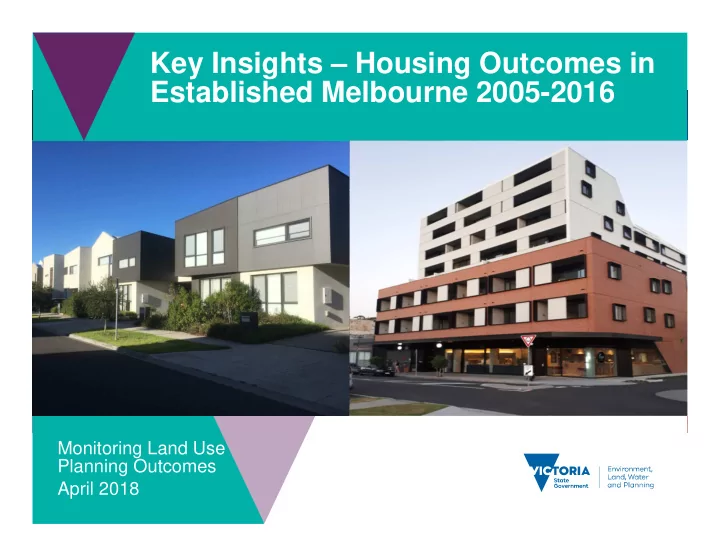
Key Insights Housing Outcomes in Established Melbourne 2005-2016 Monitoring Land Use Planning Outcomes April 2018 Introduction The Housing Development Data (HDD) provides annual lot by lot information on Melbourne's housing stock. This
2
The Housing Development Data (HDD) provides annual lot by lot information on Melbourne's housing stock. This presentation uses the HDD to examine:
Melbourne’s growth and established areas.
planning to promote housing in locations with good access to jobs, services and public transport.
commercial zones. These policies and reforms span the 2005-2016 period which encompassed Melbourne2030, the reform of the Residential Zones and the release of Plan Melbourne.
3
The 70/30 aspiration identified in Plan Melbourne (Direction 2.1) seeks to shift a higher proportion of new housing development to land with existing infrastructure by 2051. As a long term aspiration for the city’s growth the HDD demonstrates that housing growth is steadily shifting toward established areas and that the 70/30 aspiration is an achievable long term objective for Melbourne.
*Growth Areas are defined as any location within Growth Area municipalities that is subject to the Precinct Structure Planning process or a locally equivalent process. This division distinguishes land with existing infrastructure (established Melbourne) from land that requires new infrastructure.
Net new dwellings in Growth Area precinct structure planning areas and established Melbourne*
Source: HDD16
4
The redevelopment of existing and redundant sites for new housing provides a high proportion of Melbourne’s established area housing supply. There are currently 235,000 dwellings planned for major redevelopment sites throughout established Melbourne that are scheduled for development
The number of new dwellings in the urban renewal pipeline will grow as more sites are identified and undergo detailed planning.
Projected major redevelopment projects 2017
Source: Urban Development Program 2017
5
Source: Urban Development Program 2017
Projected major redevelopment projects 2017
A growing proportion of the redevelopment pipeline is in Melbourne’s middle ring. There are currently 97,000 dwellings planned in major renewal sites in Melbourne’s middle ring up from 70,000 dwellings in 2016.
20,000 40,000 60,000 80,000 100,000 120,000
Inner Middle Outer Growth Areas
Number of dwellings Region
Apartments 10+ Storey Apartments 4-9 Storey Apartments 2-3 Storey Townhouses Detached
6
Direction 1 of Melbourne2030 – A More Compact City - aimed to locate a substantial proportion
activity centres and other sites
and transport. Local government responded to Melbourne2030 directions by developing structure plans to guide the growth of their centres. Plan Melbourne Outcome 2: Melbourne provides housing choice in locations close to jobs and services reaffirms and expands the role of accessible locations in supporting housing growth.
7
Source: HDD16
The HDD demonstrates that the aspiration to locate a higher proportion
centres is being achieved. As at December 2016, 51% of the 220,000 net new dwellings completed between 2005 and 2016 were within 400 metres of an activity centre. Long term activity centre planning is successfully enabling more Melbournians to live in close proximity to jobs, services and transport.
Activity Centre policy spans both Plan Melbourne and Melbourne 2030 and is the most spatially specific and locally implemented policy promoting housing near jobs, services and transport. Melbourne 2030 identified 122 centres and Plan Melbourne an additional 11 primarily in growth areas. As Plan Melbourne is further implemented in local planning schemes other strategic areas will be added to the Department’s monitoring.
*Established Melbourne is defined as the 25 local government areas in Melbourne that do not include a growth area.
Established area dwellings* In and around Activity Centres % 2005 1,200,000 335,000 28% 2016 1,420,000 448,000 32% Change 220,000 113,000 51%
Proportion of development in established Melbourne* in and around Activity centres (400 metres) 2005-2016
8
Source: HDD16
Activity Centre Name Stock 2004 Stock 2016 Change 2005- 2016 Growth Melbourne Central City 17,476 52,192 34,716 Trebled+ Prahran/South Yarra 2,836 8,476 5,640 Trebled+ Brunswick 1,293 5,196 3,903 Trebled+ Port Melbourne-Bay Street 4,009 6,237 2,228 56% Richmond-Victoria Street 1,401 3,252 1,851 Doubled+ Box Hill 1,315 2,990 1,675 Doubled+ Doncaster Hill 423 1,878 1,455 Emerged* Fitzroy-Smith Street 2,296 3,721 1,425 62% Footscray 1,047 2,330 1,283 Doubled+ Richmond-Bridge Road 185 1,401 1,216 Emerged* Dandenong 925 1,899 974 Doubled+ Richmond-Swan Street 4,845 5,813 968 20% North Essendon 263 1,170 907 Emerged* Hawthorn-Glenferrie Road 47 843 796 Emerged* St Kilda 1,129 1,851 722 64% Activity centres with highest change in dwelling stock within the Activity Centre boundary 2005-2016
*Emerged describes centres that at 2004 had minimal housing stock which over the 12 year period added significant residential stock.
As at 2016, 32% of established area dwellings were within 400 metres of Activity Centres (approximately 450,000 dwellings). Since 2005, housing within the core of activity centres has grown by near on 90% (from 86,000 dwellings to 160,000 in 2016). In many activity centres dwelling stock has doubled and trebled, which is reflected in the changing form, amenity and general level of activity in Melbourne’s centres.
Note: table revised April 2018
9
New dwellings constructed in and around activity centres are primarily apartments. Case studies comparing the price of off the plan apartment sales with those of established stock in the suburbs of Moonee Ponds, Hawthorn, Doncaster and Brunswick demonstrate the relative affordability of new apartments. Apartments create housing choice by providing households with the option of a generally smaller dwelling that is of a comparatively lower cost than surrounding townhouses and detached houses.
*The X axis measures area. For Off the Plan apartment sales internal area is measured. For established sales the lot area is measured unless the sale is an existing apartment in which case internal area is measured. In most case established sales are detached houses and townhouses and therefore are measured according to lot size.
Moonee Ponds January 2016 - December 2017
Source: Charter Keck Kramer
10
Hawthorn January 2015 - June 2016
Source: Charter Keck Kramer
11
Brunswick and Brunswick East January 2015 - June 2015
Source: Charter Keck Kramer
12
*The X axis measures area. For Off the Plan apartment sales internal area is measured. For established sales the lot area is measured unless the sale is an existing apartment in which case internal area is
measured according to lot size.
Doncaster March 2014 - 2015
Source: Charter Keck Kramer
13
The planning system is successfully directing density to the right locations. The parts of Melbourne with the best access to jobs, services and transport are being developed at the highest residential densities while, in suburban areas, new housing is developed at relatively lower densities.
Average site density of projects in and around Activity Centres, established Melbourne, 2011-2016 (excluding Melbourne LGA)
14
Doncaster Hill Structure Plan 2002 - 2004
15
Source: HDD2016
Plan Melbourne aims to facilitate a spectrum of high, medium and lower density housing change areas that together create choice for households. When the 2004 slide is compared to the 2016 slide, a more diverse urban form can be seen to be emerging particularly in and around suburban activity centres. For households a spectrum of housing densities means greater housing choice.
Source: HDD16
16
Source: HDD2016
Source: HDD16
Plan Melbourne aims to facilitate a spectrum of high, medium and lower density housing change areas that together create choice for households. When the 2004 slide is compared to the 2016 slide, a more diverse urban form can be seen to be emerging particularly in and around suburban activity centres. For households a spectrum of housing densities means greater housing choice.
17
Essential Economics were commissioned to investigate the impacts of housing and population growth in the Heidelberg, Oakleigh and Moonee Ponds Activity
has contributed positively to street safety and retail demand
the night time economy. State activity centre policy aimed to build up centres as locations of activity, local living and as places that provide a wider range of services over longer hours.
18
Mixed use/commercial areas are an increasingly important source of Melbourne’s housing supply. In established Melbourne, housing development in commercial/mixed use areas has increased from 30%
nearly 50% in 2011-2016.
Net dwellings by residential and commercial zones 2005-2016 (excluding growth area LGAs)
Source: HDD2016
Department of Environment Land Water and Planning March 2018
19
transport which will be enhanced through the implementation of Plan Melbourne.
requires statutory implementation and a clear logic linking objectives to plans.
increases its density. The introduction of apartment standards, garden area requirements and new set back and height requirements in the central city are important steps in achieving liveability while the city changes.
monitoring.