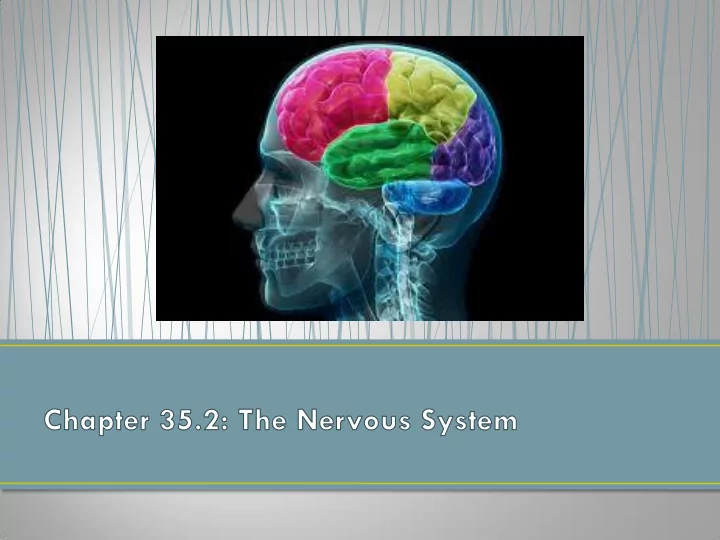
Key Concept: The nervous system controls and coordinates - - PowerPoint PPT Presentation

key concept the
SMART_READER_LITE
LIVE PREVIEW

Key Concept: The nervous system controls and coordinates - - PowerPoint PPT Presentation

Key Concept: The nervous system controls and coordinates functions throughout the body and responds to internal and external stimuli. Neurons transmit electrical signals (nerve impulses) Three types of neurons: Sensory:


slide-1
SLIDE 1
slide-2
SLIDE 2
  • Key Concept: The

nervous system controls and coordinates functions throughout the body and responds to internal and external stimuli.

slide-3
SLIDE 3
  • Neurons transmit electrical

signals (nerve impulses)

  • Three types of neurons:
  • Sensory: sensory organs 

brain & spinal cord

  • Motor: brain & spinal cord

 muscles & glands

  • Interneurons: connect sensory

& motor neurons

  • Draw and label a typical

neuron (p. 897)

slide-4
SLIDE 4
  • Cell Body: contains nucleus
  • Dendrites: to cell body
  • Axon: from cell body
  • Axon terminals: synapse
  • Myelin Sheath: insulates
  • Nodes: gaps in between
slide-5
SLIDE 5
  • Outside: Na+, Inside: K+
  • Resting potential:
  • Na+/K+ Pump: Na+ out; K+ in
  • Leak channels: K+ out
  • Inside is negative compared to
  • utside
  • Action potential: moving

impulse; charges reverse; Na+ in, K+ out; must reach threshold; all-or-none principle

  • Synapse: neuronal

communication via neurotransmitters

slide-6
SLIDE 6
slide-7
SLIDE 7

Central Nervous System (CNS)

  • CNS function: relay

messages, processes information, and analyzes information

  • Composed of the brain

and spinal cord

  • Meninges and

cerebrospinal fluid coat and protect

Peripheral Nervous System (PNS)

  • PNS function:
  • Sensory: transmits info from

sense organs to CNS

  • Motor: transmits info from

CNS to muscles or glands

  • Composed of all nerves

and support cells outside

  • f the CNS
slide-8
SLIDE 8

The Brain

  • Cerebrum: voluntary or conscious activities; intelligence;

learning; judgment; divided into 4 lobes

  • Cerebellum: “little brain”; balance and fine movements
  • Brain Stem: connects brain and spinal cord; controls

important bodily functions (i.e. blood pressure, heart rate)

  • Thalamus: relay center
  • Hypothalamus: recognition, appetite; body temp.,

hormones

slide-9
SLIDE 9

The Spinal Cord

  • Connects the brain to the

rest of the body

  • Coordinates reflexes

(automatic responses)

slide-10
SLIDE 10

Somatic Nervous System

  • Voluntary responses

and movement

  • Reflex arc: sensory

neuron, interneuron (some cases), motor neuron

Autonomic Nervous System

  • Regulation of

automatic or involuntary responses (i.e. heart rate, breathing, function of internal organs, etc…)

  • Sympathetic vs.

Parasympathetic (fight

  • r flight & rest and

digest)

slide-11
SLIDE 11