Kernel maintainership: an oral tradition PRELIMINARY VERSION - - PowerPoint PPT Presentation

kernel maintainership an oral tradition preliminary
SMART_READER_LITE
LIVE PREVIEW

Kernel maintainership: an oral tradition PRELIMINARY VERSION - - PowerPoint PPT Presentation

Embedded Linux Conference Europe 2015 Kernel maintainership: an oral tradition PRELIMINARY VERSION (Image credit: Andrew Cheal under license CC BY-ND 2.0) Gregory CLEMENT Free Electrons gregory.clement@free-electrons.com free


slide-1
SLIDE 1

Embedded Linux Conference Europe 2015

Kernel maintainership: an

  • ral tradition

– PRELIMINARY VERSION –

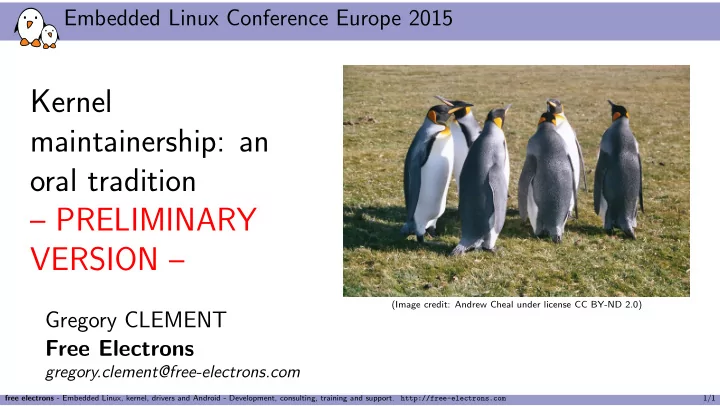
(Image credit: Andrew Cheal under license CC BY-ND 2.0)

Gregory CLEMENT Free Electrons

gregory.clement@free-electrons.com

free electrons - Embedded Linux, kernel, drivers and Android - Development, consulting, training and support. http://free-electrons.com 1/1

slide-2
SLIDE 2

Gregory CLEMENT

▶ Embedded Linux engineer and trainer at Free

Electrons

▶ Embedded Linux expertise ▶ Development, consulting and training ▶ Strong open-source focus

▶ Open-source contributor

▶ Contributing to kernel support for the Armada 370,

375, 38x, 39x and Armada XP ARM SoCs from Marvell.

▶ Co-maintainer of mvebu sub-architecture (SoCs from

Marvell Engineering Business Unit)

▶ Living near Lyon, France

Free Electrons Linux Experts

free electrons - Embedded Linux, kernel, drivers and Android - Development, consulting, training and support. http://free-electrons.com 2/1

slide-3
SLIDE 3

Motivation and Overview

▶ Motivation

▶ Implicit or unwritten rules. ▶ Make such rules more explicit. ▶ Help new maintainers and contributors. ▶ Guideline I would have liked to find.

▶ Overview

▶ The role of a maintainer ▶ Accepting a patch ▶ Interaction with other maintainers

free electrons - Embedded Linux, kernel, drivers and Android - Development, consulting, training and support. http://free-electrons.com 3/1

slide-4
SLIDE 4

The role of a maintainer

▶ Gathering patches for the subsystem

▶ Through emails. ▶ Sometime through a git tree.

▶ Reviewing the submitted patches

▶ Best case: accepted as is. ▶ Most often: ask for a new version pointing the part to improve. ▶ Worst case: rejected.

▶ Pushing the gathered patch to the upper subsystem

▶ Pull request to another maintainer. ▶ Or directly to Linus Torvalds.

free electrons - Embedded Linux, kernel, drivers and Android - Development, consulting, training and support. http://free-electrons.com 4/1

slide-5
SLIDE 5

Becoming a maintainer

▶ Creating a new subsystem:

▶ Most obvious. ▶ Under arch/ usually a new family of a CPU or an SoC. ▶ Under driver/ usually a new framework or a specialization of an existing class

driver.

▶ Joining the current maintainer:

▶ After being active in the subsystem especially by doing review. ▶ Generally asked by the current maintainer(s) but sometime after offering the help.

▶ Replacing a maintainer:

▶ Either co-opt by the current maintainer before leaving. ▶ Or asked by upper maintainer because of your involvement in this subsystem. ▶ Or on a volunteering base often because you need to push your own patches.

free electrons - Embedded Linux, kernel, drivers and Android - Development, consulting, training and support. http://free-electrons.com 5/1

slide-6
SLIDE 6

Expectation of the submitter

▶ Reviewing the patch in a couple of days (or hours)

▶ Writing and testing the code took a long time,

reviewing it would be fast.

▶ Eager to have a feedback to make things move on.

▶ Knowing the hardware by heart

▶ As maintainer of the subsystem you appear as the

expert of the hardware it supports.

▶ You supposed to have all the variant of the hardware.

▶ Updating the status of the submitted patches

▶ Letting know if the patches have been received,

reviewed, applied or rejected.

▶ Expected to be done in real time.

free electrons - Embedded Linux, kernel, drivers and Android - Development, consulting, training and support. http://free-electrons.com 6/1

slide-7
SLIDE 7

Expectation of the upper maintainer

▶ Don’t introduce any breakage. ▶ No merge conflict. ▶ No regression.

(Image credit: Mike Pennington under license CC BY-SA 2.0)

free electrons - Embedded Linux, kernel, drivers and Android - Development, consulting, training and support. http://free-electrons.com 7/1

slide-8
SLIDE 8

Timeline for the submission of a patch 1/2

▶ At least one week between submission and being applied

▶ Let time to interested to review the series ▶ Could be shorter for a new version of a series already reviewed

▶ Stay in linux-next one week before being submitted to the upper subsystem

▶ Allow to fix merge conflicts before creating an immutable branch. ▶ Could be shorter if already been in linux-next before or if the change is well

contained.

free electrons - Embedded Linux, kernel, drivers and Android - Development, consulting, training and support. http://free-electrons.com 8/1

slide-9
SLIDE 9

Timeline for the submission of a patch 2/3

▶ Deeper is the subsystem, longer will be the time between submission and merged

in mainline

free electrons - Embedded Linux, kernel, drivers and Android - Development, consulting, training and support. http://free-electrons.com 9/1

slide-10
SLIDE 10

Timeline for the submission of a patch 3/3

▶ As the Linux release candidate are weekly, then for a subsystem at N-1, series

submitted after -rc6 (or rc7) won’t be in next release.

free electrons - Embedded Linux, kernel, drivers and Android - Development, consulting, training and support. http://free-electrons.com 10/1

slide-11
SLIDE 11

Accepting a patch

▶ Obvious criteria

▶ Must respect the coding rules (use checkpatch for this). ▶ Must compiled without warning.

▶ No regression. ▶ Testing the hardware is nice to have but not mandatory.

▶ For a new device feature or device you can assume it was tested by the submitter. ▶ Ask for a tested by from other user if you have any doubt. ▶ Rely on testing farm if you can.

▶ Be careful of dependencies to the other subsystem.

free electrons - Embedded Linux, kernel, drivers and Android - Development, consulting, training and support. http://free-electrons.com 11/1

slide-12
SLIDE 12

Organization of the subsystem git tree

▶ At least 2 branches:

▶ current for gathering the fixes of the current release candidate. ▶ for-next for gathering the patches for the next release candidate.

▶ Could be useful to have a third branch for the release candidate after. ▶ Could have topic branches:

▶ For big subsystem such as arm-soc. ▶ To let other subsystems merge your subsystem related part of series (see later).

▶ Based on the -rc1 to make the merge easier.

free electrons - Embedded Linux, kernel, drivers and Android - Development, consulting, training and support. http://free-electrons.com 12/1

slide-13
SLIDE 13

The stable kernels

▶ Most of the user use kernel from a distribution. ▶ Most of the distribution use stable kernel ▶ When receiving a fix always ask if it could be useful for older kernel. ▶ Tag the commit with Cc:<stable@vger.kernel.org>. ▶ Even better use the tag

Fixes: SHA-1_ID ("title of the patch").

free electrons - Embedded Linux, kernel, drivers and Android - Development, consulting, training and support. http://free-electrons.com 13/1

slide-14
SLIDE 14

The linux-next kernel 1/2

▶ The place where all are merged the commits expected to be in kernel after the

next merge window closes.

▶ How to use it as a maintainer

▶ The branches merged in linux-next have to be declared to Stephen Rothwell. ▶ Send him an email with the name of the repository and the branch to merge. ▶ Do not have to be an immutable branch: all the branches are merged again for each

linux-next release (on a daily basis).

free electrons - Embedded Linux, kernel, drivers and Android - Development, consulting, training and support. http://free-electrons.com 14/1

slide-15
SLIDE 15

The linux-next kernel 2/2

▶ Benefit of being in linux-next

▶ Being merged every day with all the other branches allows detecting the merge

conflict early.

▶ As a bonus Stephen often came with the resolution of the conflict. ▶ Used by the autobuilder such as 0-Day done by 01.org from Intel or the

kernelci supported by Linaro.

free electrons - Embedded Linux, kernel, drivers and Android - Development, consulting, training and support. http://free-electrons.com 15/1

slide-16
SLIDE 16

Dealing with your own patches

▶ You are a maintainer but you remain a developer. ▶ You have the possibility to directly applied your own patches. ▶ Not really in the spirit of an open development. ▶ Still good to have review and suggestion. ▶ However most of the time you won’t get a review as you are supposed to be the

  • ne who review!

▶ But still apply the submission process: waiting at least one week after submitting

  • n the mailing list before applying it in your next branch.

free electrons - Embedded Linux, kernel, drivers and Android - Development, consulting, training and support. http://free-electrons.com 16/1

slide-17
SLIDE 17

Coordinating with the co-maintainers 1/2

▶ Subsystems maintained more and more often by several’s peoples. ▶ Benefits:

▶ Allow to be more responsive especially if located in distant timezone. ▶ Avoid having a stalled subsystem during holidays. ▶ Ease the turn over: easier to leave and easier to join a team.

▶ Drawbacks

▶ Need to able to find an agreement in case of opposite opinions. ▶ Need to coordinate.

free electrons - Embedded Linux, kernel, drivers and Android - Development, consulting, training and support. http://free-electrons.com 17/1

slide-18
SLIDE 18

Coordinating with the co-maintainers 2/2

▶ Each co-maintainer has her/his own interests and fields of expertise.

▶ Spread the review. ▶ Allow staying focused.

▶ An acked-by given by a co-maintainer is enough. ▶ Only one co-maintainer gathering the patches and taking care of the pull requests

for a given kernel release cycle.

▶ Easier to keep the track of the submitted patches. ▶ The git repository remains shared at least for emergency. ▶ Better to decide in advance who will be the next in charge.

▶ Coordinating by email is fine most of the time.

free electrons - Embedded Linux, kernel, drivers and Android - Development, consulting, training and support. http://free-electrons.com 18/1

slide-19
SLIDE 19

Coordinating with the maintainers of other subsystem 1/2

▶ Some series modify several subsystems in the same time. ▶ Dependencies between the patches. ▶ We want that the kernel be bisectable. ▶ The order in which the patches are applied matters. ▶ Can’t predict in which order the subsystem will be merged. ▶ Need to synchronize with the maintainers of other subsystems to solve this.

free electrons - Embedded Linux, kernel, drivers and Android - Development, consulting, training and support. http://free-electrons.com 19/1

slide-20
SLIDE 20

Coordinating with the maintainers of other subsystem 2/2

▶ One maintainer takes all the series:

▶ Will have commits modifying another subsystem in her/his git tree. ▶ May cause conflict merge.

▶ One maintainer create an immutable branch

▶ A topic branch with only the patch from the series. ▶ Will be in both tree: it will avoid the merge conflict. ▶ If a fix is needed it can’t be squashed, have to be a separate commit.

▶ Merging the series in two kernel releases:

▶ No merge conflict. ▶ No immutable branch. ▶ But the feature is delayed of at least 3 months. ▶ Still possible to have the feature by delaying the clean-up in the second release.

free electrons - Embedded Linux, kernel, drivers and Android - Development, consulting, training and support. http://free-electrons.com 20/1

slide-21
SLIDE 21

Submitting the gathered patches 1/2

▶Identify the patch to apply when reading the emails. M-x gnus-registry-set-article-mark under emacs

  • r by using patchwork.

▶Apply them on your branch. M-x dvc-gnus-article-apply-patch under emacs. ▶Add your Signed-off-by (as you are going to submit them you have to do it). git commit --amend -s --no-edit

free electrons - Embedded Linux, kernel, drivers and Android - Development, consulting, training and support. http://free-electrons.com 21/1

slide-22
SLIDE 22

Submitting the gathered patches 2/2

▶Signed your branch git tag -s tag_name branch_name ▶Push your branch on your public repository git push public_repo tags/tag_name ▶Generate the pull request cover letter: git request-pull previous_tag public_repo \ tags/tag_name | cat previous_tag is either the tag previously pulled during the last request or the rc1 of the current kernel.

free electrons - Embedded Linux, kernel, drivers and Android - Development, consulting, training and support. http://free-electrons.com 22/1

slide-23
SLIDE 23

Final words

▶ Find the good balance between

maintainer duty and submitter expectation.

▶ Be nice and helpful with the submitter

especially the new ones.

▶ Remain vigilant about the code quality

and stability of the kernel.

free electrons - Embedded Linux, kernel, drivers and Android - Development, consulting, training and support. http://free-electrons.com 23/1

slide-24
SLIDE 24

Questions?

Gregory CLEMENT gregory.clement@free-electrons.com Slides under CC-BY-SA 3.0

http://free-electrons.com/pub/conferences/2015/elce/clement-kernel-maintainership-oral- tradition

free electrons - Embedded Linux, kernel, drivers and Android - Development, consulting, training and support. http://free-electrons.com 24/1