
SLIDE 1
Kat herine Gat es 5th year VS TP Leigh Griffit hs’ Lab
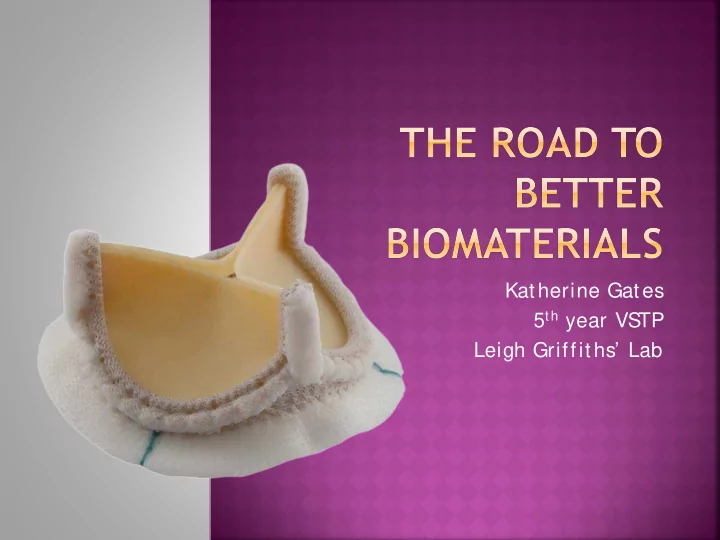
Kat herine Gat es 5 th year VS TP Leigh Griffit hs Lab American - - PowerPoint PPT Presentation
Kat herine Gat es 5 th year VS TP Leigh Griffit hs Lab American Heart Associat ion (AHA) est imat es t hat 2.5% of t he populat ion afflict ed by valve disorders 20,000 deat hs annually 100,000 valve replacement s in 2015 alone
Kat herine Gat es 5th year VS TP Leigh Griffit hs’ Lab
American Heart Associat ion (AHA) est imat es t hat 2.5%
20,000 deat hs annually 100,000 valve replacement s in 2015 alone
Bovine Pericardium (BP)
Glutaraldehyde fixation crosslinks and “ hides”
antigens
10 year lifespan ~5 years in j uvenile patients Calcification and destruction dysfunction
Anything that stimulates an immune response 33 known antigenic proteins in BP But is it all of them?
Hypothesis 1: Affinity chromatography can
be used to rapidly identify antigens that human patients have developed as a graft- specific humoral immune response towards glutaraldehyde-fixed BP heart valve replacements.
Specific aim 1: Apply affinity
chromatography shotgun proteomic antigen identification to determine which BP proteins are xenoantigenic following heart valve replacement.
Patient S
election Protein Extract Affinity Chromatography LC-MS / MS S tatistical Analysis
Bovine : 39 Mechanical : 44
Hypothesis 2: Human graft-specific immune
responses towards BP heart valve implants are independent of carbohydrate epitopes
Specific aim 2: Apply affinity
chromatography shotgun proteomic antigen identification process to deglycosylated proteins.
Patient S
election Protein Extract
Deglycosylation/Alpha-galactosidase
Affinity Chromatography LC-MS / MS S tatistical Analysis
Extraction solution does not
interfere with deglycosylation process
Optimal time is 24 hours of
deglycosylation at 37C for non- denatured proteins
Valve Center at Mayo Clinic
Prospective collection
In Vivo study Heart Transplant Patients