Trading Coordinat ion For Randomness Szymon Chachulski Mike J - - PDF document

trading coordinat ion for randomness
SMART_READER_LITE
LIVE PREVIEW

Trading Coordinat ion For Randomness Szymon Chachulski Mike J - - PDF document

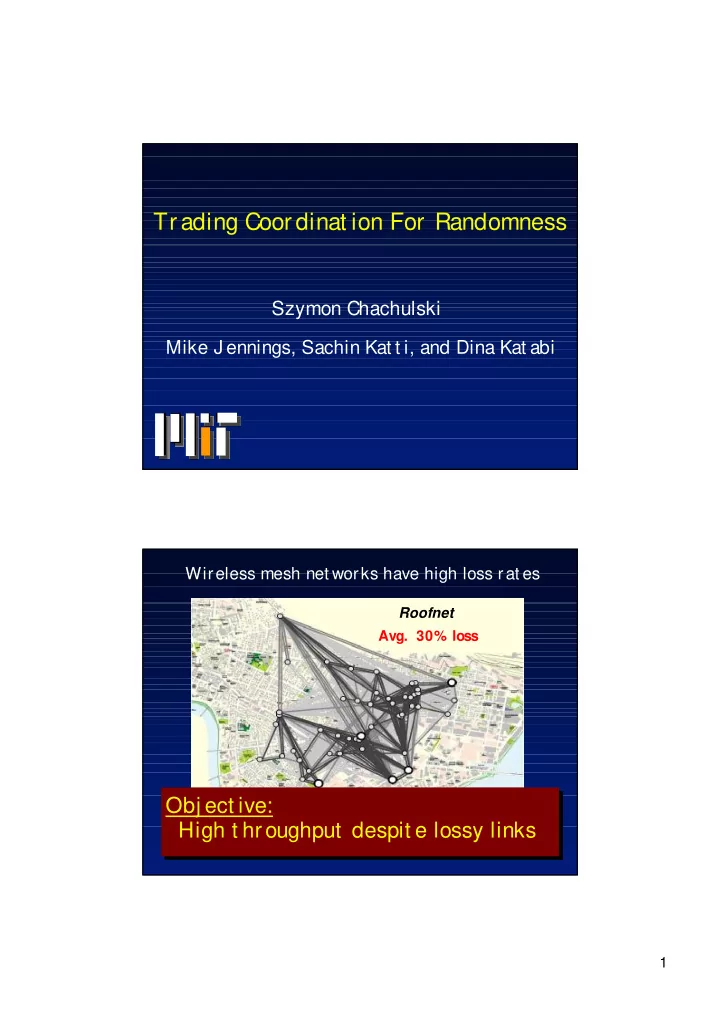
Trading Coordinat ion For Randomness Szymon Chachulski Mike J ennings, Sachin Kat t i, and Dina Kat abi Wireless mesh net works have high loss rat es Roofnet Avg. 30% loss Obj ect ive: Obj ect ive: High t hroughput despit e lossy links


slide-1
SLIDE 1

1

Trading Coordinat ion For Randomness

Szymon Chachulski Mike J ennings, Sachin Kat t i, and Dina Kat abi

Wireless mesh net works have high loss rat es

Roofnet

Obj ect ive: High t hroughput despit e lossy links Obj ect ive: High t hroughput despit e lossy links

  • Avg. 30% loss
slide-2
SLIDE 2

2

Use Opport unist ic Rout ing

src R1 dst R4 R2 R3 5 % 0% 50% 0% % % 50% 50%

Use Opport unist ic Rout ing

  • Best single pat h

loss prob. 50%

slide-3
SLIDE 3

3

  • Best single pat h

loss prob. 50%

  • I n opp. rout ing [ExOR’05], any rout er t hat hears

t he packet can f orward it loss prob. 0.54 = 6%

Use Opport unist ic Rout ing

Opport unist ic rout ing promises large increase in t hroughput Opport unist ic rout ing promises large increase in t hroughput

src R1 dst R4 R2 R3 5 % 0% 50% 0% % % 50% 50%

But

Overlap in received packet s Rout ers f orward duplicat es

slide-4
SLIDE 4

4

src R1 dst

But

R2

Overlap in received packet s Rout ers f orward duplicat es

P1 P2 P10 P1 P2 P1 P2

src R1 dst

But

R2

Overlap in received packet s Rout ers f orward duplicat es

St at e-of -t he-art opp. rout ing, ExOR imposes a global scheduler:

  • Requires f ull coordinat ion; every node must know

who received what

  • Only one node t ransmit s at a t ime, ot hers list en

P1 P2 P10 P1 P2 P1 P2

slide-5
SLIDE 5

5

Global Scheduling?

  • Global coordinat ion is t oo hard
  • One t ransmit t er

src dst

Global Scheduling?

src dst

  • Global coordinat ion is t oo hard
  • One t ransmit t er

You lost spat ial reuse!

Does opport unist ic rout ing have t o be so complicat ed? Does opport unist ic rout ing have t o be so complicat ed?

slide-6
SLIDE 6

6

Our Cont ribut ions

  • Opport unist ic rout ing wit h no global

scheduler and no coordinat ion

  • We use random net work coding
  • Experiment s show t hat randomness
  • ut perf orms bot h current rout ing and ExOR

Go Random

Each rout er f orwards random combinat ions of packet s

slide-7
SLIDE 7

7

src R1 dst

Go Random

R2

α P1+ ß P2 γ P1+ δ P2

Each rout er f orwards random combinat ions of packet s Randomness prevent s duplicat es No scheduler; No coordinat ion Simple and exploit s spat ial reuse

P1 P2 P1 P2

src dst1 dst2 dst3

P1 P2 P3 P4 P1 P2 P2 P3 P3 P4 P3 P4 P1 P4 P1 P2

Random Coding Benef it s Mult icast

Wit hout coding source ret ransmit s all 4 packet s

slide-8
SLIDE 8

8

src dst1 dst2 dst3

P1 P2 P3 P4 P1 P2 P2 P3 P3 P4 8 P1+5 P2+ P3+3 P4 7 P1+3 P2+6 P3+ P4 P3 P4 P1 P4 P1 P2

Random Coding Benef it s Mult icast

Wit hout coding source ret ransmit s all 4 packet s Wit h random coding 2 packet s are suf f icient

Random combinat ions

Random coding is more ef f icient t han global coordinat ion Random coding is more ef f icient t han global coordinat ion

MORE

slide-9
SLIDE 9

9

MORE

  • Source sends packet s in bat ches
  • Forwarders keep all heard packet s in a buf f er
  • Nodes t ransmit linear combinat ions of buf f ered packet s

src A B dst

P1 P2 P3 P1 P2 P3 =

+ b + c a

a,b,c 4,1,3 0,2,1 4,1,3 P1 P2 P3 =

+ 1 + 3 4

4,1,3 P1 P2 P3 =

+ 2 + 1

0,2,1

Can comput e linear combinat ions and sust ain high t hroughput ! Can comput e linear combinat ions and sust ain high t hroughput !

src A B dst

P1 P2 P3 P1 P2 P3 =

+ b + c a

a,b,c 4,1,3 0,2,1 4,1,3

= 2 + 1 0,2,1

8,4,7 4,1,3 8,4,7 8,4,7

MORE

  • Source sends packet s in bat ches
  • Forwarders keep all heard packet s in a buf f er
  • Nodes t ransmit linear combinat ions of buf f ered packet s
slide-10
SLIDE 10

10

  • Dest inat ion decodes once it receives enough combinat ions
  • Say bat ch is 3 packet s

1,3,2 5,4,5 4,5,5 P1 P2 P3 =

+ 3 + 2 1

P1 P2 P3 =

+ 4 + 5 5

P1 P2 P3 =

+ 5 + 5 4

  • Dest inat ion acks bat ch, and source moves t o next bat ch

MORE

  • Source sends packet s in bat ches
  • Forwarders keep all heard packet s in a buf f er
  • Nodes t ransmit linear combinat ions of buf f ered packet s

But How Do We Get t he Most Throughput ?

  • Naïve approach t ransmit s whenever 802.11 allows

I f A and B have same inf ormat ion, it is more ef f icient f or B t o send it

Need a Met hod t o Our Madness Need a Met hod t o Our Madness

A B dst

slide-11
SLIDE 11

11

Probabilist ic Forwarding

A B dst

Probabilist ic Forwarding

e1 e1 e2

A B dst Src

P1 P2

Loss rat e 50% Loss rat e 0%

slide-12
SLIDE 12

12

Probabilist ic Forwarding

e1

A B dst Src

P1 P2 e1 ?

50% of buf f er

e1 e2 e1

How many packet s should I f orward?

Probabilist ic Forwarding

e1

A B dst Src

P1 P2

50% 0%

e1 e1 e2 Pr = 0.5 Pr = 1

Comput e f orwarding probabilit ies wit hout coordinat ion using loss rat es Comput e f orwarding probabilit ies wit hout coordinat ion using loss rat es

slide-13
SLIDE 13

13

A B dst

Pr = 0.5 Pr = 1

Can ExOR Use Probabilist ic Forwarding To Remove Coordinat ion?

P1 P2 P1

P1 P1

  • Wit hout random coding

need t o know t he exact packet s t o f orward every t ime

  • Wit h random coding

need t o know only t he average amount of overlap

  • Wit hout random coding

need t o know t he exact packet s t o f orward every t ime

  • Wit h random coding

need t o know only t he average amount of overlap

Probabilit y of duplicat es is 50%

MORE needs t o adapt t o short -t erm dynamics

There are known knowns. These are t hings we know t hat we know. There are known unknowns. That is t o say, t here are t hings t hat we know we don' t know. But t here are also unknown unknowns.

Long-t erm averages are great , but … Wireless is unpredict able over short t ime-scales

slide-14
SLIDE 14

14

  • Need t o balance sent inf ormat ion wit h

received inf ormat ion

  • MORE t riggers t ransmission by recept ions
  • A node has a credit count er
  • Upon recept ion, increment t he count er using

f orwarding probabilit ies

  • Upon t ransmission, decrement t he count er
  • Source st ops

No t riggers Flow is done Adapt ing t o Short -t erm Dynamics

Perf ormance

slide-15
SLIDE 15

15

Experiment al Set up

  • We implement ed MORE in Linux
  • 20-node t est bed
  • Compare MORE wit h:
  • Current Rout ing (Single Best Pat h)
  • ExOR (St at e-of -t he-art Opport unit ic Rout ing)
  • Experiment
  • Random source-dest inat ion pairs
  • Transmit 5 MB f ile

Test bed

  • 20-node t est bed over t hree f loors
slide-16
SLIDE 16

16

Test bed

  • 20-node t est bed over t hree f loors
  • Avg. loss 27%

Does MORE I mprove Wireless Throughput ?

Current MORE

40 80

MORE’s t hroughput is

  • 2x bet t er t han current rout ing
  • 22% bet t er t han ExOR

MORE’s t hroughput is

  • 2x bet t er t han current rout ing
  • 22% bet t er t han ExOR
  • Avg. Throughput over 180 src-dst pairs [pkts/s]

ExOR

slide-17
SLIDE 17

17 0.2 0.4 0.6 0.8 1 50 100 150 200

Throughput of All Source-Dest inat ion Pairs

CDF of 180 source-destination pairs Throughput [packets/s] Current MORE ExOR

0.1 0.2 0.3 0.4 0.5 0.6

50 100

Throughput [packets/s]

MORE addresses dead spot s MORE addresses dead spot s

4x

Zoom in on t he worst 10%

Current MORE ExOR

slide-18
SLIDE 18

18

Sensit ivit y t o Bat ch Size

Throughput [packets/s]

0.25 0.5 0.75 1 50 100 150

ExOR CDF

Batch = 8 pkts Batch = 128 pkts

0.25 0.5 0.75 1 50 100 150

MORE CDF

Throughput [packets/s] Batch = 8 pkts Batch = 128 pkts

MORE works f or short f lows MORE works f or short f lows

2 dest inat ions 3 dest inat ions 4 dest inat ions 50 100

What About Mult icast ?

MORE Current

+200% +260% +320%

MORE improves bot h mult icast and unicast t hroughput MORE improves bot h mult icast and unicast t hroughput

  • Avg. Throughput Per Destination [pkts/s]
slide-19
SLIDE 19

19

MORE f or Less!

  • Lesser coordinat ion and lesser rigidit y
  • No scheduler
  • More f lexibilit y
  • Works on t op of 802.11

enj oy spat ial reuse

  • One f ramework f or unicast and mult icast
  • More t hroughput
  • 22% bet t er t han ExOR
  • 2x bet t er t han current rout ing