
SLIDE 1
JVR Solar Energy Turbine
CONFIDENTIAL June 2013
1
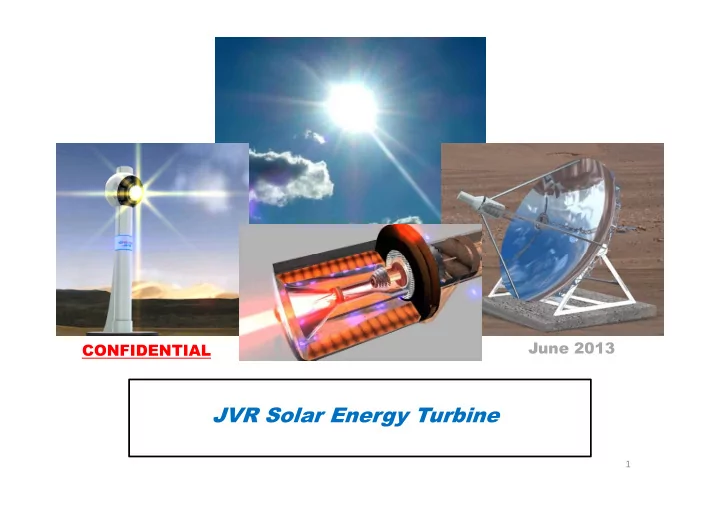
JVR Solar Energy Turbine 1 Why should we continue to consume our - - PowerPoint PPT Presentation
June 2013 CONFIDENTIAL JVR Solar Energy Turbine 1 Why should we continue to consume our natural resources and pollute the planet when we have the largest inexhaustible source of energy right in front of us: the Sun? 2 CURRENT TECHNOLOGY
CONFIDENTIAL June 2013
1
2
Why should we continue to consume our natural resources and pollute the planet when we have the largest inexhaustible source of energy right in front of us: the Sun?
Currently there are two main types of technology being used for the production of solar energy, one which uses photovoltaic panels and one which uses thermal collectors. But both of these technologies have several problems:
important limitations, The economic viability of this technology is directly related to the ability to obtain government grants and allowances, as this type of technology would otherwise never be viable in its present state.
requires water, for the production of steam to move turbines. It is a relatively expensive technology and consumes water, which is not always a readily available resource in areas with strong sunlight.
3
Thermal Thermal Sun Sun Tower Tower Plant Plant of GEMASOLAR:
Cost → 315 mill. € Power output → 20 Mw/h Location → Andalucía (SPAIN)
4
SOLAR SOLAR THERMAL THERMAL TECHNOLOGY TECHNOLOGY
5
The current situation shows that with these technologies there is still some way to go before they can be economically viable. Because
this, scientists and engineers need to change their cognitive mindset and take a step, in order to evolve beyond the steam locomotive and the Stirling motor. This is the step we have taken to achieve clean, affordable energy production, with no water consumption. energy production, with no water consumption.
The Past: Steam TheFuture: JVR Solar Turbine
6
7
8
Cold air enters the turbine and is pushed by the blades toward the dual chamber drum where it begins to heat up. The air continues to move along the walls of the turbine until it reaches the Fresnel lens which concentrates the rays on a specifically designed part which causes the air to overheat and expand, which in turn makes the turbine turn at a high speed, producing energy. As the air exits the turbine, it heats the salts/gels inside the drum that accumulate heat so it can be used to produce energy when there is no sunlight.
The air heating process is repeated again and again achieving a uniform air temperature in the process. We are talking about 85 cycles in one second and the process is continuous as long as there is direct
control system will automatically regulate the turbine so that it uses the heat energy stored in salts/ gels and, if necessary, there is a fuel injection option that ensures stable 24-hour production. stable 24-hour production.
11
To achieve maximum efficiency in generating electricity, the JVR solar turbine can be implemented in two systems: Solar Tower Solar Tower Solar Solar Parabolic Parabolic Dish Dish
12
The JVR solar tower technology is based
following features:
13
The parabolic solar collector technology bases its concentration of the sun's rays
14
turbine, installed at the front, which reaches high temperatures. The maintenance required for this type of equipment is less than other systems (twice a year). Regular cleaning of the parabolic dishes will be automatic.
15
Power Power
Temperature Temperature Price Price
Cogeneration by Cogeneration by heat heat accumulator(+20%) accumulator(+20%)
Parabolic dish + Stirling motor 3.5 Kw/h 800 C° 18.900 €
Parabolic dish + JVR turbine 15 Kw/h 1150 C° 30.000 €
Stirling Motor JVR Turbine JVR Turbine
16
17
18
As shown in previous pages, JVR technology must be applied in areas with levels of solar radiation per year high enough to make the investment profitable, so we must focus
performance in daylight hours. In addition, potentially large markets for the installation
which usually also receive a lot of sunlight. Spain and Portugal
19
which usually also receive a lot of sunlight. Spain and Portugal are the areas of greatest solar radiation index throughout the Mediterranean basin. But we must pay attention not
to the solar radiation conditions
each country, but also to energy legislation as well as the pricing scheme put in place by each country.
Growth forecast for solar energy in Growth forecast for solar energy in the Mediterranean basin. the Mediterranean basin.
20
The project needs an investment in order to meet the operating costs for the first year, sourcing, and installation of a production unit. This factory does not need to be too complex because it will be a fitting and assembly unit.
21
assembly unit.
THE THE TECHNOLOGY TECHNOLOGY
The increasing demand of humans for energy is a present reality we need to address with non-polluting technologies like the JVR solar turbine. In Spain, only 30% of the energy consumed is actually produced there. This means importing 70% from neighboring countries. This new technology will allow us to produce 3.5 times more energy than is produced by existing technology (parabolic solar collectors with Stirling motors and solar thermal towers), with the same investment, thus achieving much higher efficiency. JVR technology is also capable of generating, desalinating, and treating large amounts of water, a very important issue in countries where water is a scarce resource. resource. All patents on JVR technology have either been granted or are pending. This technology is capable of supplying this large demand for energy and contributing in large part to supply water to certain countries. The inventor of the technology requests from investors, in exchange for contributing this invention to the new company and his commitment to remain a part of the company and continue to improve the technology and develop new products, the following :
his research in several fields, which will yield new products for the company.
the new company.