
SLIDE 1
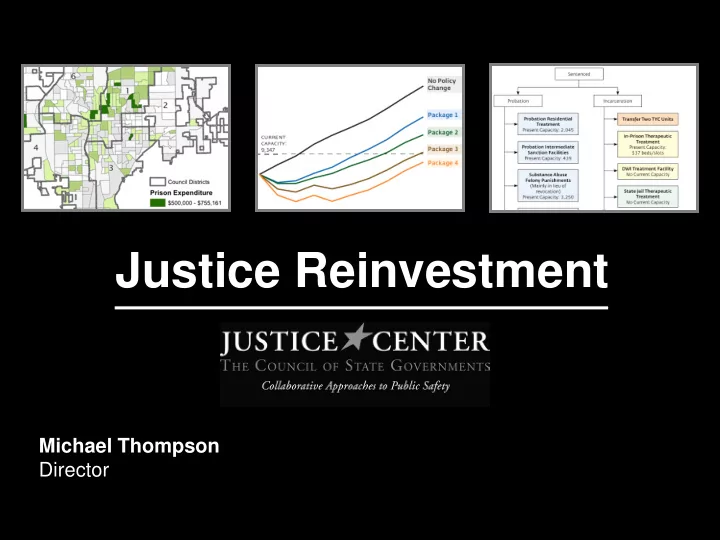
Justice Reinvestment
Michael Thompson Director
Justice Reinvestment Michael Thompson Director National - - PowerPoint PPT Presentation
Justice Reinvestment Michael Thompson Director National non-profit, non-partisan membership association of state government officials Represents all three branches of state government Justice Center provides practical,
Michael Thompson Director
membership association of state government officials
advice informed by the best available evidence
Criminal Justice / Mental Health Consensus Project Reentry Policy Council Justice Reinvestment
Spending on corrections increased 57 percent over the past 10 years One out of every three state workers is employed by the Michigan Department
As a share of general fund expenditures, corrections grew from 16.2 to 22.6 percent
Source: Data analyzed by Citizen’s Research Council.
Percent Returned to Prison
Percent Returned to Prison Within Two Years 2000 2005
Male 37% 41% Female 23% 29%
Age at release
17-21 (443) 38% 55% 21-25 (1574) 34% 45% 25-30 (1750) 35% 41% 30-35 (1356) 39% 40% 35-40 (1203) 37% 42% 40-50 (1995) 33% 36% 50-60 (517) 22% 29% 60+ (109) 8% 17%
Incarceration Rate 2000-2009 Violent Crime Rate 2000-2009
NY
TX
FL +21% CA
NY
TX
FL
CA
PA +30% PA
Arizona, 2004
60%
tate’s prison population comes from and returns to the Phoenix-Mesa metropolitan area.
Prison Admissions, 2006 Maricopa County
1/2 Mile Grid Map South Mountain Zip Code 85041 Prison Admissions = 31.8 per 1000 adults Jail Bookings = 96.5 per 1000 adults Probation = 25.1 per 1000 adults
A single neighborhood in Phoenix is home to 1% of the state’s total population but 6.5%
Dollars, 2004
1/2 Mile Grid Map
S
Maryvale Cent ral Cit y Est rella Laveen Encant o Alhambra Nort h Mount ain Paradise Valley Camelback East Deer Valley
GLENDALE
Within high expenditure neighborhoods there are numerous, smaller area, million dollar block groups
$1.8 Million $1.1 Million $1.6 Million
Crime Up? No Funding Incentive Crime Down & Revocation Rate Down? Legislature Provides the County with 40% of Averted Costs Drug and Mental Health Treatment & Interventions Victim Services
19
20
Pew Center on the States Public Safety Performance Project, The Impact of Arizona’s Probation Reforms (Washington, DC: The Pew Charitable Trusts, March 2011).
Current Capacity: 9397
Bed Shortfall
$500 m 10 yr costs
$180 m Construction $320 m Operating 22 % Increase
65 % 35 %
5 percent
29 percent 27 percent
36 percent
Probation Revocations Parole Revocations Prob./Parole, New Sentence New Court Commitments
23
8000 8500 9000 9500 10000 10500 11000 11500 2000 2002 2004 2006 2008 2010 2012 2014 2016
Current Capacity: 9,397 Status Quo Option 1 Option 2 Option 3 Combined Impact
FY2008-2016 (9 years) Projected Prison Population
Passage of SB 14 Justice Reinvestment in Kansas
Reduced spending, small prisons closed, programs cut Reduced spending
corrections
Actual
146,059 163,312 155,428 155,062 140,000 145,000 150,000 155,000 160,000 165,000
2001 2002 2003 2004 2005 2006 2007 2008 2009
Actual Population $443 million in savings from 2008-2009 2007 Baseline Projection $241 million to expand in-prison and community-based treatment and diversion programs
27
Senator John Cornyn (R-TX)
“These strategies helped my home state of Texas save nearly a quarter of a billion dollars and identify and improve existing treatment, mental health and diversion programs that led to significant reductions in probationers' and parolees' being returned to prison.” “This is the roadmap to the better outcomes that we’ve been seeking.”
$241 million to expand in-prison and community-based treatment and diversion programs
Review says possible Texas prison beds shortage
The Associated Press March 2, 2011 AUSTIN, Texas — A review finds Texas could face a shortage of as many as 12,000 inmate beds within two years if budget problems force prison system cuts and closures. The report, presented Tuesday to the Senate Criminal Justice Committee, is led by consultant Tony Fabelo. His report comes from the Justice Center, a research affiliate of the Council of State Governments. Texas lawmakers face a projected budget shortfall of at least $15 billion in the next two-year spending period. The Austin American-Statesman reports the review found that possible cuts of up to $600 million would hobble rehabilitation, probation and treatment, which help offenders stay out of trouble.
The Texas Department of Criminal Justice is in charge of the system's nearly 156,000 inmates.
30
… state funding for community corrections programs has increased, but a lack of admission criteria for these programs makes them less cost- effective at diverting
31
*2010 Evaluation of Ohio Community Based Correctional Facilities & Halfway
Impact of Ohio Community Based Correctional Facility Program on New Felony Conviction Rate Compared with Probation Supervision
+ 4 Overall, the program increased new felony conviction rate by 3 percentage points.
10 20 30 40 50 60 % Difference in Rate of New Felony Conviction
* Results for all participants
Re-Offense Rates by Risk Level Distribution by Risk Level
Re-offense refers to a new offense within 3 years
34
mthompson@csg.org
This material was prepared for the State Oklahoma. The presentation was developed by members of the Council of State Governments Justice Center staff. Because presentations are not subject to the same rigorous review process as other printed materials, the statements made reflect the views of the authors, and should not be considered the official position of the Justice Center, the members of the Council of State Governments, or the funding agency supporting the work.