
SLIDE 1
10/28/2014 1
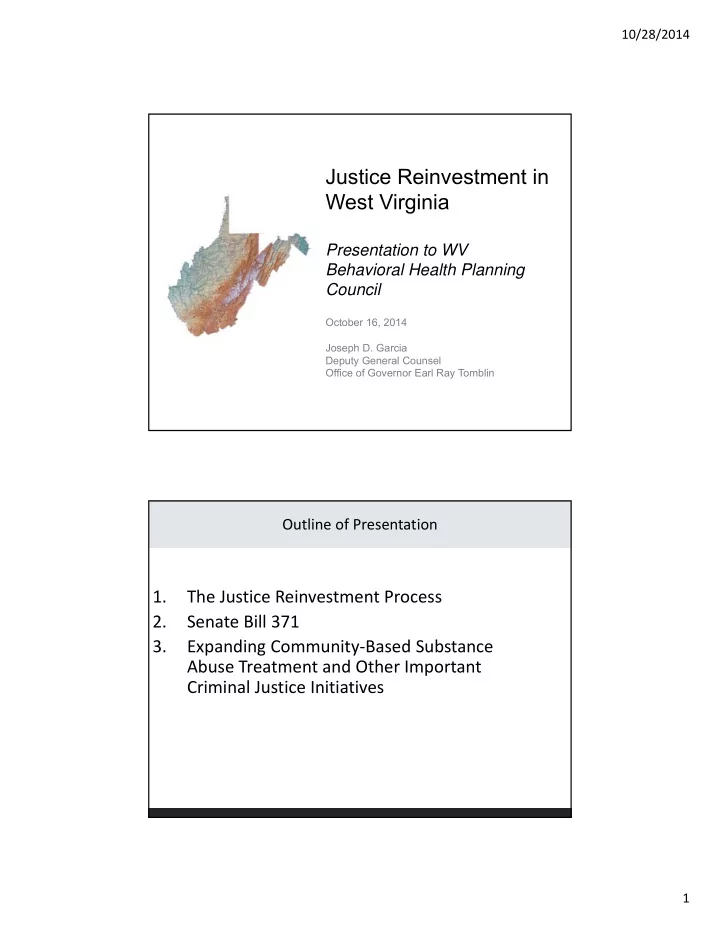
Justice Reinvestment in West Virginia
Presentation to WV Behavioral Health Planning Council
October 16, 2014 Joseph D. Garcia Deputy General Counsel Office of Governor Earl Ray Tomblin
Justice Reinvestment in West Virginia Presentation to WV - - PDF document
10/28/2014 Justice Reinvestment in West Virginia Presentation to WV Behavioral Health Planning Council October 16, 2014 Joseph D. Garcia Deputy General Counsel Office of Governor Earl Ray Tomblin Outline of Presentation 1. The Justice
10/28/2014 1
October 16, 2014 Joseph D. Garcia Deputy General Counsel Office of Governor Earl Ray Tomblin
10/28/2014 2
Council of State Governments Justice Center
3
Phase I / II Phase I Justice Reinvestment Partners
a data‐driven approach to reduce corrections spending and reinvest savings in strategies that can decrease recidivism and increase public safety.
Council of State Governments Justice Center
4
Phase I
Analyze Data and Develop Policy Options
– crime/arrests, courts, corrections, and supervision trends
treatment capacity
impacts
implement policies effectively
strategies to increase public safety
policies/programs
key measures Phase 2
Implement New Policies
10/28/2014 3
Virginia had grown 20%.
would enter the system.
dollars.
incarcerated actually made the citizens of West Virginia any safer.
Council of State Governments Justice Center
6
DOC Commitments by Offense Type 2007‐2011
400 600 800 1,000 1,200 1,400 1,600 2007 2008 2009 2010 2011
Other – Up 12% Violent – Down 1% Drug – Up 11% Property – Up 11%
589 1,368 616 751
Source: WV DOC commitments dataset
Stakeholder outreach suggested that many property offenses were also related to substance use.
10/28/2014 4
Council of State Governments Justice Center
7
DRC Probation Drug Court DOC Parole Funding for services $986,088 $0 $1,137,838 $872,000 $0 Capacity to provide services Unknown None 430 ALADRUE: 944 RSAT: 427 None Estimated demand for services – Total 108 1,449 263 2,431 492
Outpatient 43 580 105 973 197 Intensive Outpatient 43 580 105 973 197 Residential with step down 22 290 53 486 98
Source: D.A. Andrews & James Bonta, “ColorPlpt Profile Form for Men,” The Level of Service Inventory ‐ Revised: U.S. Norms, 2003 Steven Belenkoa & Jordon Peugh“Estimating Drug Treatment Needs Among State Prison Inmates.” Drug and Alcohol Dependence 77, no. 3 (2005): 269–281. Conversation with Alexa Eggleston and Fred Osher, November, 2012
Council of State Governments Justice Center
8
10/28/2014 5
conducted by CSG Justice Center, with leadership from bi‐partisan, inter‐ branch Work Group
legislature in 2013 session with bipartisan support
Tomblin on May 2, 2013
became effective July 12, 2013
Council of State Governments Justice Center
9
the use of risk assessments;
without supervision; and
based treatment for substance abuse and mental health issues.
Council of State Governments Justice Center
10
10/28/2014 6
– Adopt a statewide risk/needs assessment and focus supervision resources on higher‐risk individuals – Respond to supervision violations with swift, certain, and cost‐effective sanctions – Invest in community‐based substance abuse treatment for people on supervision with substance abuse treatment needs
Council of State Governments Justice Center
11 5,869 6,715 7,418 7,146 8,893 7,943
1,000 2,000 3,000 4,000 5,000 6,000 7,000 8,000 9,000 10,000 2007 2008 2009 2010 2011 2012 2013 2014 2015 2016 2017 2018 Justice reinvestment policies enacted (July 2013)
Source: Estimates and population figures can be found in the CSG Justice Center’s “Justice Reinvestment in West Virginia: Analyses & Policy Options to Reduce Spending on Corrections & Reinvest in Strategies to Increase Public Safety.” WVDOC provides actual prison population monthly to CSG.
Baseline Estimated Population SB 371 Estimated Population Working Group Policy Framework Estimated Population Implementation of some justice reinvestment policies began prior to the legislation’s effective date and contributed in part to an earlier decrease in the prison population than originally projected
Calendar Year‐end Population (as of April 2014)
Council of State Governments Justice Center
12
10/28/2014 7
1000 2000 3000 4000 5000 6000 7000 8000 Jan‐13 Feb‐13 Mar‐13 Apr‐13 May‐13 Jun‐13 Jul‐13 Aug‐13 Sep‐13 Oct‐13 Nov‐13 Dec‐13 Jan‐14 Feb‐14 Mar‐14 Apr‐14
Justice reinvestment policies enacted (July 2013)
DOC‐sentenced offenders confined to RJA Offenders confined to DOC institutions
Source: West Virginia DOC monthly prison population data to CSG (“WV Data Elements.xls”).
The population of DOC‐ sentenced offenders confined to regional jails has declined by roughly 50% since July 2013 The total DOC population in West Virginia has dropped by almost 300 inmates since July 2013
Monthly DOC Population 6,999 6,715 6,966 5,328 5,857 5,315 1,671 858 1,651
Council of State Governments Justice Center
13
Council of State Governments Justice Center
14
10/28/2014 8
SB 371 Provision Implementation Status West Virginia’s upfront reinvestment in community‐based substance abuse treatment (FY 2014 Supplemental Appropriation to DMAPS, FY 2015 Appropriation to DJCS) In progress. Phase 1 sites awarded May
Treatment supervision sentencing option; Effective date Jan. 1, 2014 (§62‐15‐6a) In progress. Sentencing to substance abuse treatment resources through treatment supervision became available in 7 pilot counties as part of Reinvestment pilots, awarded May 2014 Statewide expansion of drug courts by 2016 (§62‐15‐4) In progress. Supreme Court received grant to facilitate drug court expansion and education
Council of State Governments Justice Center
15
Mercer County/southwestern Virginia: 60‐100 bed treatment facility; outpatient and intensive outpatient programs; counselors and specialists Wood County: 6‐10 bed treatment facility;
counselors and specialists Marshall County: 6‐10 bed treatment facility;
counselors and specialists Kanawha County: Outpatient and intensive
counselors and specialists Logan County: Outpatient and intensive outpatient programs; counselors and specialists Cabell County: Counselors and specialists Harrison County: Counselors and specialists
Source: “Governor Tomblin Announces $1.2 Million in Justice Reinvestment Treatment Supervision Grant Awards,” press release from Office of the Governor, May 22, 2014.
Reinvestment resources are prioritized for high risk and need individuals
Substance abuse reinvestment funding levels
FY 2014 appropriation $3 million FY 2015 appropriation $3.22 million State reinvestment set at $5 million annually FY 2016 through FY 2018
Council of State Governments Justice Center
16
10/28/2014 9
Council of State Governments Justice Center
17
who hire individuals with criminal conviction
better jobs
Council of State Governments Justice Center
18
10/28/2014 10
Council of State Governments Justice Center
19
Council of State Governments Justice Center
20
10/28/2014 11
Continue inter‐agency, inter‐branch collaboration and coordination with other statewide initiatives
Council of State Governments Justice Center
21