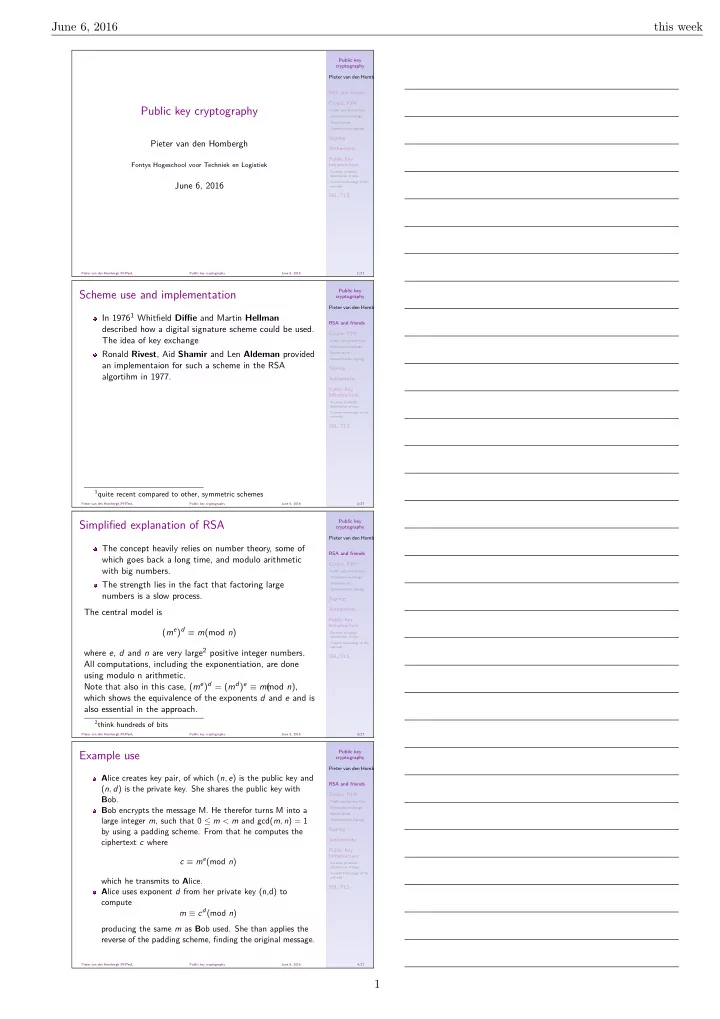
June 6, 2016 this week Public key cryptography Pieter van den - - PDF document

june 6 2016 this week
SMART_READER_LITE
LIVE PREVIEW

June 6, 2016 this week Public key cryptography Pieter van den - - PDF document

June 6, 2016 this week Public key cryptography Pieter van den Hombergh RSA and friends Crypto, PPK Public key cryptography Public and private Keys Information exchange Shared secret Authentication/signing Signing Pieter van den Hombergh


slide-1
SLIDE 1

Public key cryptography Pieter van den Hombergh RSA and friends Crypto, PPK

Public and private Keys Information exchange Shared secret Authentication/signing

Signing Authenticity Public Key Infrastructure

Securely (trusted) distribution of keys Current technology of the ww-web

SSL/TLS

Public key cryptography

Pieter van den Hombergh

Fontys Hogeschool voor Techniek en Logistiek

June 6, 2016

Pieter van den Hombergh/FHTenL Public key cryptography June 6, 2016 1/27

Public key cryptography Pieter van den Hombergh RSA and friends Crypto, PPK

Public and private Keys Information exchange Shared secret Authentication/signing

Signing Authenticity Public Key Infrastructure

Securely (trusted) distribution of keys Current technology of the ww-web

SSL/TLS

Scheme use and implementation

In 19761 Whitfield Diffie and Martin Hellman described how a digital signature scheme could be used. The idea of key exchange Ronald Rivest, Aid Shamir and Len Aldeman provided an implementaion for such a scheme in the RSA algortihm in 1977.

1quite recent compared to other, symmetric schemes

Pieter van den Hombergh/FHTenL Public key cryptography June 6, 2016 2/27

Public key cryptography Pieter van den Hombergh RSA and friends Crypto, PPK

Public and private Keys Information exchange Shared secret Authentication/signing

Signing Authenticity Public Key Infrastructure

Securely (trusted) distribution of keys Current technology of the ww-web

SSL/TLS

Simplified explanation of RSA

The concept heavily relies on number theory, some of which goes back a long time, and modulo arithmetic with big numbers. The strength lies in the fact that factoring large numbers is a slow process. The central model is (me)d ≡ m(mod n) where e, d and n are very large2 positive integer numbers. All computations, including the exponentiation, are done using modulo n arithmetic. Note that also in this case, (me)d = (md)e ≡ m( mod n), which shows the equivalence of the exponents d and e and is also essential in the approach.

2think hundreds of bits

Pieter van den Hombergh/FHTenL Public key cryptography June 6, 2016 3/27

Public key cryptography Pieter van den Hombergh RSA and friends Crypto, PPK

Public and private Keys Information exchange Shared secret Authentication/signing

Signing Authenticity Public Key Infrastructure

Securely (trusted) distribution of keys Current technology of the ww-web

SSL/TLS

Example use

Alice creates key pair, of which (n, e) is the public key and (n, d) is the private key. She shares the public key with Bob. Bob encrypts the message M. He therefor turns M into a large integer m, such that 0 ≤ m < m and gcd(m, n) = 1 by using a padding scheme. From that he computes the ciphertext c where c ≡ me(mod n) which he transmits to Alice. Alice uses exponent d from her private key (n,d) to compute m ≡ cd(mod n) producing the same m as Bob used. She than applies the reverse of the padding scheme, finding the original message.

Pieter van den Hombergh/FHTenL Public key cryptography June 6, 2016 4/27

June 6, 2016 this week 1

slide-2
SLIDE 2

Public key cryptography Pieter van den Hombergh RSA and friends Crypto, PPK

Public and private Keys Information exchange Shared secret Authentication/signing

Signing Authenticity Public Key Infrastructure

Securely (trusted) distribution of keys Current technology of the ww-web

SSL/TLS

Key generation

1 Choose two distinct large primes p and q. These should

be chosen random with a true random generator. (As in: unpredictable).

2 Compute n = p × q This n is the modulus in both public

and private key. Its length, in bits, is the key length.

3 Compute the Eulers totient function ϕ(n), which for the

primes p and q is simply n − (p + q − 1). This is kept private.

4 Choose e such that 1 < e < ϕ(n) and gcd(e, ϕ(n)) = 1,

saying e and ϕ(n) are coprime.

5 Determine d from d ≡ e−1(mod ϕ(n))

The e and n are combined into the public key, the d and n make up the private key. source: RSA

Pieter van den Hombergh/FHTenL Public key cryptography June 6, 2016 5/27

Public key cryptography Pieter van den Hombergh RSA and friends Crypto, PPK

Public and private Keys Information exchange Shared secret Authentication/signing

Signing Authenticity Public Key Infrastructure

Securely (trusted) distribution of keys Current technology of the ww-web

SSL/TLS

Public-key cryptography

Alice

0110101010 1101110100 0011011010 Large Random Number Key Generation Program

A Public A Private

The key pair, simplified.

Pieter van den Hombergh/FHTenL Public key cryptography June 6, 2016 6/27

Public key cryptography Pieter van den Hombergh RSA and friends Crypto, PPK

Public and private Keys Information exchange Shared secret Authentication/signing

Signing Authenticity Public Key Infrastructure

Securely (trusted) distribution of keys Current technology of the ww-web

SSL/TLS

Encrypt-decrypt

Hello Alice! Alice's private key Encrypt 6EB69570 08E03CE4 Hello Alice! Decrypt Alice's public key

Bob Alice

The use of the keys

Pieter van den Hombergh/FHTenL Public key cryptography June 6, 2016 7/27

Public key cryptography Pieter van den Hombergh RSA and friends Crypto, PPK

Public and private Keys Information exchange Shared secret Authentication/signing

Signing Authenticity Public Key Infrastructure

Securely (trusted) distribution of keys Current technology of the ww-web

SSL/TLS

Shared secret

Alice's private key Combine keys Bob's public key 751A696C 24D97009 Alice's public key Bob's private key

Alice

Alice and Bob's shared secret

Bob

Combine keys 751A696C 24D97009 Alice and Bob's shared secret

A shared secret can be use as key for a symmetric

  • encryption. (Diffy-Hellman)

Pieter van den Hombergh/FHTenL Public key cryptography June 6, 2016 8/27

June 6, 2016 this week 2

slide-3
SLIDE 3

Public key cryptography Pieter van den Hombergh RSA and friends Crypto, PPK

Public and private Keys Information exchange Shared secret Authentication/signing

Signing Authenticity Public Key Infrastructure

Securely (trusted) distribution of keys Current technology of the ww-web

SSL/TLS

Signing

To sign a message, a signature can be added, by encrypting with the public key. (Signed and sent by Alice to Bob). X = encrypt(pubkeyBob, encrypt(privkeyAlice, M)) where M is the message and X the result of encrypting, then signing it. The encrypted X is sent along an insecure path. Decryption and verification is done with the reverse use

  • f opposite keys.

M = decrypt(pubkeyAlice, decrypt(privkeyBob, X)) Note that the intermediate product is still encrypted (with Alice’s pubkey). Remember the evaluation order of the function calls!

Pieter van den Hombergh/FHTenL Public key cryptography June 6, 2016 9/27

Public key cryptography Pieter van den Hombergh RSA and friends Crypto, PPK

Public and private Keys Information exchange Shared secret Authentication/signing

Signing Authenticity Public Key Infrastructure

Securely (trusted) distribution of keys Current technology of the ww-web

SSL/TLS

Signing with public key technology

We have seen that encryption uses the public key of the recipient to encrypt, and the private key of same to decrypt. The Owner of the key has the private key and is (or should be the only one that can decrypt. In signing we do the (almost) reverse: From the message to be signed, we compute a hash h. The sender encrypts this hash with his private key, appends it to the message. some steps left out... (quiz which one?) The receiver decrypts the crypted hash, and if successfull, knows that the sender must have encrypted it, because he is the only one with access to the private key.

Pieter van den Hombergh/FHTenL Public key cryptography June 6, 2016 10/27

Public key cryptography Pieter van den Hombergh RSA and friends Crypto, PPK

Public and private Keys Information exchange Shared secret Authentication/signing

Signing Authenticity Public Key Infrastructure

Securely (trusted) distribution of keys Current technology of the ww-web

SSL/TLS

Signing in a picture

In place of the wiggly vertical, we could add encryption to keep the information confidential. Quiz: What will the picture then look like?

Pieter van den Hombergh/FHTenL Public key cryptography June 6, 2016 11/27

Public key cryptography Pieter van den Hombergh RSA and friends Crypto, PPK

Public and private Keys Information exchange Shared secret Authentication/signing

Signing Authenticity Public Key Infrastructure

Securely (trusted) distribution of keys Current technology of the ww-web

SSL/TLS

Man in the Middle attack

If the MITM can make the end user trust HIS certificate, he can decrypt the communication from the end user to him, and because he communicates to the server “on behalf” of the end user, also the traffic from the server intended for the end user. He can also modify the information.

Pieter van den Hombergh/FHTenL Public key cryptography June 6, 2016 12/27

June 6, 2016 this week 3

slide-4
SLIDE 4

Public key cryptography Pieter van den Hombergh RSA and friends Crypto, PPK

Public and private Keys Information exchange Shared secret Authentication/signing

Signing Authenticity Public Key Infrastructure

Securely (trusted) distribution of keys Current technology of the ww-web

SSL/TLS

Authenticity

A major concern is authenticity. Being sure that the party we are talking to is the one he claims to be. Successful authentication is often a prerequisite of authorization. This works both ways:

A computer needs to verify the authenticity of a user to allow certain operations. A user needs assurance to be certain she is connected to the proper service, not a fake one.

The problem is aggravated when the two parties do not personally know each other and have to trust the opposite anyway.

Pieter van den Hombergh/FHTenL Public key cryptography June 6, 2016 13/27

Public key cryptography Pieter van den Hombergh RSA and friends Crypto, PPK

Public and private Keys Information exchange Shared secret Authentication/signing

Signing Authenticity Public Key Infrastructure

Securely (trusted) distribution of keys Current technology of the ww-web

SSL/TLS

A helping hand

In particular the problem of the user trusting the system is problematic, since the user cannot “see” the server,

  • nly what it communicates.

To address this, we need a helper we can trust: The Certification Authority. (CA). The CA verifies that a party is who he claims to be (sometimes even by making them or a representative show up in person), than signs a Certificate Request (CSR), creating a (server) certificate. This CSR is based upon the public key of the requestor (sometimes called the supplicant).

Pieter van den Hombergh/FHTenL Public key cryptography June 6, 2016 14/27

Public key cryptography Pieter van den Hombergh RSA and friends Crypto, PPK

Public and private Keys Information exchange Shared secret Authentication/signing

Signing Authenticity Public Key Infrastructure

Securely (trusted) distribution of keys Current technology of the ww-web

SSL/TLS

Client certification, example ssh

An even stronger fortification can be achieved by also make the client (end user) present a certificate. This is the road that ssh (Secure Shell) can taken when configured to use a client or user certificate. Often this certificate is created by the end user and safely transferred to the server in a end user specific store. (Typically $HOME/.ssh under Unixoids). In this use case the end user is known to the server AND the server can verify the authentication on use AND when the best practice of setting a non empty key phrase on the private key part, the security level is quite good. Currently ssh is the tool of choice to do remote work or deployment on a server. ssh can also provide a “poor mans” VPN.

Pieter van den Hombergh/FHTenL Public key cryptography June 6, 2016 15/27

Public key cryptography Pieter van den Hombergh RSA and friends Crypto, PPK

Public and private Keys Information exchange Shared secret Authentication/signing

Signing Authenticity Public Key Infrastructure

Securely (trusted) distribution of keys Current technology of the ww-web

SSL/TLS

Questions to ask

When considering network security you might want to ask the following questions: How about data safety (eavesdropping) How about identity theft Data integrity Authenticity Privacy Sometimes the answers to these question are at odds with each other.

Pieter van den Hombergh/FHTenL Public key cryptography June 6, 2016 16/27

June 6, 2016 this week 4

slide-5
SLIDE 5

Public key cryptography Pieter van den Hombergh RSA and friends Crypto, PPK

Public and private Keys Information exchange Shared secret Authentication/signing

Signing Authenticity Public Key Infrastructure

Securely (trusted) distribution of keys Current technology of the ww-web

SSL/TLS

The problem of trust

A public key certificate is used to prove ownership of a public key. The certificate includes:

information about the key information about the owner’s identity a digital signature of a trusted entity This entity is the key to trust and must be trusted by all parties involved

You need a trusted channel to transport the

  • certificate. Why?

To create a trusted channel you need a

  • certificate. Why?

source: http://en.wikipedia.org/wiki/Certificate_authority

Pieter van den Hombergh/FHTenL Public key cryptography June 6, 2016 17/27

Public key cryptography Pieter van den Hombergh RSA and friends Crypto, PPK

Public and private Keys Information exchange Shared secret Authentication/signing

Signing Authenticity Public Key Infrastructure

Securely (trusted) distribution of keys Current technology of the ww-web

SSL/TLS

A social solution: Web of trust

Trust is in fact a human emotion. An emotion but nonetheless a crucial

  • ne to make “Business” possible.

A web of trust is based on: I trust whom you trust. What implications do we have here? This is what PGP (and GNU PG) do: people who trust

  • ne another sign each others key, thereby casting this

trust in a certificate. The certificate contains personal details (name according to e.g. passport AND drivers license, DOB etc ) and the public key. A web of trust has NO central authority.

Pieter van den Hombergh/FHTenL Public key cryptography June 6, 2016 18/27

Public key cryptography Pieter van den Hombergh RSA and friends Crypto, PPK

Public and private Keys Information exchange Shared secret Authentication/signing

Signing Authenticity Public Key Infrastructure

Securely (trusted) distribution of keys Current technology of the ww-web

SSL/TLS

Digitally distributing trust X.509

X.509 is the ITU-T standard for a public key infrastructure (PKI) In X.509 a certification authority issues certificates to bind a public key to a distinguished name3 or alternate name (e.g. email or dns entry). A CA can create/have sub ordinate or intermediate (level 2, level 3) registration authorities (RA), which can sign and issue end user (server) certificates. This builds a hierarchy of trust, with the CA a the top, the server at the bottom and the intermediate, if any, in between. Typically the root CA certificates are installed with the

  • perating system and/or the browser. Why?

Can you think of some weak spots in this whole circus? source: http://en.wikipedia.org/wiki/X.509

3See LDAP, ADS

Pieter van den Hombergh/FHTenL Public key cryptography June 6, 2016 19/27

Public key cryptography Pieter van den Hombergh RSA and friends Crypto, PPK

Public and private Keys Information exchange Shared secret Authentication/signing

Signing Authenticity Public Key Infrastructure

Securely (trusted) distribution of keys Current technology of the ww-web

SSL/TLS

Protocols ans standards using X.509

TLS/SSL S/MIME (Secure Multipurpose Internet Mail Extensions) IPsec SSH Smart card HTTPS EAP LDAP Trusted Computing Group (TNC TPM NGSCB) CableLabs (North American Cable Industry Technology Forum) WS-Security XMPP Microsoft Authenticode OPC UA

Pieter van den Hombergh/FHTenL Public key cryptography June 6, 2016 20/27

June 6, 2016 this week 5

slide-6
SLIDE 6

Public key cryptography Pieter van den Hombergh RSA and friends Crypto, PPK

Public and private Keys Information exchange Shared secret Authentication/signing

Signing Authenticity Public Key Infrastructure

Securely (trusted) distribution of keys Current technology of the ww-web

SSL/TLS

X.509 Certificate structure

Certificate

Version Serial Number Algorithm ID Issuer Validity

Not Before Not After

Subject Subject Public Key Info

Public Key Algorithm Subject Public Key

Issuer Unique Identifier (optional) Subject Unique Identifier (optional) Extensions (optional)

. . .

Certificate Signature Algorithm Certificate Signature

Pieter van den Hombergh/FHTenL Public key cryptography June 6, 2016 21/27

Public key cryptography Pieter van den Hombergh RSA and friends Crypto, PPK

Public and private Keys Information exchange Shared secret Authentication/signing

Signing Authenticity Public Key Infrastructure

Securely (trusted) distribution of keys Current technology of the ww-web

SSL/TLS

Everlasting trust?

As can be inferred from the structure, a certificate has a validity time span or period. Can you come up with some reasons? Reasons for revocation: (from CRL)

unspecified (0) keyCompromise (1) CACompromise (2) affiliationChanged (3) superseded (4) cessationOfOperation (5) certificateHold (6) removeFromCRL (8) privilegeWithdrawn (9) AACompromise (10)

It must be possible to revoke a certificate. Possible is:

Using a certificate revocation list. Use the Online Certificate Status Protocol (OCSP) OCSP is favored by some browsers.

Pieter van den Hombergh/FHTenL Public key cryptography June 6, 2016 22/27

Public key cryptography Pieter van den Hombergh RSA and friends Crypto, PPK

Public and private Keys Information exchange Shared secret Authentication/signing

Signing Authenticity Public Key Infrastructure

Securely (trusted) distribution of keys Current technology of the ww-web

SSL/TLS

Principles of a CRL

List contains the certificate serial numbers, not the whole certificates A list per CA. The list has a limited life time, e.g. it support caching, but not indefinite. Usually the CRL is signed by the CA. To validate the signature you need the CA’s certificate, which is typically pre-installed. (App, browser, OS service). Security issues: What if the revocation list is not available (think of a way to prevent access).

Pieter van den Hombergh/FHTenL Public key cryptography June 6, 2016 23/27

Public key cryptography Pieter van den Hombergh RSA and friends Crypto, PPK

Public and private Keys Information exchange Shared secret Authentication/signing

Signing Authenticity Public Key Infrastructure

Securely (trusted) distribution of keys Current technology of the ww-web

SSL/TLS

Online (and dynamic) certificate status check

The Online Certificate Status Protocol, (OCSP) is the internet protocol to obtain the status of a certificate (validity, revocation). OCSP also has some issues

Privacy: The CA can know that Bob and Alice have

  • contact. This might compromise the privacy of one or

both. When a OCSP request times out, it is typically further

  • ignored. . .

It does not protect against a man in the middle attack. (Think what this MitM can do with the net traffic).

The MustStaple TLS extension help mitigate this last two problem. In a stapling scenario, the certificate holder queries the OCSP server themselves at regular intervals, obtaining a signed, time-stamped OCSP response. The client (browser) can request a Certificate Status Request , and does not need to contact the CA.

source: http://en.wikipedia.org/wiki/OCSP_stapling

Pieter van den Hombergh/FHTenL Public key cryptography June 6, 2016 24/27

June 6, 2016 this week 6

slide-7
SLIDE 7

Public key cryptography Pieter van den Hombergh RSA and friends Crypto, PPK

Public and private Keys Information exchange Shared secret Authentication/signing

Signing Authenticity Public Key Infrastructure

Securely (trusted) distribution of keys Current technology of the ww-web

SSL/TLS

Secured HTTP connections (https://)

The purpose of the protocol is twofold:

Authentication (of least of the server). Secrecy (encryption). self signed certificates only support the last. Note that client authentication is also possible, but less used

SSL and TLS use two phases to set up a secure connection. The data connection (payload) is encrypted using a symmetric key. Such key is created anew for each session. This is done in the key exchange phase. The server and client use public key encryption to set derive a session key.

Pieter van den Hombergh/FHTenL Public key cryptography June 6, 2016 25/27

Public key cryptography Pieter van den Hombergh RSA and friends Crypto, PPK

Public and private Keys Information exchange Shared secret Authentication/signing

Signing Authenticity Public Key Infrastructure

Securely (trusted) distribution of keys Current technology of the ww-web

SSL/TLS

SSL/TLS Key exchange

After this key exchange, the actual communication (HTTP payload) can start. source: cisco http://www.cisco.com/web/about/ac123/ac147/ archived_issues/ipj_1-1/ssl.html

Pieter van den Hombergh/FHTenL Public key cryptography June 6, 2016 26/27

Public key cryptography Pieter van den Hombergh RSA and friends Crypto, PPK

Public and private Keys Information exchange Shared secret Authentication/signing

Signing Authenticity Public Key Infrastructure

Securely (trusted) distribution of keys Current technology of the ww-web

SSL/TLS

Open connection

A side effect of the expense of setting up a connection is that with SSL/TLS the TCP connection typically is kept

  • pen, where in HTTP (without s), a new connection is

established for each request/response pair. You can see this effect if you reconfigure your Apache server and then reload. The SSL connected child processes stay alive.

Pieter van den Hombergh/FHTenL Public key cryptography June 6, 2016 27/27

June 6, 2016 this week 7