June 10, 2016 Nova Scotias Presentation Three Fundamental Questions - - PowerPoint PPT Presentation

june 10 2016 nova scotia s presentation three fundamental
SMART_READER_LITE
LIVE PREVIEW

June 10, 2016 Nova Scotias Presentation Three Fundamental Questions - - PowerPoint PPT Presentation

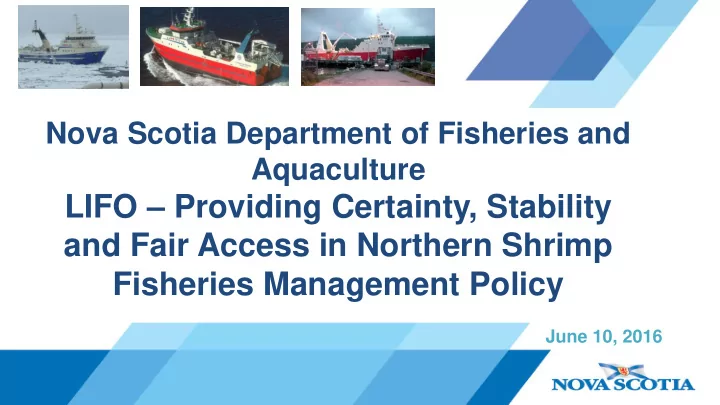
Nova Scotia Department of Fisheries and Aquaculture LIFO Providing Certainty, Stability and Fair Access in Northern Shrimp Fisheries Management Policy June 10, 2016 Nova Scotias Presentation Three Fundamental Questions


slide-1
SLIDE 1

Nova Scotia Department of Fisheries and Aquaculture

LIFO – Providing Certainty, Stability and Fair Access in Northern Shrimp Fisheries Management Policy

June 10, 2016

slide-2
SLIDE 2

Nova Scotia’s Presentation

  • Three Fundamental Questions
  • Importance of Northern Shrimp to Nova Scotia
  • Northern Shrimp Fishery – development history
  • Putting LIFO in Context
  • Policies and Principles of Fisheries Management
  • Critique of APC Assertions
  • Consequences of Abolishing or Revising LIFO
  • Concluding Points
slide-3
SLIDE 3

Three Fundamental Questions

  • Should the federal government honour its

commitments?

  • Conservation - Should we ignore lessons from the

past?

  • Fisheries Management – Do we want to set a course

to go backward?

slide-4
SLIDE 4

Importance of Northern Shrimp to Nova Scotia

  • Shrimp one of the province’s most valuable

seafood exports at ~$131 million (2015)

  • The Northern shrimp fishery constitutes the largest

portion of Nova Scotia’s shrimp export value

  • Hundreds of millions of dollars have been invested

by the NS offshore fleet to capitalize on their continued access based on the protections provided by LIFO

slide-5
SLIDE 5
slide-6
SLIDE 6

Northern Shrimp Fishery - History

  • Fishery Developed in 1970s
  • Conducted by foreign factory freezer trawlers
  • Opportunity for Canada when our 200 mile EEZ was

declared in 1977

  • Initially, foreign vessels entered royalty charter

agreements with Canadian Interests

slide-7
SLIDE 7

Northern Shrimp Fishery - History

  • Beginning in the late 1970s, efforts were made to

“Canadianize” the Northern Shrimp Fishery

  • Nova Scotia companies led the initiative
  • Major investments were made to purchase vessels and

establish onshore infrastructure

  • The historic dependence is based on 40 years of

involvement developing and prosecuting this fishery

slide-8
SLIDE 8

Northern Shrimp Fishery - History

  • Number of offshore participants grew to 17
  • Fishing areas established (SFAs)
  • Fishery is managed with TACs for each area
  • Industry entered into an Enterprise Allocation System
  • Fish on a year-round basis

– target areas based on fishing conditions, ice, conservation issues, catch rates, etc.

  • Committed to conservation – e.g. voluntarily introduced

the Nordmore grate

slide-9
SLIDE 9

Putting LIFO into Context

  • LIFO is not a policy that can be considered as an

independent concept; it has always been a critical part of the Integrated Fisheries management Plan (IFMP)

  • The fishery expansion in the late 1990s posed challenges
  • Many interests from Atlantic Canada & Quebec wanted

access

  • Existing stakeholders had concerns that shrimp would

follow the same pattern as other past failed fisheries models

slide-10
SLIDE 10

Putting LIFO into Context

  • LIFO was the policy agreed to by all to facilitate new

entrants while protecting the interests of the traditional fleet

  • DFO’s commitment to make LIFO a condition of

expansion and entrench it in the management plans eased these concerns

  • That commitment is what’s at stake now with this review
slide-11
SLIDE 11

Putting LIFO into Context

  • LIFO is working
  • Provides clear rules for exit as the resource declines.
  • Several groups who entered the fishery have already

exited under LIFO rules

  • Eight federal Fisheries Ministers representing three

federal governments have upheld LIFO

  • An independent review conducted by Ernst and Young in

2012 also upheld LIFO

slide-12
SLIDE 12

Principles/Policies of Fisheries Management

  • Nova Scotia is a strong and consistent supporter of

modern approaches to fisheries management

  • Predictable rules and policies are what should govern

fisheries – not politics

  • 3PS Scallops, Gulf Halibut and now Northern Shrimp

are all examples

  • Nova Scotia’s position on these matters is long held;

not borne of convenience

slide-13
SLIDE 13

Principles of Fisheries Management

  • “DFO’s repeated decisions to not honour the 2007 sharing arrangement for the Gulf Atlantic

halibut fixed-gear fishery contradict the stabilization and transparency process that the department has implemented and promoted. The decisions to deviate from this arrangement clearly do not promote the principle of historic dependency or DFO’s objectives in relation to resource stability and predictability and have cost harvesters in Newfoundland and Labrador almost $1.9 million. Ignoring the established sharing arrangement for Gulf Atlantic halibut, fleets’ historical participation in the fishery, and principles and objectives for resource allocation calls into question all of the sharing arrangements that have been established for commercial fisheries across Atlantic Canada.”

Government of NFLD submission to DFO Gulf Halibut review April 2016

slide-14
SLIDE 14

Principles of Fisheries Management

  • IPAC & DFO’s subsequent New Access Policy

– Recognized conservation as priority – Addressed new access criteria

  • Priority access given to fishers who have relied on and traditionally

harvested a resource - LIFO

  • Adjacency a key consideration – for inshore and nearshore fisheries -

adjacency become less compelling moving from near shore to

  • ffshore areas – New entrants got largest share of increase
  • Economic Viability - Ability to comply with LIFO to be considered

when new access is granted

slide-15
SLIDE 15

Principles of Fisheries Management

Atlantic Fisheries Policy Review (AFPR) 2004

  • Developed after 5 years of extensive industry consultation
  • Identified two objectives - Conservation & Sustainable Use and

Self Reliance

  • Identified Threats to Conservation & Sustainable Use as,

– Ineffectiveness of Top Down Management, – Uncertainty in Access and Allocation, – Closed Decision Making Processes – Excess participation

slide-16
SLIDE 16

Principles of Fisheries Management

Excess Participation “The problem of excess participation can cause low profitability in many fisheries and is

compounded by the lack of alternate economic opportunities in some regions. This can result in situations where communities are excessively dependent on the fisheries for their survival and are unable to weather the effects of a sudden reduction in fisheries resources. A downturn in the fisheries can therefore lead to conflict among resource users, pressure to compromise conservation objectives and recurring demands for increased access at the expense of other resource users.” AFPR 2004

slide-17
SLIDE 17

Principles of Fisheries Management

Atlantic Fisheries Policy Review (AFPR) 2004 – Achieving the objectives requires Shared Stewardship – Shared Stewardship requires - A Stable and Transparent Access and Allocation Approach – “The access and allocation of fisheries resources will be more stable and predictable, and decisions will be made and conflicts resolved through fair, transparent and rules-based processes.”

slide-18
SLIDE 18

Principles of Fisheries Management

  • Northern Shrimp Fishery and LIFO epitomize all aspects
  • f modern fisheries management – AFPR, New Access

– Respect for conservation – rules based, LIFO – Adjacency – new access provided – Historic dependence & economic viability- LIFO – Shared stewardship – all stakeholders supported LIFO – Clear rules and transparent decision making

  • Abolishing or modifying LIFO will have profound impacts
  • n the future of fisheries management in Canada
slide-19
SLIDE 19

Consequences of abolishing/revising LIFO

  • If the federal government chooses to not honour its

commitments..

  • Significant economic impacts on Nova Scotians involved in the

fishery – taking fish from NS to solve economic issues elsewhere

  • Conservation and sustainable use will be threatened by excess

participation

  • Modern fisheries management policies and practices will be

jeopardized.

  • DFO will be back to making unilateral decisions,

political lobbying will be the norm

slide-20
SLIDE 20

Keep LIFO because…

APC Statement Fact LIFO not used in other fisheries Irrelevant – it is a core component of this fishery, provides clear exit rules and was agreed to by all Ignores adjacency & inshore False – access and largest share provided based on adjacency Mifflin 1997 Doesn’t recognize 2007 –licenses became permanent Irrelevant – FFAW agreed in 1997 share could go to zero based on TAC, everyone knew the exit rules Doesn’t recognize investment by inshore False – LIFO defined the risk for all participants and everyone made investments based on the clear rules. Ignores viability of inshore, disproportionate impact etc. False – addressed by Mifflin in 1997, new entrants got 90% of the increase Ignores mobility of traditional fleet and access to other zones False – recognizes historic dependence on SFA 6 and protects economic viability

slide-21
SLIDE 21

Keep LIFO because…

  • Honours commitments made to Nova Scotia and the

traditional fleet to protect their historic dependence and economic viability

  • Ensures conservation and sustainable use by

avoiding excess participation.

  • Prevents returning to past failed models of top down

politically driven fisheries management

slide-22
SLIDE 22

Concluding Points

  • The old failed system of fisheries management did not

work.

  • Over the past number of years, DFO, industry and

provinces have worked hard to develop principles and rules-based management approaches

  • Modern policies and principles are reflected in IPAC, New

Access Criteria and AFPR

slide-23
SLIDE 23

Concluding Points

  • The Northern Shrimp fishery, including LIFO epitomize a

modern rules-based approach to fisheries management

  • New entrants knew what the rules and conditions were

when they entered the Northern Shrimp fishery

  • Some now don’t like the management rules want to go

back to the old system

slide-24
SLIDE 24

Concluding Points

  • If DFO decides to “change the rules” and ignore LIFO,

– NS ECONOMIC INTEREST WILL BE HURT – CONSERVATION WILL BE THREATENED – PRINCIPLE-BASED MANAGEMENT APPROACHES WILL BE THROWN OUT – DFO WILL BE BACK TO THE OLD “FIGHT FOR THE RESOURCE” SYSTEM WHERE THERE ARE WINNERS AND LOSERS – WE WILL ALL LOSE AS POLITICS TRUMPS SOUND FISHERIES MANAGEMENT