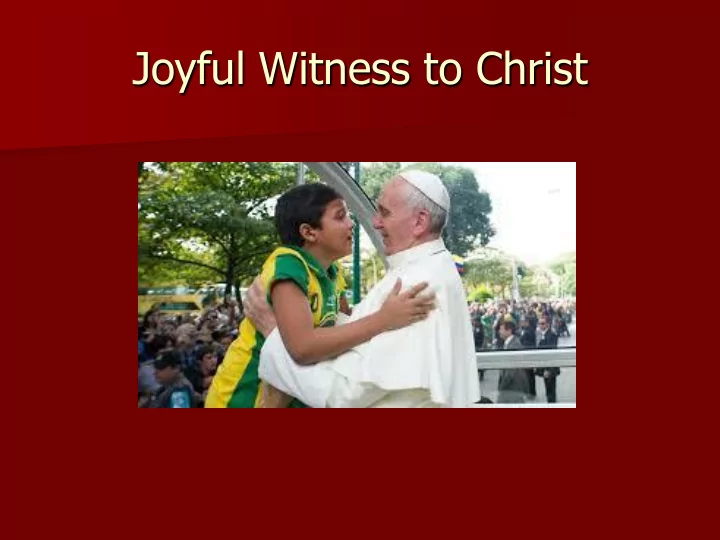
SLIDE 1
Joyful Witness to Christ
SLIDE 2
Terminology
JOY! "Infallible sign of God's Presence" –
Teilhard
Gift of the Holy Spirit (Galatians)
SLIDE 3 Terminology
Witness?
– Observer – Describer – Bystander – Passive
Greek: "Witness" is
MARTYR
– One who gives whole
– One who is actively engaged – One who surrenders totally to will of God for the good of others
SLIDE 4 Therefore,
We are called to be
joy-filled martyrs!
Like St. Lawrence of
Rome
SLIDE 5 The Deacon's Charge
Receive the Gospel
Herald you have
what you read, teach what you believe, and practice what you teach.
SLIDE 6
As always, look to Christ
SLIDE 7
Christ and the Deacon
"The basic spiritual attitude of the deacon must make it clear that the Christian path is not an ascent or a triumphal march in glory, but a path that looks downward, following Jesus Christ, who descended from heaven." Cardinal Walter Kasper
SLIDE 8
But then why are we joyful?
KENOSIS THEOSIS
SLIDE 9
Kenosis andTheosis
SLIDE 10
Philippians 2:5-8
(Kenosis)
Who, being in the form of God, Did not count equality with God Something to be grasped. But he emptied himself, Taking the form of a slave, Becoming as human beings are; And being in every way like a human being, He was humbler yet, Even to accepting death, death on a cross.
SLIDE 11
Philippians 2:9-11
(Theosis)
Therefore God also highly exalted him And gave him the name That is above every name, So that at the name of Jesus Every knee should bend, In heaven and on earth and under the earth And every tongue should confess That Jesus Christ is Lord, To the glory of God the Father.
SLIDE 12 "Faith and Reason" (1998)
The prime commitment of
theology is seen to be the understanding of God's kenosis, a grand and mysterious truth for the human mind, which finds it inconceivable that suffering and death can express a love which gives itself and seeks nothing in return.
SLIDE 13 I'm going to need more coffee. . .
Out of His infinite
love, God desired to draw near to man and walk with him. He also wanted to free him from the snares
and to open the way to intimacy with
Congregation for the
Doctrine of the Faith, "The Ecclesial Vocation of the Theologian," 1990.
"Draw near" – sense
"Intimacy with God" –
sense of Theosis
SLIDE 14 Kenosis: Essence of Divinity
Who is God in light of the
kenosis? Kenosis is not a process of de-divination but rather as an attribute
- f God's love disclosed in
the compassionate existence of Jesus. . . . God is absolute letting- be, self giving, self-
understood as the way God relates to the world; creation is a work of love,
Lucien Richard, OMI Christ: The Self-
Emptying of God (Mahwah: Paulist Press, 1997)
SLIDE 15 Kenosis: Essence of Divinity
Hans Urs von
Balthasar
Love Alone (New
York: Herder & Herder, 1969)
It is precisely in the
kenosis of Christ (and nowhere else) that the inner majesty of God's love appears, of God who 'is love' (1 John 4:8) and a 'trinity.'
SLIDE 16 Kenosis: Essence of Divinity
J. B. Metz Poverty of Spirit (New
York: Paulist Press, 1968, 1998)
God 'became human' and
took on our flesh. We say this all too casually.
Satan wants to make
Jesus strong, for what the devil really fears is the powerlessness of God in the humanity that Jesus has assumed.
Satan fears the Trojan
horse of an open human heart.
SLIDE 17
Out of divine Love, God wants us to be
Theosis – movement toward communion
with the divine – is the reason for kenosis
2 Peter 1:4: Through Christ, we "become
partakers of the divine nature."
"Divinization"
SLIDE 18 "Divinization"? Sounds Dangerous!
St. Ephrem, deacon and
doctor of the Church: "The Deity imprinted itself on humanity, so that humanity might also be cut into the seal of the Deity"
St. Athanasius of
Alexandria, deacon and bishop: "God became human so we might become God."
SLIDE 19 More recently. . . .
JPII: "The Spirit enables
us to share in the Divine
General Audience), citing Thomas Aquinas:
"The Only-begotten Son
partakers of his divinity, assumed our human nature so that, having become man, he might make men gods."
SLIDE 20 Lex Orandi, Lex Credendi
West: "By the mystery of this water and wine,
may we come to share in the divinity of Christ who humbled himself to share in our humanity."
East: "You have united, O Lord, your divinity
with our humanity and our humanity with your divinity; Your life with our mortality and our mortality with Your life. You have assumed what is ours and you have given us what is yours for the life and salvation of our souls. To you be glory forever."
SLIDE 21 Impact on All Disciples
Through Baptism: "By
sharing our human nature, weakened through Adam's sin, you enabled us to share in your divinity, and to receive the gift
SLIDE 22 Impact on Deacons?
"Deacons are icons of
Christ the Servant" (Congregation for Catholic Education, Basic Norms for the Formation of Permanent Deacons, 1998), #11.
SLIDE 23 How do we give "joyful witness" with our lives? Through kenosis. . . .
At least 47 times in
the Hebrew Scriptures that tie the care of those most in need to the covenant
Also, "Suffering
Servant" songs in Isaiah; from earliest Christianity, Christ seen as the "Suffering Servant"
SLIDE 24 Deacon as Sign of Christ, the Suffering Servant
- 1. Song #1: the Servant is
described as God's agent to bring justice, but not by force. Quiet and confident leadership.
- 2. Song #2: the Servant as
prophet, called before birth to lead the people. Again, not by force; leadership by example; unsuccessful in human terms
SLIDE 25 Deacon as Sign of Christ, the Suffering Servant
- 3. Song #3: The servant is
beaten and abused, but perseveres; described as both teacher and learner.
- 4. Song #4: The servant bears
the pain and suffering of
- thers, and is described as
- ne who intercedes with God.
Servant fails in his own lifetime, but is vindicated by God after his death.
SLIDE 26 Deacon as Sign of Christ, the Suffering Servant
John 13:
– More than simple menial service; hypodeigma – John substitutes this account at the same point the synoptics describe the Eucharist – Christ and kenosis: pours himself out completely for
– Tells the LEADERS that they must do the same, or that they cannot have fellowship with him.
SLIDE 27 The Word We Herald
Christ not only proclaimed
the Good News, Christ is the Good News
Christ bears the Good News
not merely in his teaching and in his deeds, but in his very Person.
Back to EVANGELIZATION
SLIDE 28
Evangelii Nuntiandi
Pope Paul VI: On
Evangelization in the Modern World (Evangelii Nuntiandi) (1975)
SLIDE 29 "On Evangelization in the Modern World"
Promulgated 8 December 1975:
– 10th Anniversary of the Closing of Vatican II – 1975 was a Holy Year dedicated solely to the topic of Catholic Evangelization – Was the Apostolic Exhortation developing themes from the 1974 Synod of Bishops, again dedicated solely to Catholic Evangelization – First church document to focus exclusively on evangelization.
SLIDE 30
Paul VI:
"We wish to confirm once more that the task of evangelizing all people constitutes the essential mission of the Church."
SLIDE 31
Paul VI: Evangelization must be renewed so that:
"The world of our time, which is searching, sometimes with anguish, sometimes with hope, be enabled to hear the good news not from evangelizers who are dejected, discouraged, impatient or anxious but from ministers of the gospel whose lives glow with fervor, who have first received the joy of Christ and who are willing to risk their lives so that the kingdom may be proclaimed and the church established in the midst of the world."
SLIDE 32 "Preaching the Gospel": the primum officium of the ordained
Vatican II on BISHOPS: Among the principal duties of
bishops the preaching of the Gospel occupies an eminent
preachers of the faith, who lead new disciples to Christ (LG 25)
(remember LG 24: "Diakonia")
SLIDE 33
It is the first task (primum
- fficium) of priests as co-
workers of the bishops to preach the Gospel of God to all (PO 4).
SLIDE 34 And, deacons. . . .
Later, in 1998, the Holy See will
extend this teaching to include deacons:
"The principal function [munus
praecipuum] of the deacon, therefore, is to collaborate with the bishop and the priests in the exercise of a ministry which is not of their own wisdom but of the word of God, calling all to conversion and holiness" (#23)
SLIDE 35
The US bishops put it this way (2005):
The deacon exhorts, consecrates, and guides the People of God in living faithfully the communion and mission they share in Christ, especially in making the Gospel visible in their daily lives through their concern for justice, peace, and respect for life. (National Directory, #65)
SLIDE 36 Deacon as "Apostles of Evangelization" (JPII)
Dear deacons, be active
apostles of the new
everyone to Christ! Through your efforts, may his kingdom also spread in your family, in your workplace, in the parish, in the Diocese, in the whole world!
SLIDE 37 Receive the Gospel of Christ, whose Herald you have become.
- Believe. . .
- Teach. . .
- Practice. . .