
SLIDE 1
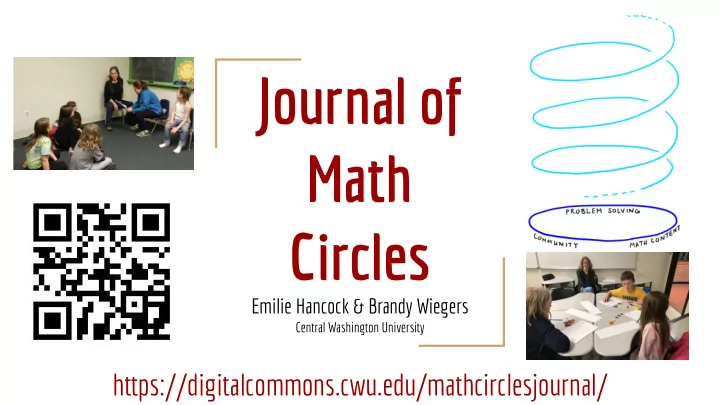
Journal of Math Circles
Emilie Hancock & Brandy Wiegers
Central Washington University
https://digitalcommons.cwu.edu/mathcirclesjournal/
Journal of Math Circles Emilie Hancock & Brandy Wiegers - - PowerPoint PPT Presentation
Journal of Math Circles Emilie Hancock & Brandy Wiegers Central Washington University https://digitalcommons.cwu.edu/mathcirclesjournal/ https://digitalcommons.cwu.edu/mathcirclesjournal/ About Journal of Math Circles Yearly issues with
Emilie Hancock & Brandy Wiegers
Central Washington University
https://digitalcommons.cwu.edu/mathcirclesjournal/
Yearly issues with special issues on themed topics No page limits! Open-access All published manuscripts have unrestricted access and will remain permanently free to read and download. https://digitalcommons.cwu.edu/mathcirclesjournal/
Editors in Chief:
Associate Editors:
Copy Editor: Brent Hancock, Central Washington University https://digitalcommons.cwu.edu/mathcirclesjournal/
Exploring Worthwhile Mathematical Tasks1
Math Circle tasks provide low-floor access to essential disciplinary questions, with high ceilings that connect to important, deep mathematical ideas.
Fostering Problem-Solving Habits of Mind2,3
Math Circle problems are facilitated in ways the promote authentic mathematical experiences, where participants maintain agency in driving exploration of mathematics.
Building a Community of Mathematical Thinkers and Problem Solvers https://digitalcommons.cwu.edu/mathcirclesjournal/
1. Cai, J., & Lester, F. (2010). Why is teaching with problem solving important to student learning. National council of teachers of mathematics, 13(12), 1-6. 2. Mason, J., Burton, L., & Stacey, K. 1982. Thinking mathematically. Addison-Wesley. 3. Selden, A., & Lim, K. H. 2010, October. Continuing discussion of mathematical habits of mind. In Proceedings of the 32nd annual meeting of the North American Chapter of the International Group for the Psychology of Mathematics Education. Columbus, OH: The Ohio State University.
The Intersection of Math Circles and the Global Math Project
The Global Math Project provides access to worthwhile mathematical tasks, like Exploding Dots. “Open research questions are right at the door.” The Global Math Project fosters problem-solving habits of mind. “[W]e can teach the world to flail with joy and find success through persistence.” The Global Math Project builds a global community of mathematical thinkers and problem solvers. Commentary from the Field: Elimu Haina Mwisho, “Education has not limits” Erick Mathew Kaaya, Global Math Project Ambassador (Meru District, Tanzania)
https://digitalcommons.cwu.edu/mathcirclesjournal/
Lesson Plans. These papers are intended to support leaders of a Math Circle session or progression of sessions.
[Grades 3-5] The Signaling Problem: Using Exploding Dots to Solve an Accessible Mystery in an Elementary-Aged Math Circle Rodi Steinig, Talking Stick Learning Center [Grades 4-8] Exploding Dots at the MSU-Billings Math Circle Tien Chih, Montana State University-Billings [High School] Advanced Topics Using Exploding Dots: An Explosion of Variations on the Theme Robert Sachs, George Mason University
https://digitalcommons.cwu.edu/mathcirclesjournal/
Outreach Programs. These papers are intended to support individuals or organizations in starting or sustaining Math Circle outreach programs.
Connecting Mathematics and Community: Challenges, Successes, and Different Perspectives Ariel Azbel, Brown University Margarita Azbel, Orlando Math Circle Isabella F. Delbakhsh, Lake Highland Preparatory Tami E. Heletz, Lake Highland Preparatory Zeynep Teymuroglu, Rollins College
https://digitalcommons.cwu.edu/mathcirclesjournal/
Professional Development. These papers are intended to support leaders of K-12 Math Circle teacher professional development.
Math Amigos: A Community Mathematics Initiative James C. Taylor, Math Circles Collaborative of New Mexico Delara Sharma, Santa Fe Public Schools Shannon Rogers, Art of Problem Solving
https://digitalcommons.cwu.edu/mathcirclesjournal/
Double-blind peer review process
Evidence-based reflective commentary
■ Participant mathematical work
■ Pictures/videos of participants in action ■ Keep a journal observation notes
TeX template, Overleaf link, article samples on website
https://digitalcommons.cwu.edu/mathcirclesjournal/
JMC is double-blind peer-reviewed and manuscript reviewers are vital to this process. As a reviewer for JMC, you will gain valuable experience and help support the Math Circle community. If you are an experienced reviewer or are interested in reviewing for the first time, visit the JMC website. https://digitalcommons.cwu.edu/mathcirclesjournal/
Authors are encouraged to attend this workshop and start preparing JMC manuscripts Time: Friday, 10:10-11:30 AM Location: DECC 201
https://digitalcommons.cwu.edu/mathcirclesjournal/
Emilie Hancock Central Washington University Departments of Mathematics, Science Education emilie.hancock@cwu.edu Brandy S. Wiegers Central Washington University Department of Mathematics brandy.wiegers@cwu.edu
https://digitalcommons.cwu.edu/mathcirclesjournal/