Joint P oint Polish olish-Finn Finnish samp ish sampli ling ng - - PowerPoint PPT Presentation

joint p oint polish olish finn finnish samp ish sampli
SMART_READER_LITE
LIVE PREVIEW

Joint P oint Polish olish-Finn Finnish samp ish sampli ling ng - - PowerPoint PPT Presentation

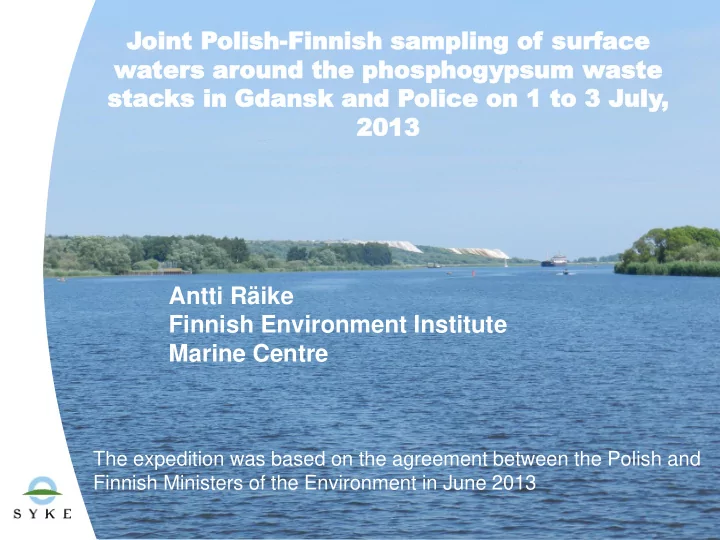
Joint P oint Polish olish-Finn Finnish samp ish sampli ling ng of of surf surfac ace e water ters s ar arou ound nd the the ph phosp ospho hogyp ypsu sum waste aste stac stacks in ks in Gdan Gdansk sk an and P d Police


slide-1
SLIDE 1

Joint P

  • int Polish
  • lish-Finn

Finnish samp ish sampli ling ng of

  • f surf

surfac ace e water ters s ar arou

  • und

nd the the ph phosp

  • spho

hogyp ypsu sum waste aste stac stacks in ks in Gdan Gdansk sk an and P d Police

  • lice on
  • n 1 t

1 to 3 J

  • 3 Jul

uly, , 2013 2013

The expedition was based on the agreement between the Polish and Finnish Ministers of the Environment in June 2013

Antti Räike Finnish Environment Institute Marine Centre

slide-2
SLIDE 2
  • Find out the role of two Polish phosphogypsum stacks as a

pollution source of the Baltic Sea

  • The main focus of the study was on phosphorus and

phosphate concentrations, but also other parameters were included

Aim of the study

Police Gdansk The Baltic Sea

slide-3
SLIDE 3

Study methods

  • Sampling and field studies 1.- 3.7.2013
  • Water quality

○ Gdansk 10 sampling stations ○ Police 7 sampling stations ○ Parameters (all together 17): conductivity, total phosphorus, phosphate phosphorus, aluminium, iron, calcium, fluoride, manganese, potassium, sulfate, sulfur, total nitrogen, ammonium, nitrate, pH, cadmium, nickel ○ Samples were analysed both in Polish and Finnish laboratories

  • Hydrology

○ Field studies ○ No flow measurements

slide-4
SLIDE 4

Gdansk phosphogypsum stack

  • Disposal started 1972
  • Disposal ended 2009
  • Area 34 ha
  • Estimated amount of phosphorus
  • f the stack:

○ 42 500 t

  • Nearest watercourse: The Dead

Vistula ○ Distance 50 m ○ The Dead Vistula has been blocked from the Vistula by a dam: nearly no freshwater flow

  • Distance to the Baltic Sea 6 km
slide-5
SLIDE 5

Gdansk: Water quality in the stack area

  • Really high

phosphorus concentrations

  • 1,5 km south from

the stack still high concentrations

  • Phosphorus

concentrations in the Dead Vistula are at the same level as in the Gulf of Finland anoxic bottom waters

Phosphate P Other P

slide-6
SLIDE 6

Gdansk: Water quality results

  • Phosphate phosphorus

concentrations near the stack nearly 5 times higher than those close to the sea

  • Total phosphorus

concentrations 3 times higher

  • This clearly indicates the

influence of the stack

  • Without knowledge of flow

conditions estimation of export to the Baltic Sea is impossible

The Baltic Sea

Phosphate P Other P Stack

slide-7
SLIDE 7

Police phosphogypsum stack

  • Disposal started 1970
  • Disposal continues
  • Area 180 ha
  • Estimated phosphorus amount

○ 213 000 t

  • Nearest water course: The Odra

○ Distance to the river >150 m

  • Distance to the Baltic Sea 10 km

(Bay of Szczecin)

  • More developed water protection

system than in Gdansk (including e.g. a WWTP)

slide-8
SLIDE 8

Police sampling stations

  • 5 sampling stations in

the River Odra

  • 1 sampling station in a

ditch where treated wastewater is discharged into the Odra

  • An island in the Odra

divides flow: The amount water flowing between the stack and the island is unknown X

The stack WWTP

River flow divides

slide-9
SLIDE 9

Police water quality results

  • Phosphorus concentrations

increase when river water passes the stack

  • Polish monitoring results

indicate the same thing

  • Increase in concentration

was 28% including loading from the WWTP

  • Water flow is unknown: It is

impossible to estimate phosphorus export

Phosphate P Other P

slide-10
SLIDE 10

Conclusions

  • Polish and Finnish Laboratory analyses were comparable
  • Gdansk: The exceptional high phosphorus concentrations in the

Dead Vistula can only originate from the phosphogypsum stack

  • Police: Increase in total phosphorus concentrations downstream the

stack may indicate leaching

  • Gaps in knowledge of hydrological conditions in both places.

Therefore it is impossible to estimate loading to the Baltic Sea.

  • Recommendation: More research on hydrological conditions are

needed in both places. This would enable reliable estimation of the potential phosphorus load into the Baltic Sea caused by the stacks.