Joe Lesser 3M Sash-to-Save 3M Joseph Lesser Advisor: Karl DeWahl - - PowerPoint PPT Presentation

joe lesser
SMART_READER_LITE
LIVE PREVIEW

Joe Lesser 3M Sash-to-Save 3M Joseph Lesser Advisor: Karl DeWahl - - PowerPoint PPT Presentation

Joe Lesser 3M Sash-to-Save 3M Joseph Lesser Advisor: Karl DeWahl 3M Overview 76,000 employees 56,000 products adhesives, abrasives, laminates, electronic circuits and optical films Operates in 60 countries


slide-1
SLIDE 1

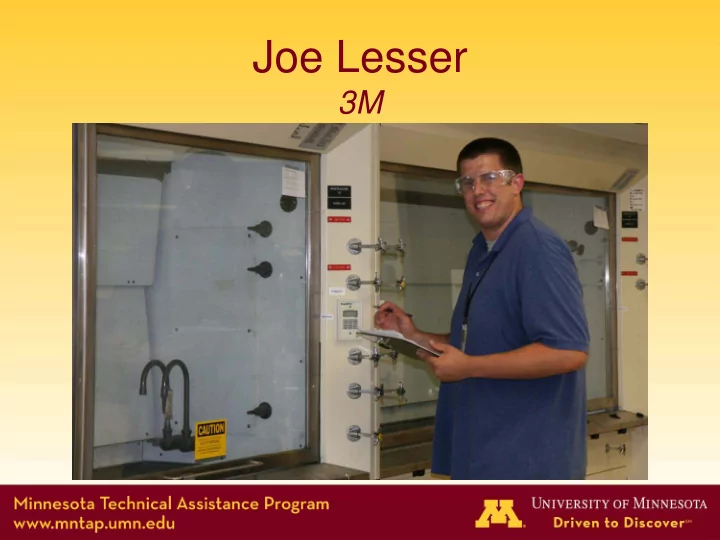
Joe Lesser

3M

slide-2
SLIDE 2

“Sash-to-Save”

3M

Joseph Lesser Advisor: Karl DeWahl

slide-3
SLIDE 3

3M Overview

  • 76,000 employees
  • 56,000 products

– adhesives, abrasives, laminates, electronic circuits and optical films

  • Operates in 60 countries
  • Products available in 200 countries
  • Sales of $23.1 billion in 2009
slide-4
SLIDE 4

Motivations for Change

  • 3M Center has the highest energy cost
  • f any 3M location.
  • 50% for HVAC in labs
slide-5
SLIDE 5

Problem Background

  • Many labs have excess exhaust and

wasted energy.

– Fume hoods are always on – Fume hoods often underutilized

slide-6
SLIDE 6

Possible Solutions Examined by 3M

  • Installing on/off switches
  • Decommission hoods when not in use
  • Installing Variable Air Volume Systems
  • Close Hood Sashes
slide-7
SLIDE 7

Installing on/off switches

  • Pros

– Employees can turn off the hoods

  • Cons

– On/off switch may cause safety problems

slide-8
SLIDE 8

Decommission fume hoods when not in use

  • Pros

– Save energy when hoods are turned off – Potentially create leverage for upgrades

  • Cons

– Too time consuming – Re-commissioned hoods continue to run inefficiently – Potential cost of upgrades

slide-9
SLIDE 9

Installing Variable Air Volume Systems

  • Pros

– Decreased energy consumption

  • Cons

– Cost of installation

  • Divisions that are in charge of the labs have no

incentive to update their ventilation system

slide-10
SLIDE 10

Close Fume Hood Sashes when not in use

  • Pros

– Decreases energy consumption – Implementation cost

  • Cons

– Actually getting people to close their hoods when not in used

slide-11
SLIDE 11

“Sash-to-Save” Program

  • Uses social marketing to encourage

people to close their fume hood sashes when not in use.

slide-12
SLIDE 12

Approach

  • Survey every fume hood at 3M Center

– 1800 hoods total – 1300 for this project

  • Gather several pieces of information

– Hood location – Vertical or horizontal? – An estimation of use

  • Never, Rarely, Some, or Frequently

– Open or closed?

  • Enter all of that information into a database.
slide-13
SLIDE 13

Approach (cont.)

  • Create “audit routes”

– Roughly 80 routes total – Volunteer auditors check whether hoods are open

  • r closed

– To be done either before or after hours. – Should not take no longer than 15 minutes to complete – Each “audit route” will followed once every 2-3 weeks. – A database will analyze and distribute results

slide-14
SLIDE 14

Audit Route Map

slide-15
SLIDE 15

Approach (cont.)

  • Audit results will be communicated to

lab occupants and their managers

  • A quarterly pizza party for any division

in each building that has a closure rate

  • f 95% or higher will be the incentive.
slide-16
SLIDE 16

Results From Two Pilot Building

slide-17
SLIDE 17

Long Term Benefits of “Sash-to-Save”

  • Almost $1 million in savings a year if

hoods are closed on nights and weekends.

slide-18
SLIDE 18

Immediate Benefits

  • When surveying, I would close every

fume hood that was open.

  • This has energy saving potential
  • After a month, I preformed a spot check
  • n a set of OPEN and “Rarely” or

“Never” used fume hoods.

  • This set consisted of 138 hoods.
slide-19
SLIDE 19

Spot Check Results

Use Status % Closed

Never 100.00% Rare 69.42% Total 73.19%

slide-20
SLIDE 20

Immediate Benefits

  • Assumptions

– $4 per cubic feet per minute (CFM) per year – Closing a fume hood decrease flow by 40% – To be conservative taking 50% of that total

  • Low end savings = $65,000/year
  • High end savings = $175,000/year
slide-21
SLIDE 21

Personal Benefits

  • Learned simple ways in which a

company can save energy and money

  • Learned new problem solving

techniques

  • Had the opportunity to work for a great

company that has provided me with a very valuable learning experience