Jews Metropolitan Tel Aviv, with 2.5 million Jews, is the - - PDF document

jews metropolitan tel aviv with 2 5 million jews is the
SMART_READER_LITE
LIVE PREVIEW

Jews Metropolitan Tel Aviv, with 2.5 million Jews, is the - - PDF document

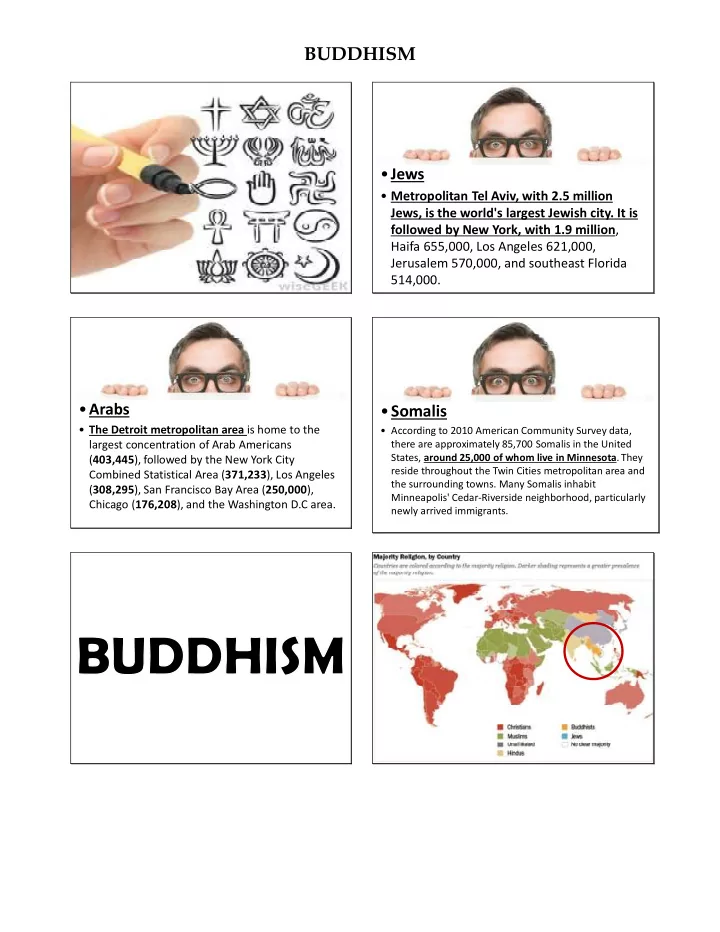
Jews Metropolitan Tel Aviv, with 2.5 million Jews, is the world's largest Jewish city. It is followed by New York, with 1.9 million , Haifa 655,000, Los Angeles 621,000, Jerusalem 570,000, and southeast Florida


slide-1
SLIDE 1
  • Jews
  • Metropolitan Tel Aviv, with 2.5 million

Jews, is the world's largest Jewish city. It is followed by New York, with 1.9 million, Haifa 655,000, Los Angeles 621,000, Jerusalem 570,000, and southeast Florida 514,000.

  • Arabs
  • The Detroit metropolitan area is home to the

largest concentration of Arab Americans (403,445), followed by the New York City Combined Statistical Area (371,233), Los Angeles (308,295), San Francisco Bay Area (250,000), Chicago (176,208), and the Washington D.C area.

  • Somalis
  • According to 2010 American Community Survey data,

there are approximately 85,700 Somalis in the United States, around 25,000 of whom live in Minnesota. They reside throughout the Twin Cities metropolitan area and the surrounding towns. Many Somalis inhabit Minneapolis' Cedar-Riverside neighborhood, particularly newly arrived immigrants.

slide-2
SLIDE 2
  • Because of its emphasis on

meditation and mindfulness, Buddhism is often considered to be a form of psychology rather than a religion.

  • Many traditional Buddhists

believe in reincarnation and

  • rebirth. Modern Buddhists

believe this idea can be jettisoned without losing any central value.

  • Shinto 660BC
  • Zoroastrianism 660BC
  • Taoism 604 BC
  • Jainism 560 BC

560BC

  • Confucianism 551 BC

"It is interesting to note that about the sixth century ... there was a period of unusual religious creativeness when six

  • f the world's living religions
  • riginated." (Hume, The World's Living Religions, 14, 15)

BIBLICALLY, THE NORTHERN NATION of Israel has been completely dispersed by the

  • Assyrians. The southern kingdom
  • f Judah still remains in Babylon

waiting for Cyrus of Persia to destroy the Babylonian kingdom of Nebuchadnezzar.

slide-3
SLIDE 3
  • Zerubbabel will lead the nation of

Judah back to Jerusalem in 536BC with Haggai and Zechariah preaching in 520BC.

  • Founder: Siddharta Gautama

("the Buddha"), an Indian prince

  • 6th Century BCE Prophet
  • Hindu Reformer
  • Founded Contemplative,

Practical Philosophical, “Religious” System

  • Date founded: @520 BCE
  • Place founded: Northeastern India
  • Focused on eliminating life’s

Suffering.

  • Adherents: 360 million
  • Size rank: 4th largest WR
  • Main locations: China, Japan,

Korea, Southeast Asia

  • Spiritual leader: Monk (Dali

Lama in Tibetan Buddhism)

  • Place of ritual: Temple,

meditation hall.

slide-4
SLIDE 4
  • Theism: Varies - Theravada

[Hinayana] is atheistic [retire from; conservative; fewer]; Mahayana is more polytheistic [remain in; liberal; broader].

  • Karma
  • Dharma
  • Reincarnation
  • Buddhists believe in NO

GODS [the Buddha was not normally

viewed as a god]

  • Ultimate reality: None.

Nothing is permanent.

  • There is suffering in Life and

there is a way to end it forever.

  • Nothing in the creation has

any intrinsic nature, thus there is emptiness.

slide-5
SLIDE 5
  • Human nature: There is no

self or soul. Human existence is nothing more than a combination of five impermanent components (khandas).

  • Purpose of life: Theravada -

Become an arhat, escape the cycle of rebirth, and attain nirvana.

  • Mahayana - Become a

boddhisatva then help others attain enlightenment.

  • Afterlife: Rebirth or nirvana.

Nirvana is seen simply as the cessation of suffering by some and as a heavenly paradise by others.

  • Buddha is one who is

perfected and purified and has no more cravings and thus no more births.

  • http://aumamen.com/topic/buddhism-interesting-facts
  • Purpose of Life is to attain

liberation from the cycle of birth and death which is the cause of suffering.

  • http://aumamen.com/topic/buddhism-interesting-facts
  • Life Goal is NIRVANA
  • Changing Metaphysics

–No everlasting soul –Everything is impermanent –Redefinition of reincarnation

slide-6
SLIDE 6
  • No necessary belief in God
  • No caste system
  • Religion becomes intensely

therapeutic and practical for the follower

  • Self-saving; based on the

principle of salvation by one's

  • wn efforts or character.

http://www.wordnik.com/words/autosoteric

  • “Jesus saves, but . . .”
  • “Jesus is necessary, but He is not enough.”
  • Buddha taught and traveled

his entire life until the age of 80 when he passed away. His final request of his followers was this: . . .

  • . . . “All component things in

the world are changeable. They are not lasting. Work hard to gain your own salvation.”

  • http://blog.sivanaspirit.com/10-facts-about-buddha/
  • Three Jewels/Three Refuges
  • Three Delusions
  • Three Trainings
  • Three Marks of Existence
  • Four Noble Truths
  • Four Immeasurables or Sublime

States

  • Four Reminders
  • Four Bodhisattva Vows
  • Five Precepts
  • Five Powers
  • Five Hindrances
  • Five Dhyani (Wisdom) Buddhas
slide-7
SLIDE 7
  • Six Perfections
  • Six Realms of Existence
  • Noble Eightfold Path
  • Ten Paramita
  • Twelve Links of Dependent Arising
  • 35 Buddhas of Confession
  • 1.Life is tough, you will have

troubles. 2.Troubles are caused by holding on too hard [craving].

  • 3.Escaping this trouble is
  • possible. The cure to craving

is to overcome the craving.

  • 4. There is a path to do so

through “detachment.” The

  • vercoming of craving is

achieved through an eight- fold path.

slide-8
SLIDE 8
  • All of humanity observes the

human condition. WR are humanity’s response to the problem without biblical/special revelation.

  • With little effort, a student of

Scripture could put biblical verses supporting the four- noble truths and the eight- fold path.

  • The Story without JESUS ends

up being about US and not HIM.

  • Their answer to “sin” and

suffering is not found in the person and work of Jesus Christ. In Buddha thought, deliverance from such things is only possible through the doing of good works.

  • Because Buddhism does not

embrace the exclusive nature of biblical truth and the central place Jesus Christ has in the unfolding of God’s Story, . . .

  • . . . they are lost and do not have

their sins atoned and they will be separated from God forever and experience His absence and feel the torment of their rejection of Him forever.

slide-9
SLIDE 9
  • !"#

!"#

!"#

In the West, Buddhism is synonymous with peace, compassion, wisdom, and ecumenical

  • brotherhood. This is true also in the case of its

most noted figure, the Dalai Lama. Moreover, Buddhism has a reputation as a persecuted religion, and Tibet is the emblem of this. But the latest Report on Religious Liberty in the World, released in Rome on June 25, 2004 by Aid to the Church in Need, contains striking evidence

  • f a contrary nature.

In almost all of the Asian states in which Buddhism is the majority religion, there is cruel religious repression. And this strikes all of the non-Buddhist religions.

http://chiesa.espresso.repubblica.it/articolo/7058%2 6eng%3Dy.html?refresh_ce

!"

  • China is the country with the largest

population of Buddhists, approximately 244 million or 18.2%

  • f its total population.
  • With more than 117,000 Buddhist

adherents, the greater area of Los Angeles, CA reported the highest number of Buddhist adherents.

  • Whereas the greater area of

Birmingham, AL reported the lowest — only 64 identified as Buddhist adherents.

slide-10
SLIDE 10
  • !"