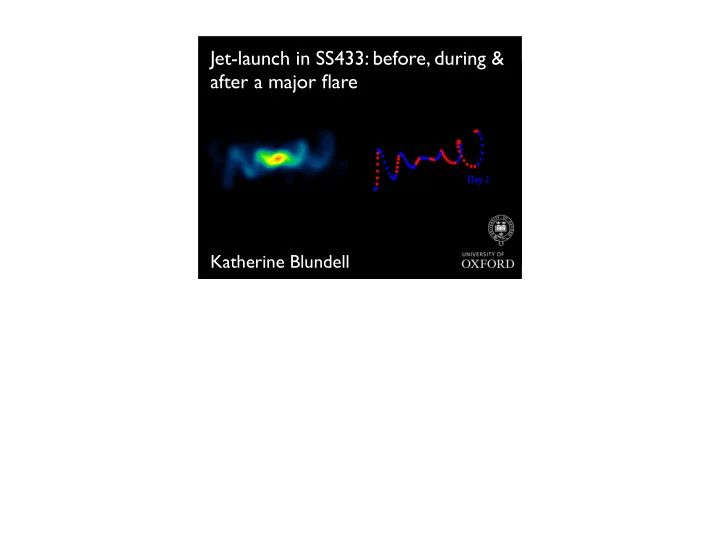
SLIDE 1
Jet-launch in SS433: before, during & after a major flare
Katherine Blundell
SLIDE 2 In quiessence (long before a flare) there are three modes of mass-loss
- 1. The famous jets (precessing & nodding)
- 2. Accretion disc wind (poloidal)
- 3. Circumbinary disc wind (“sideways”)
SLIDE 3 blue jet lines red jet lines HeI HeI HeI CII “Stationary” H-α line
SLIDE 4
- During quiescence “stationary Hα” line
fitted by 3 gaussians
- Ideagram encodes positions & FWHM
- One fat gaussian: the accretion disc wind
- position moves with ~orbital period
- width changes with precession phase
- knows about 6.5-day nodding
- Two (really) stationary lines: circumbinary disc
- stationary in wavelength
- intensity varies with orbital period
- matter orbiting at 200 km/s
- implies 40 solar masses enclosed
- seen in direct imaging...
The wind speed also seems to show a 6.5-day periodicity with the same phase as the nodding - this, together with the dependence on precession phase, closely associates it with the accretion disc.
SLIDE 5
- During quiescence “stationary Hα” line
fitted by 3 gaussians
- Ideagram encodes positions & FWHM
- One fat gaussian: the accretion disc wind
- position moves with ~orbital period
- speed changes with precession phase
- speed knows about 6.5-day nodding
- Two (really) stationary lines: circumbinary disc
- stationary in wavelength
- intensity varies with orbital period
- matter orbiting at 200 km/s
- implies 40 solar masses enclosed
- seen in direct imaging...
Blundell, Bowler & Schmidtobreick 2007↑ & 2008↓
Time
↑
The wind speed also seems to show a 6.5-day periodicity with the same phase as the nodding - this, together with the dependence on precession phase, closely associates it with the accretion disc.
SLIDE 6 VLBA image
Mass-loss from the circumbinary disc feeds the ruff ruff
Blundell, Mioduszewski, Muxlow, Podsiadlowski, Rupen 2001
SLIDE 7
The orientation of the ruff axis changes with time Doolin & Blundell 2009
SLIDE 8
Apparent periodicity of ~550 days (42 orbital periods) Doolin & Blundell 2009
SLIDE 9 Doolin & Blundell 2011 Doolin & Blundell 2011
3D simulations show stable families of circumbinary orbits across binary eccentricity / mass fraction space
SLIDE 10 blue jet lines red jet lines HeI HeI HeI CII Stationary H-α line
SLIDE 11
“the kinematic model” Blundell & Bowler 2005
SLIDE 12
Blundell & Bowler 2005
SLIDE 13
Blundell & Bowler 2005
SLIDE 14
The sum of the two redshifts tells us the jet speed, if the jets are symmetric Blundell & Bowler 2005
SLIDE 15
Blundell & Bowler 2005
SLIDE 16
Blundell & Bowler 2005
SLIDE 17
Blundell & Bowler 2005
SLIDE 18 The difference of the two redshifts tells us about the angle of the jet axis, if the jets are symmetric
Blundell & Bowler 2005
SLIDE 19
flare Jet speed increases from 0.24c to ~0.28c Enhanced jet speeds are associated with all flares in SS433 for which data exist
Blundell, Schmidtobreick & Trushkin 2011
SLIDE 20
- After an extended period
- f quiescence, SS433
exhibits a flare
- “Stationary” H-α line now
fitted by 5 gaussians
- Two widely separated lines
appear, that veer to the blue: spiralling-in material within the accretion disc?
Blundell, Schmidtobreick & Trushkin 2011
SLIDE 21
Accretion disc speed from H-α increases from 500 km/s to 700 km/s before and during onset of flare
Blundell, Schmidtobreick & Trushkin 2011
SLIDE 22 Dependence of wind speed on precession phase And a leap in the intensity of the wind just before the speed increase...
Blundell, Schmidtobreick & Trushkin 2011
SLIDE 23
The start of a massive radio flare
Blundell, Schmidtobreick & Trushkin, MNRAS 2011
SLIDE 24
Blundell, Schmidtobreick & Trushkin, MNRAS 2011
SLIDE 25 10 months later...
SLIDE 26
SLIDE 27
SLIDE 28
SLIDE 29
SLIDE 30
How does this relate to the kinematic model?
SLIDE 31
SLIDE 32
SLIDE 33
SLIDE 34
SLIDE 35
SLIDE 36
SLIDE 37
ApJ Lett
ploughed out by precessing jet
in a major flare
SLIDE 38 Summary
- Three modes of mass-loss in both quiescence and in flaring
- SS433 has a poloidal disc wind (70% of Brγ - Perez & Blundell 2009)
- SS433 has a circumbinary disc that precesses
- Ruff precesses with ~550 day period
- Just before a flare, accretion disc revealed in Hα (500 → 700+ km/s)
- Jets can snow-plough out wind ejecta
- Flare sequence:
➡ accretion disc appears in the optical, wind intensity doubles, radio
quenches, wind speed doubles, jets increase in speed and intensity, 3 days later radio flaring, 10 months later enhanced wind ejecta has been snow-ploughed out