SLIDE 1
Jeff Zimpfer & Sallie Beavers Kaloko-Honokhau National - - PowerPoint PPT Presentation
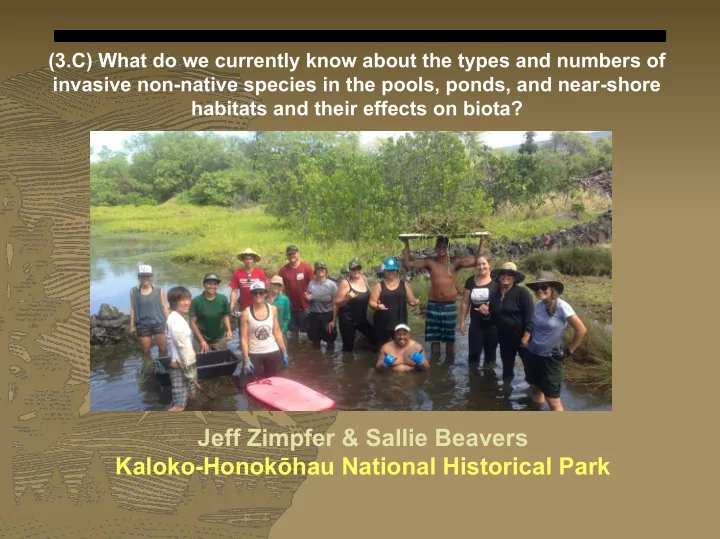
(3.C) What do we currently know about the types and numbers of invasive non-native species in the pools, ponds, and near-shore habitats and their effects on biota? Jeff Zimpfer & Sallie Beavers Kaloko-Honokhau National Historical Park
SLIDE 2
SLIDE 3
E X P E R I E N C E Y O U R A M E R I C A ™
Study % of pools with invasive fish # of pools surveyed Poecillids Tilapia* Maciolek & Brock 1974 11% n=264 Marrack et al. 2015 25% n=398 23.9% (n=95) 3.5% (n=14) NPS unpub. (KHNHP) 2018 18.8% n=191 18.8% (n=36) 1.6% (n=3)
*Tilapia introduced to Aimakap 2008 (MacKenzie and Bruland 2012)
Invasive Fish in West Hawaii USGS-NPS Research Fish Eradication Methods
- Assess efficacy to eradicate tilapia and Poeciliids &
determine effects on native species (Nico et al. 2015)
- Rotenone
- Auhuhu –Tephrosia purpurea
- Carbon Dioxide
- eDNA – confirm presence/absence
SLIDE 4
- Kaloko Fishpond
➢ Upside Down Jellyfish
Cassiopeia andromeda
➢ Alien Alga –
Acanthophora spicifera (Weijerman et al. 2008)
- Marine waters
➢ Crown of Thorns Starfish (native can be invasive)
Acanthaster planci
- Regular monitoring (Brown et al. 2011, Marrack et al.
2014, Weijerman et al. 2014)
➢ Invasive Snapper, Grouper
SLIDE 5
Mlama ‘Aimakap Fishpond
- B. maritima & Paspallum removal